ARUN KAPPEN
ENGINEERING
THERMODYNAMICS
Texts Recommended
• Engineering Thermodynamics –
P K Nag
• Thermodynamics – J P Holman
• Thermodynamics – Yunus A
Cengel
• Fundamentals of Engineering
Thermodynamics –
E Rathakrishnan
• Engineering Thermodynamics –
INTRODUCTION
• Thermodynamics can be def ined
as t he science of energy
• Word “Thermodynamics”
originat es f rom t he greek words
t her me[heat ] and dynamis[power]
• The early underst anding of
t her modynamics cent ered around
t he concept of get t ing power
f rom hot bodies or f rom heat ,
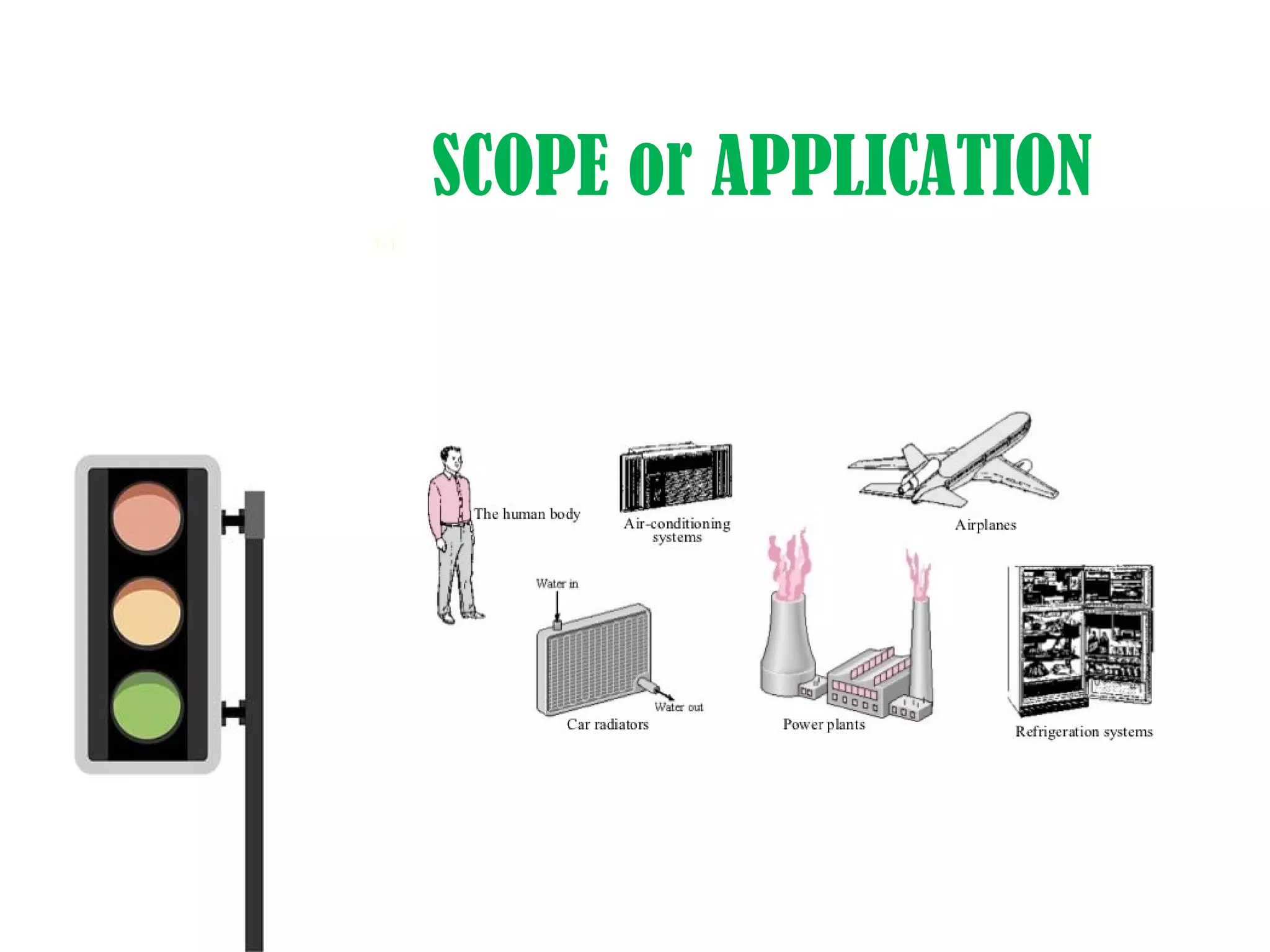
SCOPE or APPLICATION
• Household appliances
– Airconditioningsystems
– Refrigerator
– Pressurecooker
– Waterheater
– Theiron
– Computer, TVetc.
• Industrial applications
– Designandanalysisofautomotiveengines
– Designofrocketsandjetengines
– Powerplants
– Solarcolletorsetc.
Macroscopic V/S
Microscopic Approach
• It is well-known that substances
consists of a large number of
particles called molecules
• The properties of a substance
depend on the behaviour of these
particles
• For example, the pressure of a gas
in a container is the result of
momentum transfer between the
MACROSCOPIC APPROACH
• Macroscopic approach to the study
of thermodynamics does not
require a knowledge of events
occuring at the molecular level.
• These effects can be perceived by
human senses or measured by
instruments. Eg:- Pressure,
Temperature etc.
• This approach is also called
CLASSICAL THERMODYNAMICS
MICROSCOPIC APPROACH
 In this method, the property
of a system is considered to
be the result of average
behaviour of large groups of
individual particles[molecules]
 It is also called STATISTICAL
THERMODYNAMICS
 In microscopic approach, the
effect of molecular motion is
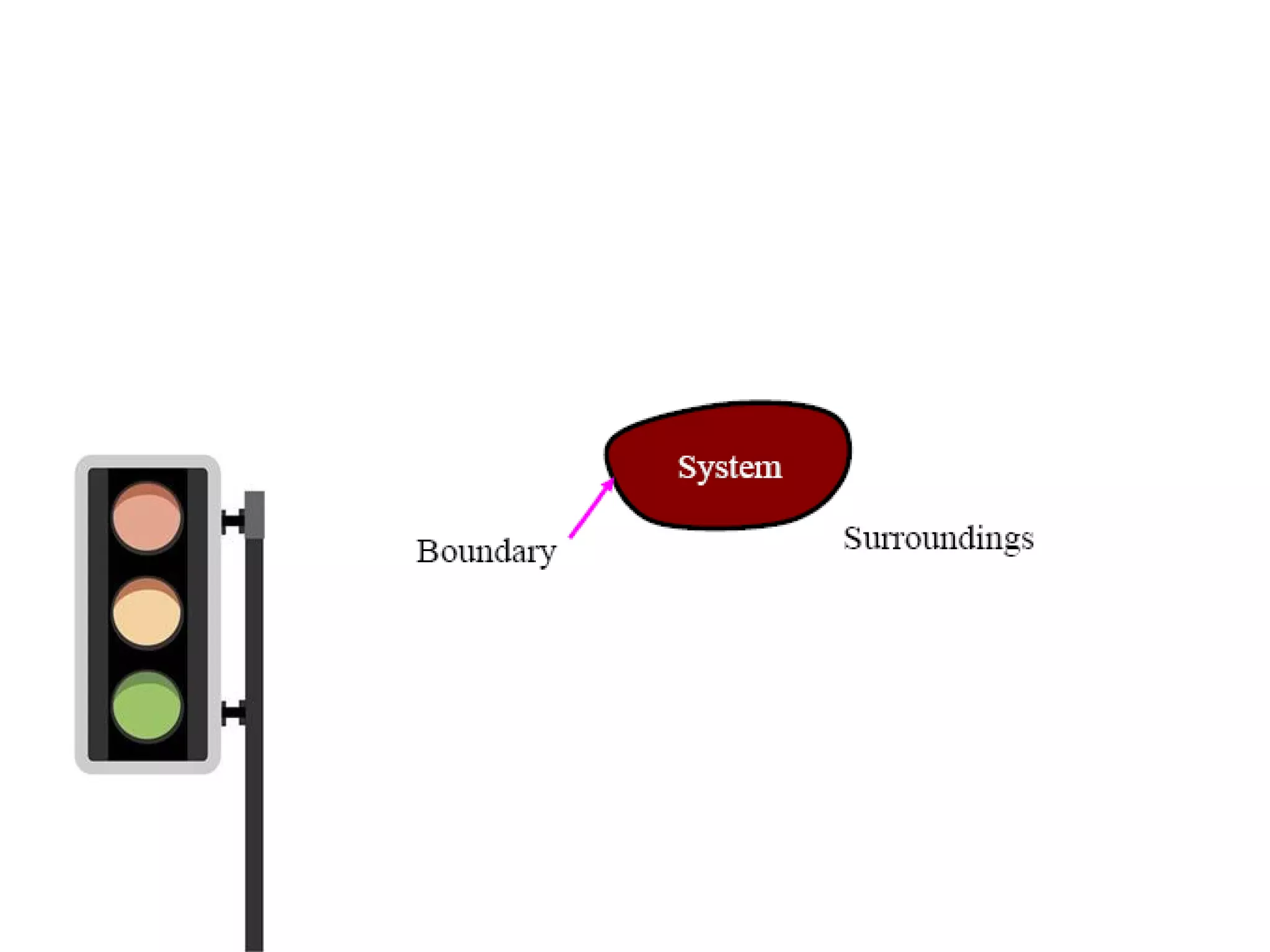
• Certain quantity of matter or a region in space
chosen for study is called a system
• The mass or region outside the system is
called the surroundings
• The surface which separates the
system from the surroundings are
called the boundary
•The boundary of a system can be
fixed or movable
•It’s the contact surface shared by
SYSTEM ANd SURROUNdINGS
TYPES OF SYSTEM
• OPEN SYSTEM
• CLOSED SYSTEM
• ISOLATED SYSTEM
OPEN SYSTEM
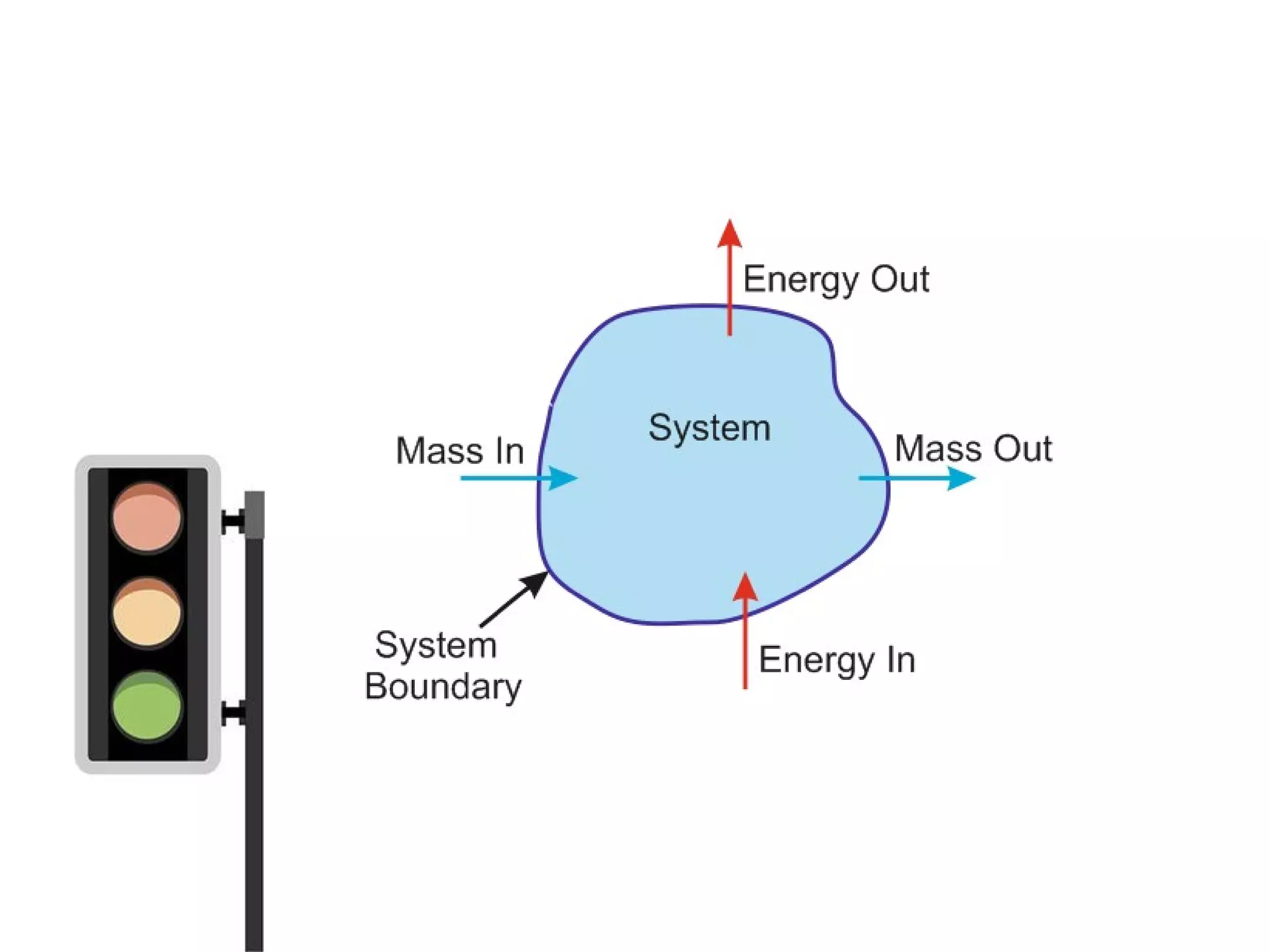
• Open systems are those in which we
permit both energy and mass to
cross the system boundary in either
direction (from the system to
surroundings or vice versa)
• In analysing open systems, we typically
look at a specified region of space, and
observe what happens at the boundaries
of that region.
• Most of the engineering devices are open
system.
CLOSED SYSTEM
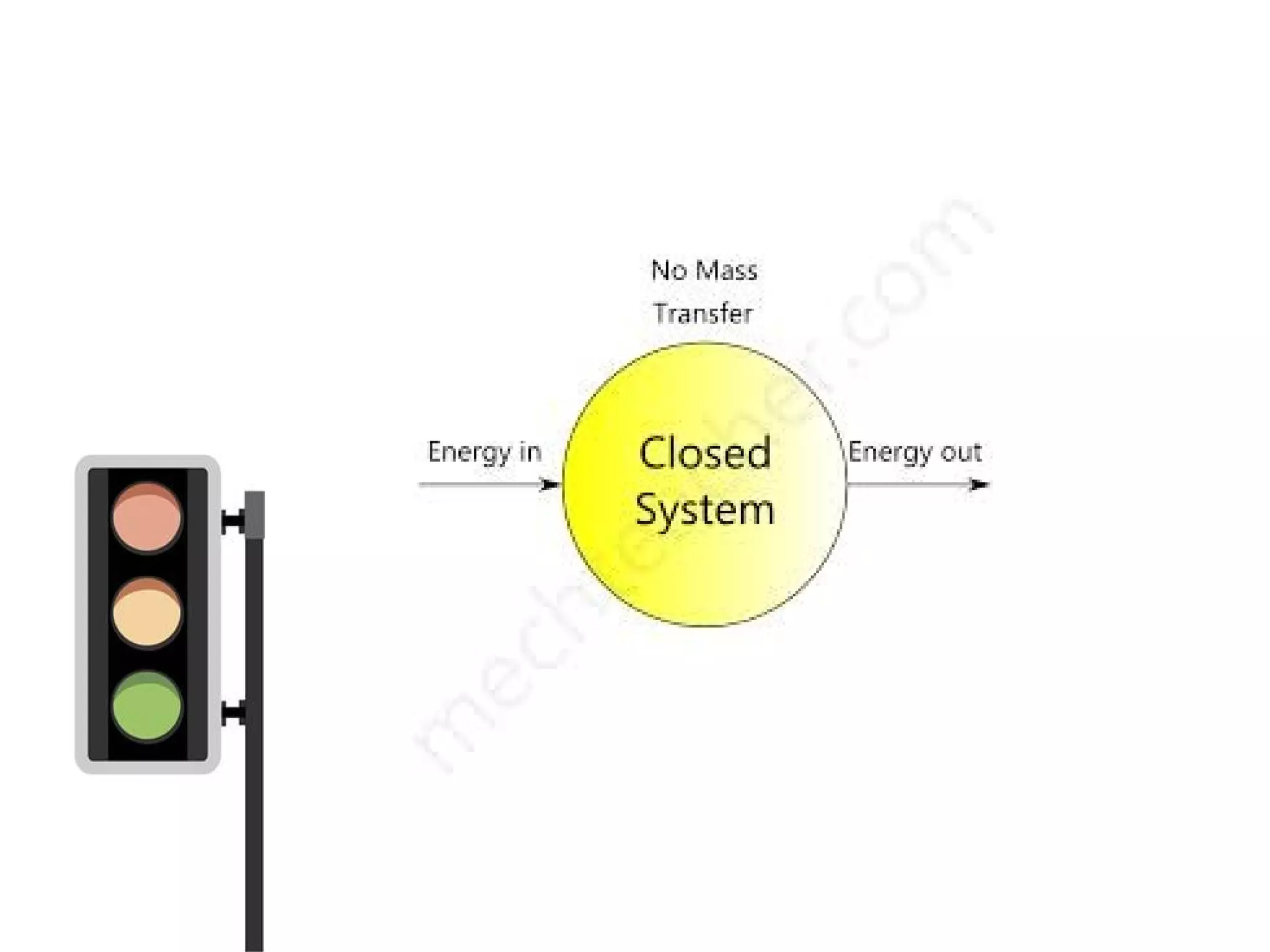
Closed systems are those in which
we permit only energy to cross the
system boundary in either
direction (from the system to
surroundings or vice versa)
Its also called a control mass
Mass is not allowed to cross the
system boundary
The volume need not be fixed in
this case [eg:- a piston cylinder
ISOLATED SYSTEM
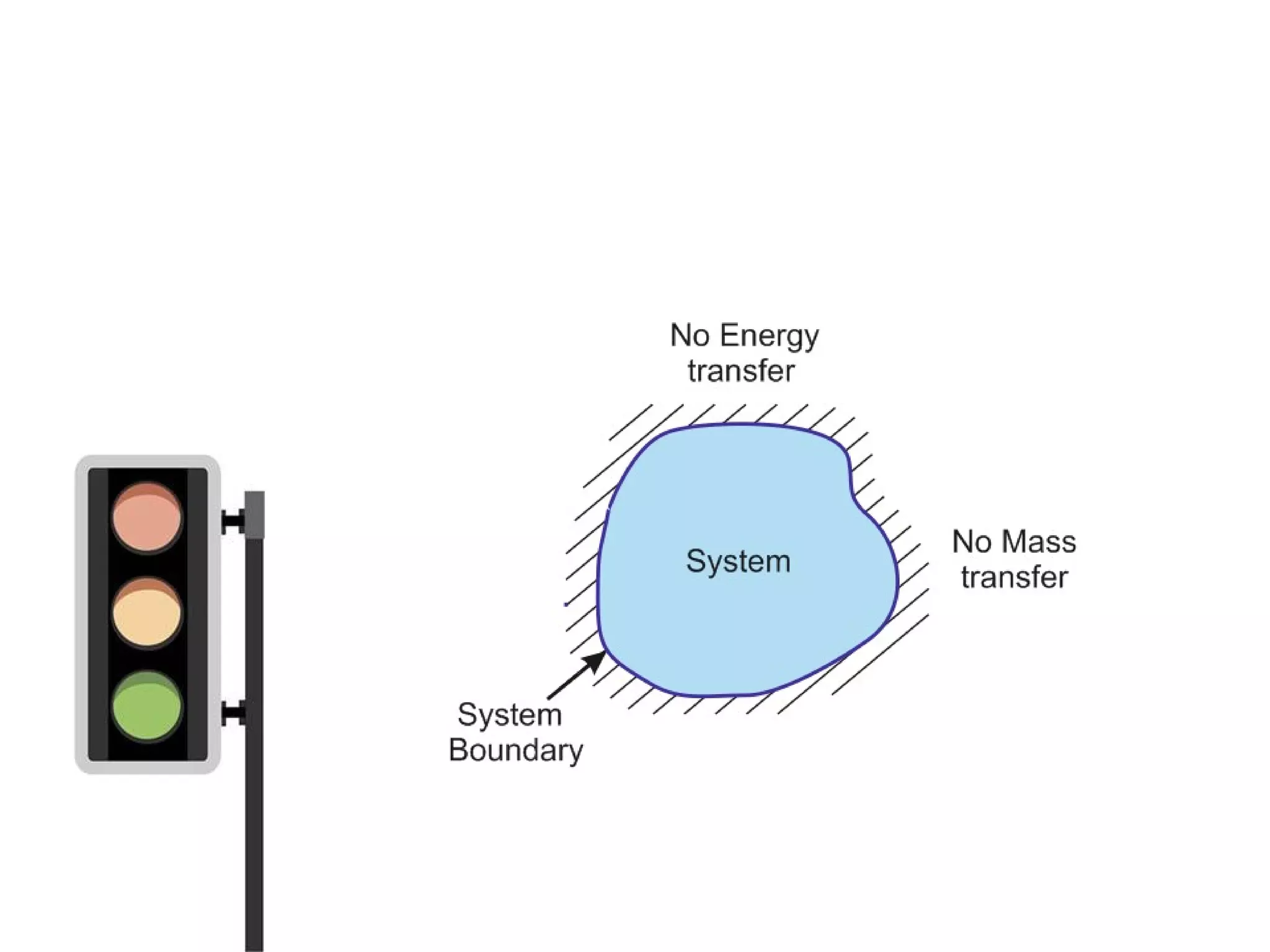
• Isolated Systems are those in which
there is no interaction between
system and the surroundings.
• It is of fixed mass and energy, and
hence there is no mass and energy
transfer across the system
boundary.
HOMOGENEOUS AND
HETEROGENEOUS SYSTEM
• A quantity of matter homogeneous throughout in chemical
composition and physical structure is called a phase
• If the substance within the system exists in a single phase like
liquid, solid or gas, then the system is called homogeneous
system
• In these systems, substance should exist only in one phase
• If the substance within the system exists in more than one
phase, then the system is called heterogeneous
Eg:- water and steam
PROPERTY
• A property of a system is defined as any identifiable
and observable characteristic features by which a
system can be specified
• Eg : - Pressure, Volume, Temperature etc.
• These are all macroscopic in nature
Intensive and Extensive properties
• Propert ies which are
independent of t he mass of t he
syst em are called int ensive
propert ies
Eg:- Pressure, Temperature, Densityetc.
• Propert ies which depends on t he
mass of t he syst em are called
ext ensive propert ies
Eg:-Volume, energyetc.
• Specif ic ext ensive propert ies,
i.e, ext ensive propert ies per unit
mass, are int ensive propert ies.
Eg:- Specific volume,
specific energy etc.
• When all t he propert ies of a
syst em have def init e values, t he
syst em is said t o exist at a
def init e state
• Propert ies are t he coordinat es
t o describe t he state of a
system
• Any operat ion in which one or
more of t he propert ies of a
• The succession of st at es passed
t hrough during a change of st at e
is called t he path of t he change
of st at e
• When t he pat h is complet ely
specif ied, t he change of st at e is
called a process
• I f af t er a number of processes,
t he syst em comes back t o it s
THERMODYNAMIC
PROCESS
• Any change that a system undergoes from one
equilibrium state to another is called a process
• The series of states through which a system
passes during a process is called the path of the
process
• To describe a process completely, one should
specify the initial and final states of the process
and the path it follows
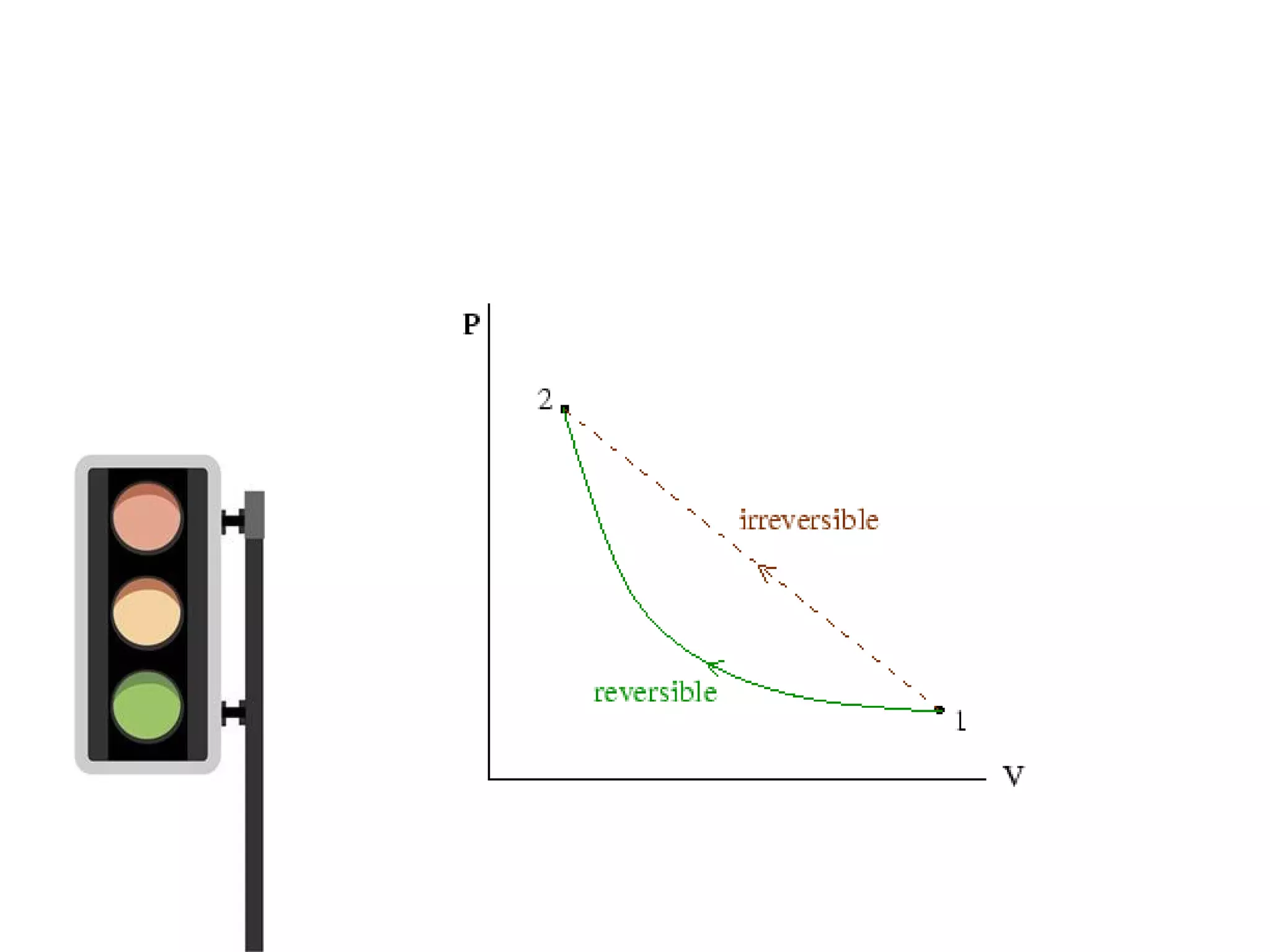
• There are reversible processes and irreversible
processes
• A reversible process or a quasi-static process is
represented by a solid dark line
• An irreversible process is denoted by a dashed
line
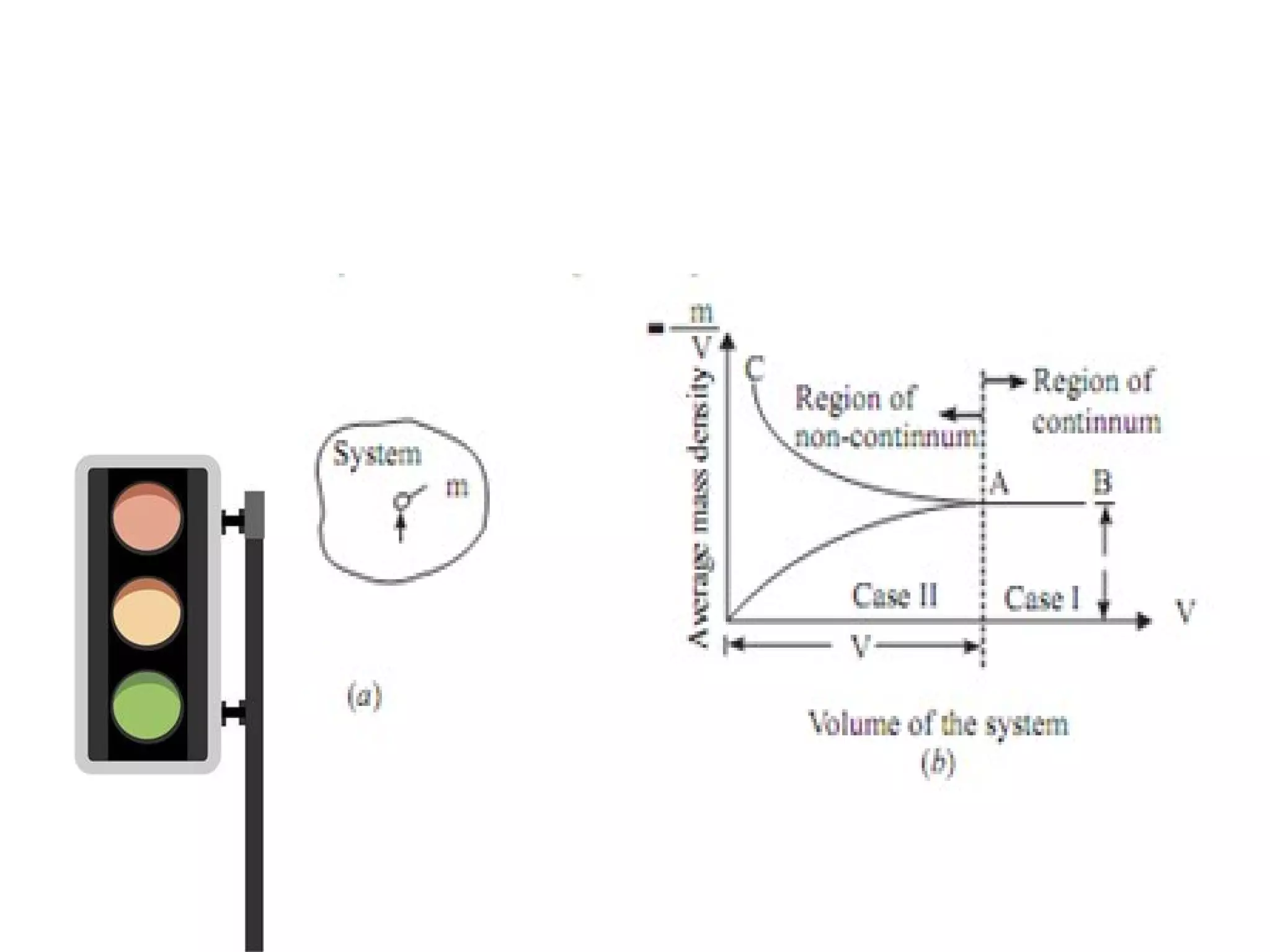
CONTINUUM
• Mat t er is made up of at oms t hat are widely
spaced in t he gas phase
• But it is very convenient t o disregard t he
at omic nat ure of a subst ance and view it as
a cont inuous, homogeneous mat t er wit h no
holes, t hat is, a cont inuum
• From macroscopic point of view we deal
wit h volumes which are very large compared
t o it s molecular dimensions.
• Wit hin t his volume span, we can assume t he
subst ance t o be cont inuous
• Thus, t he concept of cont inuum goes hand
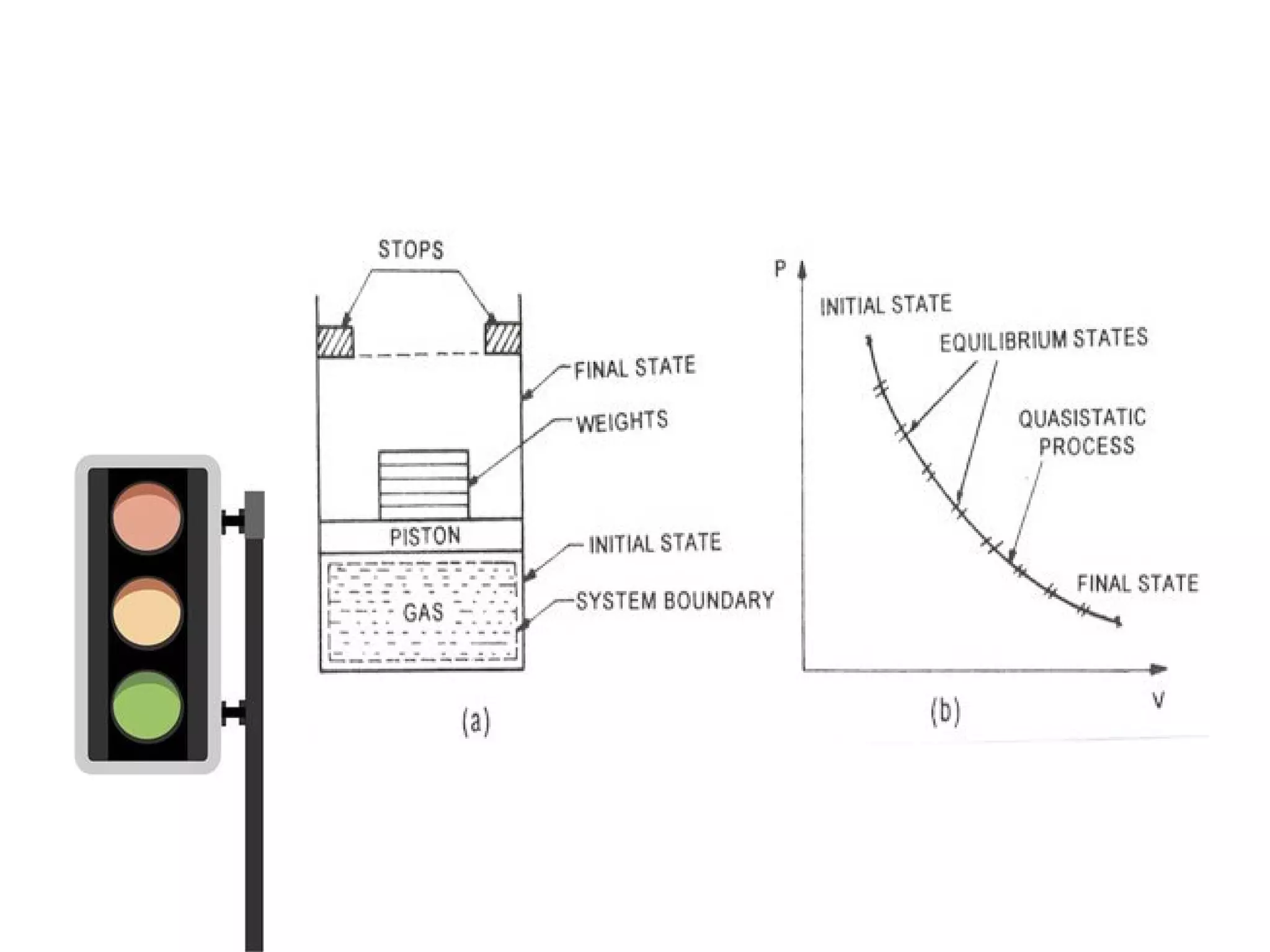
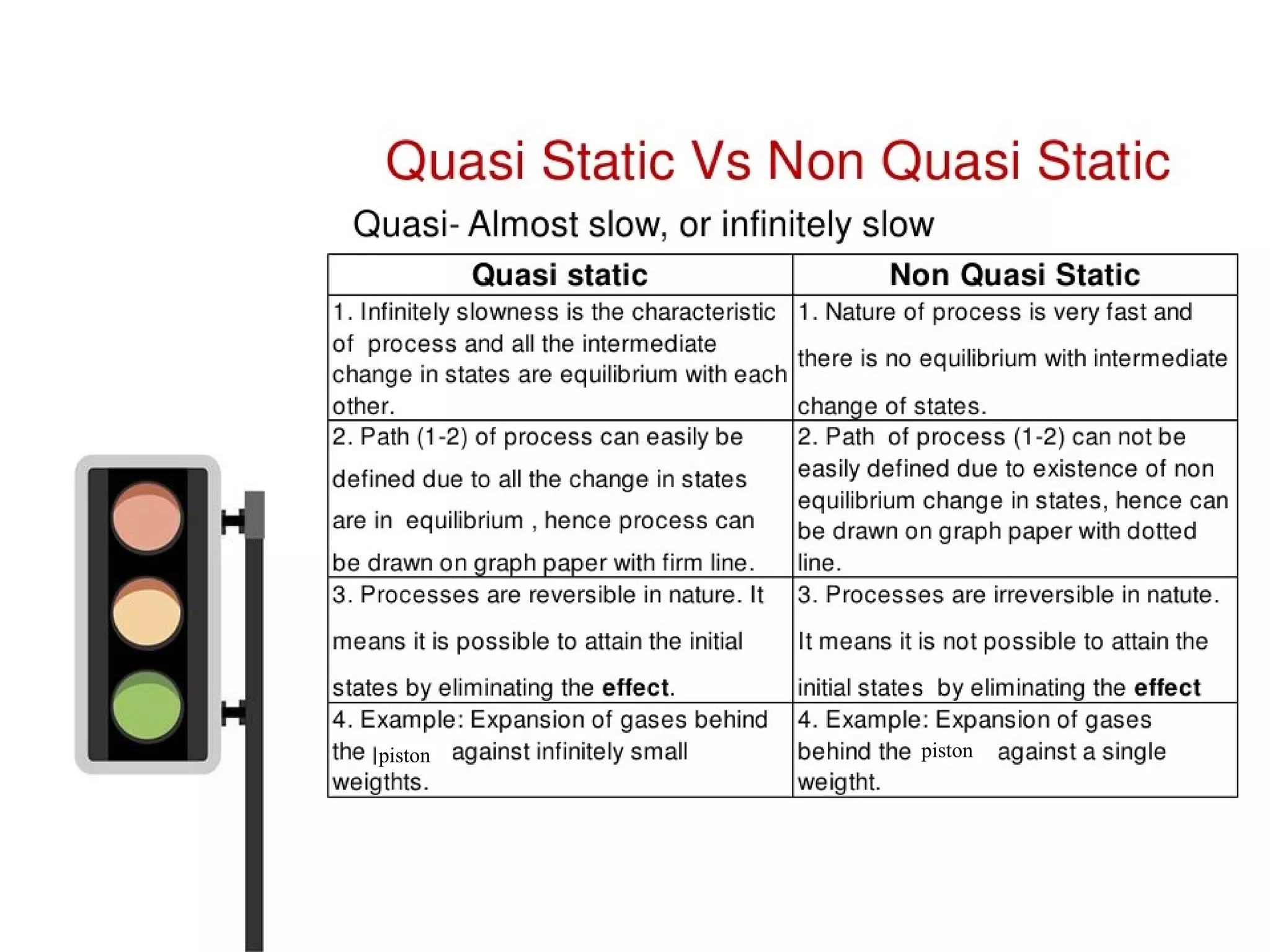
QUASI STATIC PROCESS
• The word “Quasi” means “almost”
• “Quasi-static” process is an almost
static or stationary process
• Infinite slowness is the characteristic
feature of a quasi-static process
• So a quasi static process is also a
reversible process
• Infinite time is required to execute a
quasi static process
piston piston
THERMODYNAMIC EQUILIBRIUM
• A system is said to exist in a state
of thermodynamic equilibrium
when no change in any macroscopic
property is registered, if the system
is isolated from its surroundings
• An isolated system always reaches
in course of time a state of
thermodynamic equilibrium and can
never depart from it spontaneously
• A system is said to be in
thermodynamic equilibrium if its in
• Mechanical equilibrium
• A syst em is said t o be in mechanical
equilibrium when t here is no
unbalanced f orce act ing on any part of
t he syst em or t he syst em as a whole
• Thermal equilibrium
• A syst em is said t o be in t hermal
equilibrium when t here is no
t emperat ure dif f erence bet ween t he
part s of t he syst em or bet ween t he
syst em and it s surroundings
• Chemical equilibrium
• A syst em is said t o be in chemical
equilibrium when t here is no chemical
PATH AND POINT FUNCTIONS
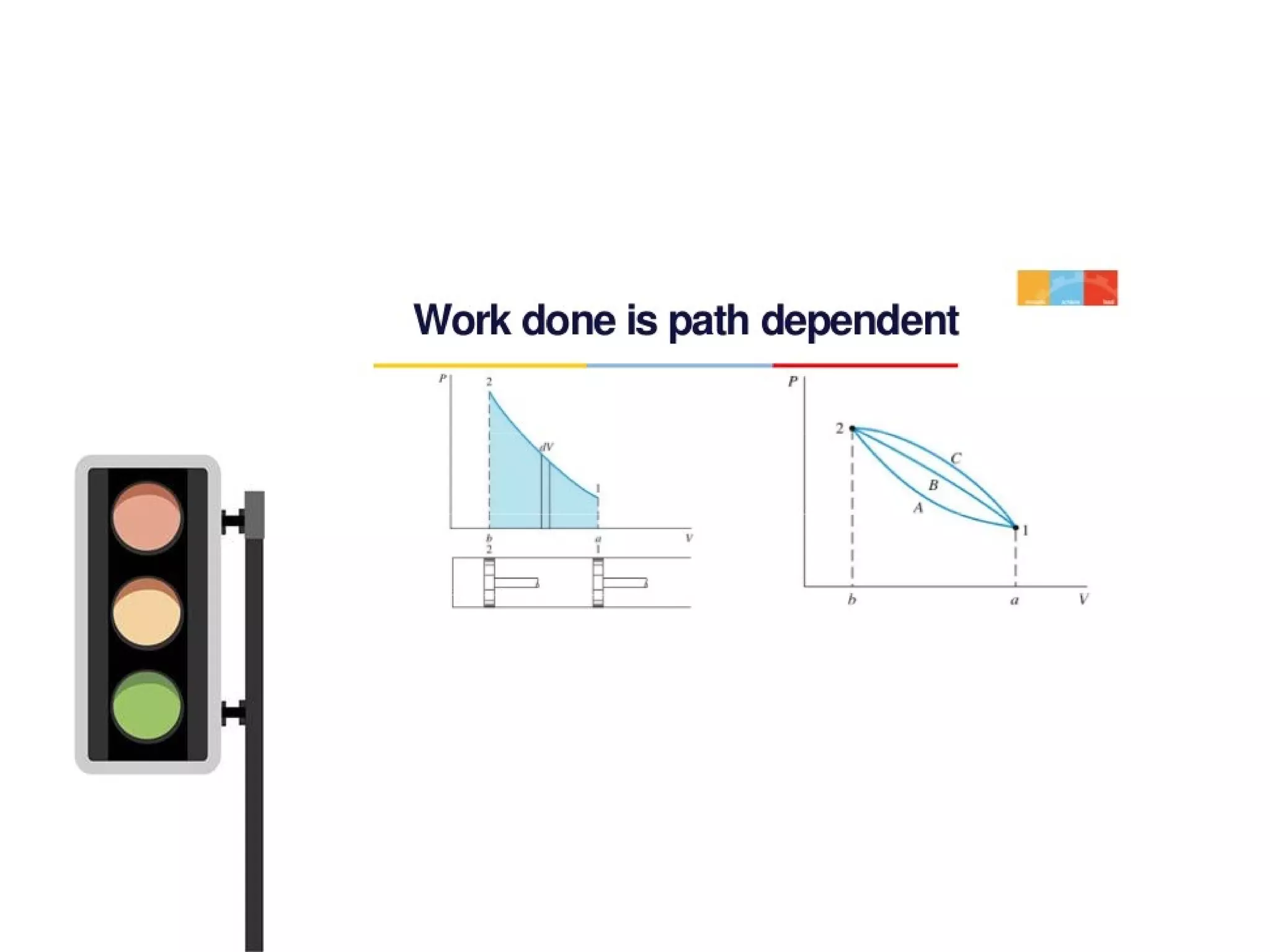
• Path isthelocusof all pointsthrough
which thesystem passesin itschange
from onestateto another
• It ispossibleto go from state1 to state
2 along different pathsasshown in the
figure[i.e, thorough A, B or C]
• Propertieslikepressure, temperature,
volumeetc. doesnot depend on the
path followed in reaching thestate, but
• Characteristics of a process which depends upon the
path followed in going from one state to another are
referred to as path functions
• Eg:- Work transfer, heat transfer etc.
• Path functions are not properties of system, while point
functions are properties of system
Thermodynamics basics

Thermodynamics basics

  • 1.
  • 2.
    Texts Recommended • EngineeringThermodynamics – P K Nag • Thermodynamics – J P Holman • Thermodynamics – Yunus A Cengel • Fundamentals of Engineering Thermodynamics – E Rathakrishnan • Engineering Thermodynamics –
  • 3.
    INTRODUCTION • Thermodynamics canbe def ined as t he science of energy • Word “Thermodynamics” originat es f rom t he greek words t her me[heat ] and dynamis[power] • The early underst anding of t her modynamics cent ered around t he concept of get t ing power f rom hot bodies or f rom heat ,
  • 4.
  • 5.
    • Household appliances –Airconditioningsystems – Refrigerator – Pressurecooker – Waterheater – Theiron – Computer, TVetc. • Industrial applications – Designandanalysisofautomotiveengines – Designofrocketsandjetengines – Powerplants – Solarcolletorsetc.
  • 6.
    Macroscopic V/S Microscopic Approach •It is well-known that substances consists of a large number of particles called molecules • The properties of a substance depend on the behaviour of these particles • For example, the pressure of a gas in a container is the result of momentum transfer between the
  • 7.
    MACROSCOPIC APPROACH • Macroscopicapproach to the study of thermodynamics does not require a knowledge of events occuring at the molecular level. • These effects can be perceived by human senses or measured by instruments. Eg:- Pressure, Temperature etc. • This approach is also called CLASSICAL THERMODYNAMICS
  • 8.
    MICROSCOPIC APPROACH  Inthis method, the property of a system is considered to be the result of average behaviour of large groups of individual particles[molecules]  It is also called STATISTICAL THERMODYNAMICS  In microscopic approach, the effect of molecular motion is
  • 9.
    • Certain quantityof matter or a region in space chosen for study is called a system • The mass or region outside the system is called the surroundings • The surface which separates the system from the surroundings are called the boundary •The boundary of a system can be fixed or movable •It’s the contact surface shared by SYSTEM ANd SURROUNdINGS
  • 11.
    TYPES OF SYSTEM •OPEN SYSTEM • CLOSED SYSTEM • ISOLATED SYSTEM
  • 12.
    OPEN SYSTEM • Opensystems are those in which we permit both energy and mass to cross the system boundary in either direction (from the system to surroundings or vice versa) • In analysing open systems, we typically look at a specified region of space, and observe what happens at the boundaries of that region. • Most of the engineering devices are open system.
  • 14.
    CLOSED SYSTEM Closed systemsare those in which we permit only energy to cross the system boundary in either direction (from the system to surroundings or vice versa) Its also called a control mass Mass is not allowed to cross the system boundary The volume need not be fixed in this case [eg:- a piston cylinder
  • 16.
    ISOLATED SYSTEM • IsolatedSystems are those in which there is no interaction between system and the surroundings. • It is of fixed mass and energy, and hence there is no mass and energy transfer across the system boundary.
  • 18.
    HOMOGENEOUS AND HETEROGENEOUS SYSTEM •A quantity of matter homogeneous throughout in chemical composition and physical structure is called a phase • If the substance within the system exists in a single phase like liquid, solid or gas, then the system is called homogeneous system • In these systems, substance should exist only in one phase • If the substance within the system exists in more than one phase, then the system is called heterogeneous Eg:- water and steam
  • 19.
    PROPERTY • A propertyof a system is defined as any identifiable and observable characteristic features by which a system can be specified • Eg : - Pressure, Volume, Temperature etc. • These are all macroscopic in nature
  • 20.
    Intensive and Extensiveproperties • Propert ies which are independent of t he mass of t he syst em are called int ensive propert ies Eg:- Pressure, Temperature, Densityetc. • Propert ies which depends on t he mass of t he syst em are called ext ensive propert ies Eg:-Volume, energyetc.
  • 21.
    • Specif icext ensive propert ies, i.e, ext ensive propert ies per unit mass, are int ensive propert ies. Eg:- Specific volume, specific energy etc.
  • 22.
    • When allt he propert ies of a syst em have def init e values, t he syst em is said t o exist at a def init e state • Propert ies are t he coordinat es t o describe t he state of a system • Any operat ion in which one or more of t he propert ies of a
  • 23.
    • The successionof st at es passed t hrough during a change of st at e is called t he path of t he change of st at e • When t he pat h is complet ely specif ied, t he change of st at e is called a process • I f af t er a number of processes, t he syst em comes back t o it s
  • 24.
    THERMODYNAMIC PROCESS • Any changethat a system undergoes from one equilibrium state to another is called a process • The series of states through which a system passes during a process is called the path of the process • To describe a process completely, one should specify the initial and final states of the process and the path it follows
  • 25.
    • There arereversible processes and irreversible processes • A reversible process or a quasi-static process is represented by a solid dark line • An irreversible process is denoted by a dashed line
  • 27.
    CONTINUUM • Mat ter is made up of at oms t hat are widely spaced in t he gas phase • But it is very convenient t o disregard t he at omic nat ure of a subst ance and view it as a cont inuous, homogeneous mat t er wit h no holes, t hat is, a cont inuum • From macroscopic point of view we deal wit h volumes which are very large compared t o it s molecular dimensions. • Wit hin t his volume span, we can assume t he subst ance t o be cont inuous • Thus, t he concept of cont inuum goes hand
  • 29.
    QUASI STATIC PROCESS •The word “Quasi” means “almost” • “Quasi-static” process is an almost static or stationary process • Infinite slowness is the characteristic feature of a quasi-static process • So a quasi static process is also a reversible process • Infinite time is required to execute a quasi static process
  • 31.
  • 32.
    THERMODYNAMIC EQUILIBRIUM • Asystem is said to exist in a state of thermodynamic equilibrium when no change in any macroscopic property is registered, if the system is isolated from its surroundings • An isolated system always reaches in course of time a state of thermodynamic equilibrium and can never depart from it spontaneously • A system is said to be in thermodynamic equilibrium if its in
  • 33.
    • Mechanical equilibrium •A syst em is said t o be in mechanical equilibrium when t here is no unbalanced f orce act ing on any part of t he syst em or t he syst em as a whole • Thermal equilibrium • A syst em is said t o be in t hermal equilibrium when t here is no t emperat ure dif f erence bet ween t he part s of t he syst em or bet ween t he syst em and it s surroundings • Chemical equilibrium • A syst em is said t o be in chemical equilibrium when t here is no chemical
  • 34.
    PATH AND POINTFUNCTIONS • Path isthelocusof all pointsthrough which thesystem passesin itschange from onestateto another • It ispossibleto go from state1 to state 2 along different pathsasshown in the figure[i.e, thorough A, B or C] • Propertieslikepressure, temperature, volumeetc. doesnot depend on the path followed in reaching thestate, but
  • 35.
    • Characteristics ofa process which depends upon the path followed in going from one state to another are referred to as path functions • Eg:- Work transfer, heat transfer etc. • Path functions are not properties of system, while point functions are properties of system