Histology / Basal Cells
presented By:-
‫ﻣ‬
‫ﺻ‬
‫ط‬
‫ﻔ‬
‫ﻰ‬
‫ظ‬
‫ﺎ‬
‫ﻓ‬
‫ر‬
‫ﺣ‬
‫ﺳ‬
‫ن‬
Presented to:-
‫د‬
.
‫ﻋ‬
‫ﻣ‬
‫ﺎ‬
‫ر‬
‫ﻋ‬
‫ﻠ‬
‫ﻲ‬
Introduction:-
The Most Common Skin Cancer
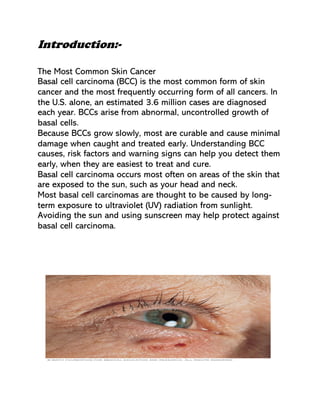
Basal cell carcinoma (BCC) is the most common form of skin
cancer and the most frequently occurring form of all cancers. In
the U.S. alone, an estimated 3.6 million cases are diagnosed
each year. BCCs arise from abnormal, uncontrolled growth of
basal cells.
Because BCCs grow slowly, most are curable and cause minimal
damage when caught and treated early. Understanding BCC
causes, risk factors and warning signs can help you detect them
early, when they are easiest to treat and cure.
Basal cell carcinoma occurs most often on areas of the skin that
are exposed to the sun, such as your head and neck.
Most basal cell carcinomas are thought to be caused by long-
term exposure to ultraviolet (UV) radiation from sunlight.
Avoiding the sun and using sunscreen may help protect against
basal cell carcinoma.
•What Does BCC look like?
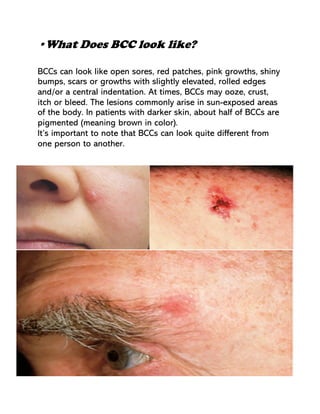
BCCs can look like open sores, red patches, pink growths, shiny
bumps, scars or growths with slightly elevated, rolled edges
and/or a central indentation. At times, BCCs may ooze, crust,
itch or bleed. The lesions commonly arise in sun-exposed areas
of the body. In patients with darker skin, about half of BCCs are
pigmented (meaning brown in color).
It’s important to note that BCCs can look quite different from
one person to another.
•Symptoms:-
Basal cell carcinoma usually develops on sun-exposed
parts of your body, especially your head and neck. Less
often, basal cell carcinoma can develop on parts of your
body usually protected from the sun, such as the genitals.
Basal cell carcinoma appears as a change in the skin,
such as a growth or a sore that won't heal. These changes
in the skin (lesions) usually have one of the following
characteristics:
• A pearly white, skin-colored or pink bump that
is translucent, meaning you can see a bit through
the surface. Tiny blood vessels are often visible. In
people with darker skin tones, the lesion may be
darker but still somewhat translucent. The most
common type of basal cell carcinoma, this lesion
often appears on the face and ears. The lesion
may rupture, bleed and scab over.
• A brown, black or blue lesion — or a lesion with
dark spots — with a slightly raised, translucent
border.
• A flat, scaly, reddish patch with a raised edge is
more common on the back or chest. Over time,
these patches can grow quite large.
• A white, waxy, scar-like lesion without a clearly
defined border, called morpheaform basal cell
carcinoma, is the least common.
•Causes:-
Basal cell carcinoma occurs when one of the skin's basal cells
develops a mutation in its DNA.
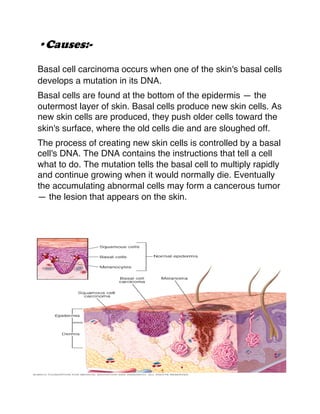
Basal cells are found at the bottom of the epidermis — the
outermost layer of skin. Basal cells produce new skin cells. As
new skin cells are produced, they push older cells toward the
skin's surface, where the old cells die and are sloughed off.
The process of creating new skin cells is controlled by a basal
cell's DNA. The DNA contains the instructions that tell a cell
what to do. The mutation tells the basal cell to multiply rapidly
and continue growing when it would normally die. Eventually
the accumulating abnormal cells may form a cancerous tumor
— the lesion that appears on the skin.
•Risk factors:-
Factors that increase your risk of basal cell carcinoma include:
• Chronic sun exposure. A lot of time spent in the sun — or
in commercial tanning beds — increases the risk of basal
cell carcinoma. The threat is greater if you live in a sunny or
high-altitude location, both of which expose you to more UV
radiation. Severe sunburns also increase your risk.
• Fair skin. The risk of basal cell carcinoma is higher among
people who freckle or burn easily or who have very light skin,
red or blond hair, or light-colored eyes.
• Increasing age. Because basal cell carcinoma often takes
decades to develop, the majority of basal cell carcinomas
occur in older adults. But it can also affect younger adults
and is becoming more common in people in their 20s and
30s.
• Immune-suppressing drugs. Taking medications that
suppress your immune system, such as anti-rejection drugs
used after transplant surgery, significantly increases your
risk of skin cancer.
• Exposure to arsenic. Arsenic, a toxic metal that's found
widely in the environment, increases the risk of basal cell
carcinoma and other cancers. Everyone has some arsenic
exposure because it occurs naturally. But some people may
have higher exposure if they drink contaminated well water
or have a job that involves producing or using arsenic.
• Inherited syndromes that cause skin cancer.Certain rare
genetic diseases can increase the risk of basal cell
carcinoma, including nevoid basal cell carcinoma syndrome
(Gorlin-Goltz syndrome) and xeroderma pigmentosum.
•Prevention:-
• Avoid the sun during the middle of the day. In many places, the sun's
rays are strongest between about 10 a.m. and 4 p.m. Schedule outdoor
activities for other times of the day, even during winter or when the sky is
cloudy.
• Wear sunscreen year-round. Use a broad-spectrum sunscreen with
an SPF of at least 30, even on cloudy days. Apply sunscreen generously,
and reapply every two hours — or more often if you're swimming or
perspiring.
• Wear protective clothing. Cover your skin with dark, tightly woven clothing
that covers your arms and legs, and a broad-brimmed hat, which provides
more protection than does a baseball cap or visor.
Some companies also sell protective clothing. A dermatologist can
recommend an appropriate brand. Don't forget sunglasses. Look for those
that block both types of UV radiation — UVA and UVB rays.
• Avoid tanning beds. Tanning beds emit UV rays and can increase your
risk of skin cancer.
• Check your skin regularly and report changes to your doctor. Examine
your skin often for new skin growths or changes in existing moles, freckles,
bumps and birthmarks. With the help of mirrors, check your face, neck, ears
and scalp.
Examine your chest and trunk and the tops and undersides of your arms
and hands. Examine both the front and the back of your legs and your feet,
including the soles and the spaces between your toes. Also check your
genital area and between your buttocks.
Treatments:-
The goal is to get rid of the cancer while leaving as small a scar as possible. To choose the best
treatment, your doctor will consider the size and place of the cancer, and how long you've had it.
They'll also take into account the chance of scarring, as well as your overall health.
These are some of the treatment options your doctor may suggest:
Cutting out the tumor. Your doctor may call this an "excision." First they'll numb the tumor and
the skin around it. Then they'll scrape the tumor with a spoon-shaped device. Next they'll cut out
the tumor and a small surrounding area of normal-appearing skin and send it to a lab.
If the lab results show there are cancer cells in the area around your tumor, your doctor may need
to remove more of your skin.
Freezing your cancer cells. This is known as "cryosurgery." Your doctor kills your cancer cells by
freezing them with liquid nitrogen.
Mohs surgery. This is a technique that's named after the doctor who invented it. Your surgeon
removes your tumor layer by layer. They take out some tissue, then look at it under a microscope
to see if it has cancer cells, before moving on to the next layer.
Your doctor may recommend this surgery if your tumor is:
• Large
• In a sensitive area of your body
• Has been there for a long time
• Came back after you had other treatments
Creams and pills. Your doctor may suggest some medicine that can treat your basal cell
carcinoma. Two creams that you put on your skin are:
• fluorouracil (5-FU)
• limiquimod
You may need to apply these creams for several weeks. Your doctor will check you regularly to
see how well they are working.
Refrences:-
https://www.mayoclinic.org/diseases-conditions/basal-cell-
carcinoma/symptoms-causes/syc-20354187
https://www.webmd.com/melanoma-skin-cancer/melanoma-
guide/basal- cell-carcinoma
https://www.skincancer.org/skin-cancer-information/basal-cell-
carcinoma/
https://www.google.com/amp/s/amp.cancer.org/cancer/basal-
and- squamous-cell-skin-cancer/about/what-is-basal-and-
squamous-cell.html

Prepared by: Mustafa Dhafer

  • 1.
    Histology / BasalCells presented By:- ‫ﻣ‬ ‫ﺻ‬ ‫ط‬ ‫ﻔ‬ ‫ﻰ‬ ‫ظ‬ ‫ﺎ‬ ‫ﻓ‬ ‫ر‬ ‫ﺣ‬ ‫ﺳ‬ ‫ن‬ Presented to:- ‫د‬ . ‫ﻋ‬ ‫ﻣ‬ ‫ﺎ‬ ‫ر‬ ‫ﻋ‬ ‫ﻠ‬ ‫ﻲ‬
  • 2.
    Introduction:- The Most CommonSkin Cancer Basal cell carcinoma (BCC) is the most common form of skin cancer and the most frequently occurring form of all cancers. In the U.S. alone, an estimated 3.6 million cases are diagnosed each year. BCCs arise from abnormal, uncontrolled growth of basal cells. Because BCCs grow slowly, most are curable and cause minimal damage when caught and treated early. Understanding BCC causes, risk factors and warning signs can help you detect them early, when they are easiest to treat and cure. Basal cell carcinoma occurs most often on areas of the skin that are exposed to the sun, such as your head and neck. Most basal cell carcinomas are thought to be caused by long- term exposure to ultraviolet (UV) radiation from sunlight. Avoiding the sun and using sunscreen may help protect against basal cell carcinoma.
  • 3.
    •What Does BCClook like? BCCs can look like open sores, red patches, pink growths, shiny bumps, scars or growths with slightly elevated, rolled edges and/or a central indentation. At times, BCCs may ooze, crust, itch or bleed. The lesions commonly arise in sun-exposed areas of the body. In patients with darker skin, about half of BCCs are pigmented (meaning brown in color). It’s important to note that BCCs can look quite different from one person to another.
  • 4.
    •Symptoms:- Basal cell carcinomausually develops on sun-exposed parts of your body, especially your head and neck. Less often, basal cell carcinoma can develop on parts of your body usually protected from the sun, such as the genitals. Basal cell carcinoma appears as a change in the skin, such as a growth or a sore that won't heal. These changes in the skin (lesions) usually have one of the following characteristics: • A pearly white, skin-colored or pink bump that is translucent, meaning you can see a bit through the surface. Tiny blood vessels are often visible. In people with darker skin tones, the lesion may be darker but still somewhat translucent. The most common type of basal cell carcinoma, this lesion often appears on the face and ears. The lesion may rupture, bleed and scab over. • A brown, black or blue lesion — or a lesion with dark spots — with a slightly raised, translucent border. • A flat, scaly, reddish patch with a raised edge is more common on the back or chest. Over time, these patches can grow quite large. • A white, waxy, scar-like lesion without a clearly defined border, called morpheaform basal cell carcinoma, is the least common.
  • 5.
    •Causes:- Basal cell carcinomaoccurs when one of the skin's basal cells develops a mutation in its DNA. Basal cells are found at the bottom of the epidermis — the outermost layer of skin. Basal cells produce new skin cells. As new skin cells are produced, they push older cells toward the skin's surface, where the old cells die and are sloughed off. The process of creating new skin cells is controlled by a basal cell's DNA. The DNA contains the instructions that tell a cell what to do. The mutation tells the basal cell to multiply rapidly and continue growing when it would normally die. Eventually the accumulating abnormal cells may form a cancerous tumor — the lesion that appears on the skin.
  • 6.
    •Risk factors:- Factors thatincrease your risk of basal cell carcinoma include: • Chronic sun exposure. A lot of time spent in the sun — or in commercial tanning beds — increases the risk of basal cell carcinoma. The threat is greater if you live in a sunny or high-altitude location, both of which expose you to more UV radiation. Severe sunburns also increase your risk. • Fair skin. The risk of basal cell carcinoma is higher among people who freckle or burn easily or who have very light skin, red or blond hair, or light-colored eyes. • Increasing age. Because basal cell carcinoma often takes decades to develop, the majority of basal cell carcinomas occur in older adults. But it can also affect younger adults and is becoming more common in people in their 20s and 30s. • Immune-suppressing drugs. Taking medications that suppress your immune system, such as anti-rejection drugs used after transplant surgery, significantly increases your risk of skin cancer. • Exposure to arsenic. Arsenic, a toxic metal that's found widely in the environment, increases the risk of basal cell carcinoma and other cancers. Everyone has some arsenic exposure because it occurs naturally. But some people may have higher exposure if they drink contaminated well water or have a job that involves producing or using arsenic. • Inherited syndromes that cause skin cancer.Certain rare genetic diseases can increase the risk of basal cell carcinoma, including nevoid basal cell carcinoma syndrome (Gorlin-Goltz syndrome) and xeroderma pigmentosum.
  • 7.
    •Prevention:- • Avoid thesun during the middle of the day. In many places, the sun's rays are strongest between about 10 a.m. and 4 p.m. Schedule outdoor activities for other times of the day, even during winter or when the sky is cloudy. • Wear sunscreen year-round. Use a broad-spectrum sunscreen with an SPF of at least 30, even on cloudy days. Apply sunscreen generously, and reapply every two hours — or more often if you're swimming or perspiring. • Wear protective clothing. Cover your skin with dark, tightly woven clothing that covers your arms and legs, and a broad-brimmed hat, which provides more protection than does a baseball cap or visor. Some companies also sell protective clothing. A dermatologist can recommend an appropriate brand. Don't forget sunglasses. Look for those that block both types of UV radiation — UVA and UVB rays. • Avoid tanning beds. Tanning beds emit UV rays and can increase your risk of skin cancer. • Check your skin regularly and report changes to your doctor. Examine your skin often for new skin growths or changes in existing moles, freckles, bumps and birthmarks. With the help of mirrors, check your face, neck, ears and scalp. Examine your chest and trunk and the tops and undersides of your arms and hands. Examine both the front and the back of your legs and your feet, including the soles and the spaces between your toes. Also check your genital area and between your buttocks.
  • 8.
    Treatments:- The goal isto get rid of the cancer while leaving as small a scar as possible. To choose the best treatment, your doctor will consider the size and place of the cancer, and how long you've had it. They'll also take into account the chance of scarring, as well as your overall health. These are some of the treatment options your doctor may suggest: Cutting out the tumor. Your doctor may call this an "excision." First they'll numb the tumor and the skin around it. Then they'll scrape the tumor with a spoon-shaped device. Next they'll cut out the tumor and a small surrounding area of normal-appearing skin and send it to a lab. If the lab results show there are cancer cells in the area around your tumor, your doctor may need to remove more of your skin. Freezing your cancer cells. This is known as "cryosurgery." Your doctor kills your cancer cells by freezing them with liquid nitrogen. Mohs surgery. This is a technique that's named after the doctor who invented it. Your surgeon removes your tumor layer by layer. They take out some tissue, then look at it under a microscope to see if it has cancer cells, before moving on to the next layer. Your doctor may recommend this surgery if your tumor is: • Large • In a sensitive area of your body • Has been there for a long time • Came back after you had other treatments Creams and pills. Your doctor may suggest some medicine that can treat your basal cell carcinoma. Two creams that you put on your skin are: • fluorouracil (5-FU) • limiquimod You may need to apply these creams for several weeks. Your doctor will check you regularly to see how well they are working.
  • 9.