Chapter 11

                          Unique Marketing
                               Issues
                            Bruce R. Barringer
                             R. Duane Ireland


©2010 Pearson Education                          11-1
Chapter Objectives
                                    1 of 2

1. Explain the purpose of market segmentation.
2. Describe the importance of selecting a target market.
3. Explain why its important for a start-up to establish
   a unique position in its target market.
4. Describe the importance of the ability to position a
   company’s products on benefits rather than features.
5. Illustrate the two major ways in which a company
   builds a brand.


   ©2010 Pearson Education                           6-2
Chapter Objectives
                                   2 of 2


6. Identify the four components of the marketing mix.
7. Explain the difference between a core product and
    an actual product.
8. Contrast cost-based pricing and value-based
    pricing.
9. Explain the differences between advertising and
    public relations.
10. Weigh the advantages and disadvantages of selling
    direct versus selling through intermediaries.

  ©2010 Pearson Education                          11-3
Selecting a Market and Establishing a
           Position in the Market
• Important Questions That All Startups Must Ask
   – In order to succeed, a new firm must address this important
     issue: Who are our customers are how will we appeal to
     them?
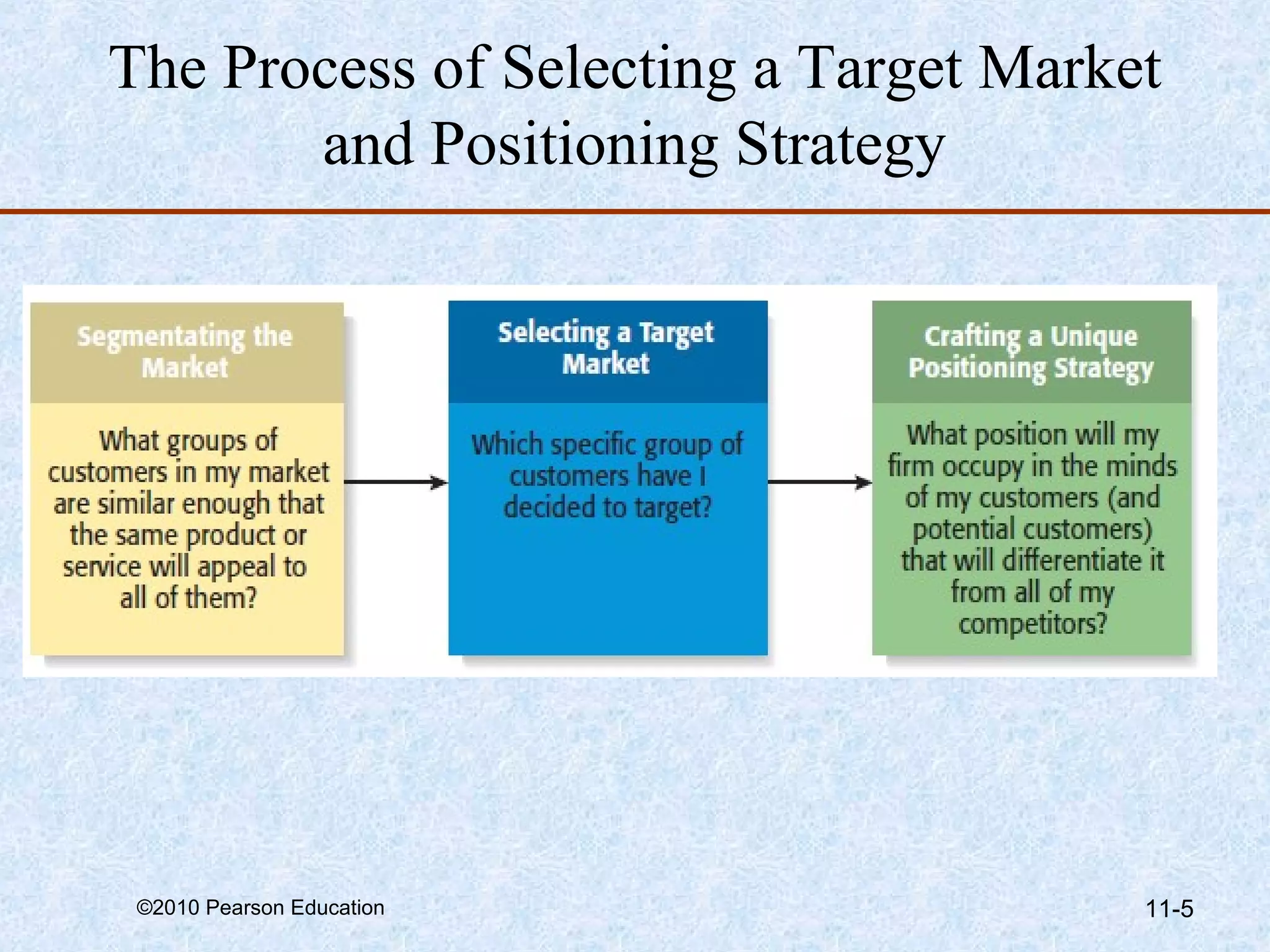
   – A well-managed start-up approaches this query by
     following a three-step process:
        • Segmenting the market.
        • Selecting a target market.
        • Establishing a unique position in the target market


  ©2010 Pearson Education                                       11-4
The Process of Selecting a Target Market
       and Positioning Strategy


 ©2010 Pearson Education               11-5
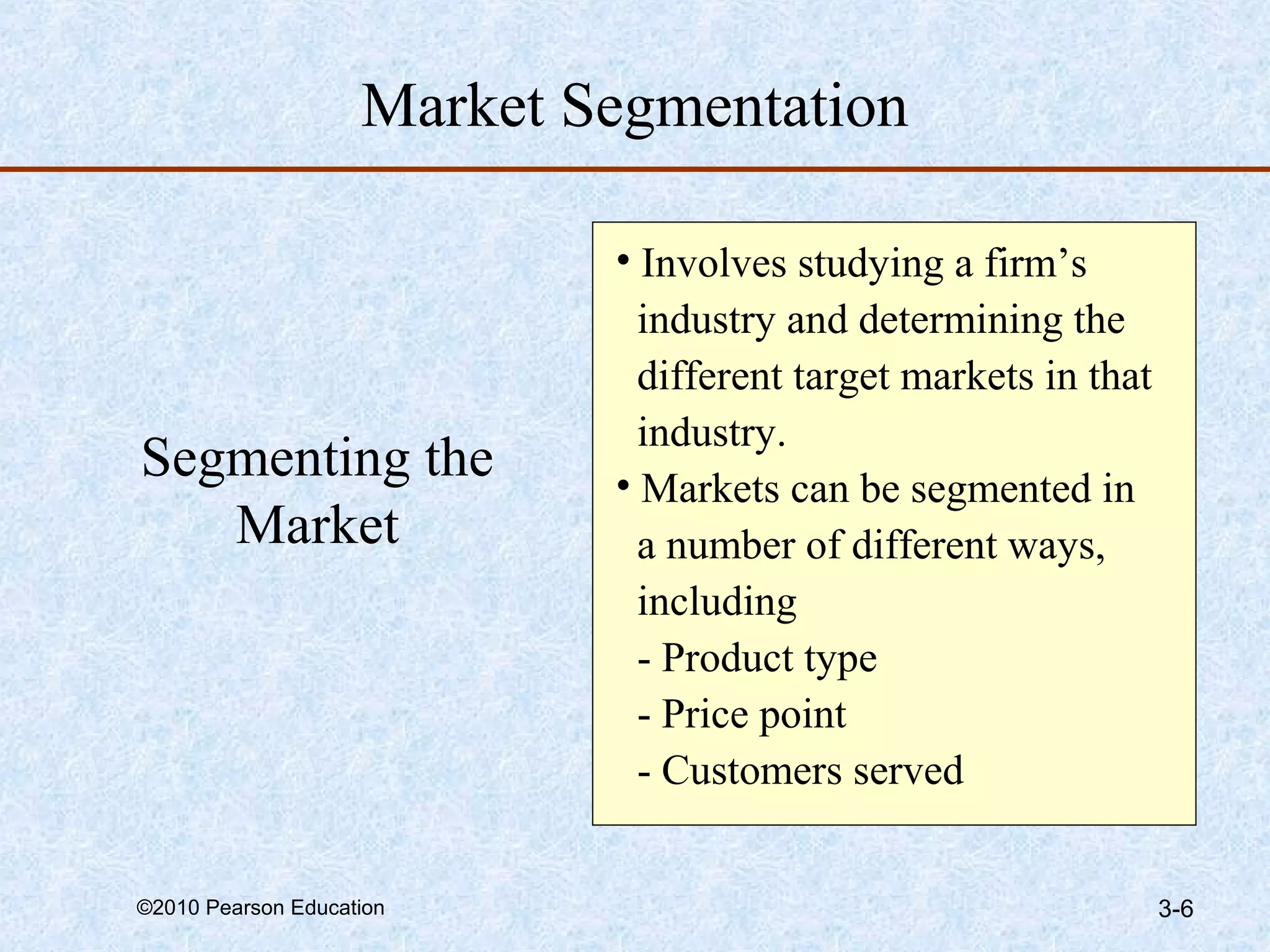
Market Segmentation

                            • Involves studying a firm’s
                              industry and determining the
                              different target markets in that
                              industry.
Segmenting the              • Markets can be segmented in
   Market                     a number of different ways,
                              including
                              - Product type
                              - Price point
                              - Customers served


©2010 Pearson Education                                          3-6
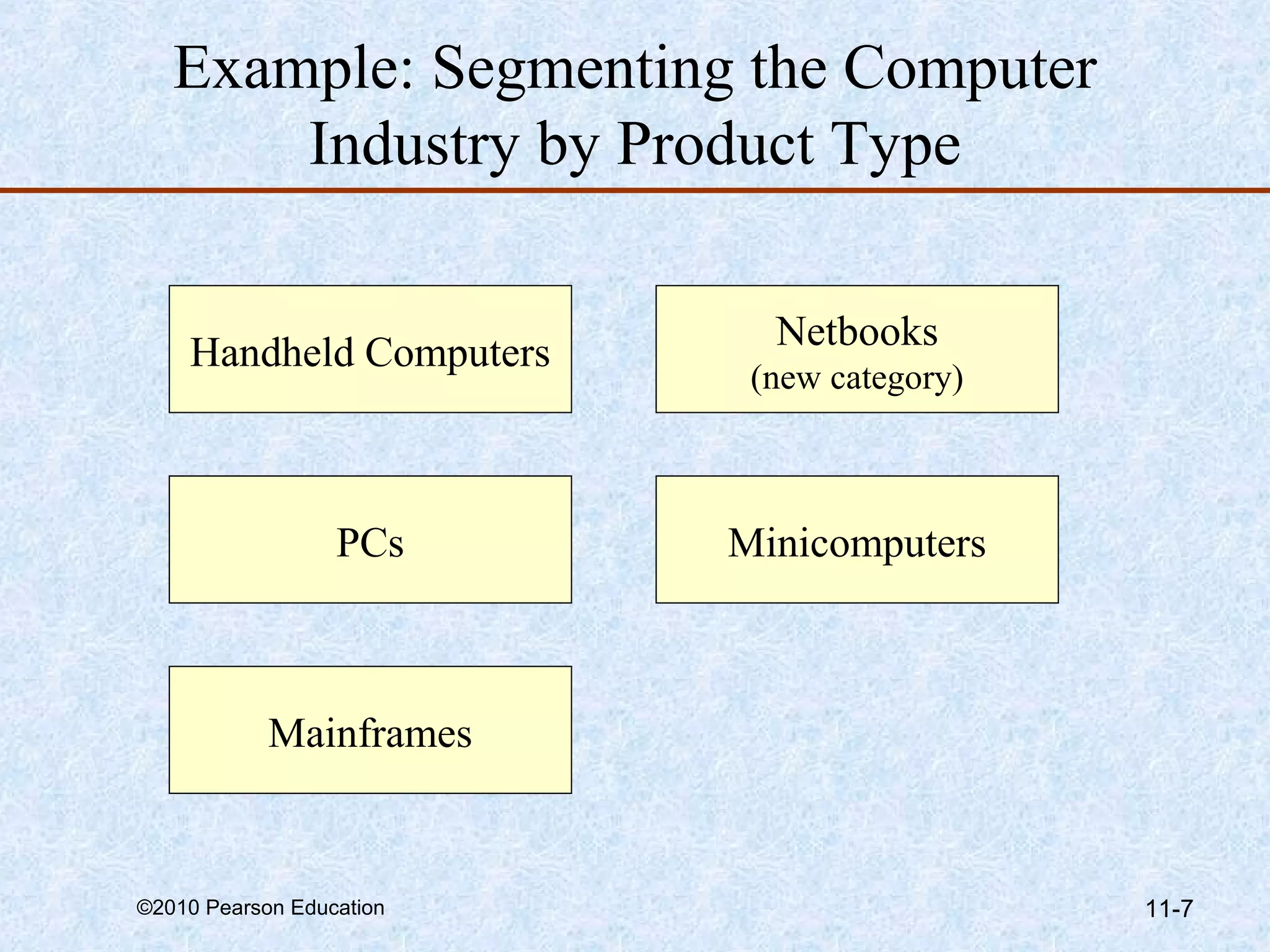
Example: Segmenting the Computer
       Industry by Product Type

                            Netbooks
    Handheld Computers
                           (new category)


                  PCs     Minicomputers


            Mainframes


©2010 Pearson Education                     11-7
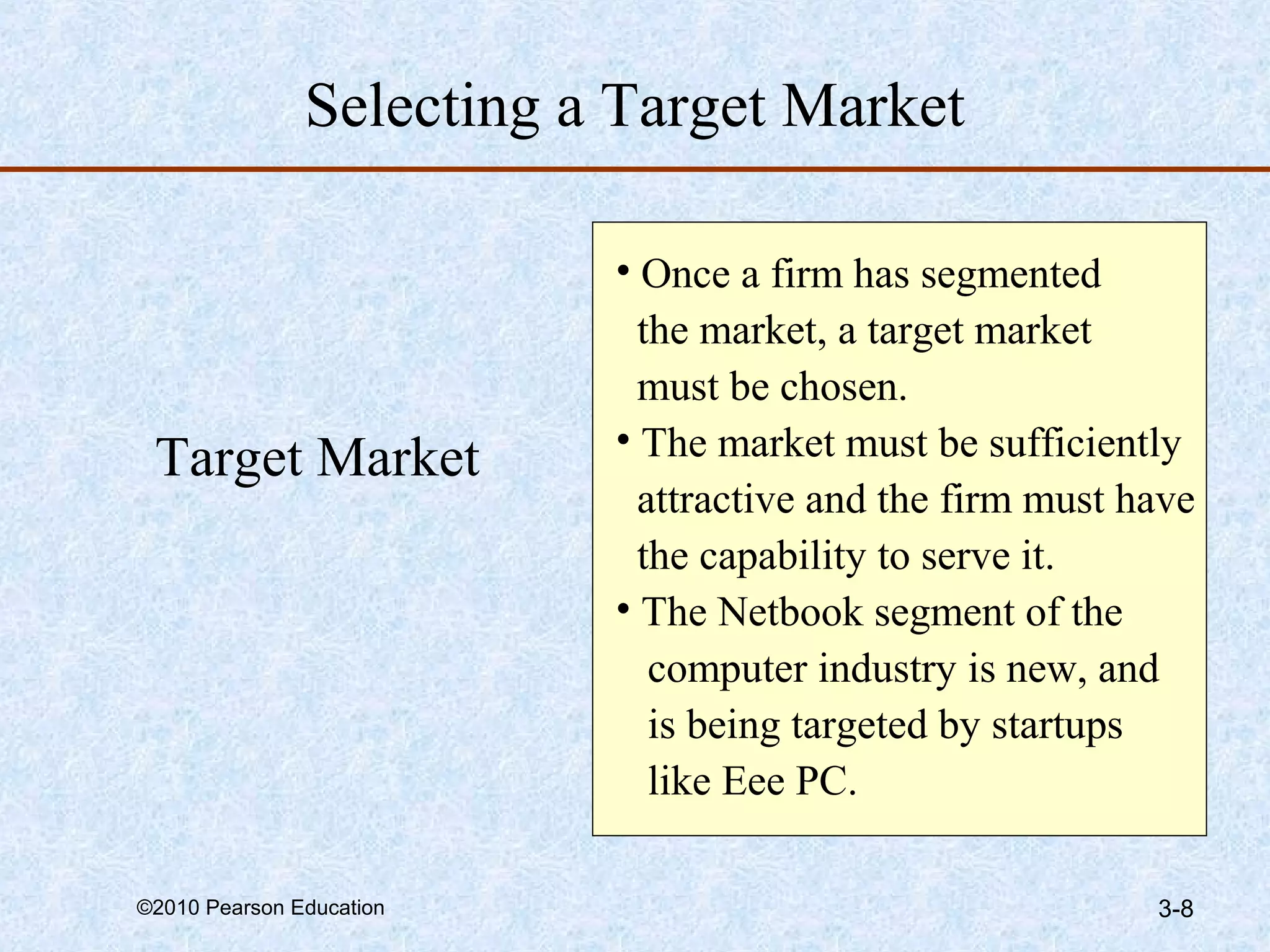
Selecting a Target Market

                          • Once a firm has segmented
                            the market, a target market
                            must be chosen.
                          • The market must be sufficiently
 Target Market
                            attractive and the firm must have
                            the capability to serve it.
                          • The Netbook segment of the
                             computer industry is new, and
                             is being targeted by startups
                             like Eee PC.

©2010 Pearson Education                                   3-8
Establishing a Unique Position
                           1 of 2


                          • After selecting a target market, the
                            firm’s next step is to establish a
                            “position” within the market that
    Positioning             differentiates it from its rivals.
                          • A “position” is the part of a market
                            that the firm is claiming as its own.
                          • A firm establishing a unique
                            position in its customers’ minds
                            by drawing attention to two or
                            three of the product’s attributes.

©2010 Pearson Education                                       3-9
Establishing a Unique Position
                                    2 of 2


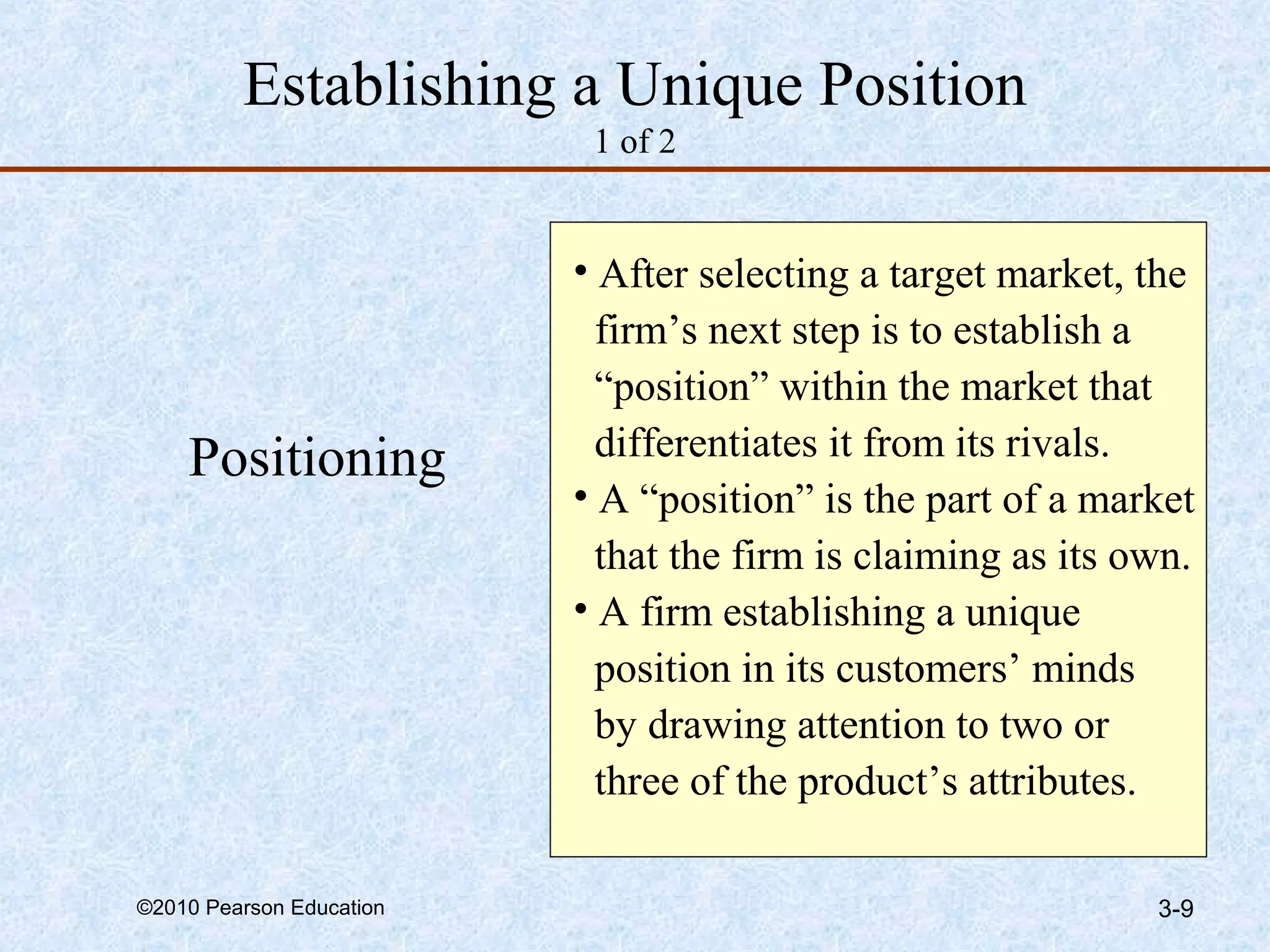
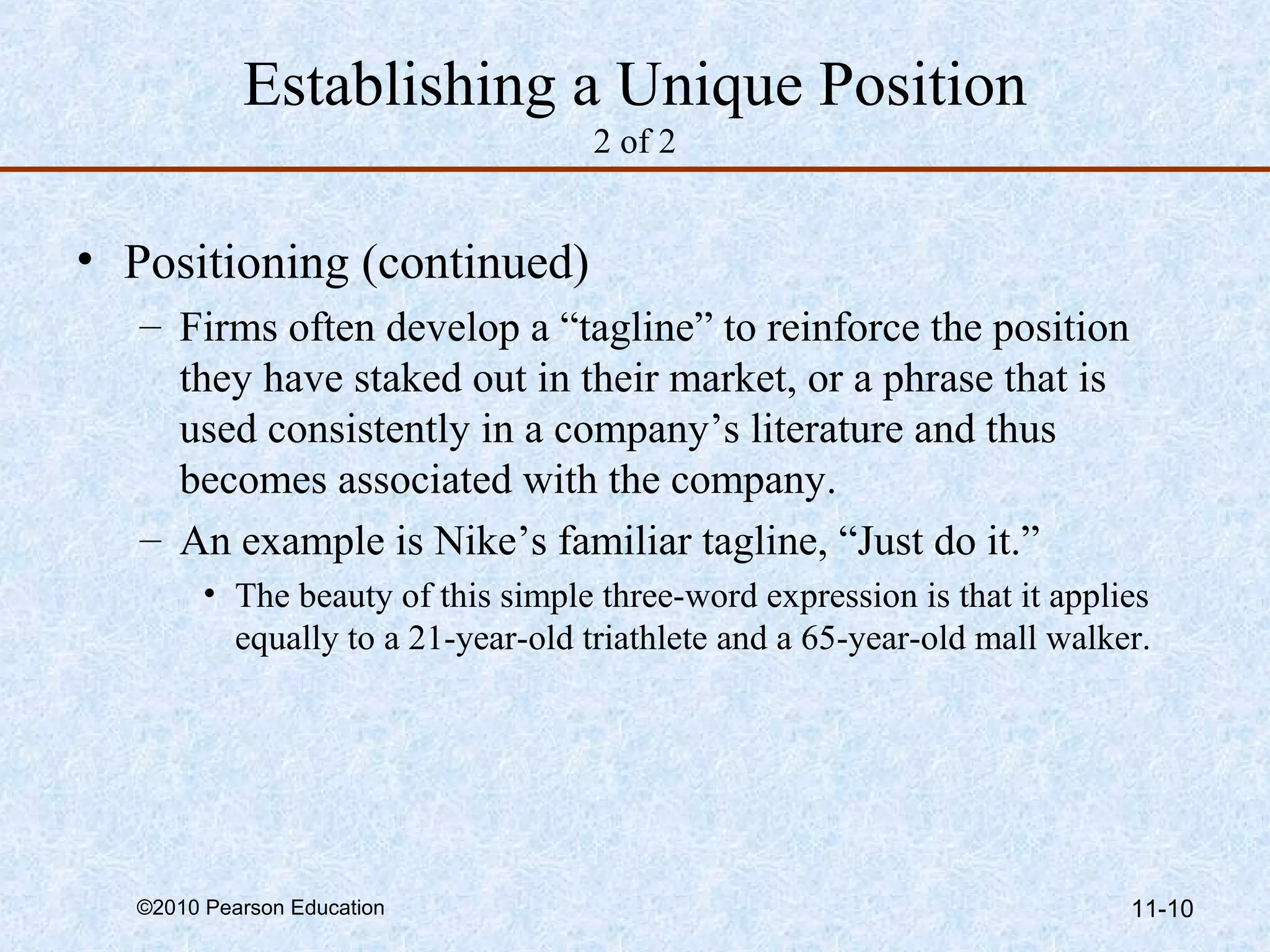
• Positioning (continued)
   – Firms often develop a “tagline” to reinforce the position
     they have staked out in their market, or a phrase that is
     used consistently in a company’s literature and thus
     becomes associated with the company.
   – An example is Nike’s familiar tagline, “Just do it.”
        • The beauty of this simple three-word expression is that it applies
          equally to a 21-year-old triathlete and a 65-year-old mall walker.


  ©2010 Pearson Education                                                 11-10
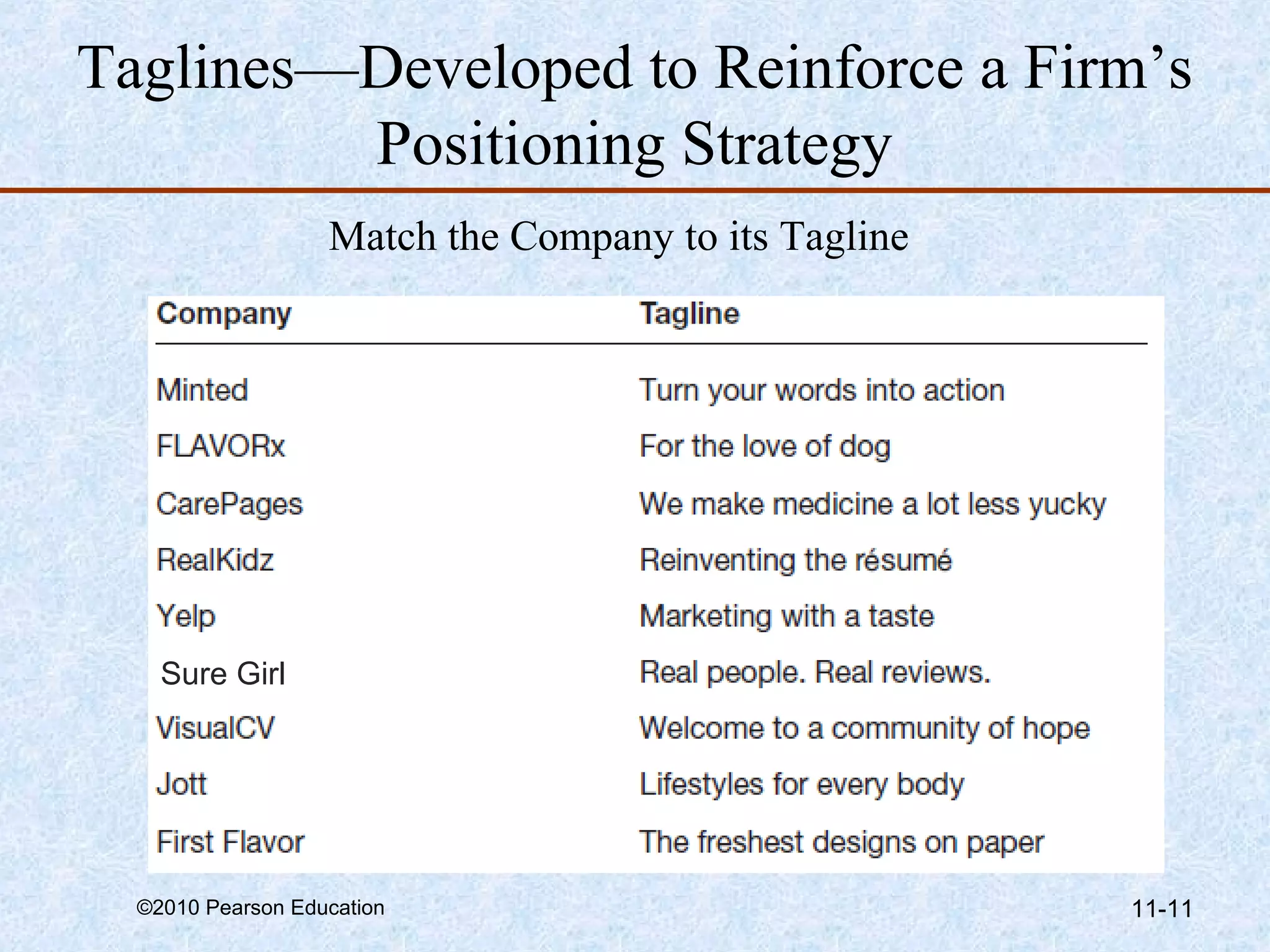
Taglines—Developed to Reinforce a Firm’s
         Positioning Strategy
                   Match the Company to its Tagline


    Sure Girl


  ©2010 Pearson Education                             11-11
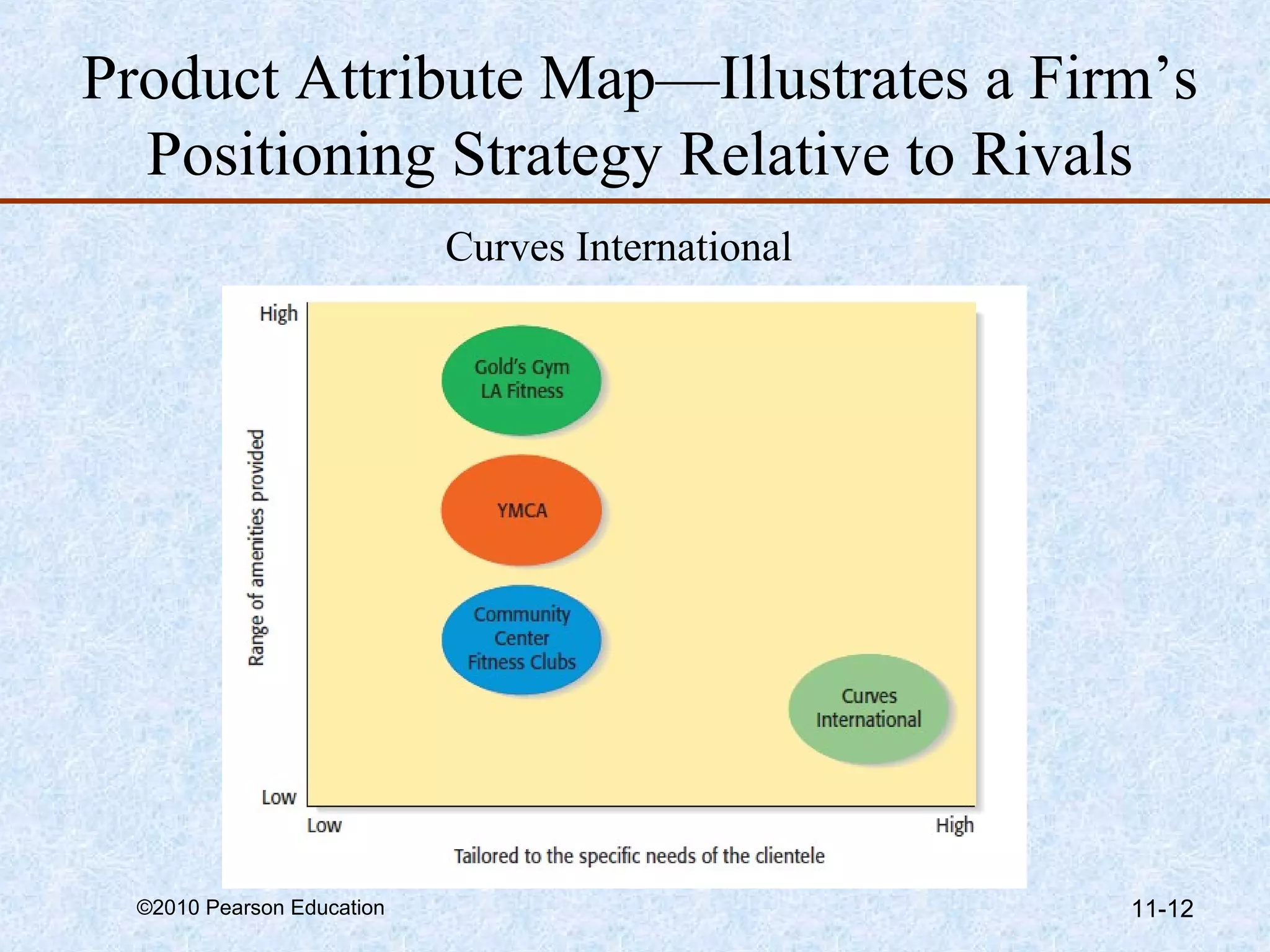
Product Attribute Map—Illustrates a Firm’s
  Positioning Strategy Relative to Rivals
                            Curves International


  ©2010 Pearson Education                          11-12
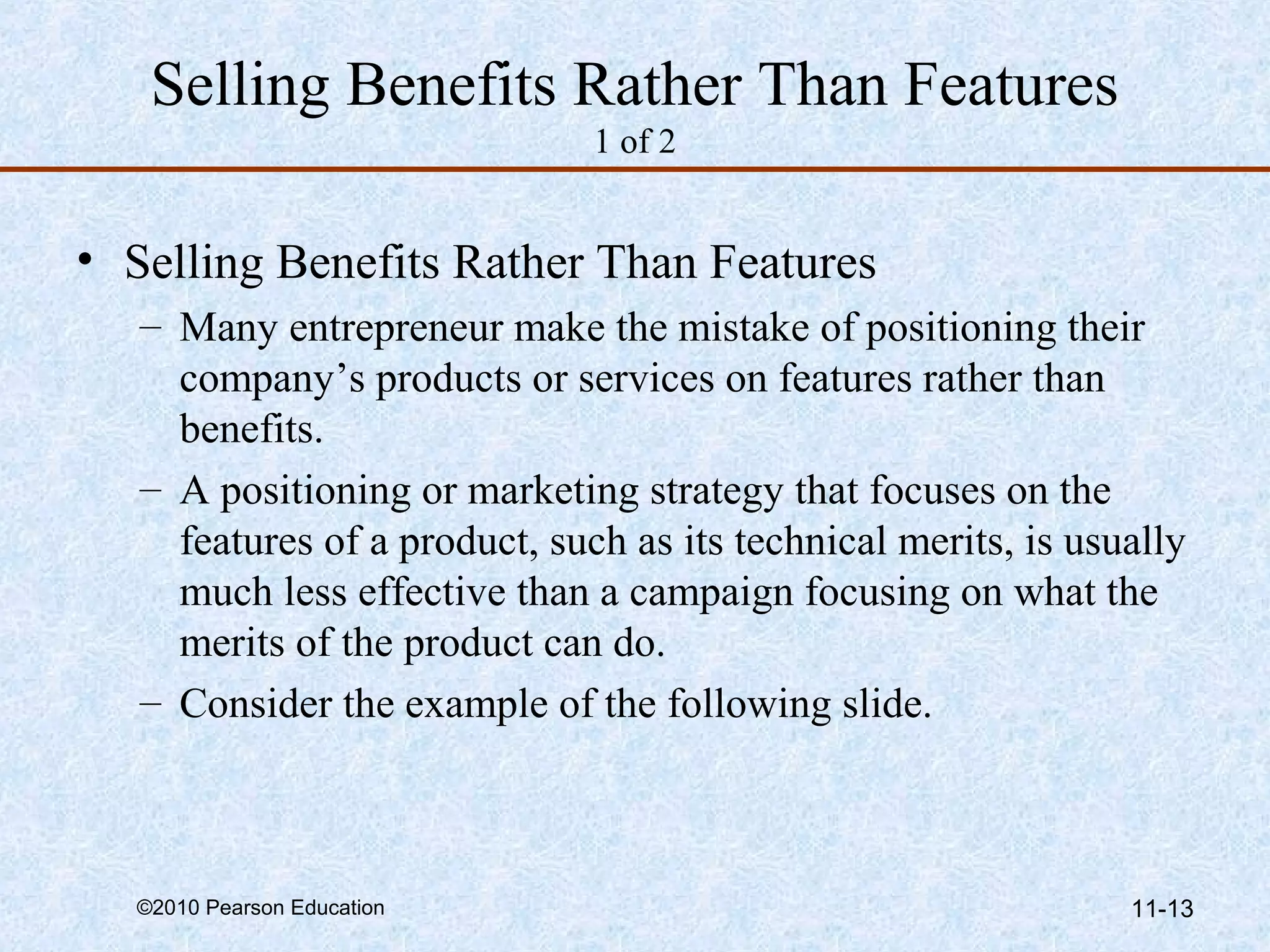
Selling Benefits Rather Than Features
                               1 of 2


• Selling Benefits Rather Than Features
   – Many entrepreneur make the mistake of positioning their
     company’s products or services on features rather than
     benefits.
   – A positioning or marketing strategy that focuses on the
     features of a product, such as its technical merits, is usually
     much less effective than a campaign focusing on what the
     merits of the product can do.
   – Consider the example of the following slide.


  ©2010 Pearson Education                                       11-13
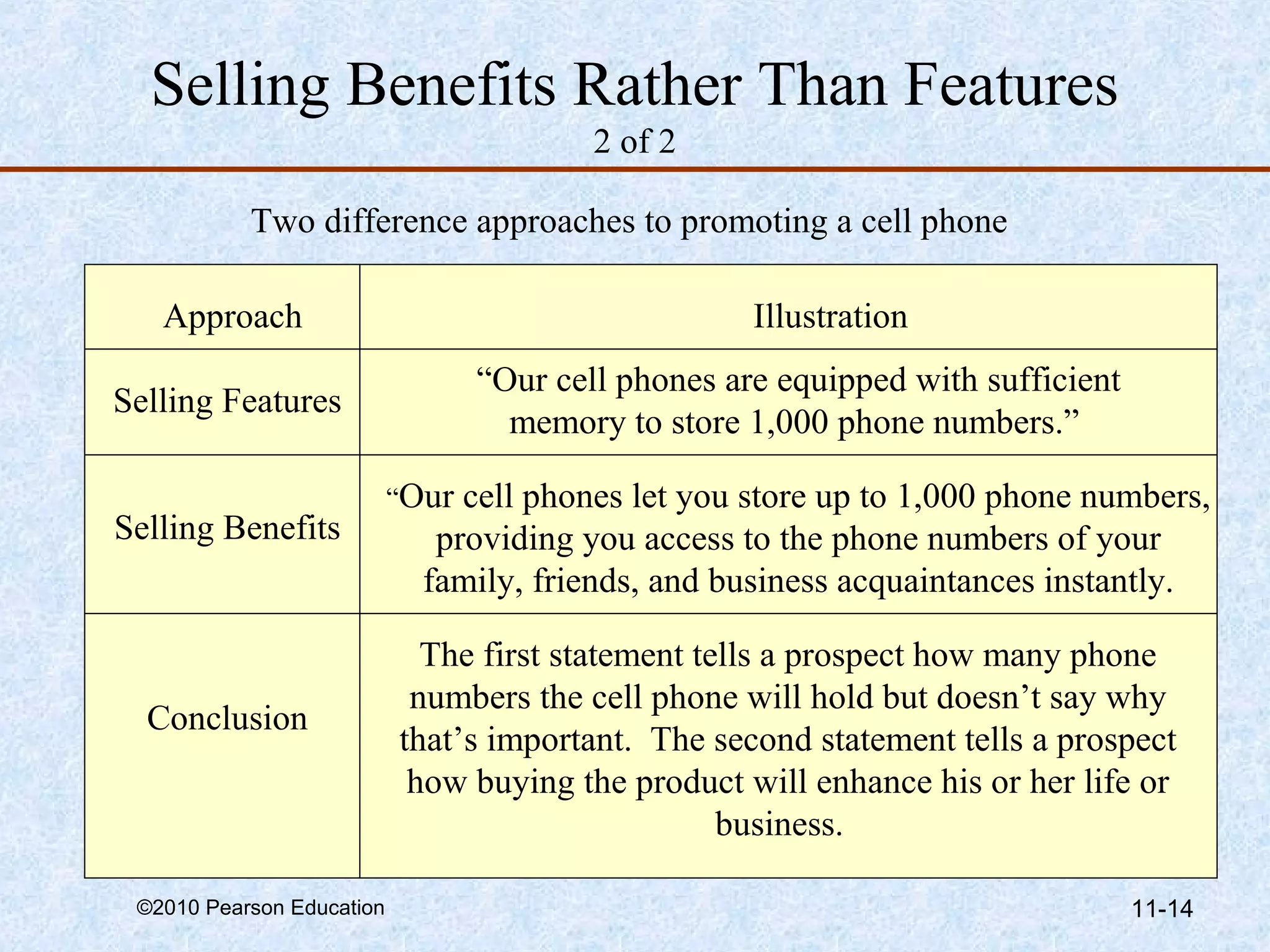
Selling Benefits Rather Than Features
                                          2 of 2

           Two difference approaches to promoting a cell phone

   Approach                                          Illustration
                                  “Our cell phones are equipped with sufficient
Selling Features
                                    memory to store 1,000 phone numbers.”

                           “Our cell phones let you store up to 1,000 phone numbers,
Selling Benefits              providing you access to the phone numbers of your
                             family, friends, and business acquaintances instantly.

                             The first statement tells a prospect how many phone
                            numbers the cell phone will hold but doesn’t say why
  Conclusion
                           that’s important. The second statement tells a prospect
                            how buying the product will enhance his or her life or
                                                   business.

 ©2010 Pearson Education                                                          11-14
Establishing a Brand
                                    1 of 5


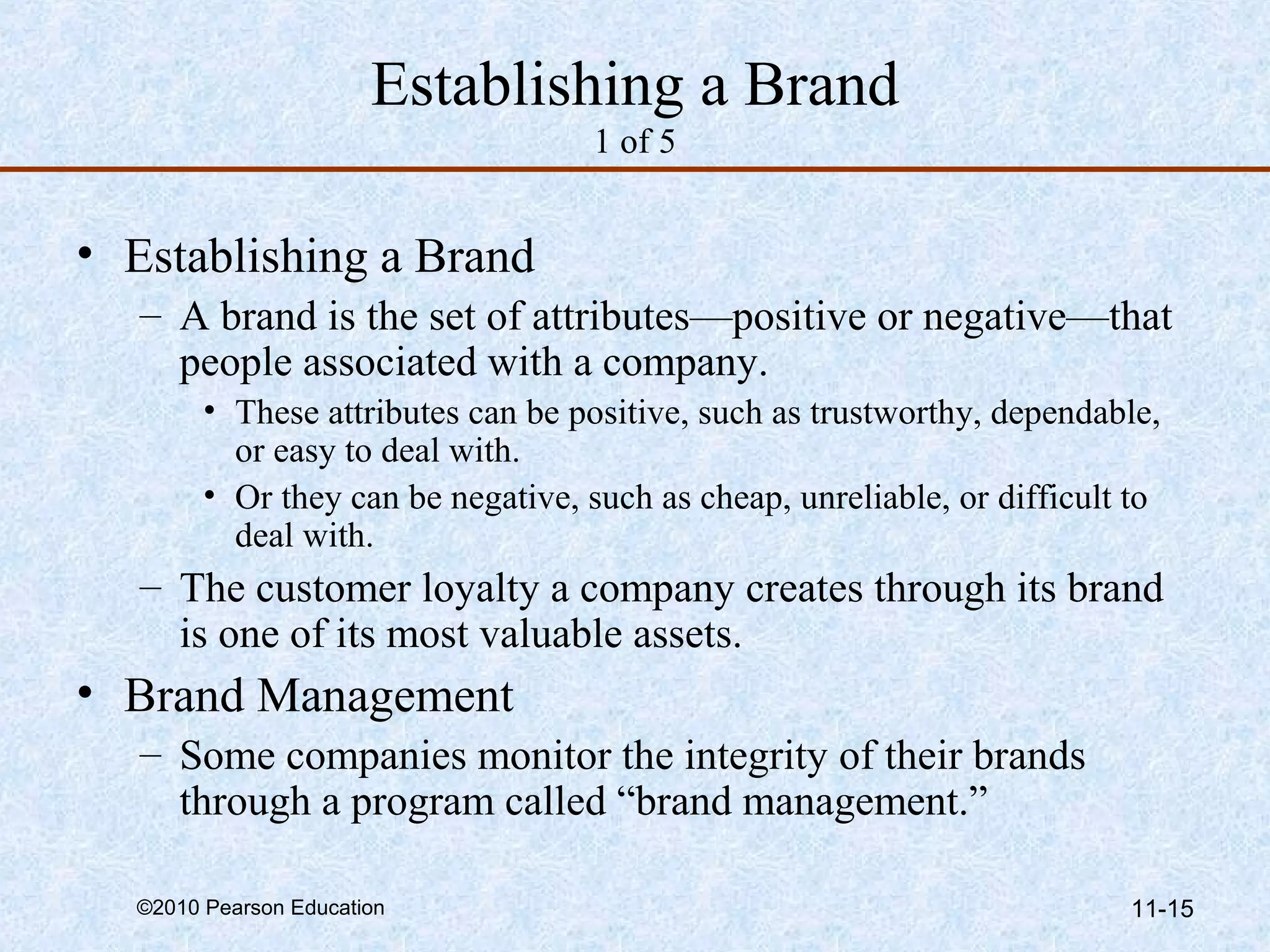
• Establishing a Brand
   – A brand is the set of attributes—positive or negative—that
     people associated with a company.
        • These attributes can be positive, such as trustworthy, dependable,
          or easy to deal with.
        • Or they can be negative, such as cheap, unreliable, or difficult to
          deal with.
   – The customer loyalty a company creates through its brand
     is one of its most valuable assets.
• Brand Management
   – Some companies monitor the integrity of their brands
     through a program called “brand management.”

  ©2010 Pearson Education                                                 11-15
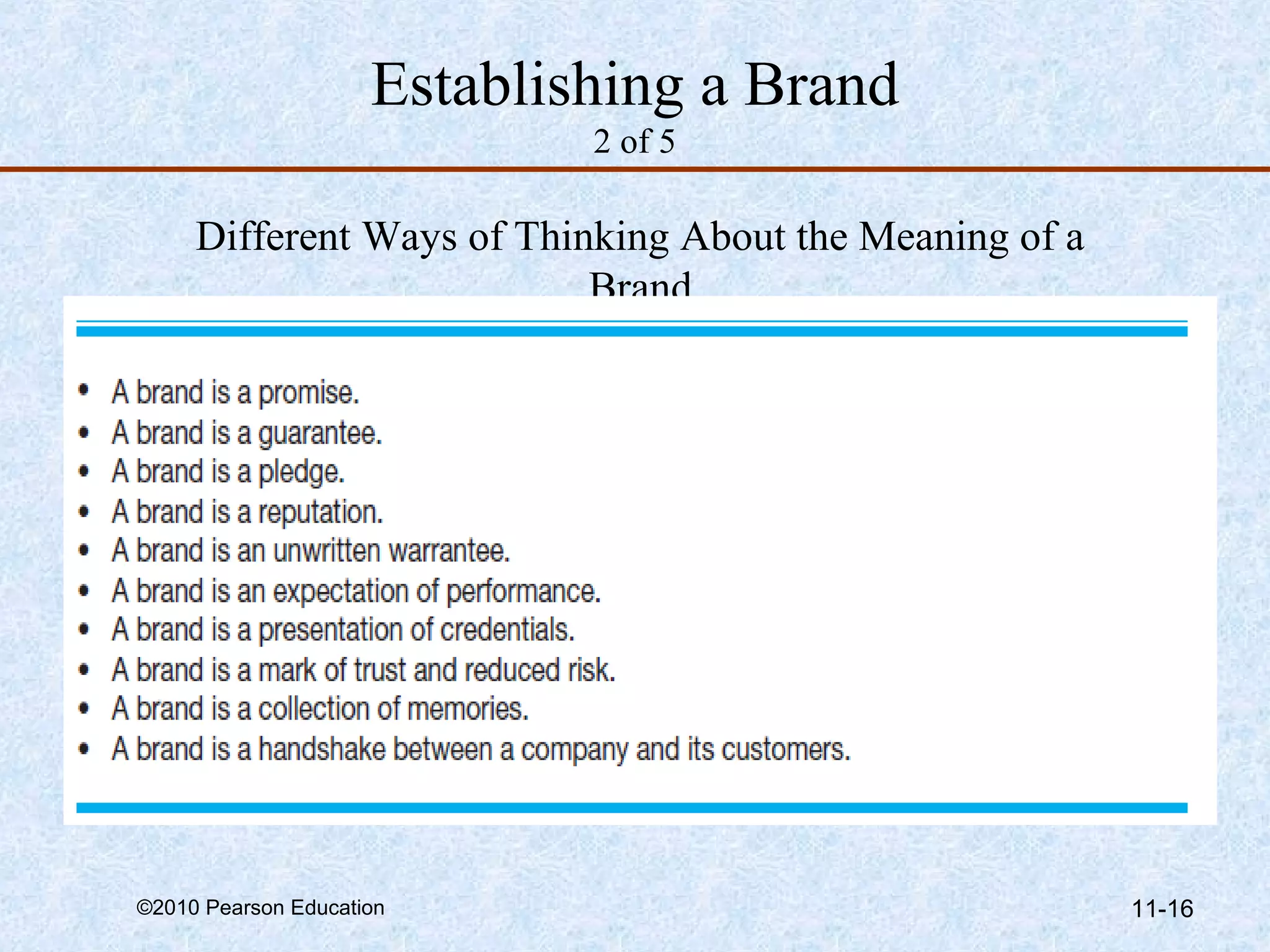
Establishing a Brand
                             2 of 5

     Different Ways of Thinking About the Meaning of a
                           Brand


©2010 Pearson Education                                  11-16
Establishing a Brand
                                   3 of 5


• Establishing a Brand
   – So how does a firm establish a brand?
        • On a philosophical level, a firm must have meaning in its
          customer’s lives. It must create value—something for which
          customers are willing to pay.
        • On a more practical level, brands are built through a number of
          techniques, including advertising, public relations, sponsorships,
          support of social causes, and good performance.
        • A firm’s name, logo, Web site design, and even its letterhead are
          part of its brand.


  ©2010 Pearson Education                                                 11-17
Establishing a Brand
                               4 of 5

• Power of a Strong Brand
  – Ultimately, a strong brand can be a very powerful asset for
    a firm.
• Cobranding
  – A technique that companies use to strengthen their brands
    is to enter into a cobranding arrangements with other firms.
  – Cobranding refers to a relationship between two or more
    firms where the firm’s brands promote each another.


  ©2010 Pearson Education                                   11-18
Establishing a Brand
                             5 of 5


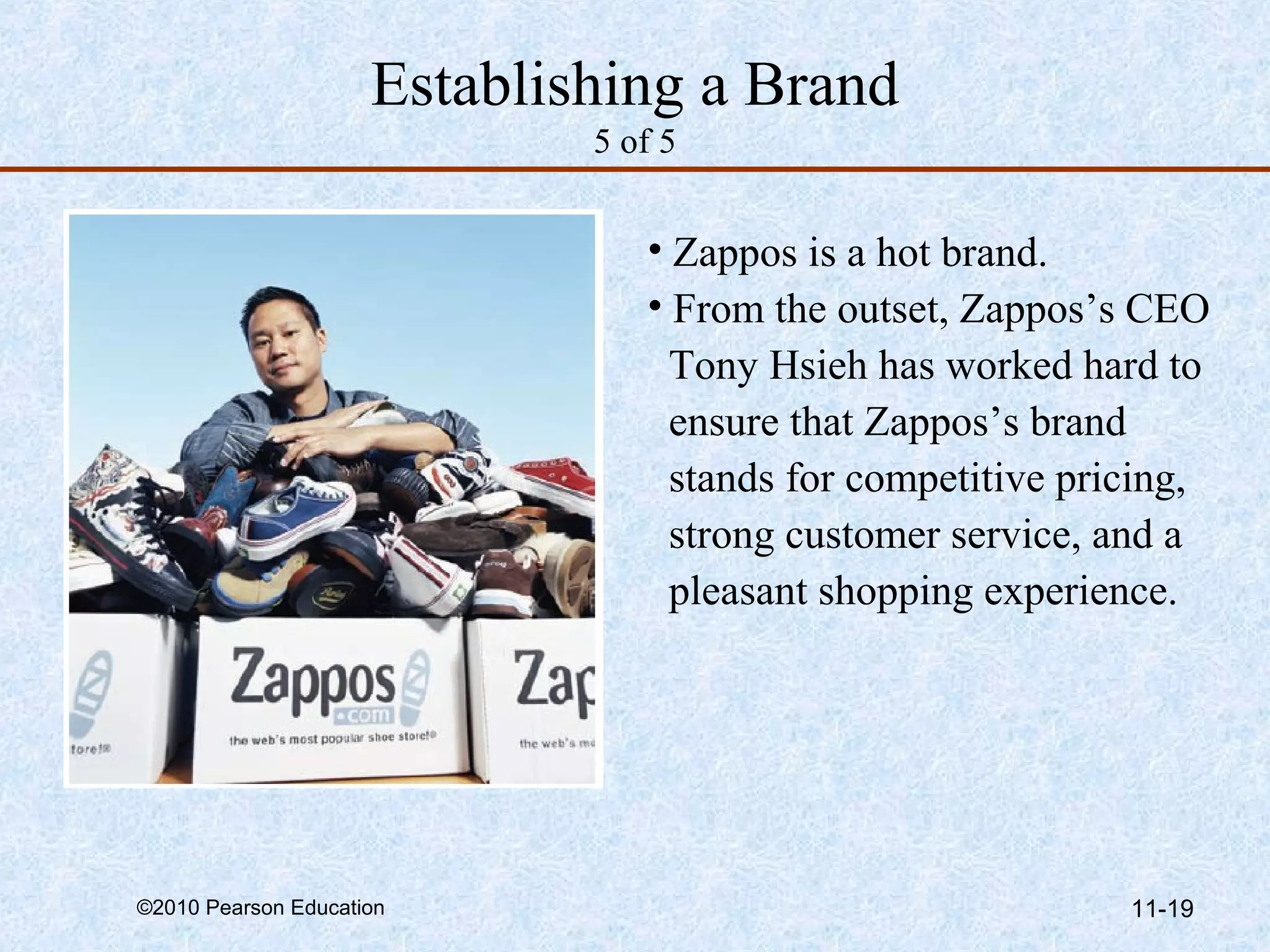
                                • Zappos is a hot brand.
                                • From the outset, Zappos’s CEO
                                  Tony Hsieh has worked hard to
                                  ensure that Zappos’s brand
                                  stands for competitive pricing,
                                  strong customer service, and a
                                  pleasant shopping experience.


©2010 Pearson Education                                     11-19
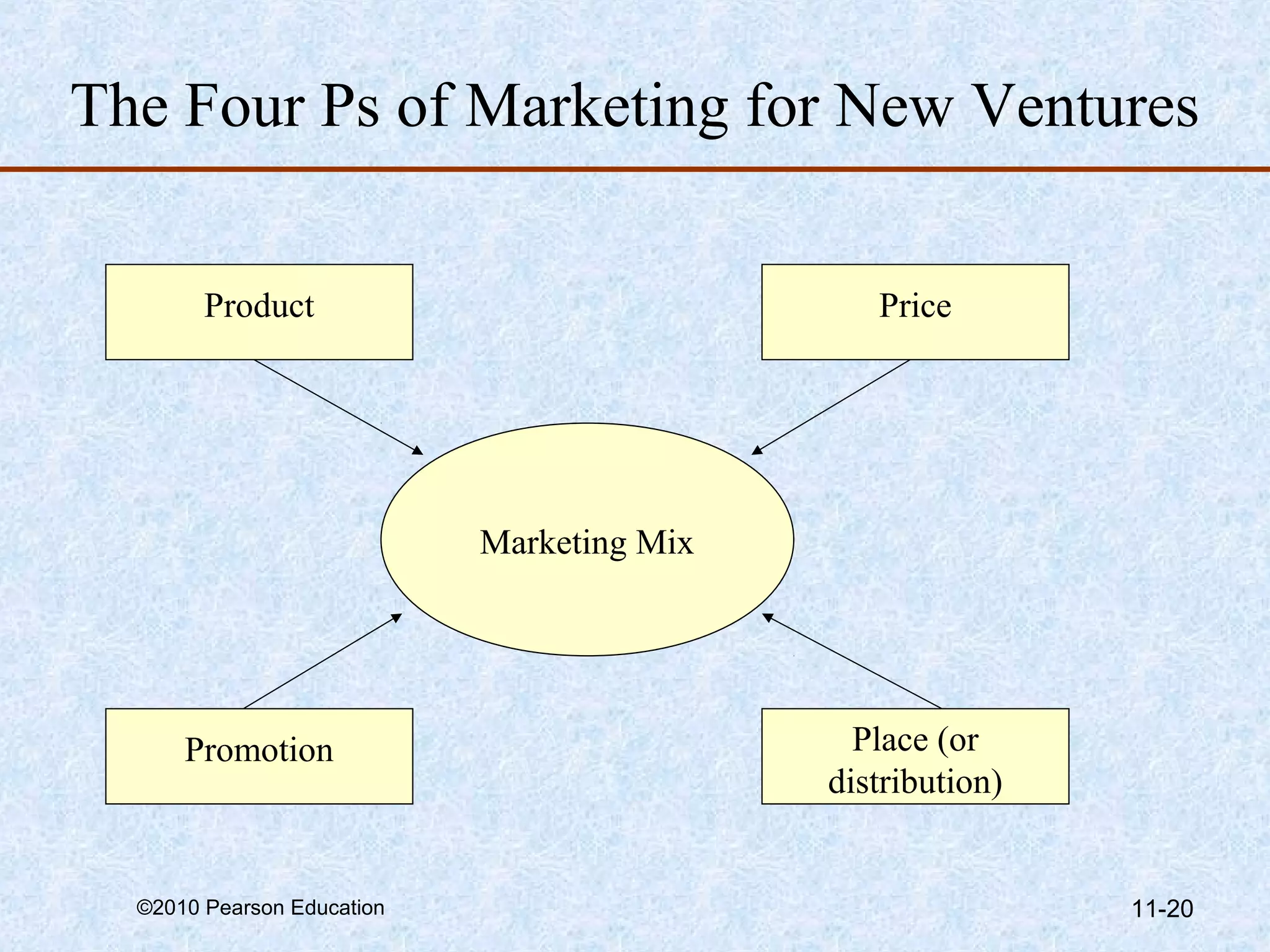
The Four Ps of Marketing for New Ventures


        Product                                Price


                            Marketing Mix


      Promotion                               Place (or
                                            distribution)


  ©2010 Pearson Education                                   11-20
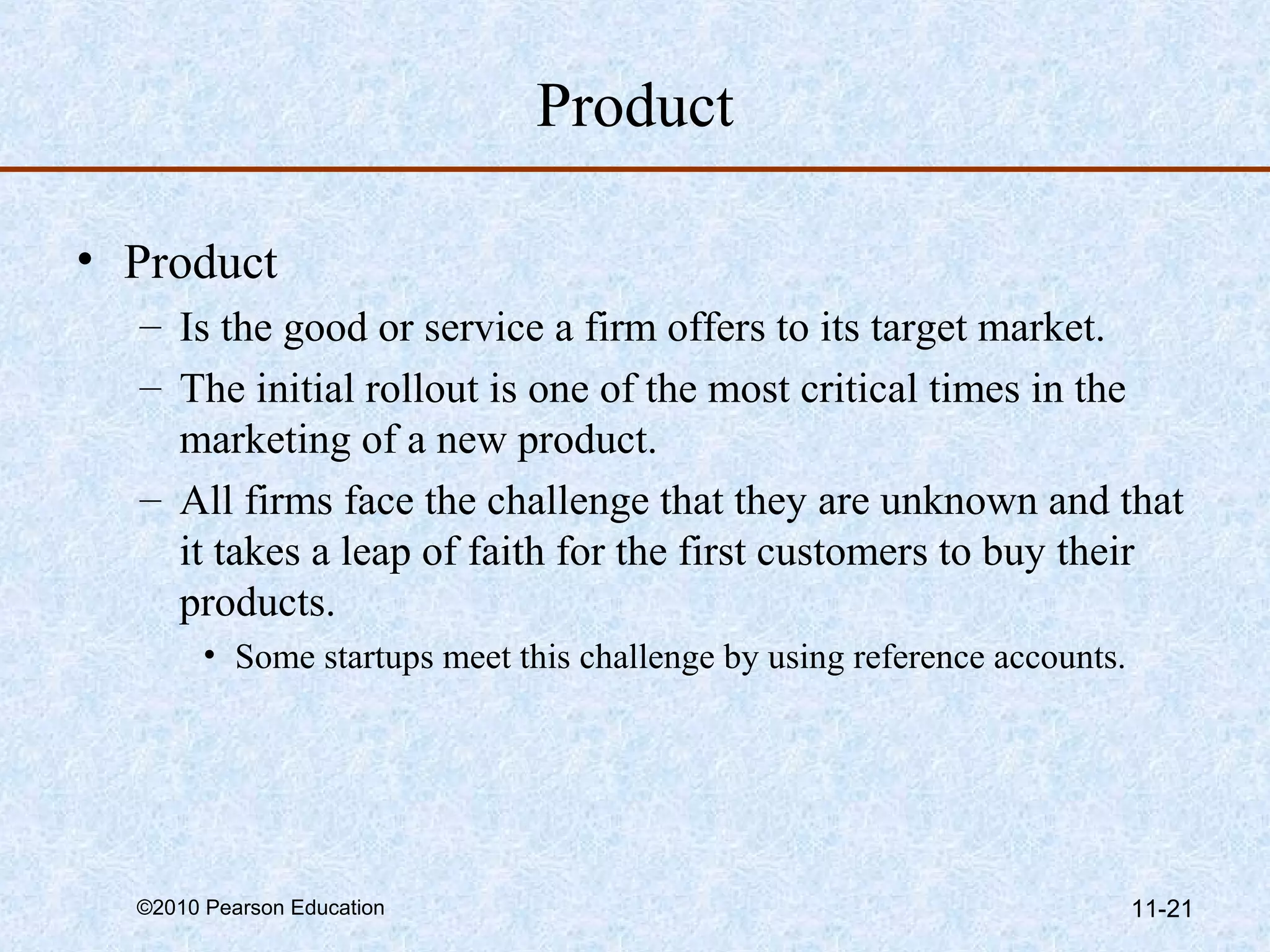
Product

• Product
  – Is the good or service a firm offers to its target market.
  – The initial rollout is one of the most critical times in the
    marketing of a new product.
  – All firms face the challenge that they are unknown and that
    it takes a leap of faith for the first customers to buy their
    products.
        • Some startups meet this challenge by using reference accounts.


  ©2010 Pearson Education                                                  11-21
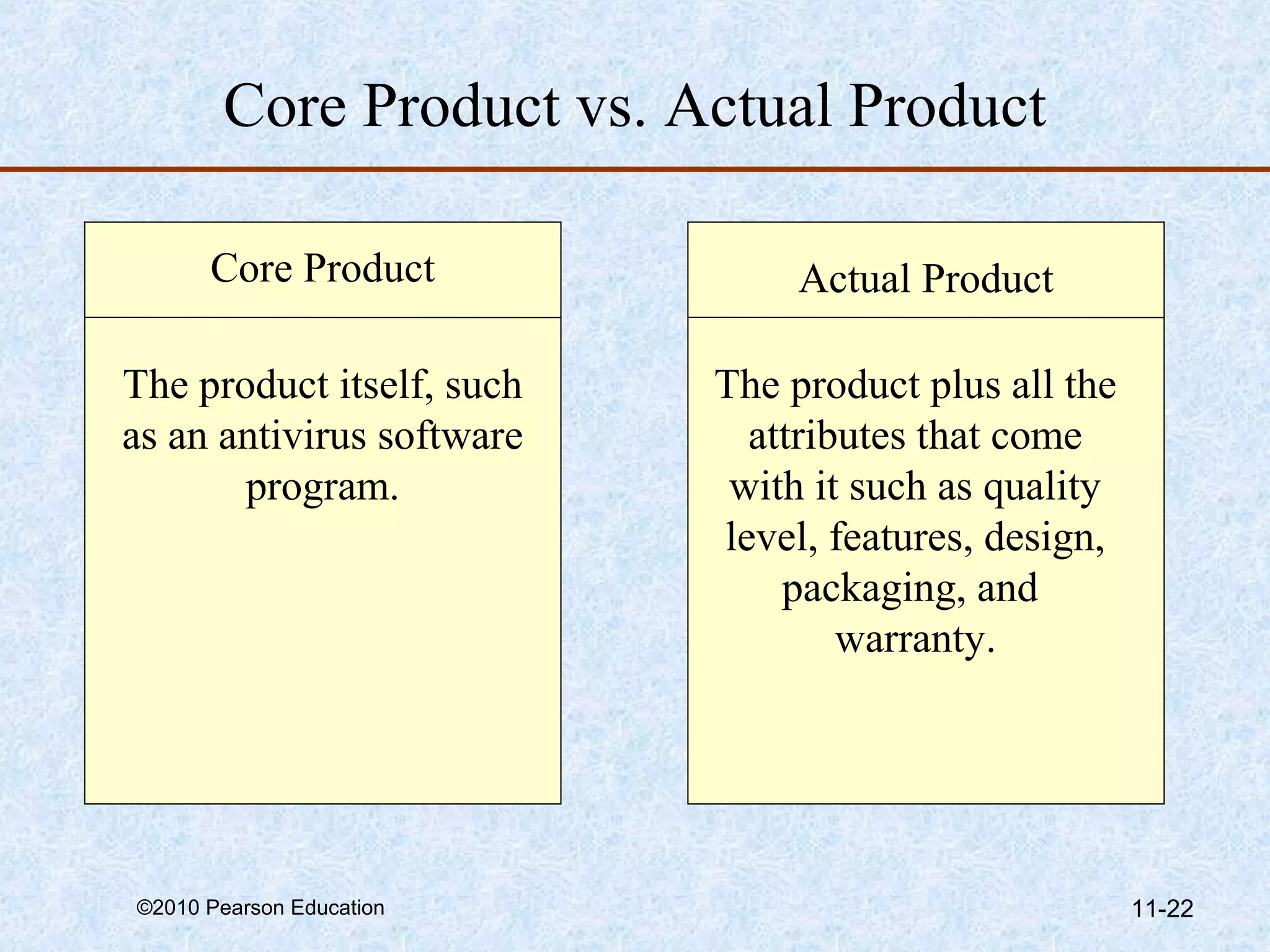
Core Product vs. Actual Product

      Core Product              Actual Product

The product itself, such   The product plus all the
as an antivirus software     attributes that come
       program.             with it such as quality
                           level, features, design,
                               packaging, and
                                   warranty.


©2010 Pearson Education                               11-22
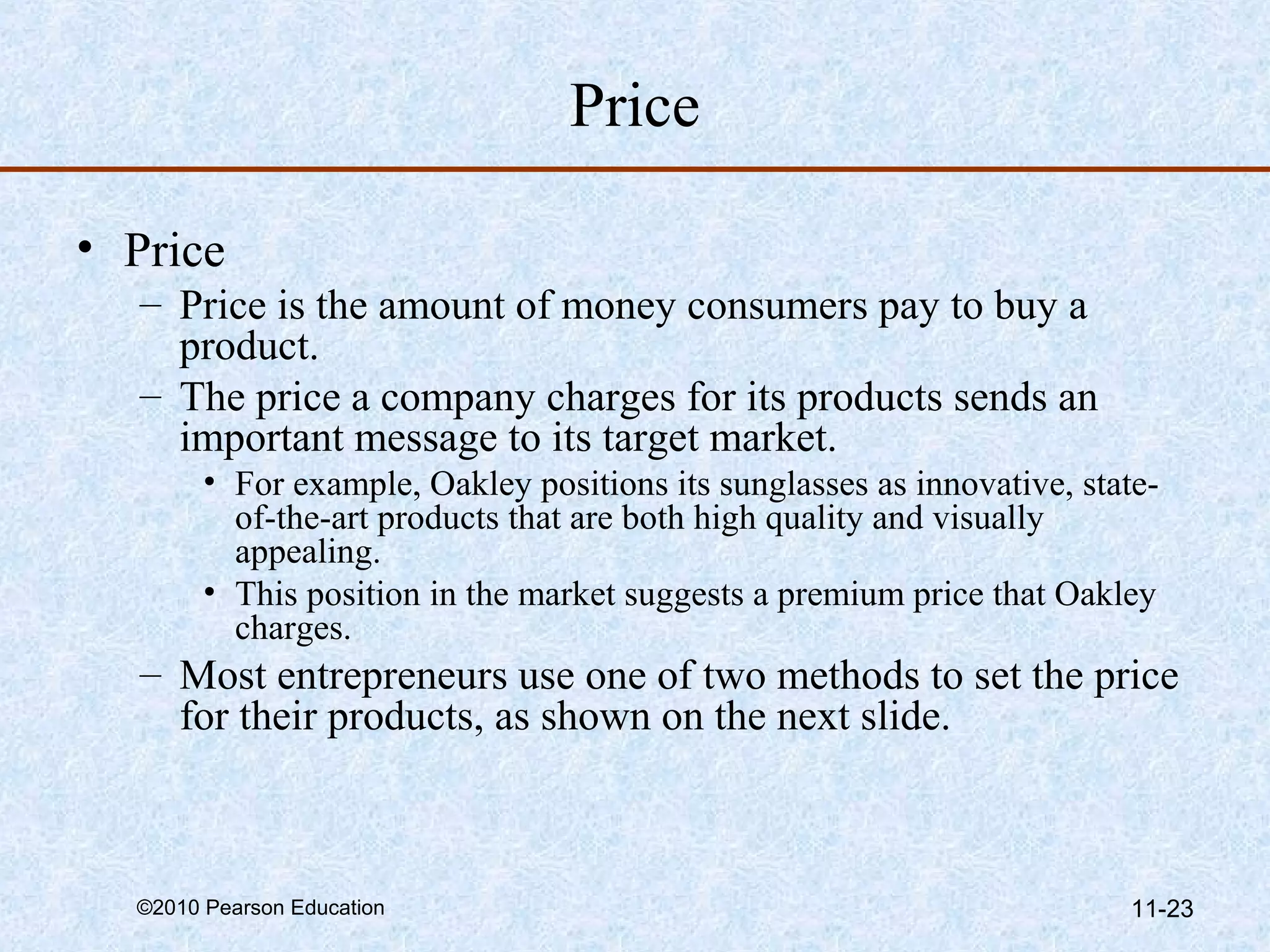
Price

• Price
  – Price is the amount of money consumers pay to buy a
    product.
  – The price a company charges for its products sends an
    important message to its target market.
        • For example, Oakley positions its sunglasses as innovative, state-
          of-the-art products that are both high quality and visually
          appealing.
        • This position in the market suggests a premium price that Oakley
          charges.
  – Most entrepreneurs use one of two methods to set the price
    for their products, as shown on the next slide.


  ©2010 Pearson Education                                                 11-23
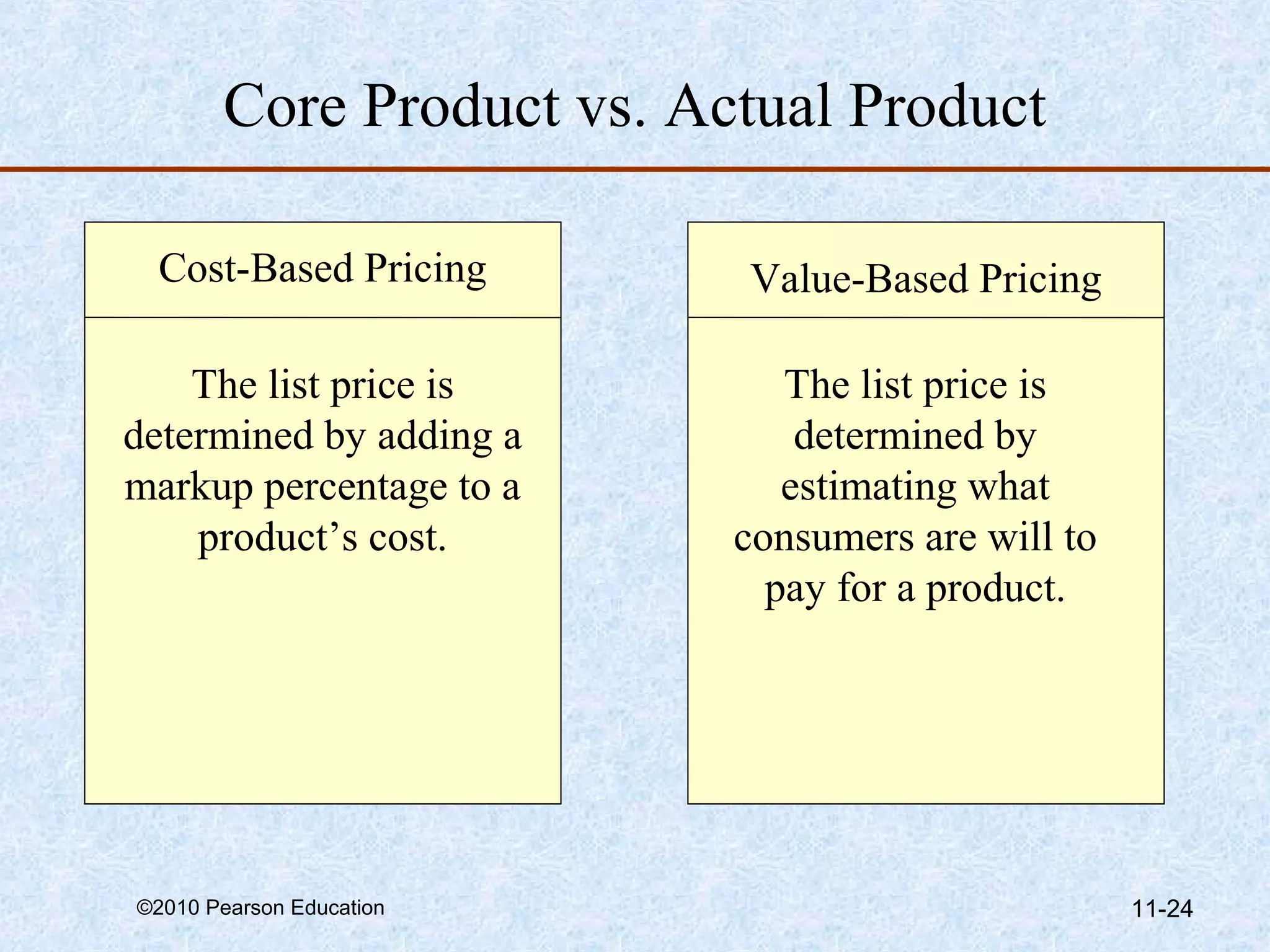
Core Product vs. Actual Product

  Cost-Based Pricing       Value-Based Pricing

    The list price is         The list price is
determined by adding a         determined by
markup percentage to a        estimating what
    product’s cost.        consumers are will to
                             pay for a product.


©2010 Pearson Education                            11-24
Promotion

• Promotion
  – Refers to the activities the firm takes to communicate the
    merits of its product to its target market.
  – There are several common activities that entrepreneurs use
    to promote their products and services.
• Advertising
  – Advertising is making people aware of a product or service
    in hopes of persuading them to buy it.


  ©2010 Pearson Education                                  11-25
Pluses and Minuses of Advertising
Pluses

• Raise customer awareness of a product.
• Explain a product’s comparative features and benefits.
• Create associations between a product and a certain lifestyle.
Minuses

• Low credibility.
• The possibility that a high percentage of people who see the add
  will not be interested .
• Message clutter.
• Relative costliness compared to other forms of promotion.
• Intrusiveness.                                                11-26
    ©2010 Pearson Education
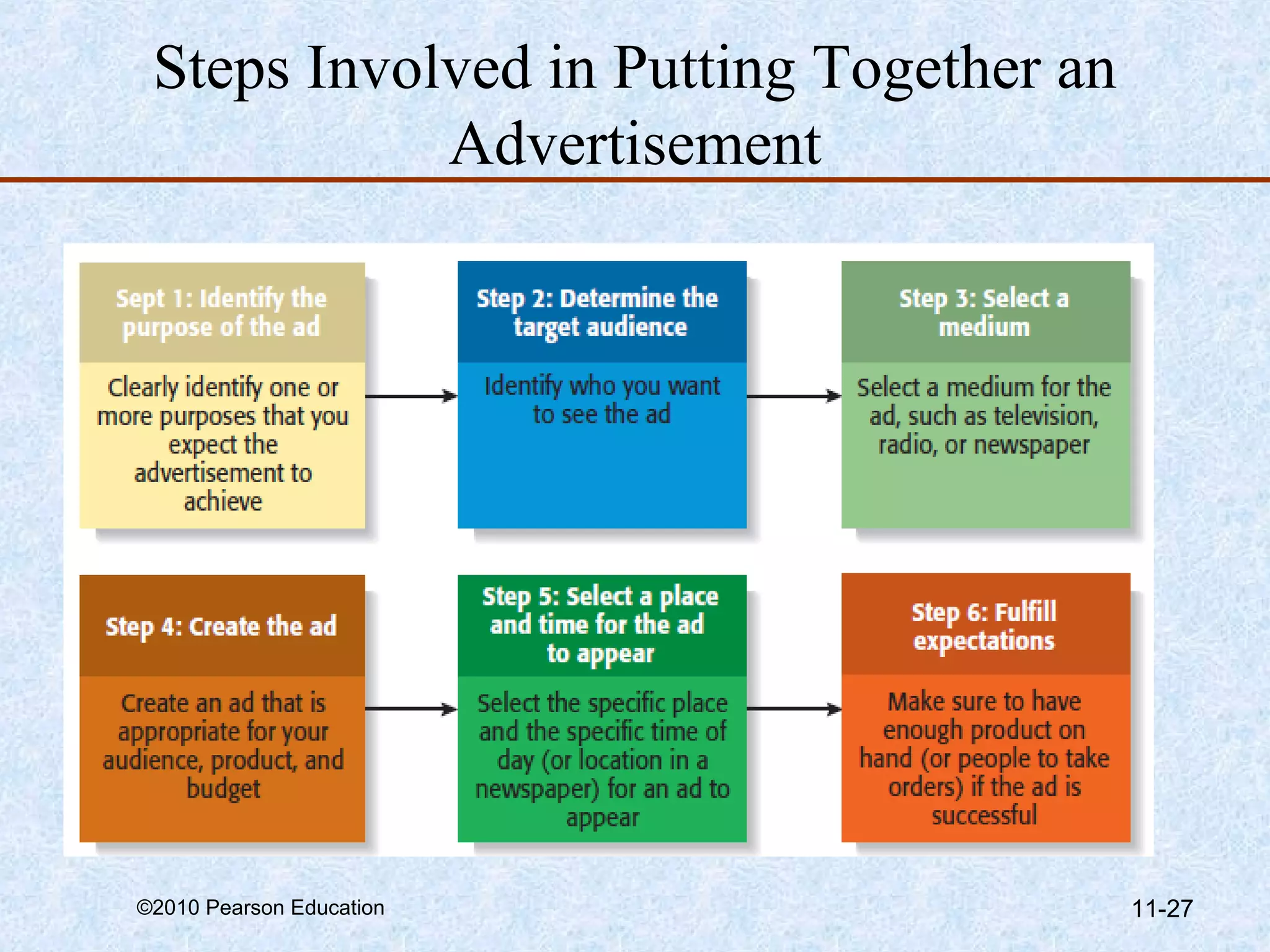
Steps Involved in Putting Together an
            Advertisement


©2010 Pearson Education                  11-27
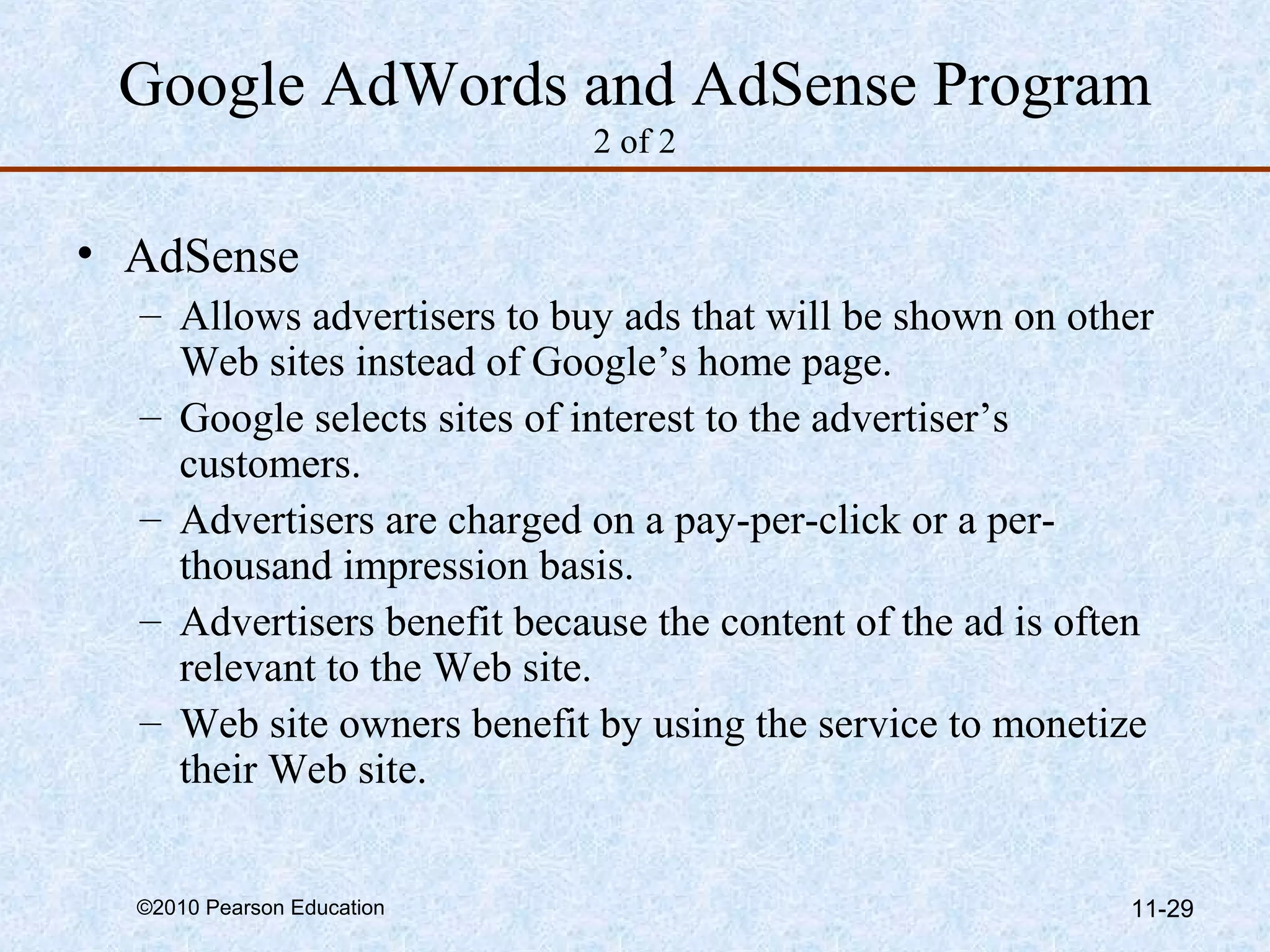
Google AdWords and AdSense Program
                             1 of 2


• AdWords
  – Allows advertisers to buy keywords on the Google home
    page.
  – Triggers text-based ads to the side (and sometimes above)
    search results when the keyword is used.
  – The program includes local, national, and international
    distribution.
  – Advertisers pay a certain amount per click.
  – Advertisers benefit because they are able to place their ads
    in front of people who are already searching for
    information about their product.


  ©2010 Pearson Education                                    11-28
Google AdWords and AdSense Program
                            2 of 2


• AdSense
  – Allows advertisers to buy ads that will be shown on other
    Web sites instead of Google’s home page.
  – Google selects sites of interest to the advertiser’s
    customers.
  – Advertisers are charged on a pay-per-click or a per-
    thousand impression basis.
  – Advertisers benefit because the content of the ad is often
    relevant to the Web site.
  – Web site owners benefit by using the service to monetize
    their Web site.


  ©2010 Pearson Education                                   11-29
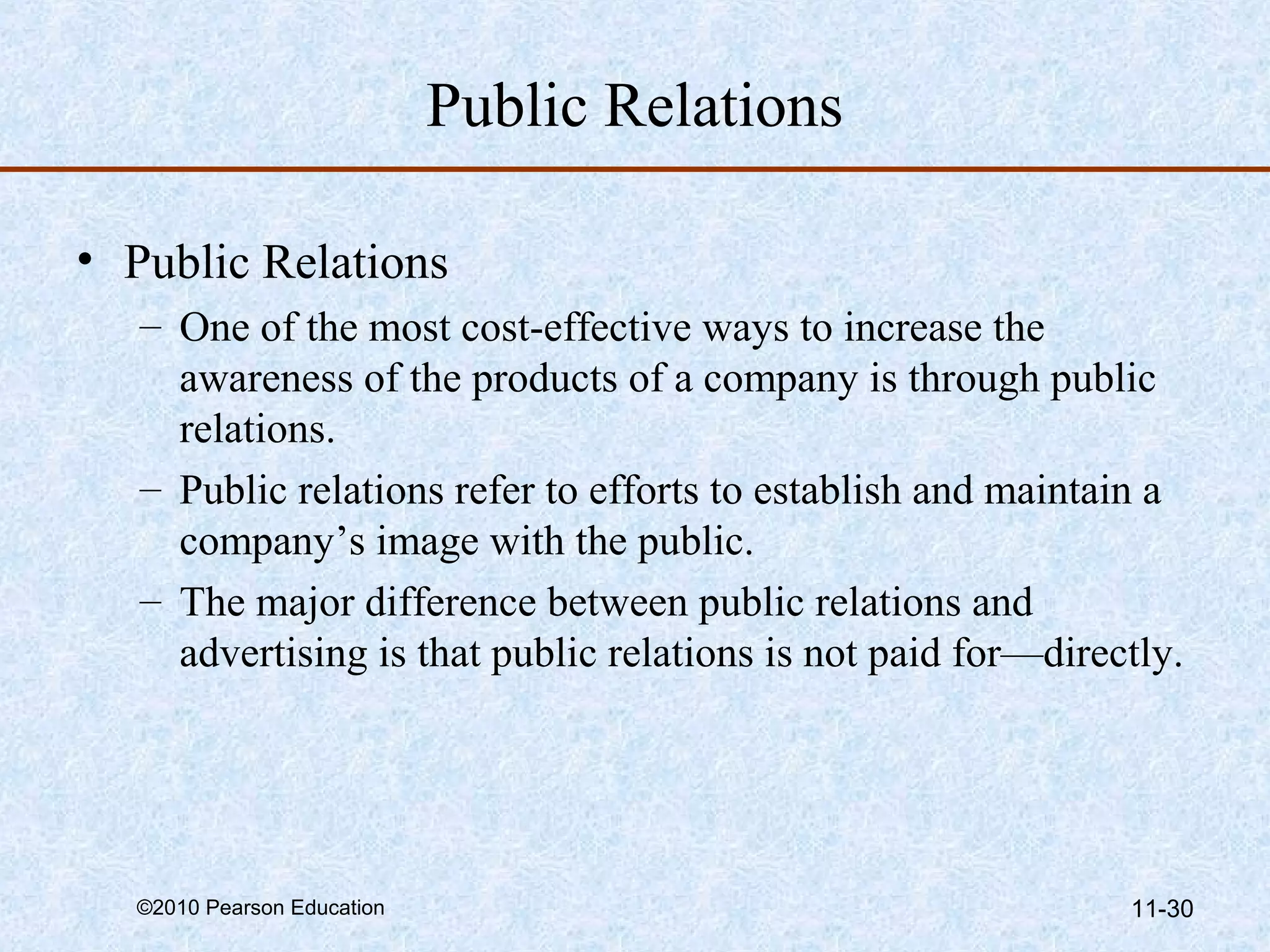
Public Relations

• Public Relations
   – One of the most cost-effective ways to increase the
     awareness of the products of a company is through public
     relations.
   – Public relations refer to efforts to establish and maintain a
     company’s image with the public.
   – The major difference between public relations and
     advertising is that public relations is not paid for—directly.


  ©2010 Pearson Education                                      11-30
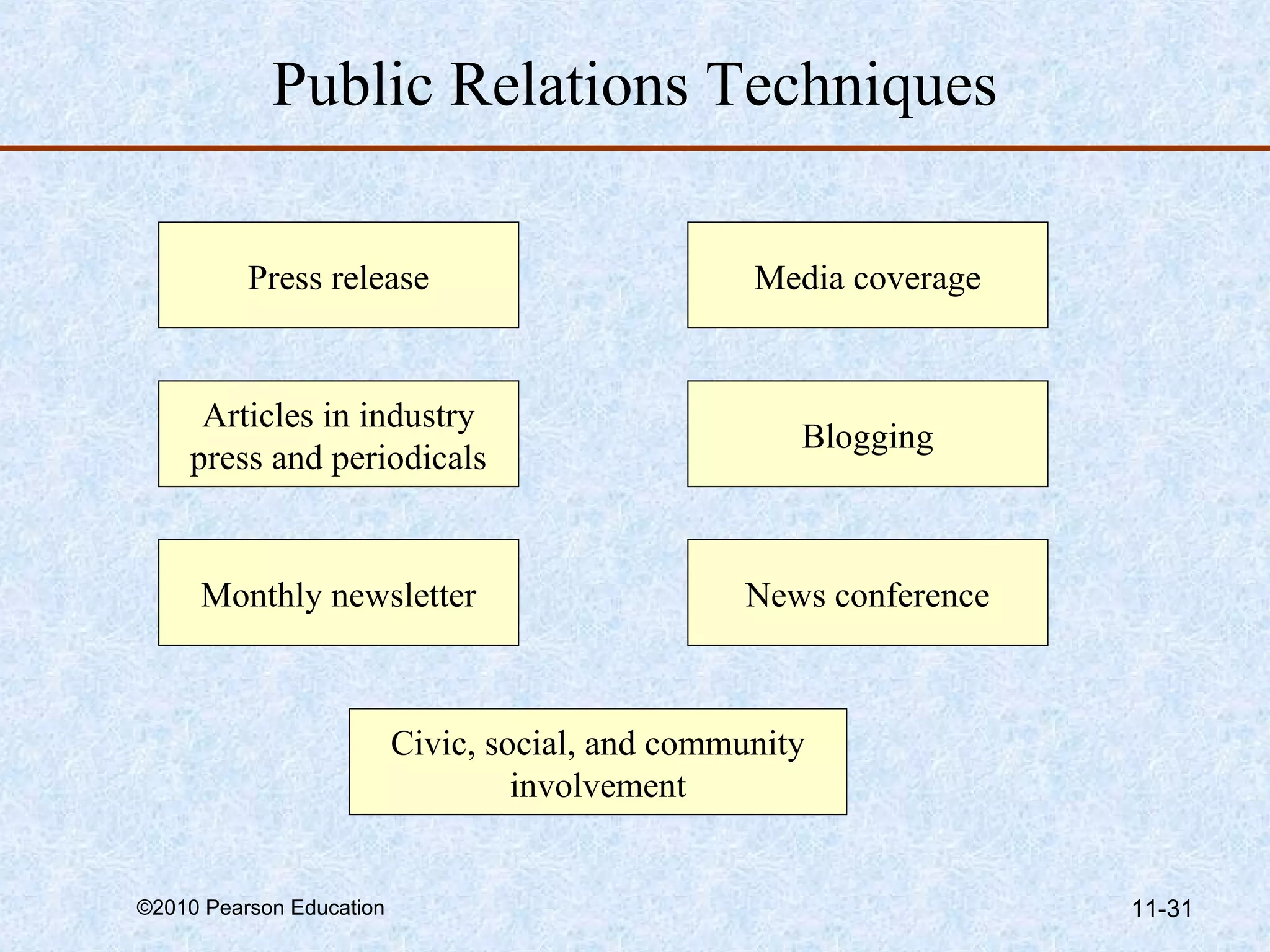
Public Relations Techniques

          Press release                           Media coverage


     Articles in industry
                                                     Blogging
    press and periodicals


     Monthly newsletter                          News conference


                          Civic, social, and community
                                   involvement


©2010 Pearson Education                                            11-31
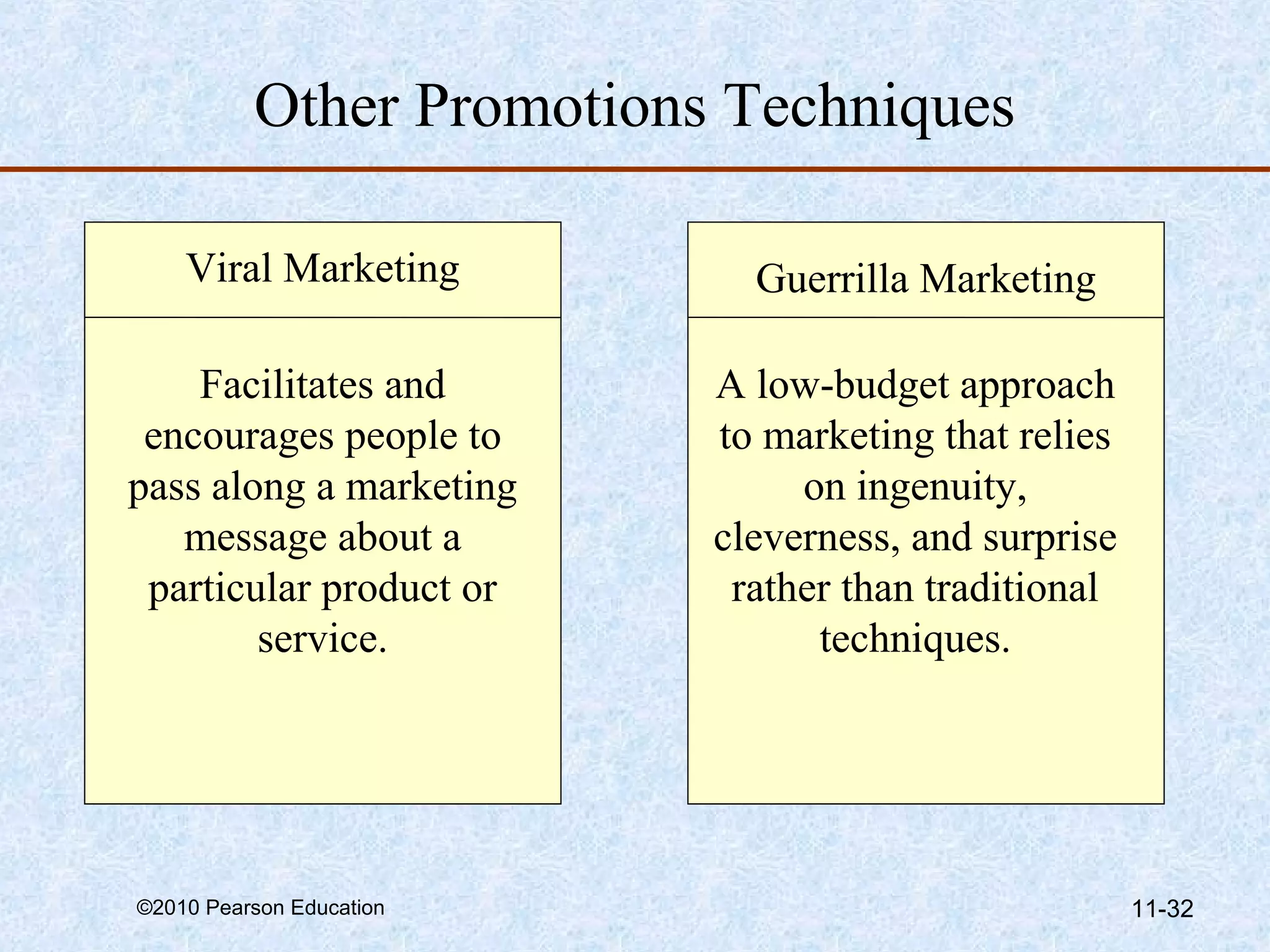
Other Promotions Techniques

    Viral Marketing         Guerrilla Marketing

    Facilitates and       A low-budget approach
 encourages people to     to marketing that relies
pass along a marketing         on ingenuity,
   message about a        cleverness, and surprise
 particular product or     rather than traditional
        service.                techniques.


©2010 Pearson Education                              11-32
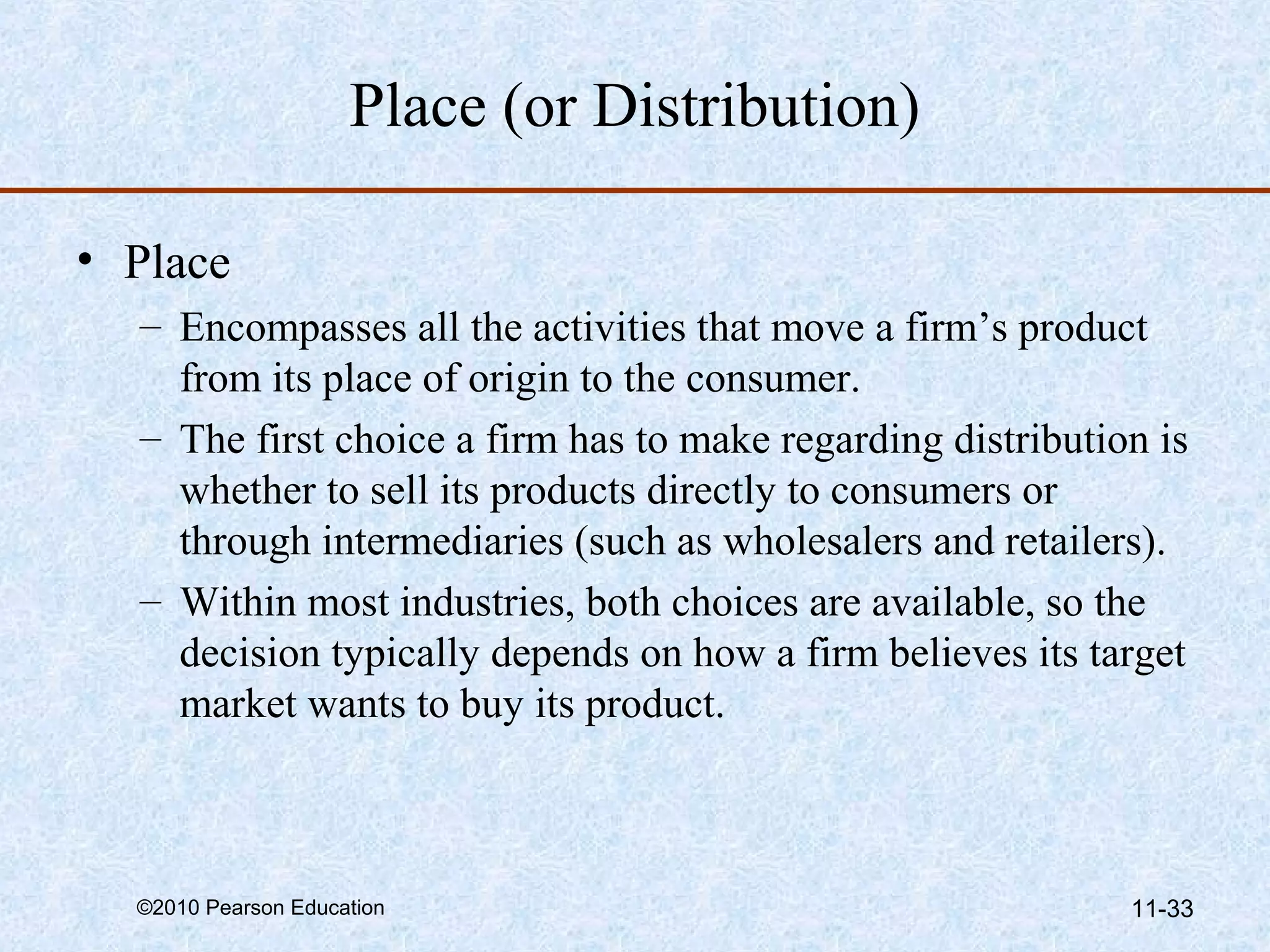
Place (or Distribution)

• Place
  – Encompasses all the activities that move a firm’s product
    from its place of origin to the consumer.
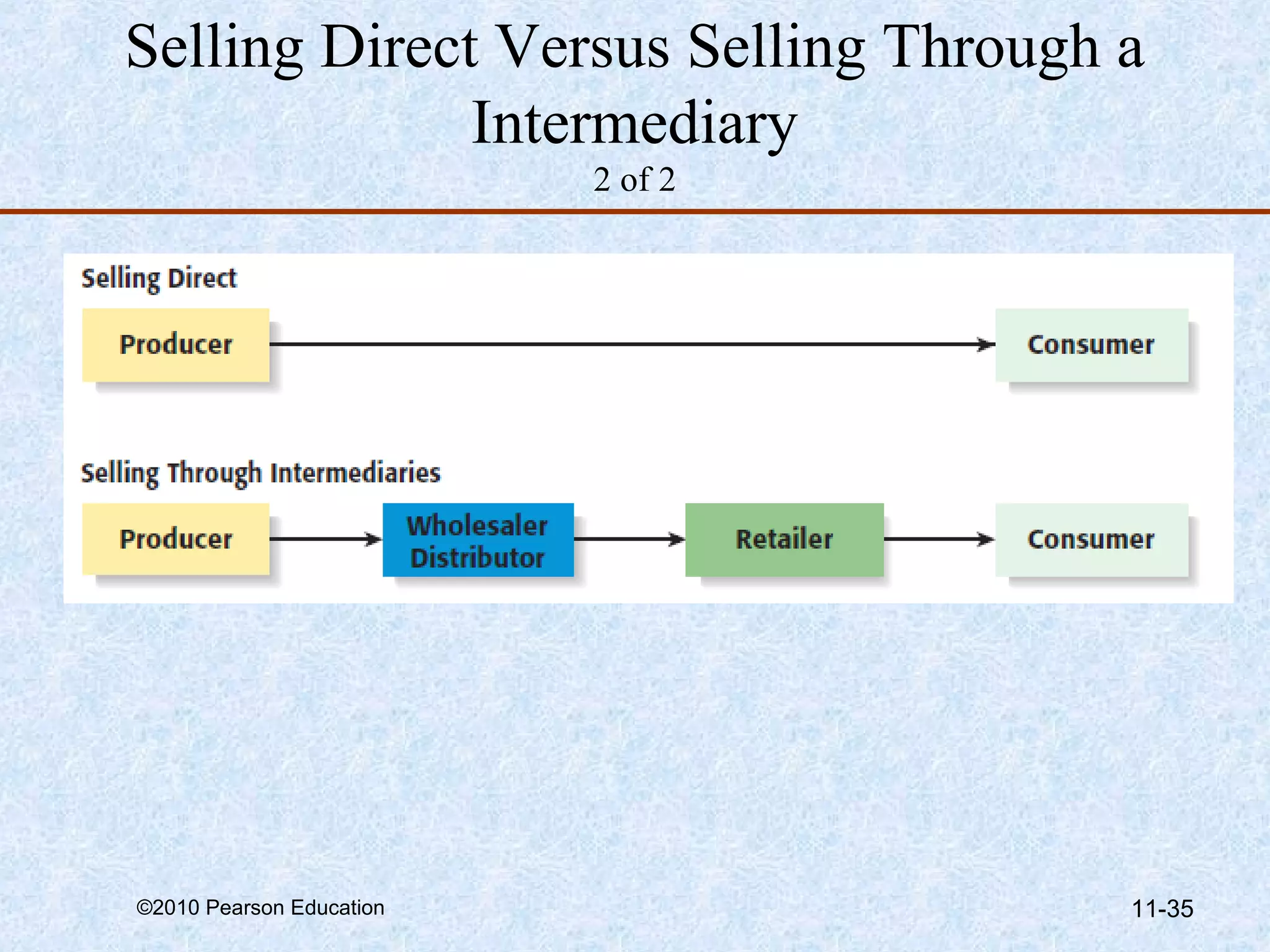
  – The first choice a firm has to make regarding distribution is
    whether to sell its products directly to consumers or
    through intermediaries (such as wholesalers and retailers).
  – Within most industries, both choices are available, so the
    decision typically depends on how a firm believes its target
    market wants to buy its product.


  ©2010 Pearson Education                                    11-33
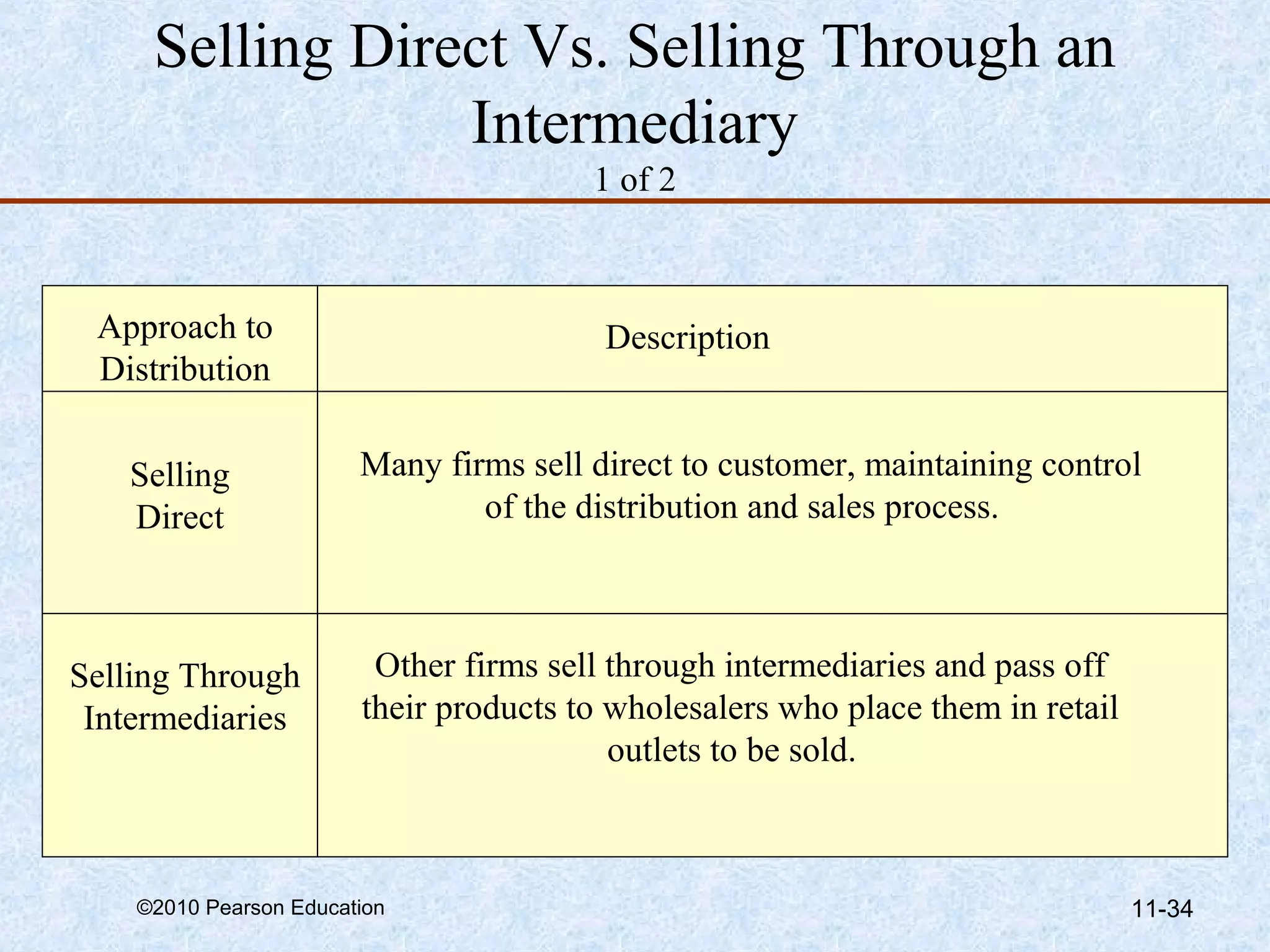
Selling Direct Vs. Selling Through an
                 Intermediary
                                        1 of 2


 Approach to                             Description
 Distribution


   Selling              Many firms sell direct to customer, maintaining control
   Direct                       of the distribution and sales process.


Selling Through          Other firms sell through intermediaries and pass off
 Intermediaries         their products to wholesalers who place them in retail
                                          outlets to be sold.


    ©2010 Pearson Education                                                      11-34
Selling Direct Versus Selling Through a
              Intermediary
                          2 of 2


©2010 Pearson Education               11-35
All rights reserved. No part of this publication may be reproduced,
  stored in a retrieval system, or transmitted, in any form or by any
means, electronic, mechanical, photocopying, recording, or otherwise,
 without the prior written permission of the publisher. Printed in the
                       United States of America.

      Copyright ©2010 Pearson Education, Inc.
         publishing as Pearson Education

  ©2010 Pearson Education

Barringer e3 ppt_11

  • 1.
    Chapter 11 Unique Marketing Issues Bruce R. Barringer R. Duane Ireland ©2010 Pearson Education 11-1
  • 2.
    Chapter Objectives 1 of 2 1. Explain the purpose of market segmentation. 2. Describe the importance of selecting a target market. 3. Explain why its important for a start-up to establish a unique position in its target market. 4. Describe the importance of the ability to position a company’s products on benefits rather than features. 5. Illustrate the two major ways in which a company builds a brand. ©2010 Pearson Education 6-2
  • 3.
    Chapter Objectives 2 of 2 6. Identify the four components of the marketing mix. 7. Explain the difference between a core product and an actual product. 8. Contrast cost-based pricing and value-based pricing. 9. Explain the differences between advertising and public relations. 10. Weigh the advantages and disadvantages of selling direct versus selling through intermediaries. ©2010 Pearson Education 11-3
  • 4.
    Selecting a Marketand Establishing a Position in the Market • Important Questions That All Startups Must Ask – In order to succeed, a new firm must address this important issue: Who are our customers are how will we appeal to them? – A well-managed start-up approaches this query by following a three-step process: • Segmenting the market. • Selecting a target market. • Establishing a unique position in the target market ©2010 Pearson Education 11-4
  • 5.
    The Process ofSelecting a Target Market and Positioning Strategy ©2010 Pearson Education 11-5
  • 6.
    Market Segmentation • Involves studying a firm’s industry and determining the different target markets in that industry. Segmenting the • Markets can be segmented in Market a number of different ways, including - Product type - Price point - Customers served ©2010 Pearson Education 3-6
  • 7.
    Example: Segmenting theComputer Industry by Product Type Netbooks Handheld Computers (new category) PCs Minicomputers Mainframes ©2010 Pearson Education 11-7
  • 8.
    Selecting a TargetMarket • Once a firm has segmented the market, a target market must be chosen. • The market must be sufficiently Target Market attractive and the firm must have the capability to serve it. • The Netbook segment of the computer industry is new, and is being targeted by startups like Eee PC. ©2010 Pearson Education 3-8
  • 9.
    Establishing a UniquePosition 1 of 2 • After selecting a target market, the firm’s next step is to establish a “position” within the market that Positioning differentiates it from its rivals. • A “position” is the part of a market that the firm is claiming as its own. • A firm establishing a unique position in its customers’ minds by drawing attention to two or three of the product’s attributes. ©2010 Pearson Education 3-9
  • 10.
    Establishing a UniquePosition 2 of 2 • Positioning (continued) – Firms often develop a “tagline” to reinforce the position they have staked out in their market, or a phrase that is used consistently in a company’s literature and thus becomes associated with the company. – An example is Nike’s familiar tagline, “Just do it.” • The beauty of this simple three-word expression is that it applies equally to a 21-year-old triathlete and a 65-year-old mall walker. ©2010 Pearson Education 11-10
  • 11.
    Taglines—Developed to Reinforcea Firm’s Positioning Strategy Match the Company to its Tagline Sure Girl ©2010 Pearson Education 11-11
  • 12.
    Product Attribute Map—Illustratesa Firm’s Positioning Strategy Relative to Rivals Curves International ©2010 Pearson Education 11-12
  • 13.
    Selling Benefits RatherThan Features 1 of 2 • Selling Benefits Rather Than Features – Many entrepreneur make the mistake of positioning their company’s products or services on features rather than benefits. – A positioning or marketing strategy that focuses on the features of a product, such as its technical merits, is usually much less effective than a campaign focusing on what the merits of the product can do. – Consider the example of the following slide. ©2010 Pearson Education 11-13
  • 14.
    Selling Benefits RatherThan Features 2 of 2 Two difference approaches to promoting a cell phone Approach Illustration “Our cell phones are equipped with sufficient Selling Features memory to store 1,000 phone numbers.” “Our cell phones let you store up to 1,000 phone numbers, Selling Benefits providing you access to the phone numbers of your family, friends, and business acquaintances instantly. The first statement tells a prospect how many phone numbers the cell phone will hold but doesn’t say why Conclusion that’s important. The second statement tells a prospect how buying the product will enhance his or her life or business. ©2010 Pearson Education 11-14
  • 15.
    Establishing a Brand 1 of 5 • Establishing a Brand – A brand is the set of attributes—positive or negative—that people associated with a company. • These attributes can be positive, such as trustworthy, dependable, or easy to deal with. • Or they can be negative, such as cheap, unreliable, or difficult to deal with. – The customer loyalty a company creates through its brand is one of its most valuable assets. • Brand Management – Some companies monitor the integrity of their brands through a program called “brand management.” ©2010 Pearson Education 11-15
  • 16.
    Establishing a Brand 2 of 5 Different Ways of Thinking About the Meaning of a Brand ©2010 Pearson Education 11-16
  • 17.
    Establishing a Brand 3 of 5 • Establishing a Brand – So how does a firm establish a brand? • On a philosophical level, a firm must have meaning in its customer’s lives. It must create value—something for which customers are willing to pay. • On a more practical level, brands are built through a number of techniques, including advertising, public relations, sponsorships, support of social causes, and good performance. • A firm’s name, logo, Web site design, and even its letterhead are part of its brand. ©2010 Pearson Education 11-17
  • 18.
    Establishing a Brand 4 of 5 • Power of a Strong Brand – Ultimately, a strong brand can be a very powerful asset for a firm. • Cobranding – A technique that companies use to strengthen their brands is to enter into a cobranding arrangements with other firms. – Cobranding refers to a relationship between two or more firms where the firm’s brands promote each another. ©2010 Pearson Education 11-18
  • 19.
    Establishing a Brand 5 of 5 • Zappos is a hot brand. • From the outset, Zappos’s CEO Tony Hsieh has worked hard to ensure that Zappos’s brand stands for competitive pricing, strong customer service, and a pleasant shopping experience. ©2010 Pearson Education 11-19
  • 20.
    The Four Psof Marketing for New Ventures Product Price Marketing Mix Promotion Place (or distribution) ©2010 Pearson Education 11-20
  • 21.
    Product • Product – Is the good or service a firm offers to its target market. – The initial rollout is one of the most critical times in the marketing of a new product. – All firms face the challenge that they are unknown and that it takes a leap of faith for the first customers to buy their products. • Some startups meet this challenge by using reference accounts. ©2010 Pearson Education 11-21
  • 22.
    Core Product vs.Actual Product Core Product Actual Product The product itself, such The product plus all the as an antivirus software attributes that come program. with it such as quality level, features, design, packaging, and warranty. ©2010 Pearson Education 11-22
  • 23.
    Price • Price – Price is the amount of money consumers pay to buy a product. – The price a company charges for its products sends an important message to its target market. • For example, Oakley positions its sunglasses as innovative, state- of-the-art products that are both high quality and visually appealing. • This position in the market suggests a premium price that Oakley charges. – Most entrepreneurs use one of two methods to set the price for their products, as shown on the next slide. ©2010 Pearson Education 11-23
  • 24.
    Core Product vs.Actual Product Cost-Based Pricing Value-Based Pricing The list price is The list price is determined by adding a determined by markup percentage to a estimating what product’s cost. consumers are will to pay for a product. ©2010 Pearson Education 11-24
  • 25.
    Promotion • Promotion – Refers to the activities the firm takes to communicate the merits of its product to its target market. – There are several common activities that entrepreneurs use to promote their products and services. • Advertising – Advertising is making people aware of a product or service in hopes of persuading them to buy it. ©2010 Pearson Education 11-25
  • 26.
    Pluses and Minusesof Advertising Pluses • Raise customer awareness of a product. • Explain a product’s comparative features and benefits. • Create associations between a product and a certain lifestyle. Minuses • Low credibility. • The possibility that a high percentage of people who see the add will not be interested . • Message clutter. • Relative costliness compared to other forms of promotion. • Intrusiveness. 11-26 ©2010 Pearson Education
  • 27.
    Steps Involved inPutting Together an Advertisement ©2010 Pearson Education 11-27
  • 28.
    Google AdWords andAdSense Program 1 of 2 • AdWords – Allows advertisers to buy keywords on the Google home page. – Triggers text-based ads to the side (and sometimes above) search results when the keyword is used. – The program includes local, national, and international distribution. – Advertisers pay a certain amount per click. – Advertisers benefit because they are able to place their ads in front of people who are already searching for information about their product. ©2010 Pearson Education 11-28
  • 29.
    Google AdWords andAdSense Program 2 of 2 • AdSense – Allows advertisers to buy ads that will be shown on other Web sites instead of Google’s home page. – Google selects sites of interest to the advertiser’s customers. – Advertisers are charged on a pay-per-click or a per- thousand impression basis. – Advertisers benefit because the content of the ad is often relevant to the Web site. – Web site owners benefit by using the service to monetize their Web site. ©2010 Pearson Education 11-29
  • 30.
    Public Relations • PublicRelations – One of the most cost-effective ways to increase the awareness of the products of a company is through public relations. – Public relations refer to efforts to establish and maintain a company’s image with the public. – The major difference between public relations and advertising is that public relations is not paid for—directly. ©2010 Pearson Education 11-30
  • 31.
    Public Relations Techniques Press release Media coverage Articles in industry Blogging press and periodicals Monthly newsletter News conference Civic, social, and community involvement ©2010 Pearson Education 11-31
  • 32.
    Other Promotions Techniques Viral Marketing Guerrilla Marketing Facilitates and A low-budget approach encourages people to to marketing that relies pass along a marketing on ingenuity, message about a cleverness, and surprise particular product or rather than traditional service. techniques. ©2010 Pearson Education 11-32
  • 33.
    Place (or Distribution) •Place – Encompasses all the activities that move a firm’s product from its place of origin to the consumer. – The first choice a firm has to make regarding distribution is whether to sell its products directly to consumers or through intermediaries (such as wholesalers and retailers). – Within most industries, both choices are available, so the decision typically depends on how a firm believes its target market wants to buy its product. ©2010 Pearson Education 11-33
  • 34.
    Selling Direct Vs.Selling Through an Intermediary 1 of 2 Approach to Description Distribution Selling Many firms sell direct to customer, maintaining control Direct of the distribution and sales process. Selling Through Other firms sell through intermediaries and pass off Intermediaries their products to wholesalers who place them in retail outlets to be sold. ©2010 Pearson Education 11-34
  • 35.
    Selling Direct VersusSelling Through a Intermediary 2 of 2 ©2010 Pearson Education 11-35
  • 36.
    All rights reserved.No part of this publication may be reproduced, stored in a retrieval system, or transmitted, in any form or by any means, electronic, mechanical, photocopying, recording, or otherwise, without the prior written permission of the publisher. Printed in the United States of America. Copyright ©2010 Pearson Education, Inc. publishing as Pearson Education ©2010 Pearson Education