EV682 Developing a positive learning environment - diversity
and inclusion
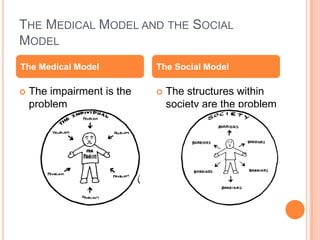
THE MEDICAL MODEL AND THE SOCIAL
MODEL
The Medical Model


The impairment is the
problem

The Social Model


The structures within
society are the problem
WHY CELEBRATE DIVERSITY, WHY ENSURE
EQUALITIES?
Support young children’s self esteem, identity and
confidence
 Address underachievement:
 Social inclusion-Full participation in society
 equality of access: encourage parent/carer and
community participation
 Encourage (self?)respect and citizenship




Poverty- Field, Allen review, Sure start etc
Some of

The Paperwork…
1981 Education Act
1988 Education Act
1989 UN Children’s Act
1993 Education Act
1994 SEN Code of Practice
1996 Education Act

2001 SEN Code
2002 DRC Code
2003 Excellence & Enjoyment
2004 Every Child Matters

2004: ‘Removing barriers to achievement’
2008:Framework for a Fairer Future
2010:The Equality Act
2011: Support and aspiration:
2012: Support and aspiration: progress and next
steps
NEW NATIONAL CURRICULUM INCLUSION
STATEMENT
Setting suitable challenges
 4.1 Teachers should set high expectations for every pupil.
They should plan stretching work for pupils whose
attainment is significantly above the expected standard.
They have an even greater obligation to plan lessons for
pupils who have low levels of prior attainment or come from
disadvantaged backgrounds. Teachers should use
appropriate assessment to set targets which are
deliberately ambitious.
Responding to pupils’ needs and overcoming potential
barriers for individuals and groups of pupils
 4.2 Teachers should take account of their duties under
equal opportunities legislation that covers
race, disability, sex, religion or belief, sexual
orientation, pregnancy and maternity, and gender
reassignment.
DEVELOPMENT MATTERS (2012)
“Children have a right, spelled out in the United Nations
Convention on the Rights of the Child, to provision
which enables them to develop their
personalities, talents and abilities irrespective of
ethnicity, culture or religion, home language, family
background, learning difficulties, disabilities or
gender.” p1
THE PUBLIC SECTOR EQUALITY DUTY


5.1 The Equality Act 2010 introduced a single Public Sector
Equality Duty (PSED) (sometimes also referred to as the
‘general duty’) that applies to public bodies, including
maintained schools and Academies, and which extends to all
protected characteristics - race, disability, sex, age, religion or
belief, sexual orientation, pregnancy and maternity and gender
reassignment. This combined equality duty came into effect in
April 2011. It has three main elements



Eliminate discrimination and other conduct that is prohibited by the
Act,
 Advance equality of opportunity between people who share a
protected characteristic and people who do not share it,
 Foster good relations across all characteristics - between people
who share a protected characteristic and people who do not share
it.
‘We will remove the bias towards
inclusion and propose to strengthen
parental choice by improving the range
and diversity of schools from which
parents can choose, making sure they
are aware of the options available to
them and by changing statutory
guidance for local authorities’.

•Single category of SEN
•Single assessment process
•Education, Health and Care plan
(statutory protection)
•More transparency for parents
•Personal budgets for parents (2014)
•Improve the range and diversity of
schools from which parents can
choose
Source: DfE (2011) Support and aspiration: A new approach to special educational needs and disability, [Online] Address:
http://www.education.gov.uk/publications/eOrderingDownload/Green-Paper-SEN.pdf (Access date: 10th March 2011)
WHERE DO WE STAND?
TEACHERS EXPECTATIONS
•
•

•
•
•

Teachers may not examine their own assumptions and
prejudices
Teachers are aware that equal opportunity and equality
issues are potentially explosive and may therefore ignore
them
Some teachers believe it is not their job to get involved
Teachers say they never hear children expressing racist
attitudes
Teachers believe certain children fit in well (Can still hold
generalised negative attitudes of a group of people)

Gaine (1995)
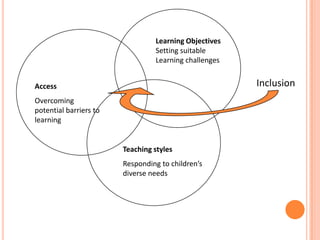
Learning Objectives
Setting suitable
Learning challenges

Inclusion

Access

Overcoming
potential barriers to
learning

Teaching styles
Responding to children’s
diverse needs
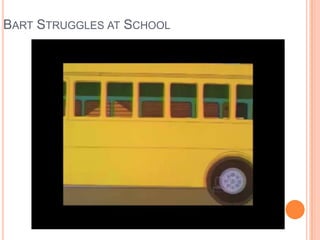
BART STRUGGLES AT SCHOOL
What

question does this raise
for you regarding inclusion?
What do you think are the key
messages coming from the
clip?
Have you seen practice like
this on placement?
‘Of course, diversity has implications that
reach beyond the classroom. Differences in
culture, gender, language and wealth shape
the totality of young lives. Sometimes these
differences appear closely connected with
educational success, but not all of them and
not for every child.’

(Alexander, 2010) p110.
BEAUTY AND THE BEAST


http://www.channel4.com/programmes/beauty-thebeast-ugly-face-of-prejudice/videos/all/judging-bylooks
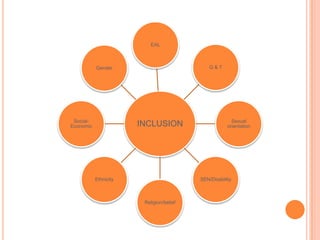
EAL

G&T

Gender

SocialEconomic

INCLUSION

Ethnicity

Sexual
orientation

SEN/Disability

Religion/belief
BARRIERS TO LEARNING AND
PARTICIPATION
Physical
 Psychological
 Social
 Cultural
 Environmental
 Who may be affected? How can these barriers be
removed/minimised?

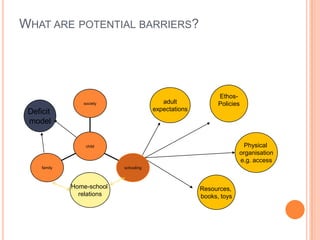
WHAT ARE POTENTIAL BARRIERS?

adult
expectations

society

Deficit
model

EthosPolicies

Physical
organisation
e.g. access

child

family

schooling

Home-school
relations

Resources,
books, toys
What is Inclusion?
Inclusive education describes the process by which a
school or setting attempts to respond to all children
as individuals by reconsidering and restructuring its
curricular organisation and provision and allocating
resources to enhance equality of opportunity.
Through this process, the school or setting builds its
capacity to accept all children from the local
community who wish to attend and in so
doing, reduces the need to exclude children.
Adapted from Sebba and Ainscow 1996

19
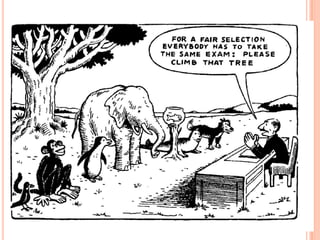
WAYS OF THINKING ABOUT ‘FAIR’ TREATMENT
People should be treated according to their merit
or what they deserve
 People should be treated according to what they
need
 Everyone should be treated equally and in the
same way


(see Smith, E. (2012) Key Issues in Education and
Social Justice. London: Sage, p7)
USEFUL RESOURCES FOR SUPPORTING THE
INCLUSION OF ALL LEARNERS INCLUDING
THOSE WITH

SEND

http://www.brighton.ac.uk/education/environment/reso
urces/sen.php?PageId=312
REFERENCES









Alexander, R. (Ed). (2010) Children, their World, their
Education: final report from the Cambridge Primary Review.
London: Routledge
Blair, M (2002) in Cole ‘Education for all’
Dunne, M. and Gazeley, L. http://www.incoeducation.co.uk/cms/cms_features_benefits/website_accessi
bility
Hodkinson, A. and Vickerman, P. (2009) Key Issues in Special
Educational Needs and Inclusion, London: Sage
Matheson, D. ed. (2008) An Introduction to the Study of
Education. 3rd ed. Oxon: Routledge
Thomas, G. and Loxley, A. (2001) Deconstructing Special
educational and Constructing Inclusion, Buckingham: Open
University
REFERENCES














http://www.deafnessatbirth.org.uk/content2/practice/know/04/content.pdf
www.dfee.gov.uk/sen
Multiverse web site
Ofsted website
Removing barriers to achievement: the government strategy for SEN
(DfES2004m)
Leading on inclusion (DfES 2005m)
Promoting inclusion and tackling underperformance (DfES 2005o)
Educational inequality (OFSTED 2000 HMI232
Bhattacharyya, Ison and Blair 2003 ‘Minority ethnic attainment and
participation in education and training: the evidence’ DfES
Malik, H (1998) A practical guide to Equal Opportunities
Mittler (2000) ‘working towards inclusive education’
(see Smith, E. (2012) Key Issues in Education and Social Justice.
London: Sage, p7)

EV682 Developing an Inclusive Learning Environment

  • 1.
    EV682 Developing apositive learning environment - diversity and inclusion
  • 2.
    THE MEDICAL MODELAND THE SOCIAL MODEL The Medical Model  The impairment is the problem The Social Model  The structures within society are the problem
  • 4.
    WHY CELEBRATE DIVERSITY,WHY ENSURE EQUALITIES? Support young children’s self esteem, identity and confidence  Address underachievement:  Social inclusion-Full participation in society  equality of access: encourage parent/carer and community participation  Encourage (self?)respect and citizenship   Poverty- Field, Allen review, Sure start etc
  • 5.
    Some of The Paperwork… 1981Education Act 1988 Education Act 1989 UN Children’s Act 1993 Education Act 1994 SEN Code of Practice 1996 Education Act 2001 SEN Code 2002 DRC Code 2003 Excellence & Enjoyment 2004 Every Child Matters 2004: ‘Removing barriers to achievement’ 2008:Framework for a Fairer Future 2010:The Equality Act 2011: Support and aspiration: 2012: Support and aspiration: progress and next steps
  • 6.
    NEW NATIONAL CURRICULUMINCLUSION STATEMENT Setting suitable challenges  4.1 Teachers should set high expectations for every pupil. They should plan stretching work for pupils whose attainment is significantly above the expected standard. They have an even greater obligation to plan lessons for pupils who have low levels of prior attainment or come from disadvantaged backgrounds. Teachers should use appropriate assessment to set targets which are deliberately ambitious. Responding to pupils’ needs and overcoming potential barriers for individuals and groups of pupils  4.2 Teachers should take account of their duties under equal opportunities legislation that covers race, disability, sex, religion or belief, sexual orientation, pregnancy and maternity, and gender reassignment.
  • 7.
    DEVELOPMENT MATTERS (2012) “Childrenhave a right, spelled out in the United Nations Convention on the Rights of the Child, to provision which enables them to develop their personalities, talents and abilities irrespective of ethnicity, culture or religion, home language, family background, learning difficulties, disabilities or gender.” p1
  • 8.
    THE PUBLIC SECTOREQUALITY DUTY  5.1 The Equality Act 2010 introduced a single Public Sector Equality Duty (PSED) (sometimes also referred to as the ‘general duty’) that applies to public bodies, including maintained schools and Academies, and which extends to all protected characteristics - race, disability, sex, age, religion or belief, sexual orientation, pregnancy and maternity and gender reassignment. This combined equality duty came into effect in April 2011. It has three main elements  Eliminate discrimination and other conduct that is prohibited by the Act,  Advance equality of opportunity between people who share a protected characteristic and people who do not share it,  Foster good relations across all characteristics - between people who share a protected characteristic and people who do not share it.
  • 9.
    ‘We will removethe bias towards inclusion and propose to strengthen parental choice by improving the range and diversity of schools from which parents can choose, making sure they are aware of the options available to them and by changing statutory guidance for local authorities’. •Single category of SEN •Single assessment process •Education, Health and Care plan (statutory protection) •More transparency for parents •Personal budgets for parents (2014) •Improve the range and diversity of schools from which parents can choose Source: DfE (2011) Support and aspiration: A new approach to special educational needs and disability, [Online] Address: http://www.education.gov.uk/publications/eOrderingDownload/Green-Paper-SEN.pdf (Access date: 10th March 2011)
  • 10.
    WHERE DO WESTAND? TEACHERS EXPECTATIONS • • • • • Teachers may not examine their own assumptions and prejudices Teachers are aware that equal opportunity and equality issues are potentially explosive and may therefore ignore them Some teachers believe it is not their job to get involved Teachers say they never hear children expressing racist attitudes Teachers believe certain children fit in well (Can still hold generalised negative attitudes of a group of people) Gaine (1995)
  • 11.
    Learning Objectives Setting suitable Learningchallenges Inclusion Access Overcoming potential barriers to learning Teaching styles Responding to children’s diverse needs
  • 12.
  • 13.
    BART STRUGGLES ATSCHOOL What question does this raise for you regarding inclusion? What do you think are the key messages coming from the clip? Have you seen practice like this on placement?
  • 14.
    ‘Of course, diversityhas implications that reach beyond the classroom. Differences in culture, gender, language and wealth shape the totality of young lives. Sometimes these differences appear closely connected with educational success, but not all of them and not for every child.’ (Alexander, 2010) p110.
  • 15.
    BEAUTY AND THEBEAST  http://www.channel4.com/programmes/beauty-thebeast-ugly-face-of-prejudice/videos/all/judging-bylooks
  • 16.
  • 17.
    BARRIERS TO LEARNINGAND PARTICIPATION Physical  Psychological  Social  Cultural  Environmental  Who may be affected? How can these barriers be removed/minimised? 
  • 18.
    WHAT ARE POTENTIALBARRIERS? adult expectations society Deficit model EthosPolicies Physical organisation e.g. access child family schooling Home-school relations Resources, books, toys
  • 19.
    What is Inclusion? Inclusiveeducation describes the process by which a school or setting attempts to respond to all children as individuals by reconsidering and restructuring its curricular organisation and provision and allocating resources to enhance equality of opportunity. Through this process, the school or setting builds its capacity to accept all children from the local community who wish to attend and in so doing, reduces the need to exclude children. Adapted from Sebba and Ainscow 1996 19
  • 20.
    WAYS OF THINKINGABOUT ‘FAIR’ TREATMENT People should be treated according to their merit or what they deserve  People should be treated according to what they need  Everyone should be treated equally and in the same way  (see Smith, E. (2012) Key Issues in Education and Social Justice. London: Sage, p7)
  • 21.
    USEFUL RESOURCES FORSUPPORTING THE INCLUSION OF ALL LEARNERS INCLUDING THOSE WITH SEND http://www.brighton.ac.uk/education/environment/reso urces/sen.php?PageId=312
  • 22.
    REFERENCES       Alexander, R. (Ed).(2010) Children, their World, their Education: final report from the Cambridge Primary Review. London: Routledge Blair, M (2002) in Cole ‘Education for all’ Dunne, M. and Gazeley, L. http://www.incoeducation.co.uk/cms/cms_features_benefits/website_accessi bility Hodkinson, A. and Vickerman, P. (2009) Key Issues in Special Educational Needs and Inclusion, London: Sage Matheson, D. ed. (2008) An Introduction to the Study of Education. 3rd ed. Oxon: Routledge Thomas, G. and Loxley, A. (2001) Deconstructing Special educational and Constructing Inclusion, Buckingham: Open University
  • 23.
    REFERENCES             http://www.deafnessatbirth.org.uk/content2/practice/know/04/content.pdf www.dfee.gov.uk/sen Multiverse web site Ofstedwebsite Removing barriers to achievement: the government strategy for SEN (DfES2004m) Leading on inclusion (DfES 2005m) Promoting inclusion and tackling underperformance (DfES 2005o) Educational inequality (OFSTED 2000 HMI232 Bhattacharyya, Ison and Blair 2003 ‘Minority ethnic attainment and participation in education and training: the evidence’ DfES Malik, H (1998) A practical guide to Equal Opportunities Mittler (2000) ‘working towards inclusive education’ (see Smith, E. (2012) Key Issues in Education and Social Justice. London: Sage, p7)

Editor's Notes

  • #3 This is one model and can be applied to all children in respect of race , gender, SEND etcThe medical model implies that there is something wrong with the individual, that the individual can be fixed.The social model implies that there are barriers to be overcome so that all individuals can function well in society.And this leads us to a rights based approach rather than a charity based approach.We’re going to look very briefly at the History of Inclusion and I’d like you to consider what model each of these key point sin history reflects.Legislation reflects the move from medical to social and back to medical ie parents hold budgets to buy services child needs – focus back on child not environment
  • #8 Non-discrimination (Article 2): The Convention applies to all children, whatever their race, religion or abilities; whatever they think or say, whatever type of family they come from. It doesn’t matter where children live, what language they speak, what their parents do, whether they are boys or girls, what their culture is, whether they have a disability or whether they are rich or poor. No child should be treated unfairly on any basis.
  • #9 Consider the apparent Move backwards as reflected in ‘eliminate ‘ when previous legislation moved towards ‘promoting inclusion and diversity ’
  • #10 The Green Paper states that life chances for the approx two million children and young people in England who are identified as having a special educational need (SEN), or who are disabled, are disproportionately poor.
  • #12 Or we can see it like thisLearning objective – what do we want the child to learn?Access – how is the child going to access this learning?Teaching style – how can I adapt my pedagogy to support the child’s learning?
  • #22 SoE web area. An excellent resource. Could be very useful to support school based work.