Meeting the Palliative Needs of
Children, Young People and their
Families
Barbara Gelb OBE
Chief Executive
Together for Short Lives
Choice and Children’s Palliative Care
• We estimate there are 49,000 (and growing) children and young
people across the UK with life shortening conditions.
• That’s approximately one child in every secondary school
• This ‘patient’ voice is too often not heard or listened to and therefore
‘patient’ choice is too often absent.
• Through my eyes:
https://www.youtube.com/watch?v=Ghof4Xjzs2s#action=share
Choice can be overwhelming &
underdelivered
“It’s a minefield and you get frightened going through it. Services don’t
join up and people don’t explain things to you. By the time I had made it
all fit together, my child had passed away.”
“That makes me sad that he could have had so much more out of life.”
Parent carer of a child who needed palliative care
Can you choose to rest? Short
breaks
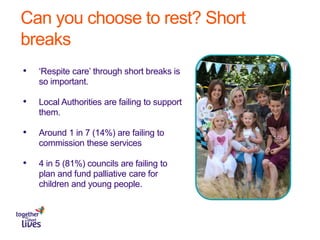
• ‘Respite care’ through short breaks is
so important.
• Local Authorities are failing to support
them.
• Around 1 in 7 (14%) are failing to
commission these services
• 4 in 5 (81%) councils are failing to
plan and fund palliative care for
children and young people.
Funding Choice
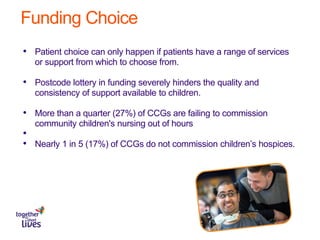
• Patient choice can only happen if patients have a range of services
or support from which to choose from.
• Postcode lottery in funding severely hinders the quality and
consistency of support available to children.
• More than a quarter (27%) of CCGs are failing to commission
community children's nursing out of hours
•
• Nearly 1 in 5 (17%) of CCGs do not commission children’s hospices.
Choice in death
Having end of life care available where
it is wanted – home, hospice or hospital
– everyone makes choices in different
ways.
Choice to be on the move
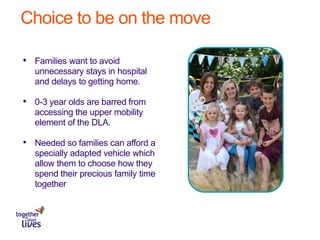
• Families want to avoid
unnecessary stays in hospital
and delays to getting home.
• 0-3 year olds are barred from
accessing the upper mobility
element of the DLA.
• Needed so families can afford a
specially adapted vehicle which
allow them to choose how they
spend their precious family time
together
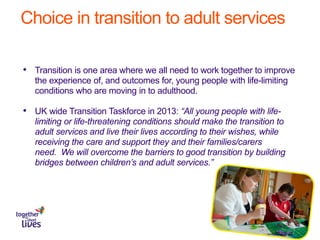
Choice in transition to adult services
• Transition is one area where we all need to work together to improve
the experience of, and outcomes for, young people with life-limiting
conditions who are moving in to adulthood.
• UK wide Transition Taskforce in 2013: “All young people with life-
limiting or life-threatening conditions should make the transition to
adult services and live their lives according to their wishes, while
receiving the care and support they and their families/carers
need. We will overcome the barriers to good transition by building
bridges between children’s and adult services.”
Government’s response to the
Review of Choice at End of Life.
“To support high quality personalised care for children and young
people, commissioners and providers of services must prioritise
children's palliative care in their strategic planning so that services can
work together seamlessly and advance care planning can be shared
and acted upon.
Commissioners should also consider how they can structure services
that offer accessible, high quality respite and bereavement support for
children and their families. In the case of maternity and neonatal
services, hospitals should ensure they are providing the right facilities
and staff with the right skills to provide emotional and psychological
support, as well as privacy and
compassion when a child dies.”
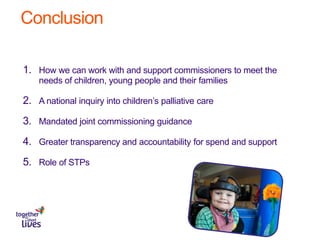
Conclusion
1. How we can work with and support commissioners to meet the
needs of children, young people and their families
2. A national inquiry into children’s palliative care
3. Mandated joint commissioning guidance
4. Greater transparency and accountability for spend and support
5. Role of STPs
Kath Sutherland
Equalities Consultant and
Founder,
START Ability Services
Presented by: Kath Sutherland
Equalities Consultant and Founder,
START Ability Services
 Effective person centred support is about society’s approach to
providing solutions to remove the barriers that people with
palliative needs or who are at the end of life, and their families,
face.
 This can only be achieved through responsive, co-ordinated
services and partnership working, based on the principles of co-
production.
 It requires a societal response that effectively and appropriately:
o considers the needs, wishes and personal circumstances of
individuals who are at end of life and their informal caregivers.
o effectively utilises available local and community resources.
o addresses the impact on currently available resources within
the health and social care sector.
o invests future resource allocation in both proven methods that
effectively support people at the end of life, their families and
communities, as well as on health and social care research, and
implementation support and training.
START Ability Services 2016
Attitudinal Barriers
 Work on assumptions and use stereotypes.
 Fail to treat people on an equitable basis – ‘one size fits all’.
 Go along with 'the Society of Perfection‘, which does not exist!
 Can often create dependence.
These barriers result in:
1. inappropriate information and support provision, based on
‘loss’ (of function, ability, skills, capacity and self identity);
2. a lack of timely information, so that people can make
informed choices as needs and circumstances change;
3. fragmented reactive services, rather than co-ordinated and
proactive services;
4. more use of costly intensive support services because of
breakdowns in informal care and support networks.
START Ability Services 2016
Environmental Barriers
 Prevent free movement from place to place.
 Prevent free physical access to buildings.
 Prevent free movement within buildings.
 Prevent equal access to services or information.
Perceived cost implications, of ensuring access for all, is often used
as a reason to exclude people.
Organisational Barriers
On a local basis, may include policies and/or practices which:
 fail to reasonably accommodate difference; and
 exclude people.
On a national basis:
 policies and regulations unthinkingly applied;
 policies and regulations that are difficult to navigate or
understand.
START Ability Services 2016
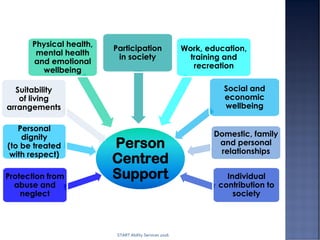
Person
Centred
SupportProtection from
abuse and
neglect
Personal
dignity
(to be treated
with respect)
Suitability
of living
arrangements
Physical health,
mental health
and emotional
wellbeing
Participation
in society
Work, education,
training and
recreation
Social and
economic
wellbeing
Domestic, family
and personal
relationships
Individual
contribution to
society
START Ability Services 2016
Reframing our thinking about end of life and palliative support
needs leads to:
 tools and strategies that facilitate co-production and improved
partnership working;
 accessible information that enables people and their informal
caregivers to make informed decisions about current and any
future support needs;
 tools and strategies that facilitate independence;
 informed decision making, based on shared knowledge of
resources and all aspects of wellbeing for individuals; and
 holistic solutions that meet the needs of individuals and their
informal support networks, in a more cost-effective manner.
START Ability Services 2016
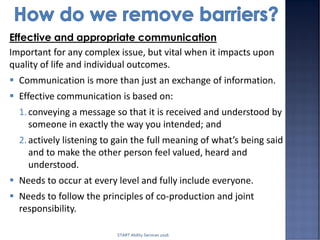
Effective and appropriate communication
Important for any complex issue, but vital when it impacts upon
quality of life and individual outcomes.
 Communication is more than just an exchange of information.
 Effective communication is based on:
1.conveying a message so that it is received and understood by
someone in exactly the way you intended; and
2.actively listening to gain the full meaning of what’s being said
and to make the other person feel valued, heard and
understood.
 Needs to occur at every level and fully include everyone.
 Needs to follow the principles of co-production and joint
responsibility.
START Ability Services 2016
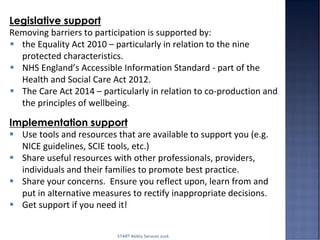
Legislative support
Removing barriers to participation is supported by:
 the Equality Act 2010 – particularly in relation to the nine
protected characteristics.
 NHS England’s Accessible Information Standard - part of the
Health and Social Care Act 2012.
 The Care Act 2014 – particularly in relation to co-production and
the principles of wellbeing.
Implementation support
 Use tools and resources that are available to support you (e.g.
NICE guidelines, SCIE tools, etc.)
 Share useful resources with other professionals, providers,
individuals and their families to promote best practice.
 Share your concerns. Ensure you reflect upon, learn from and
put in alternative measures to rectify inappropriate decisions.
 Get support if you need it!
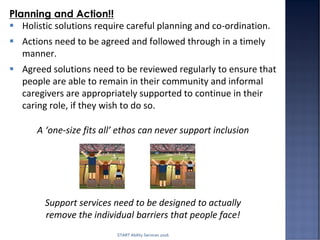
A ‘one-size fits all’ ethos can never support inclusion
Support services need to be designed to actually
remove the individual barriers that people face!
Planning and Action!!
 Holistic solutions require careful planning and co-ordination.
 Actions need to be agreed and followed through in a timely
manner.
 Agreed solutions need to be reviewed regularly to ensure that
people are able to remain in their community and informal
caregivers are appropriately supported to continue in their
caring role, if they wish to do so.
START Ability Services 2016
1.People are all individuals. They have individual needs, wishes,
aspirations and unique abilities... And this should always be
reflected in their support.
Actions, policies, procedures or systems must facilitate
individualised solutions.
2.The way we talk about an issue affects the way we think about
and respond to that issue.
Think about the way in which you describe people who are at
the end of their life.
3.Providing effective support can cost very little. But, you need
to consider minimising the impact of barriers.
Identify the barriers that are faced and ensure systems minimise
the impact.
START Ability Services 2016
If you would like more information, please don’t
hesitate to contact us:
Main Office: 01204 480075
Email: start.ability@ntlworld.com
Skype: start.ability
Website: www.startability.org.uk
Twitter: @StartAbility
START Ability Services 2016

Barbara Gelb

  • 1.
    Meeting the PalliativeNeeds of Children, Young People and their Families Barbara Gelb OBE Chief Executive Together for Short Lives
  • 2.
    Choice and Children’sPalliative Care • We estimate there are 49,000 (and growing) children and young people across the UK with life shortening conditions. • That’s approximately one child in every secondary school • This ‘patient’ voice is too often not heard or listened to and therefore ‘patient’ choice is too often absent. • Through my eyes: https://www.youtube.com/watch?v=Ghof4Xjzs2s#action=share
  • 3.
    Choice can beoverwhelming & underdelivered “It’s a minefield and you get frightened going through it. Services don’t join up and people don’t explain things to you. By the time I had made it all fit together, my child had passed away.” “That makes me sad that he could have had so much more out of life.” Parent carer of a child who needed palliative care
  • 4.
    Can you chooseto rest? Short breaks • ‘Respite care’ through short breaks is so important. • Local Authorities are failing to support them. • Around 1 in 7 (14%) are failing to commission these services • 4 in 5 (81%) councils are failing to plan and fund palliative care for children and young people.
  • 5.
    Funding Choice • Patientchoice can only happen if patients have a range of services or support from which to choose from. • Postcode lottery in funding severely hinders the quality and consistency of support available to children. • More than a quarter (27%) of CCGs are failing to commission community children's nursing out of hours • • Nearly 1 in 5 (17%) of CCGs do not commission children’s hospices.
  • 6.
    Choice in death Havingend of life care available where it is wanted – home, hospice or hospital – everyone makes choices in different ways.
  • 7.
    Choice to beon the move • Families want to avoid unnecessary stays in hospital and delays to getting home. • 0-3 year olds are barred from accessing the upper mobility element of the DLA. • Needed so families can afford a specially adapted vehicle which allow them to choose how they spend their precious family time together
  • 8.
    Choice in transitionto adult services • Transition is one area where we all need to work together to improve the experience of, and outcomes for, young people with life-limiting conditions who are moving in to adulthood. • UK wide Transition Taskforce in 2013: “All young people with life- limiting or life-threatening conditions should make the transition to adult services and live their lives according to their wishes, while receiving the care and support they and their families/carers need. We will overcome the barriers to good transition by building bridges between children’s and adult services.”
  • 9.
    Government’s response tothe Review of Choice at End of Life. “To support high quality personalised care for children and young people, commissioners and providers of services must prioritise children's palliative care in their strategic planning so that services can work together seamlessly and advance care planning can be shared and acted upon. Commissioners should also consider how they can structure services that offer accessible, high quality respite and bereavement support for children and their families. In the case of maternity and neonatal services, hospitals should ensure they are providing the right facilities and staff with the right skills to provide emotional and psychological support, as well as privacy and compassion when a child dies.”
  • 10.
    Conclusion 1. How wecan work with and support commissioners to meet the needs of children, young people and their families 2. A national inquiry into children’s palliative care 3. Mandated joint commissioning guidance 4. Greater transparency and accountability for spend and support 5. Role of STPs
  • 11.
    Kath Sutherland Equalities Consultantand Founder, START Ability Services
  • 12.
    Presented by: KathSutherland Equalities Consultant and Founder, START Ability Services
  • 13.
     Effective personcentred support is about society’s approach to providing solutions to remove the barriers that people with palliative needs or who are at the end of life, and their families, face.  This can only be achieved through responsive, co-ordinated services and partnership working, based on the principles of co- production.  It requires a societal response that effectively and appropriately: o considers the needs, wishes and personal circumstances of individuals who are at end of life and their informal caregivers. o effectively utilises available local and community resources. o addresses the impact on currently available resources within the health and social care sector. o invests future resource allocation in both proven methods that effectively support people at the end of life, their families and communities, as well as on health and social care research, and implementation support and training. START Ability Services 2016
  • 14.
  • 15.
    Attitudinal Barriers  Workon assumptions and use stereotypes.  Fail to treat people on an equitable basis – ‘one size fits all’.  Go along with 'the Society of Perfection‘, which does not exist!  Can often create dependence. These barriers result in: 1. inappropriate information and support provision, based on ‘loss’ (of function, ability, skills, capacity and self identity); 2. a lack of timely information, so that people can make informed choices as needs and circumstances change; 3. fragmented reactive services, rather than co-ordinated and proactive services; 4. more use of costly intensive support services because of breakdowns in informal care and support networks. START Ability Services 2016
  • 16.
    Environmental Barriers  Preventfree movement from place to place.  Prevent free physical access to buildings.  Prevent free movement within buildings.  Prevent equal access to services or information. Perceived cost implications, of ensuring access for all, is often used as a reason to exclude people. Organisational Barriers On a local basis, may include policies and/or practices which:  fail to reasonably accommodate difference; and  exclude people. On a national basis:  policies and regulations unthinkingly applied;  policies and regulations that are difficult to navigate or understand. START Ability Services 2016
  • 17.
    Person Centred SupportProtection from abuse and neglect Personal dignity (tobe treated with respect) Suitability of living arrangements Physical health, mental health and emotional wellbeing Participation in society Work, education, training and recreation Social and economic wellbeing Domestic, family and personal relationships Individual contribution to society START Ability Services 2016
  • 18.
    Reframing our thinkingabout end of life and palliative support needs leads to:  tools and strategies that facilitate co-production and improved partnership working;  accessible information that enables people and their informal caregivers to make informed decisions about current and any future support needs;  tools and strategies that facilitate independence;  informed decision making, based on shared knowledge of resources and all aspects of wellbeing for individuals; and  holistic solutions that meet the needs of individuals and their informal support networks, in a more cost-effective manner. START Ability Services 2016
  • 19.
    Effective and appropriatecommunication Important for any complex issue, but vital when it impacts upon quality of life and individual outcomes.  Communication is more than just an exchange of information.  Effective communication is based on: 1.conveying a message so that it is received and understood by someone in exactly the way you intended; and 2.actively listening to gain the full meaning of what’s being said and to make the other person feel valued, heard and understood.  Needs to occur at every level and fully include everyone.  Needs to follow the principles of co-production and joint responsibility. START Ability Services 2016
  • 20.
    START Ability Services2016 Legislative support Removing barriers to participation is supported by:  the Equality Act 2010 – particularly in relation to the nine protected characteristics.  NHS England’s Accessible Information Standard - part of the Health and Social Care Act 2012.  The Care Act 2014 – particularly in relation to co-production and the principles of wellbeing. Implementation support  Use tools and resources that are available to support you (e.g. NICE guidelines, SCIE tools, etc.)  Share useful resources with other professionals, providers, individuals and their families to promote best practice.  Share your concerns. Ensure you reflect upon, learn from and put in alternative measures to rectify inappropriate decisions.  Get support if you need it!
  • 21.
    A ‘one-size fitsall’ ethos can never support inclusion Support services need to be designed to actually remove the individual barriers that people face! Planning and Action!!  Holistic solutions require careful planning and co-ordination.  Actions need to be agreed and followed through in a timely manner.  Agreed solutions need to be reviewed regularly to ensure that people are able to remain in their community and informal caregivers are appropriately supported to continue in their caring role, if they wish to do so. START Ability Services 2016
  • 22.
    1.People are allindividuals. They have individual needs, wishes, aspirations and unique abilities... And this should always be reflected in their support. Actions, policies, procedures or systems must facilitate individualised solutions. 2.The way we talk about an issue affects the way we think about and respond to that issue. Think about the way in which you describe people who are at the end of their life. 3.Providing effective support can cost very little. But, you need to consider minimising the impact of barriers. Identify the barriers that are faced and ensure systems minimise the impact. START Ability Services 2016
  • 23.
    If you wouldlike more information, please don’t hesitate to contact us: Main Office: 01204 480075 Email: start.ability@ntlworld.com Skype: start.ability Website: www.startability.org.uk Twitter: @StartAbility START Ability Services 2016