141
The Open-Source Approach for
Computational Modeling and Simulation
for Earthquake Engineering: History,
Accomplishments, and Future Needs
.4
Gregory L. Fenves
¿
Cockrell School of Engineering
The University of Texas at Austin
1!Tih, 1 .....- •i
E
National Autonomous University of Mexico
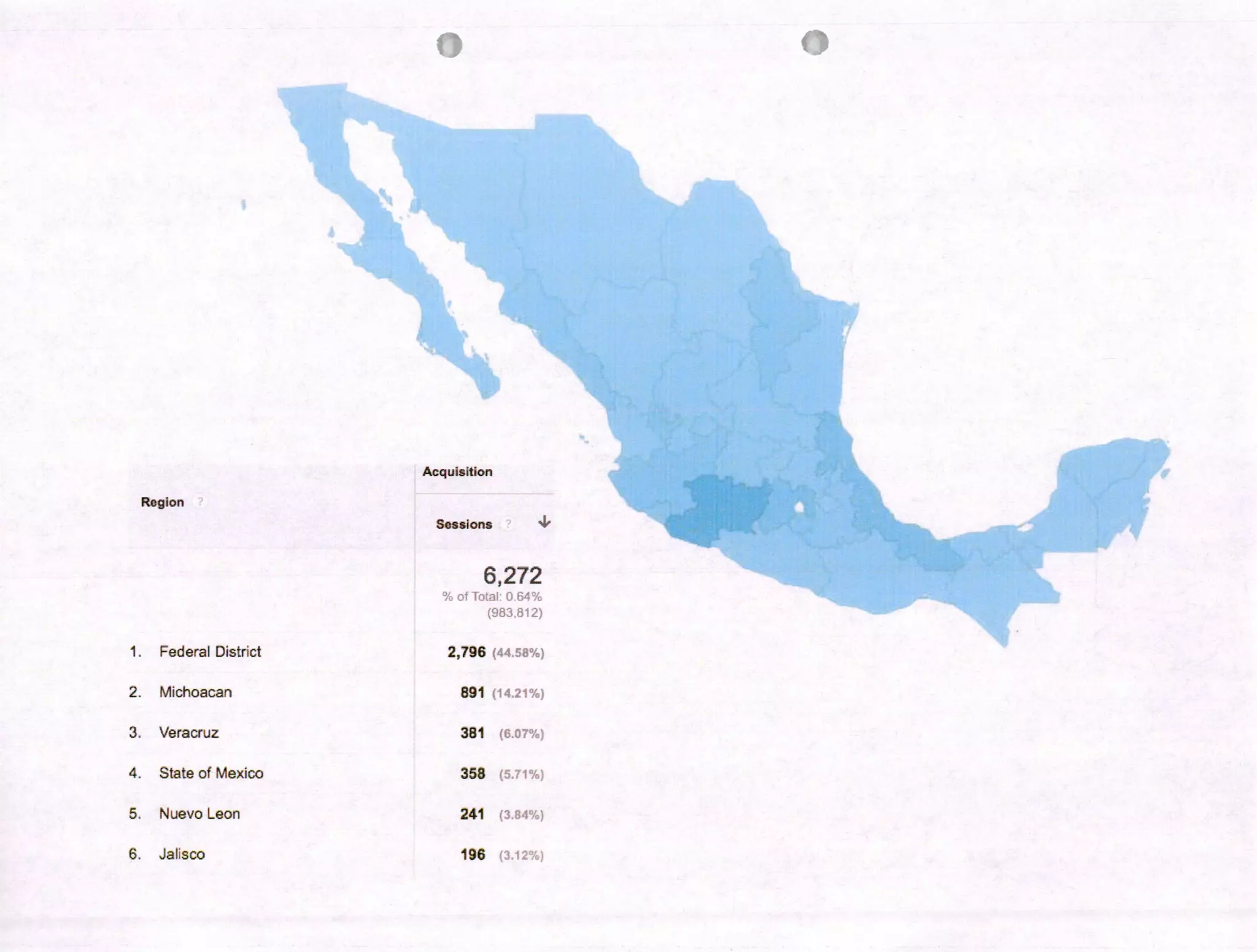
Mexíco City, Feb. 5, 2015 c
- i) i]
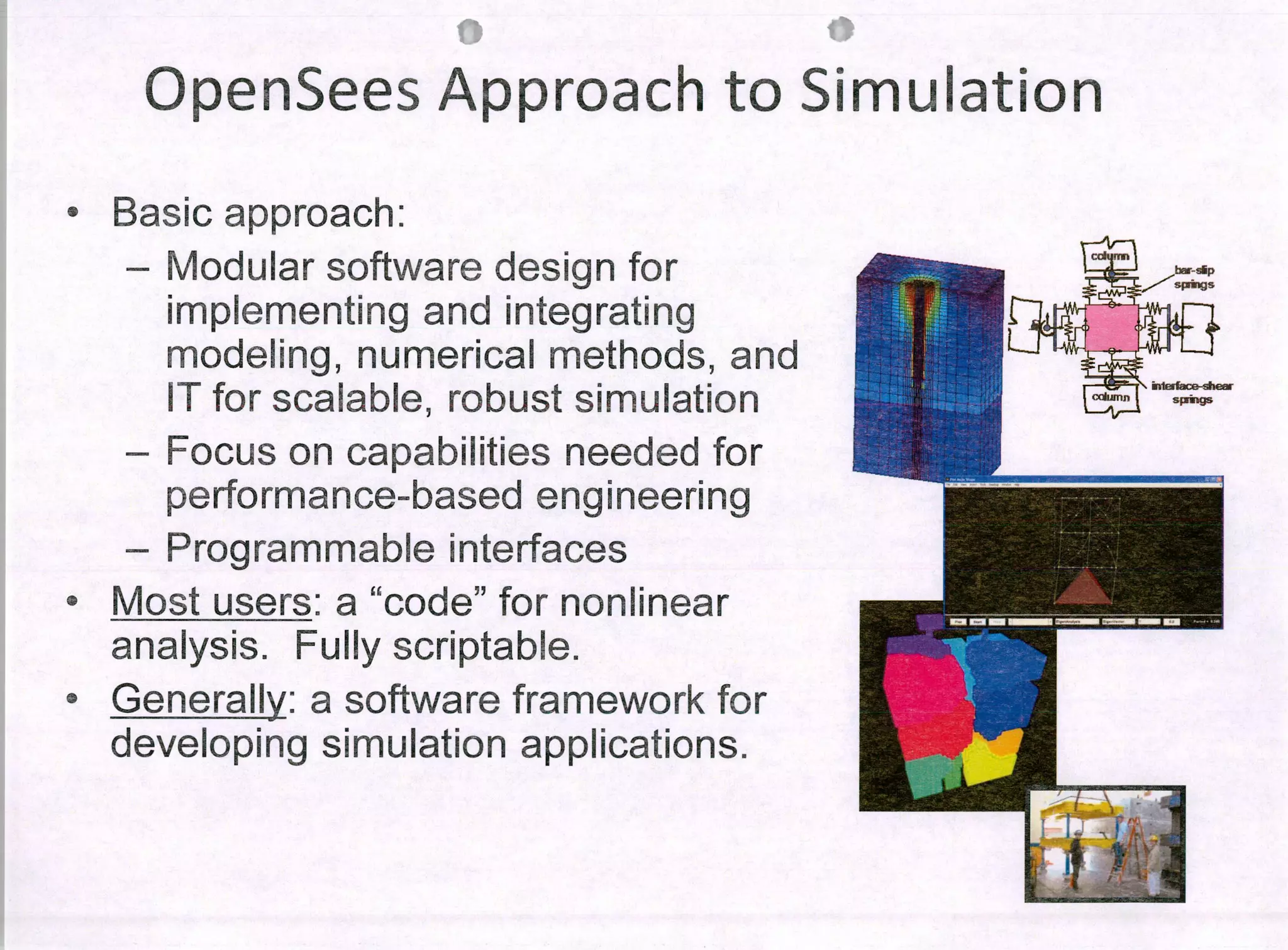
-
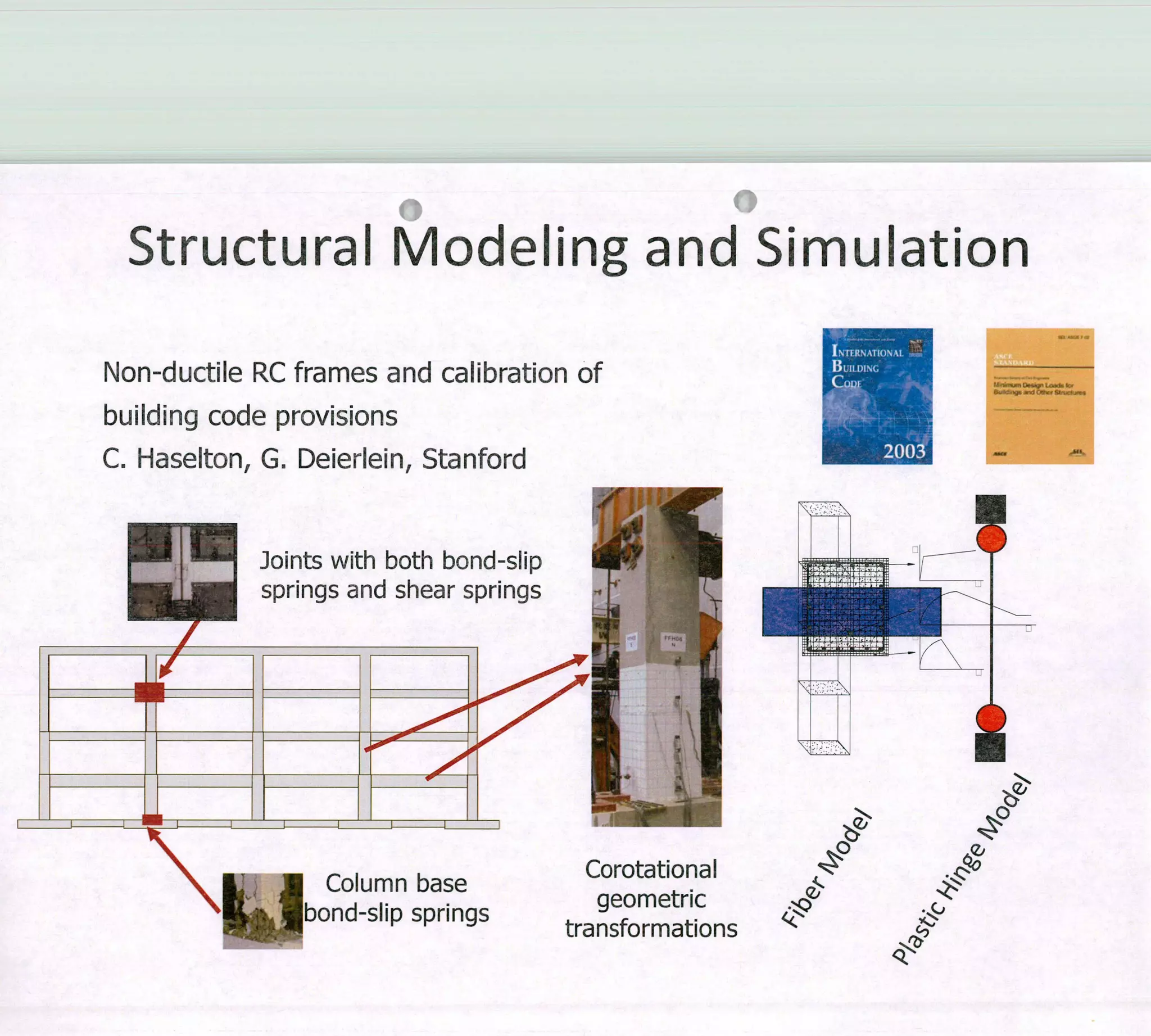
HP-1
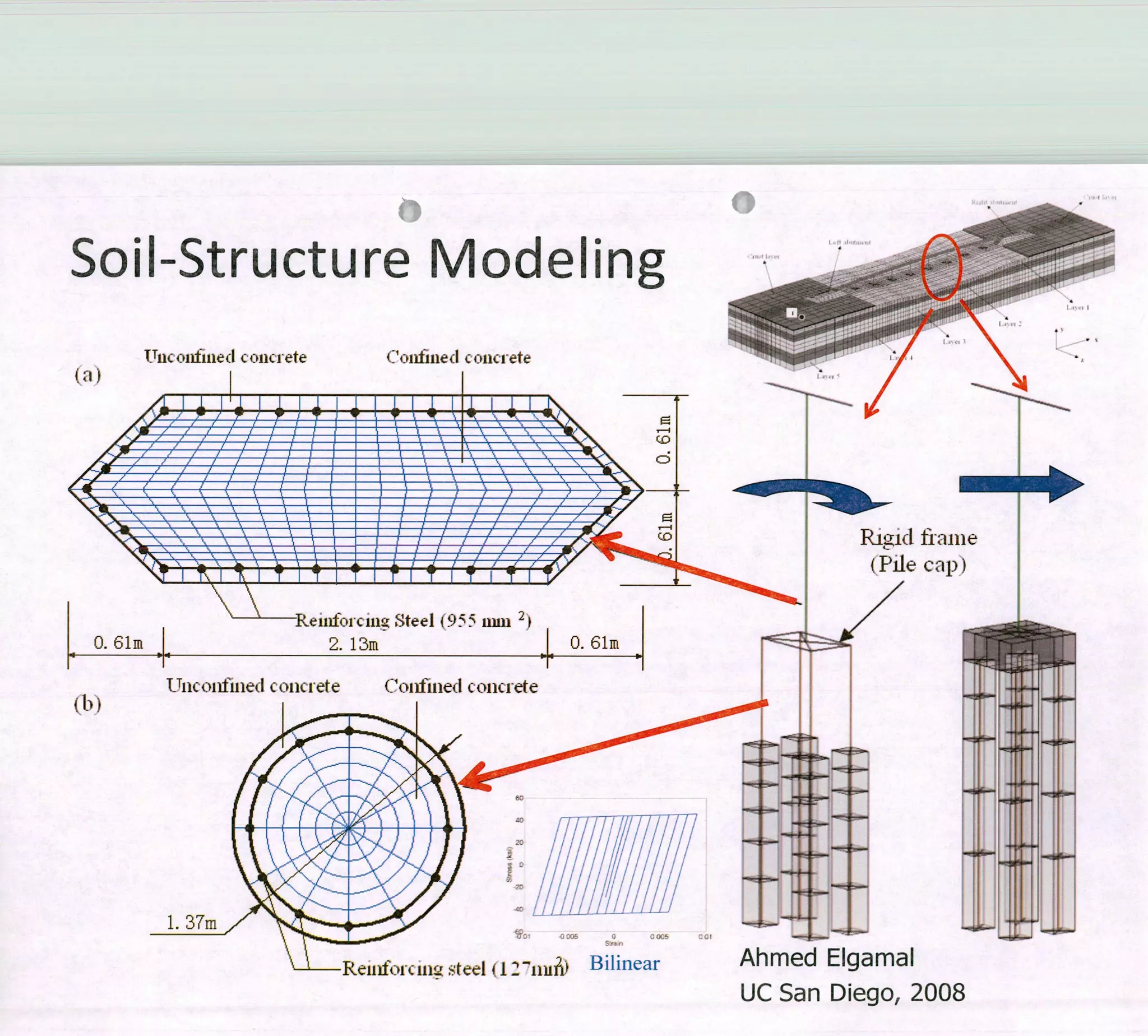
i]
-
(L r
l'LJ
1
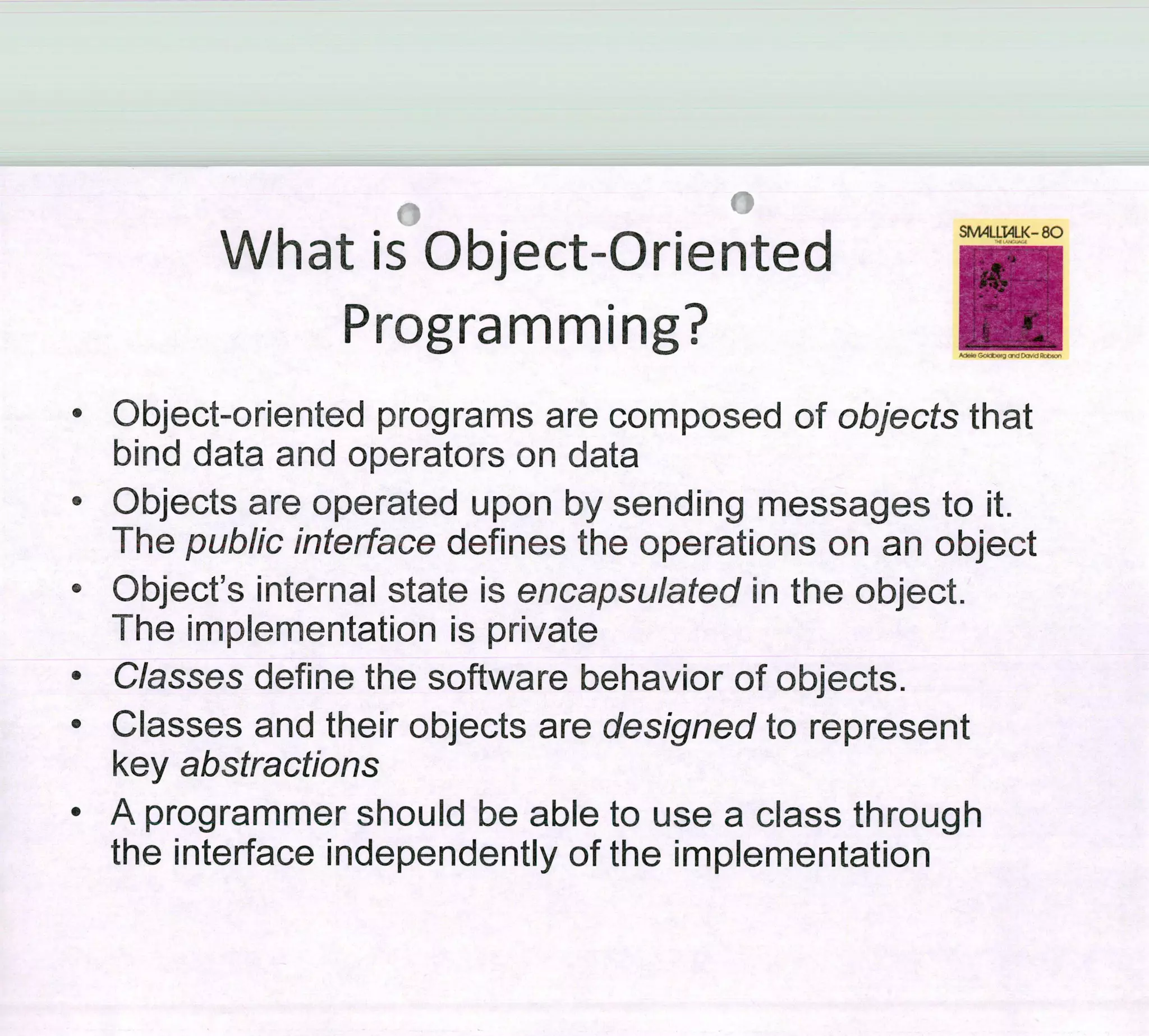
Fundamentals Are Timeless
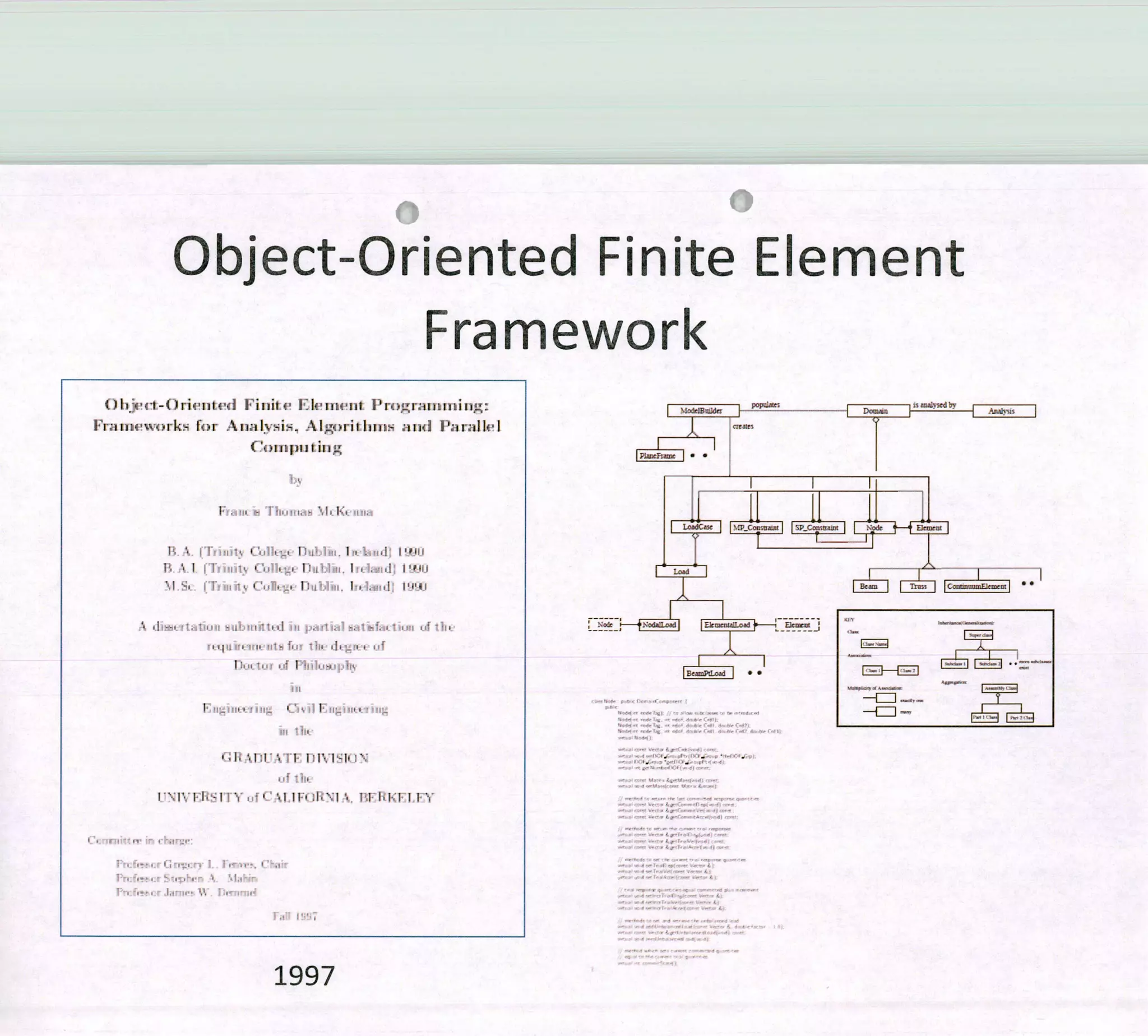
38
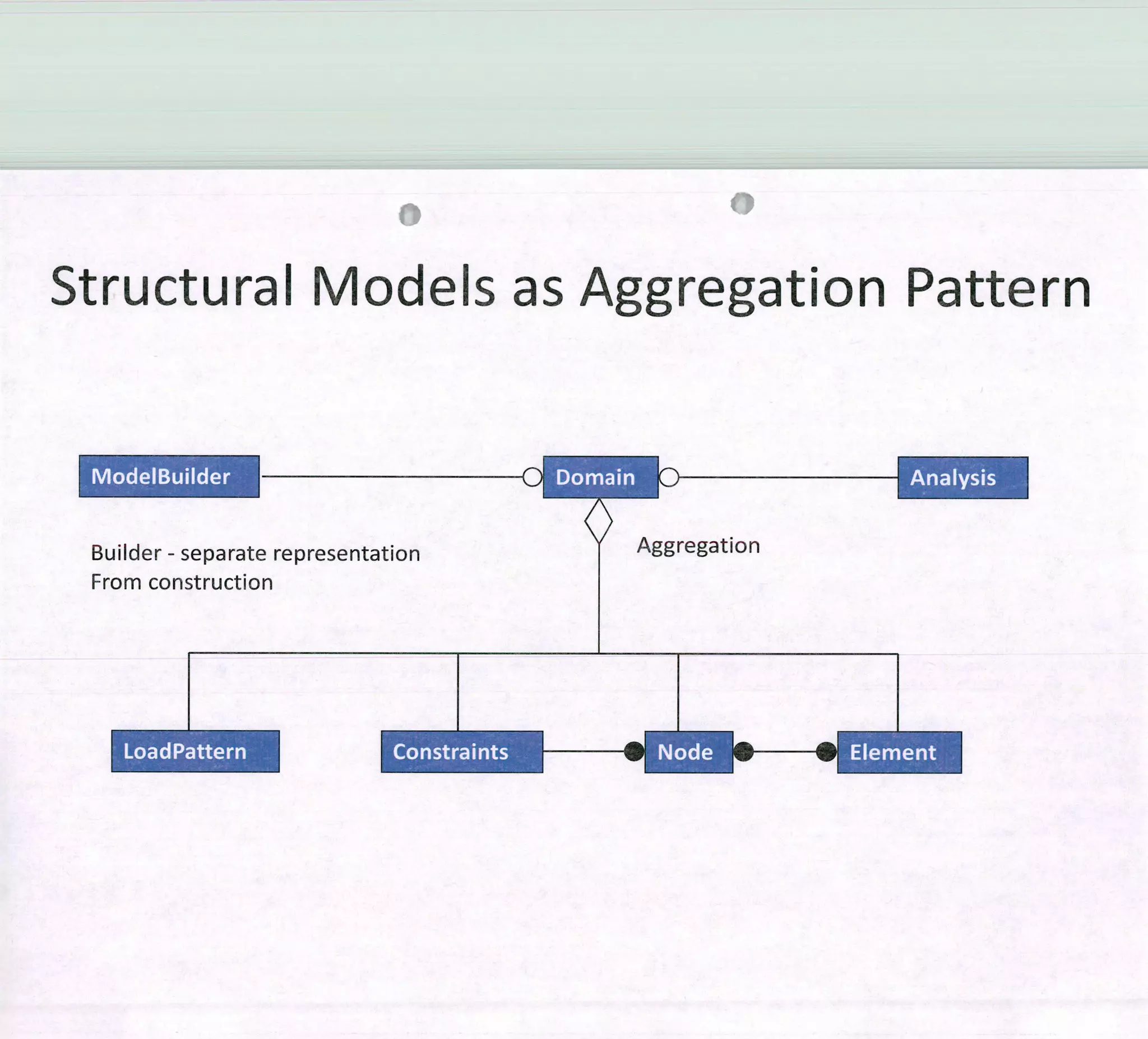
C. FLIOaBILIrÍ OF A i-p I'1BBa
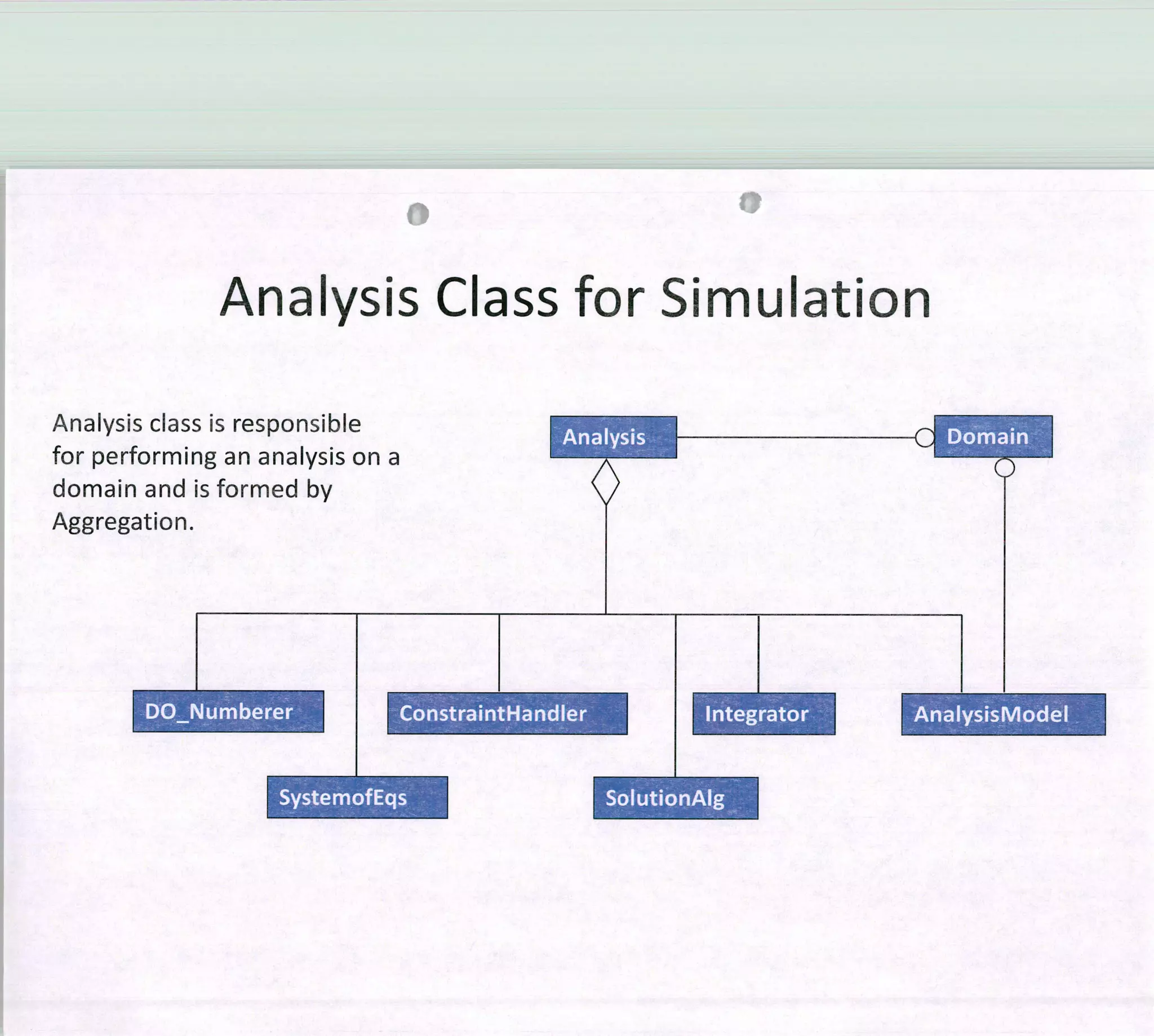
Considering the slice as the basic elenent of the 1-O camber,
the sarne 000rdinate transformation procese discussed aboye can be
used te c1cu1tta the flexibjljty of any arbitrary 1-D member.
To demonetrate the procedure, the flexjbjljty of a straight, Uaiforni
bar will be evaluated.
1. Unifona Bar y
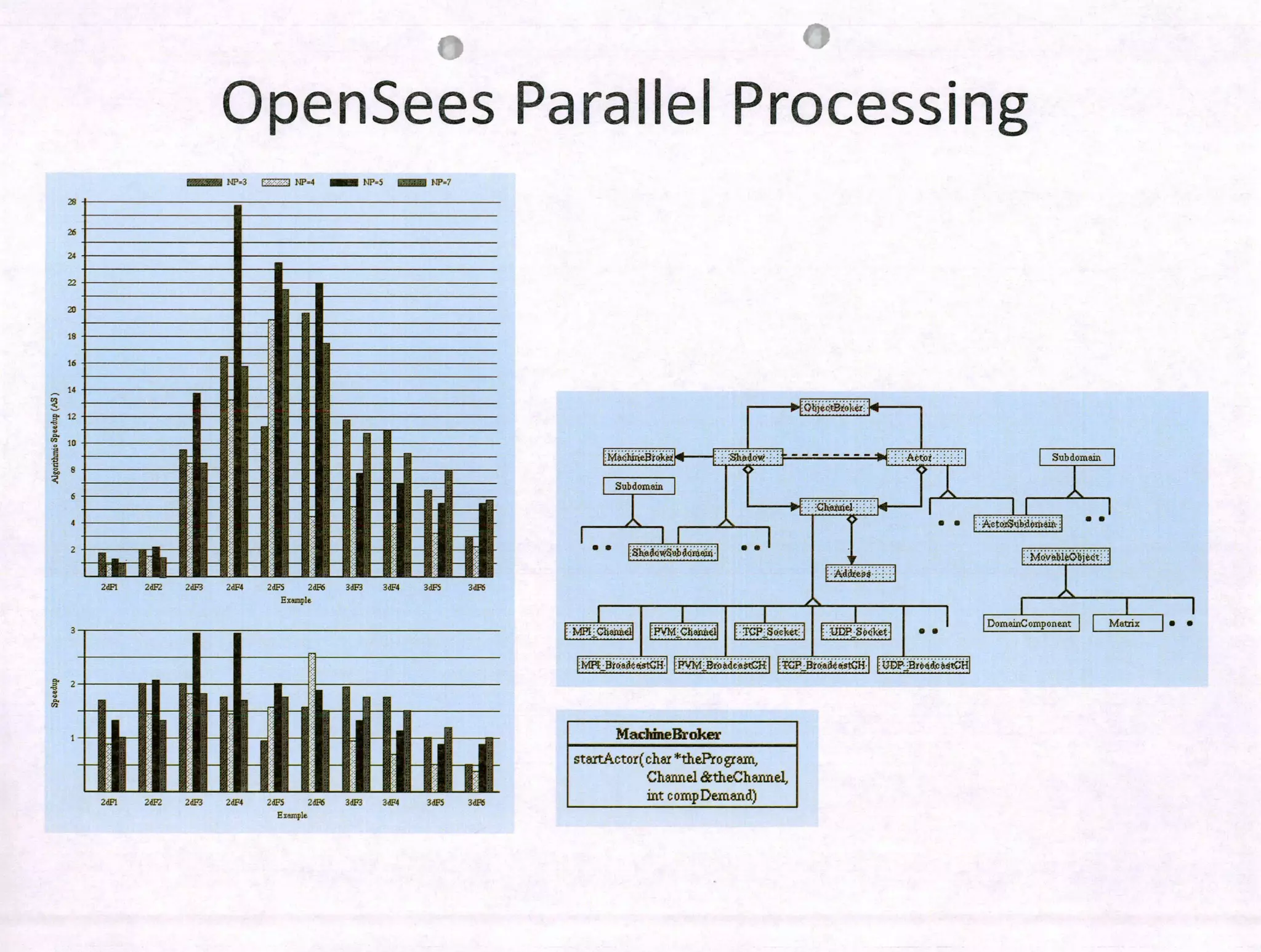
-
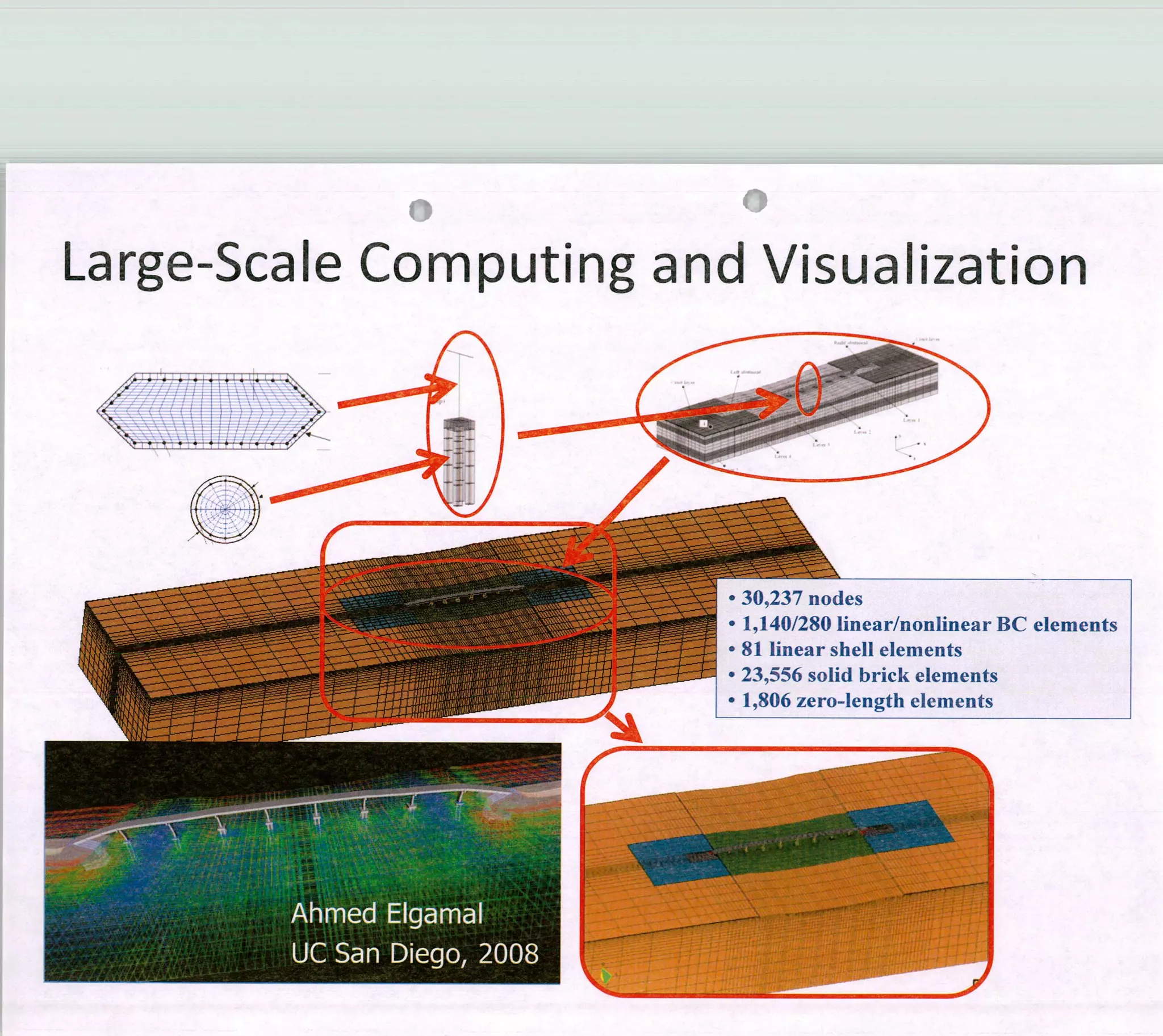
ELAflC PRCPTI.Ç
A-nAI P(cg
- L -------__
(L
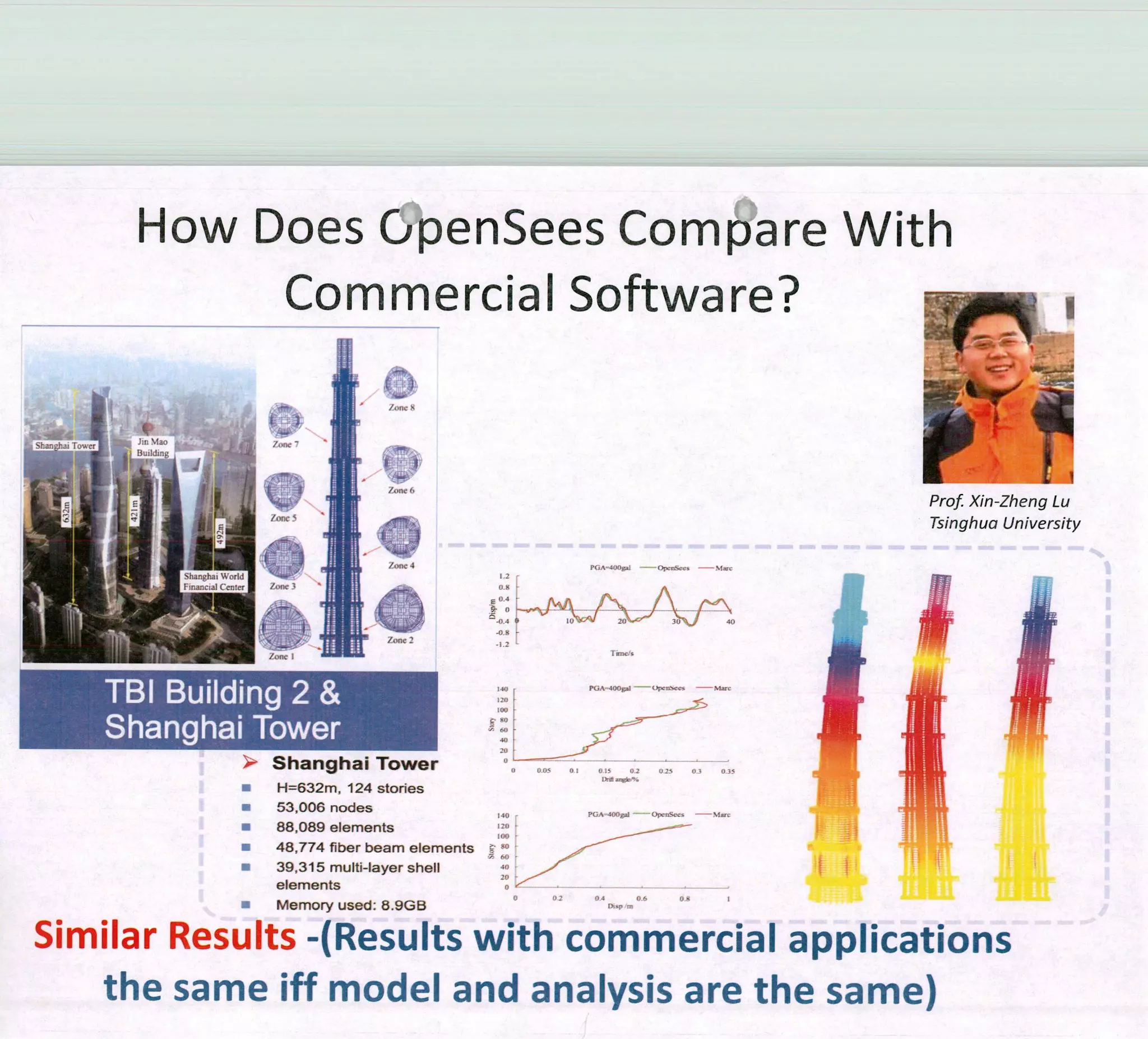
OL
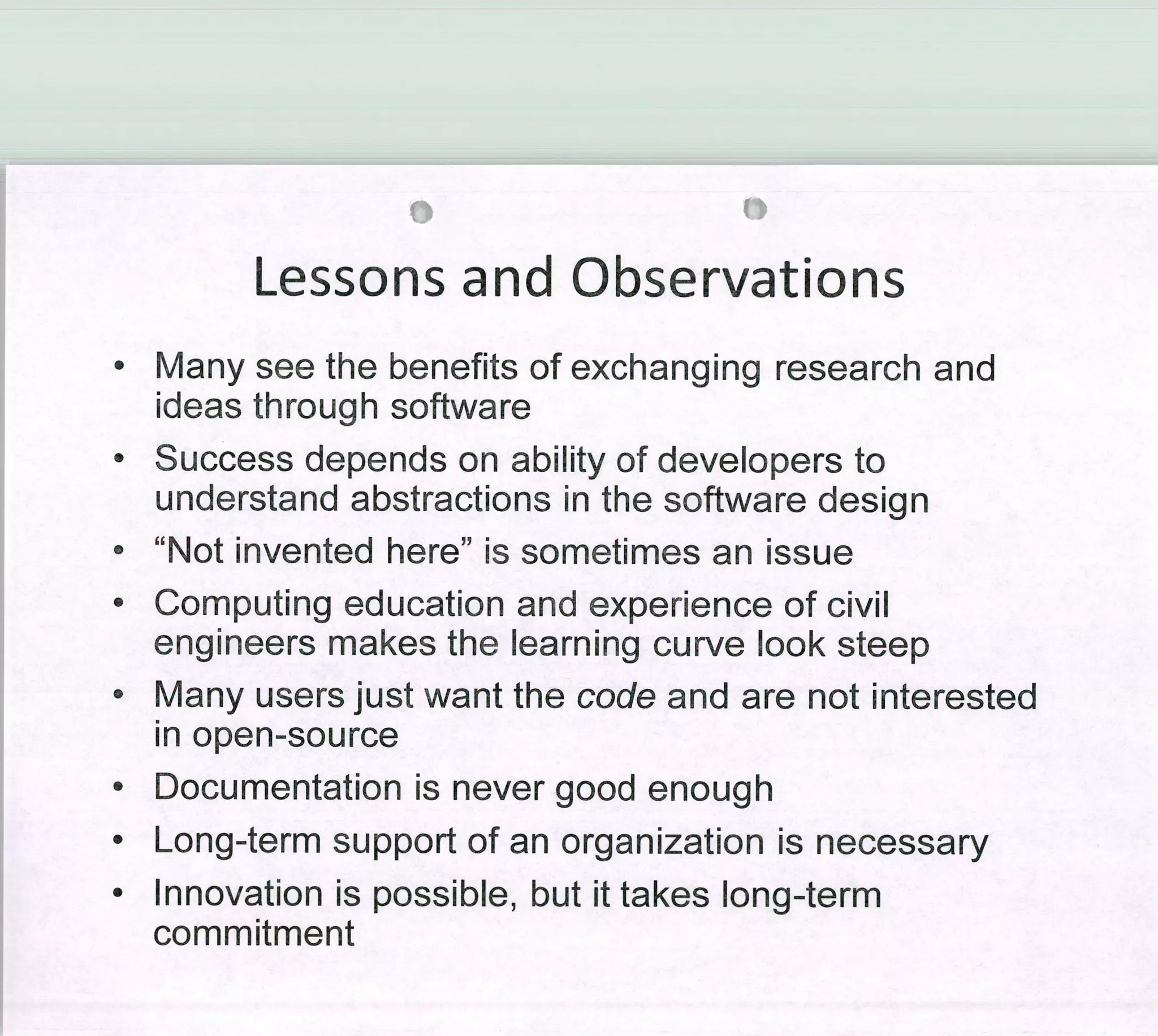
Kc 4
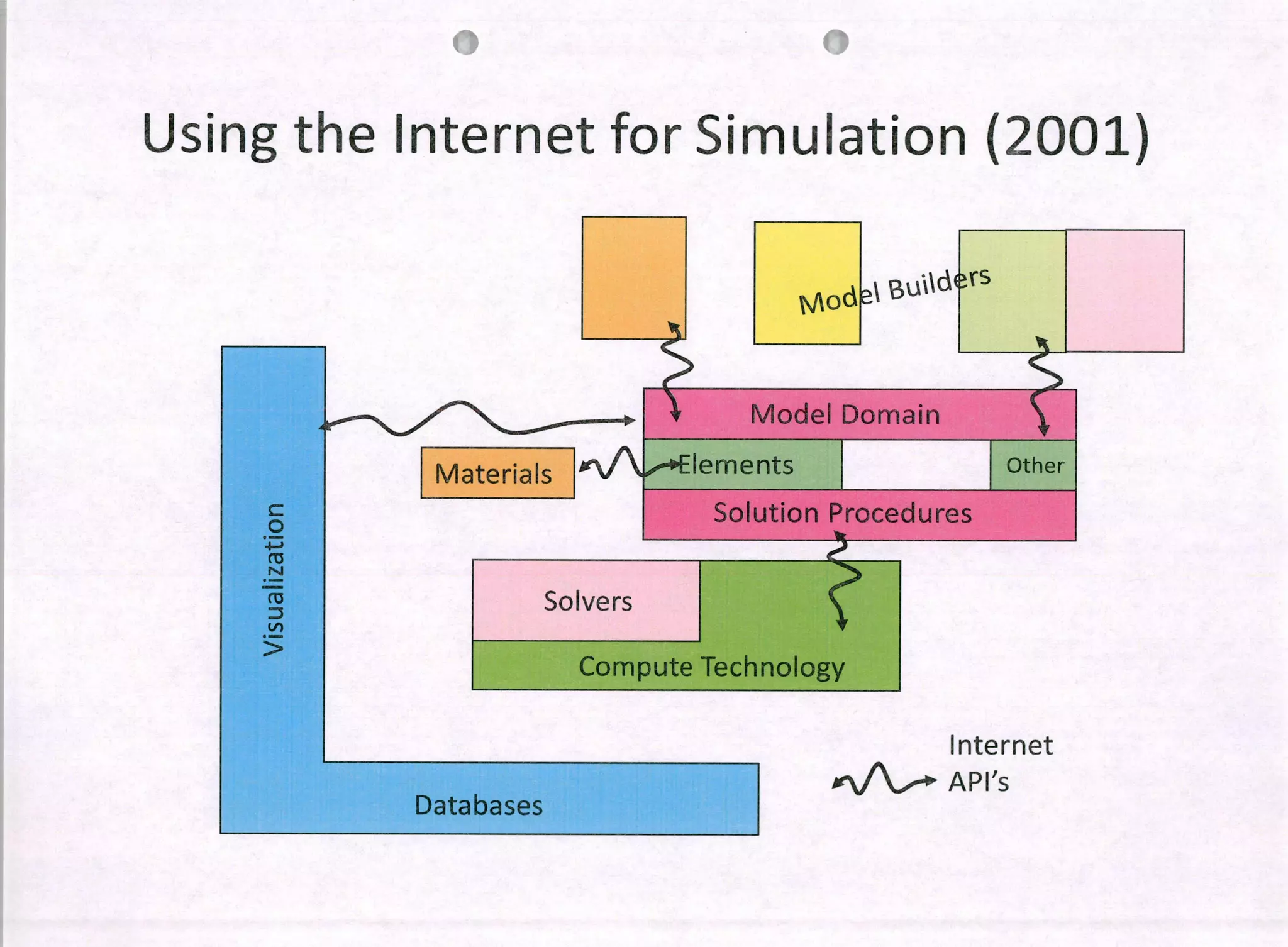
flne first step ja any flexibility cnolysjs is the seleetion of
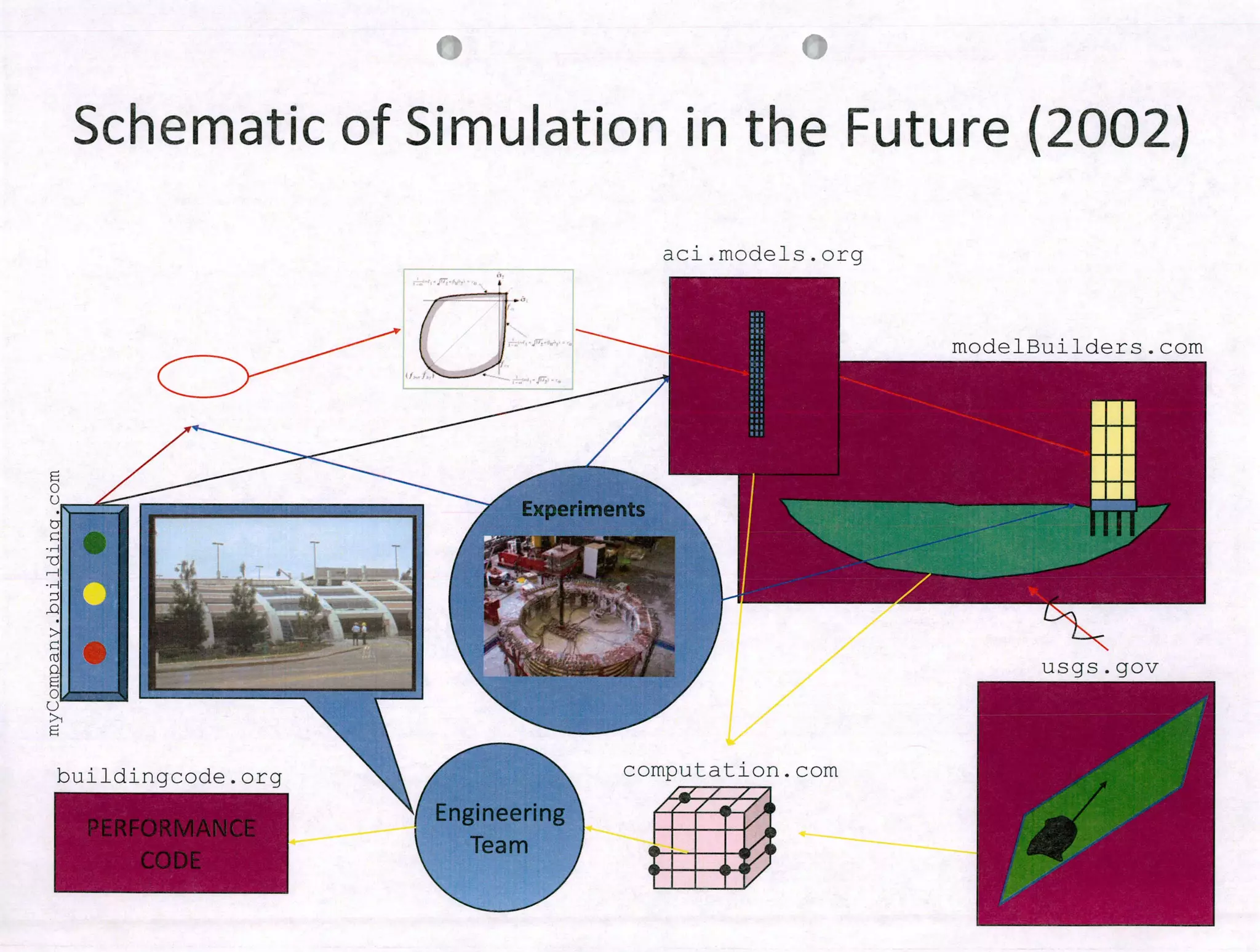
the forne systen for whjch the fiexlbility is desired. Ifthebarjs
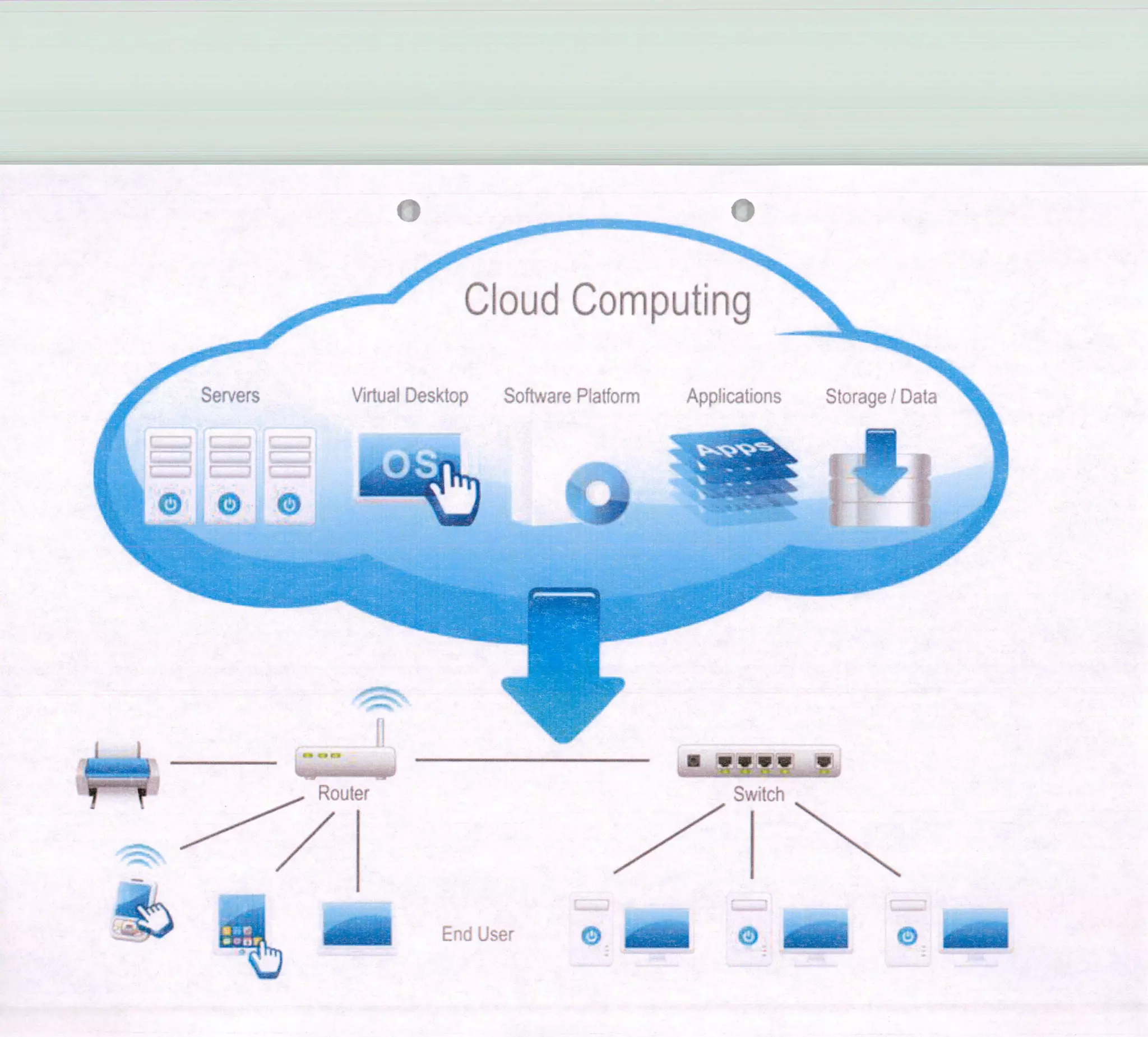
te be used ja structure lying and loaded in one plane, the three forces
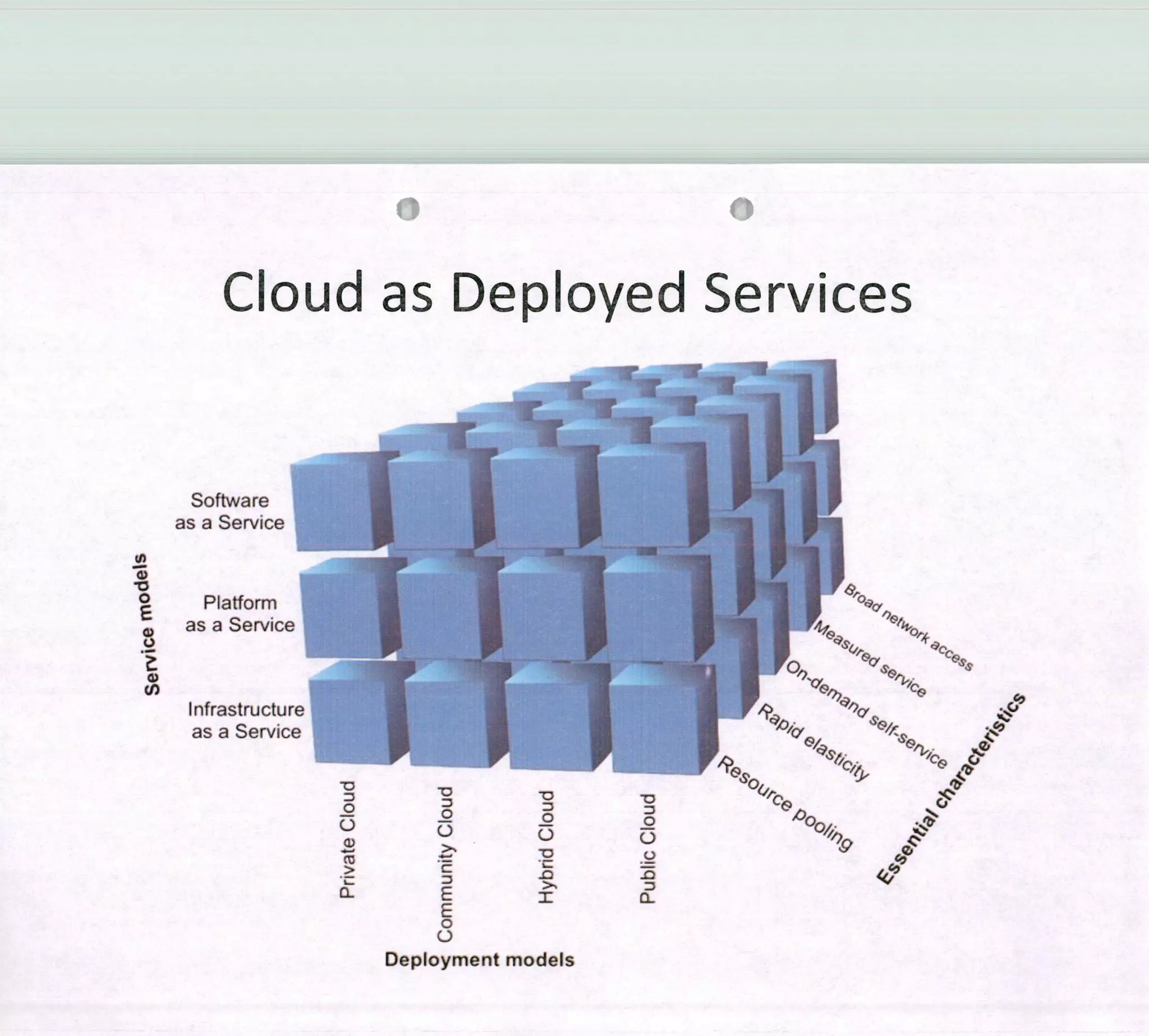
ahovn ja the sketch wouJ.d be saltable.
The flexibillty of the bar may now be cbtaned by su=ing up
the internet york ja all Slices of length dx caused by unit values
of these external jorcas, thus F = . 1 (bi)Tf1b1 JL(bs)Tfsbsdx The
alice flexibiljty f 5 is given in Eq. 13. The jorge tran5formatjoa
matrix b 5 represente the fornes ja the arbitrary slice at position
"x" causeci by unit values of the externel meniber fornes, thus
P 1 0 0
mz O1- p
M o o o (15)
y MIy L L -JBar
y
T o o Oj
nr alice
S5 = b5R (15a)
Noy ja Calcndatisg the Internet work of t:e &ljce at position "X"
Ray Clough, UC Berkeley, 1960s
PLEKURAL
/ ELt)flt.
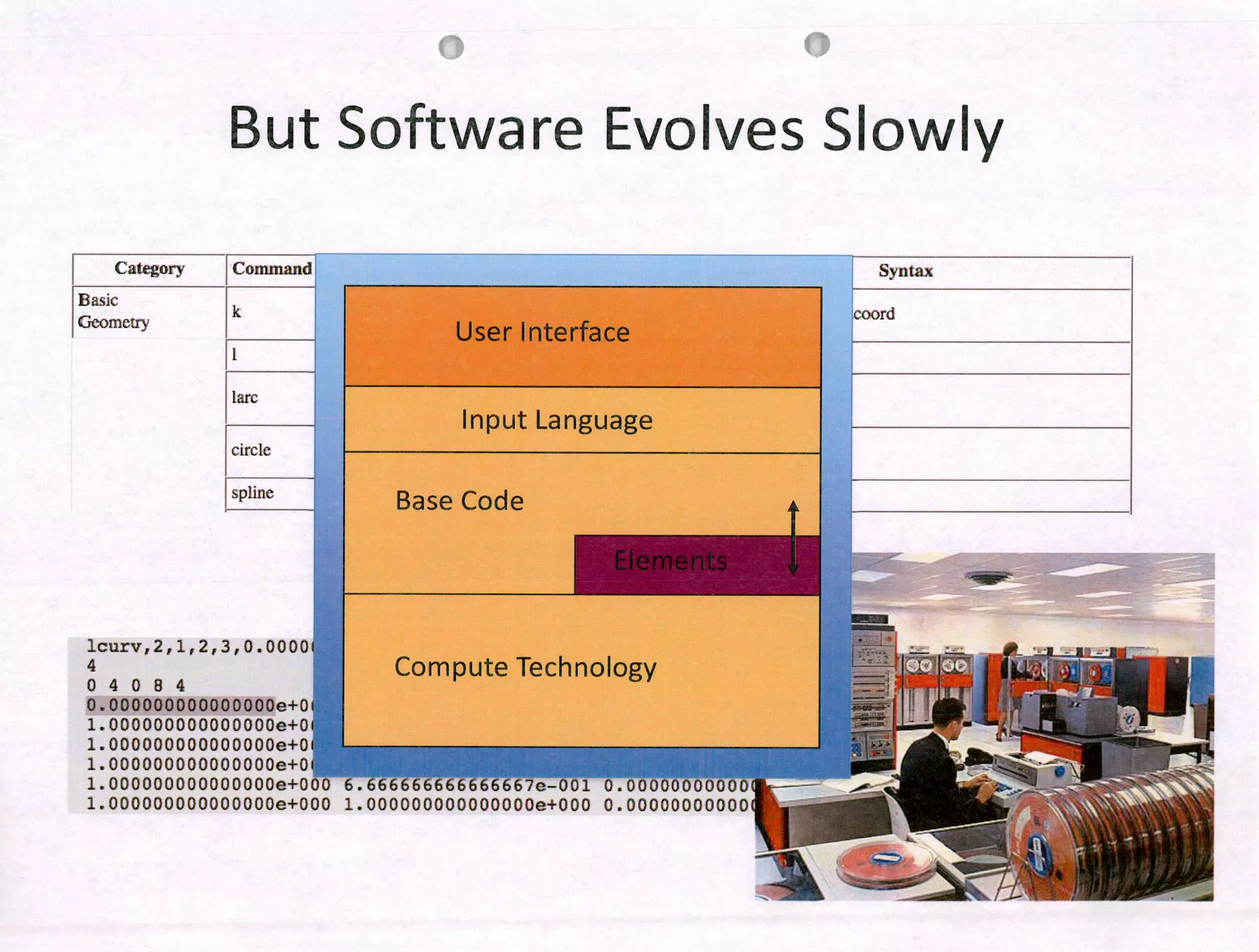
But Software Evolves Slow1y
1 Category 1 Command
Basic
k
Gcometry
larc
circic
1 spline
lcurv,2, 1, 2,3, 0. 0000
4
04084
0.00000000000 0000e+0
1. 000000000000000e+O
1. 000000000000000e+Ü
1. 000000000000000e+ioü
1.0000000 00000000e+000
6. 66666666()666667c-U(JI
1. 000000000000000e+000
Ii 14 &_I
;.
!TT1JLS.
0
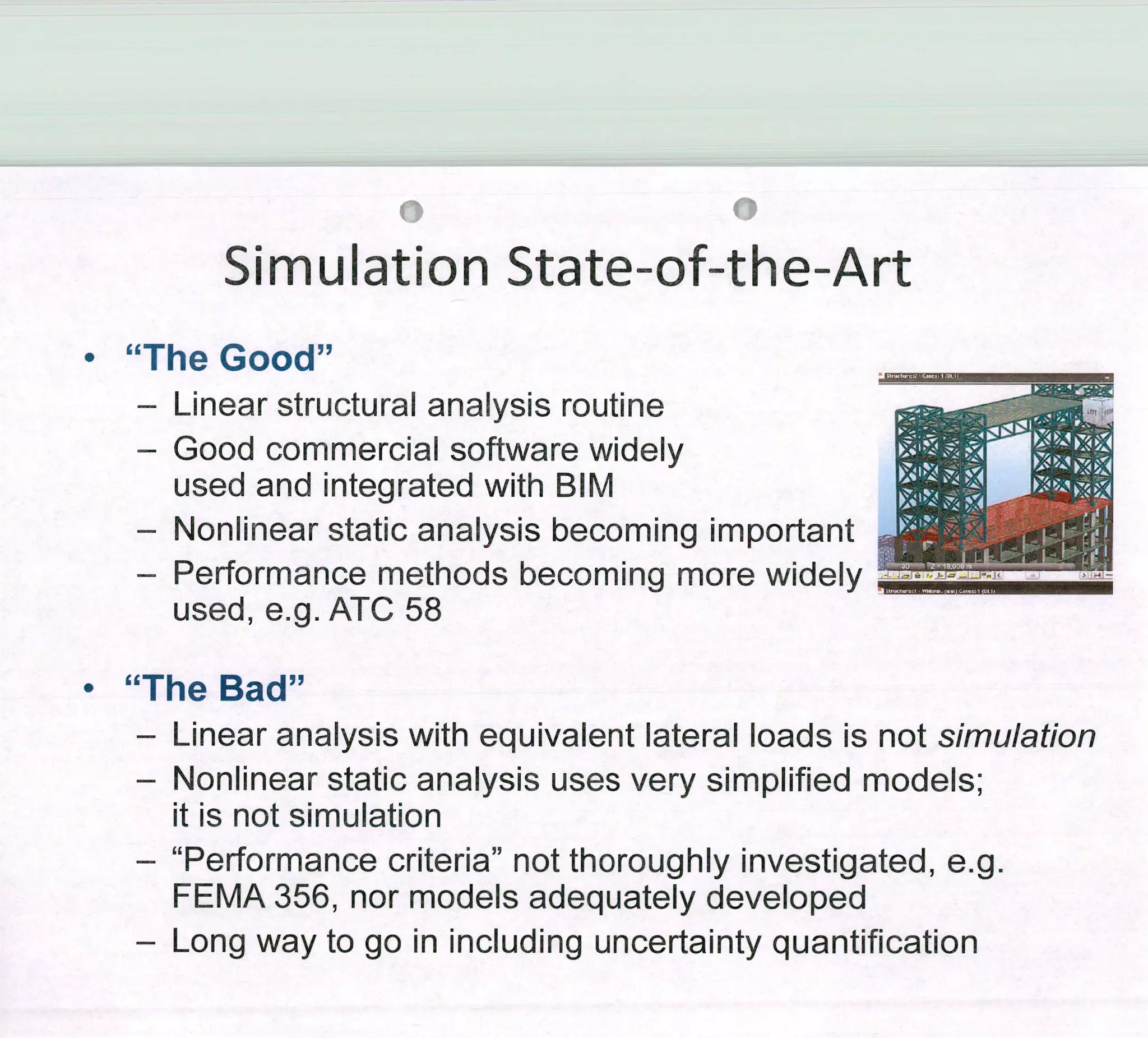
Simulation State-of-the-Art
0
"The Good"
- Linear structural analysis routine
- Good commercial software widely
used and ¡ntegrated with BlM
- Nonlinear static analysis becoming important
- Performance methods becoming more widely
used, e.g. ATC 58
9
"The Bad"
- Linear analysís with equivalent latera 1 loads is not simulation
- Nonlinear static analysis uses very simplified models;
it is not simulation
- "Performance criteria" not thoroughly investigated, e.g.
FEMA 356, nor modeis adequately developed
- Long way to go in including uncertainty quantification
rs ro
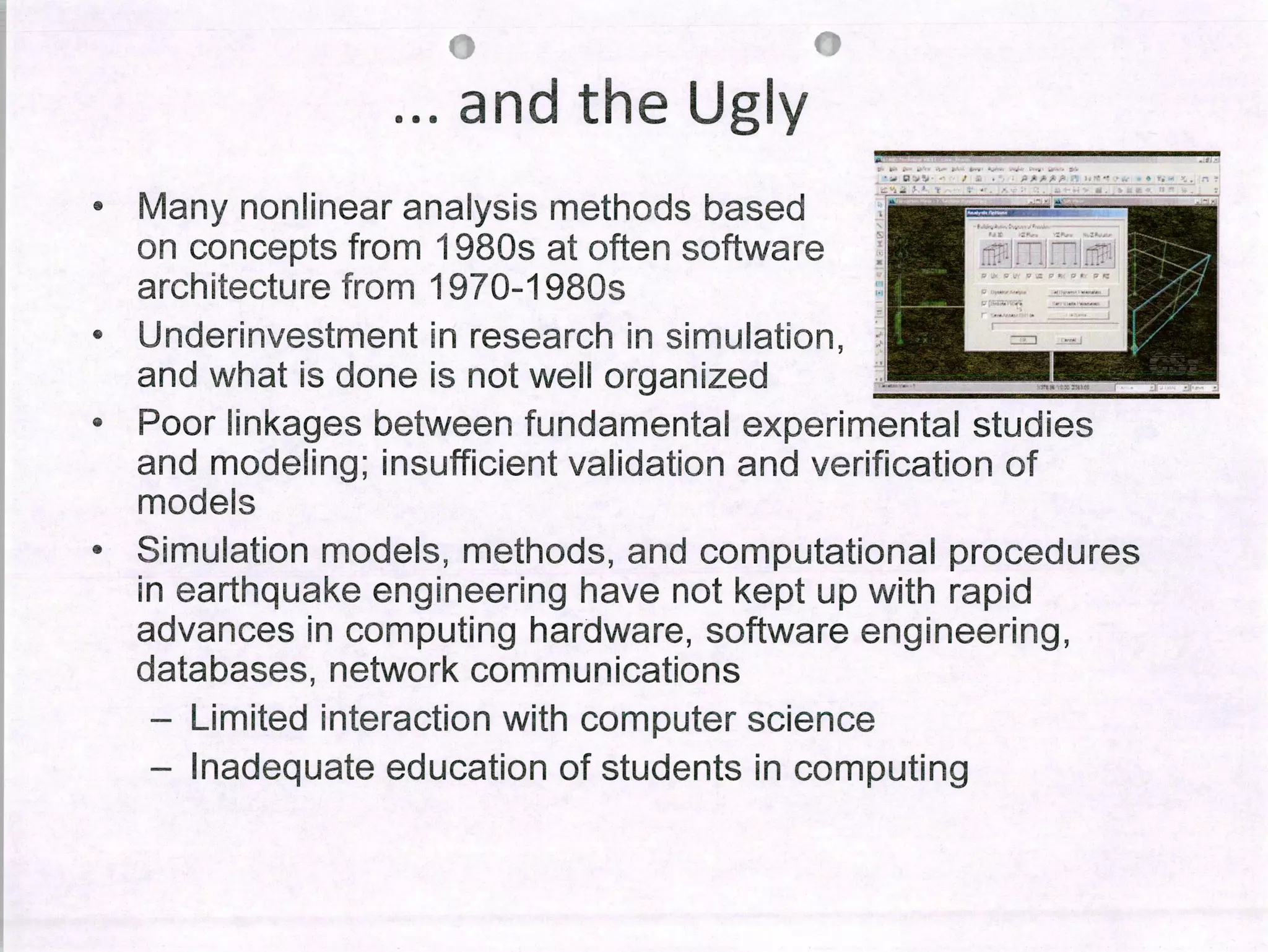
and the Ug1y
• Many non linear analysis methods based
on concepts from 1980sat often software
architecture from 1970-1980s
• Underinvestment in research in simulation,
and what ¡s done is not well organized
Poor Iinkages between fundamental experimental studies
and modeling; ¡nsufficient validation and verification of
models
• Simulation modeis, methods, and computational procedures
in earthquake engineering have not kept up with rapid
advances in computing hardware, software engineering,
databases, network communicatíons
- Limited interaction with computer science
- Inadequate education of students in computing
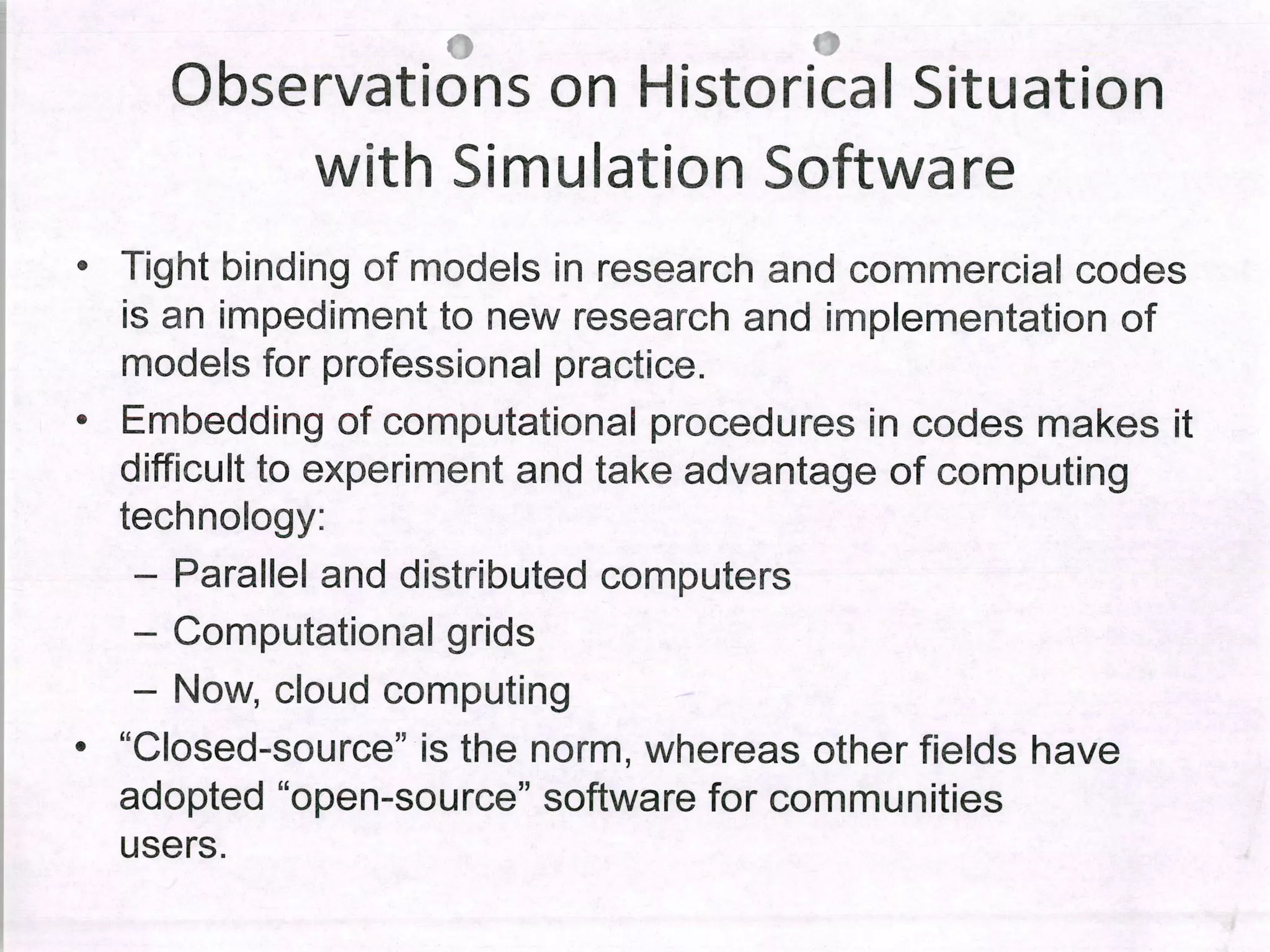
Observations on Historical Situation
with Simulation Software
• Tight binding of modeis in research and commercial codes
is an impediment to new research and implementation of
modeis for professional practice.
• Embedding of computational procedures in codes makes it
difficult to experiment and take advantage of computing
technology:
- Parallel and distributed computers
- Computational grids
- Now, cloud computing
• "Closed-source" ¡s the norm, whereas other fields have
adopted "open-source" software for communities
users.
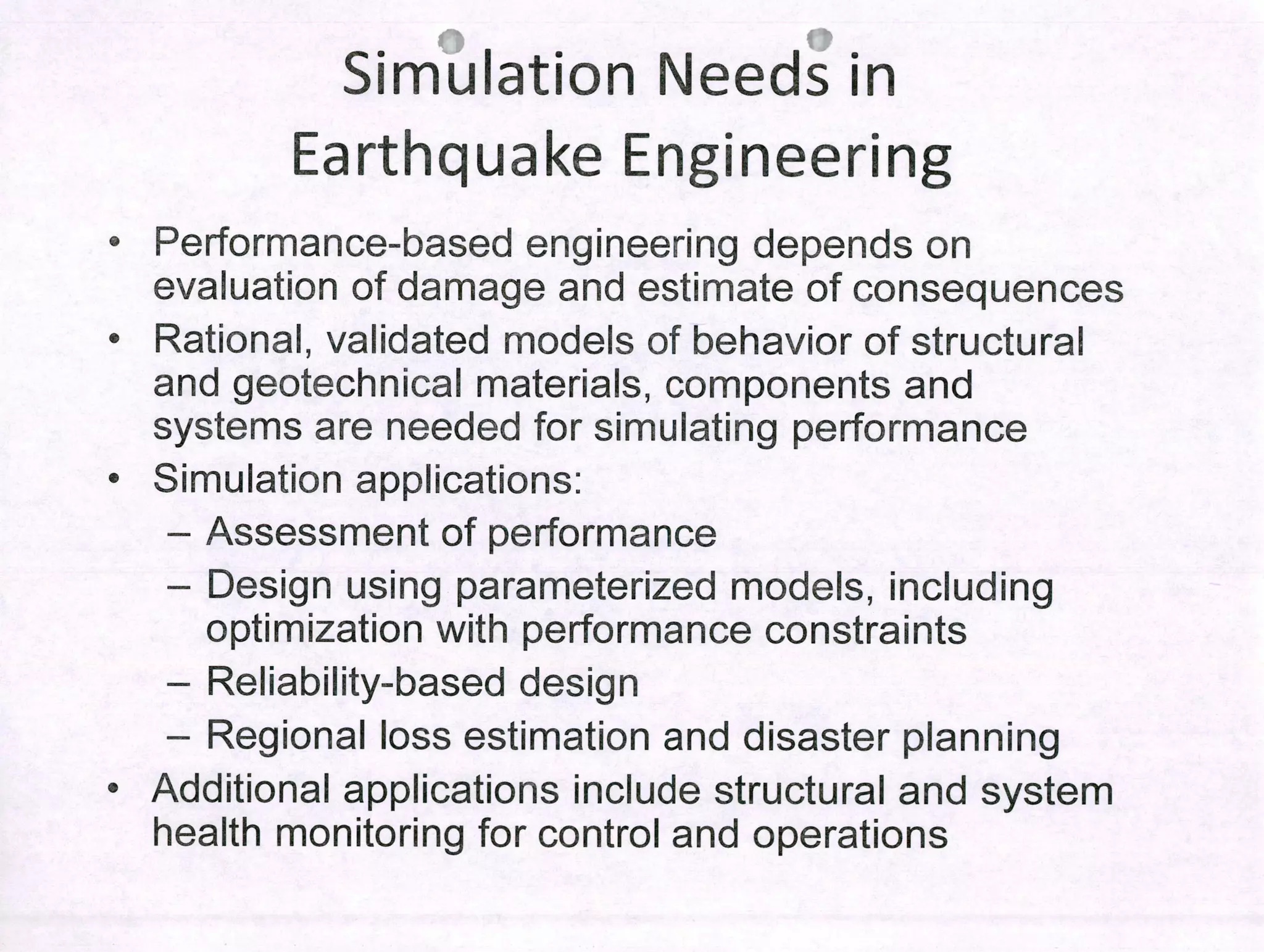
Simulation Needs in
Earthquake Engineering
• Performance-based engineering depends on
evaluation of damage and estimate of consequences
• Rational, validated modeis of behavior of structural
and geotechnical materlais, components and
systems are needed for simulating performance
• Simulation applications:
- Assessment of performance
- Design using parameterized modeis, including
optimization with performance constraints
- Reliability-based desígn
- Regional loss estimation and disaster planning
• Additional applications include structural and system
health monitoring for control and operations
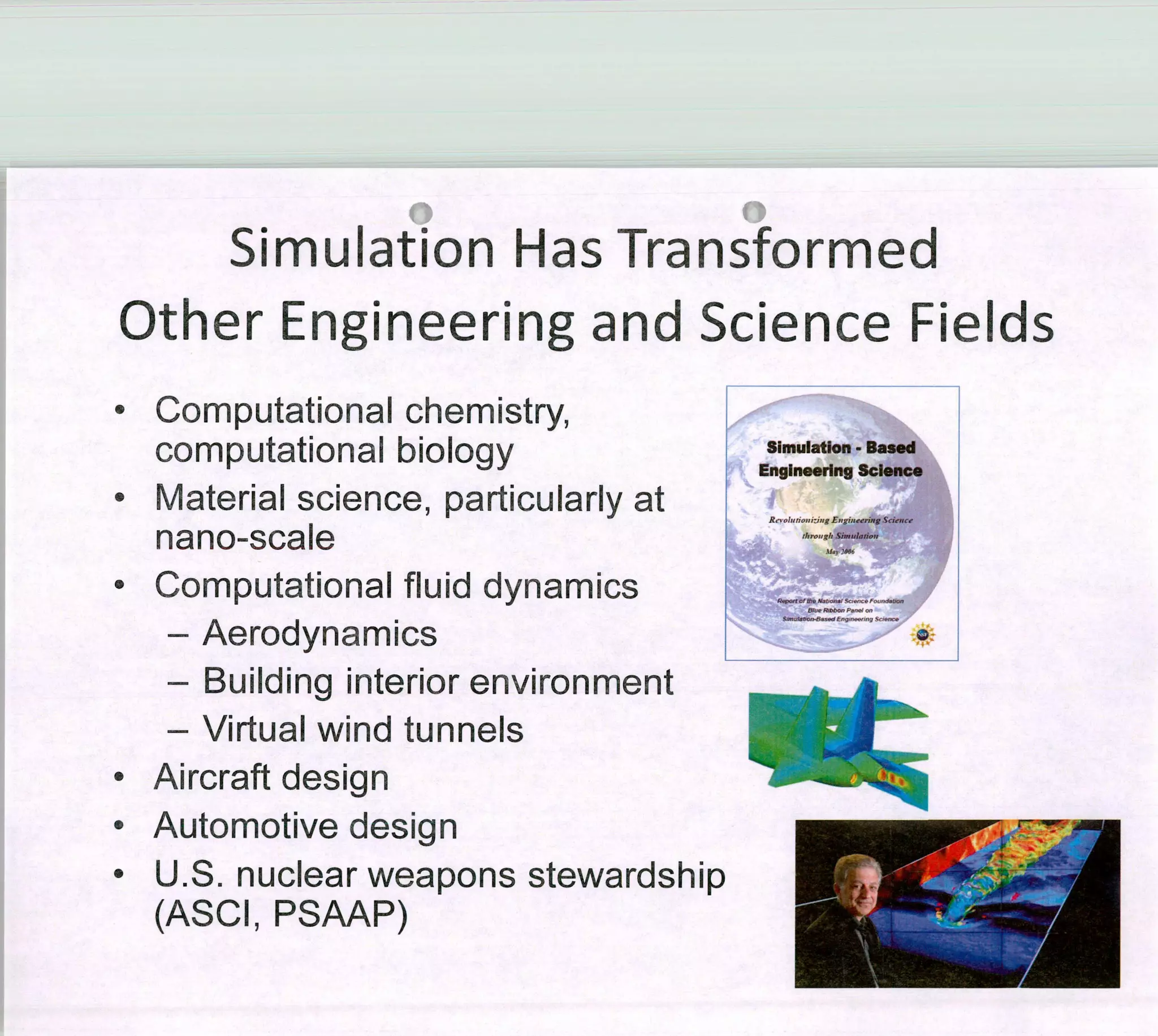
Simulation Has Transformed
Other Engineering and Science Fie1ds
£
• Computational chemisiry,
Simulation- Based
computational bioiogy Englneering Science
• F/1 a te r ¡ a 1 s ci e11ce, p a rt ¡ c u 1 a rl y a t
Sinn,lo,io,,
nano-scale
• Computational fluid dynamics
S.dE,g,ong
- Aerodynamics
- Building interior environment
- Virtual wind tunnels
• Aircraftdesign
• Automotive design
• U.S. nuclear weapons stewardship
(ASCI, PSAAP)
fN
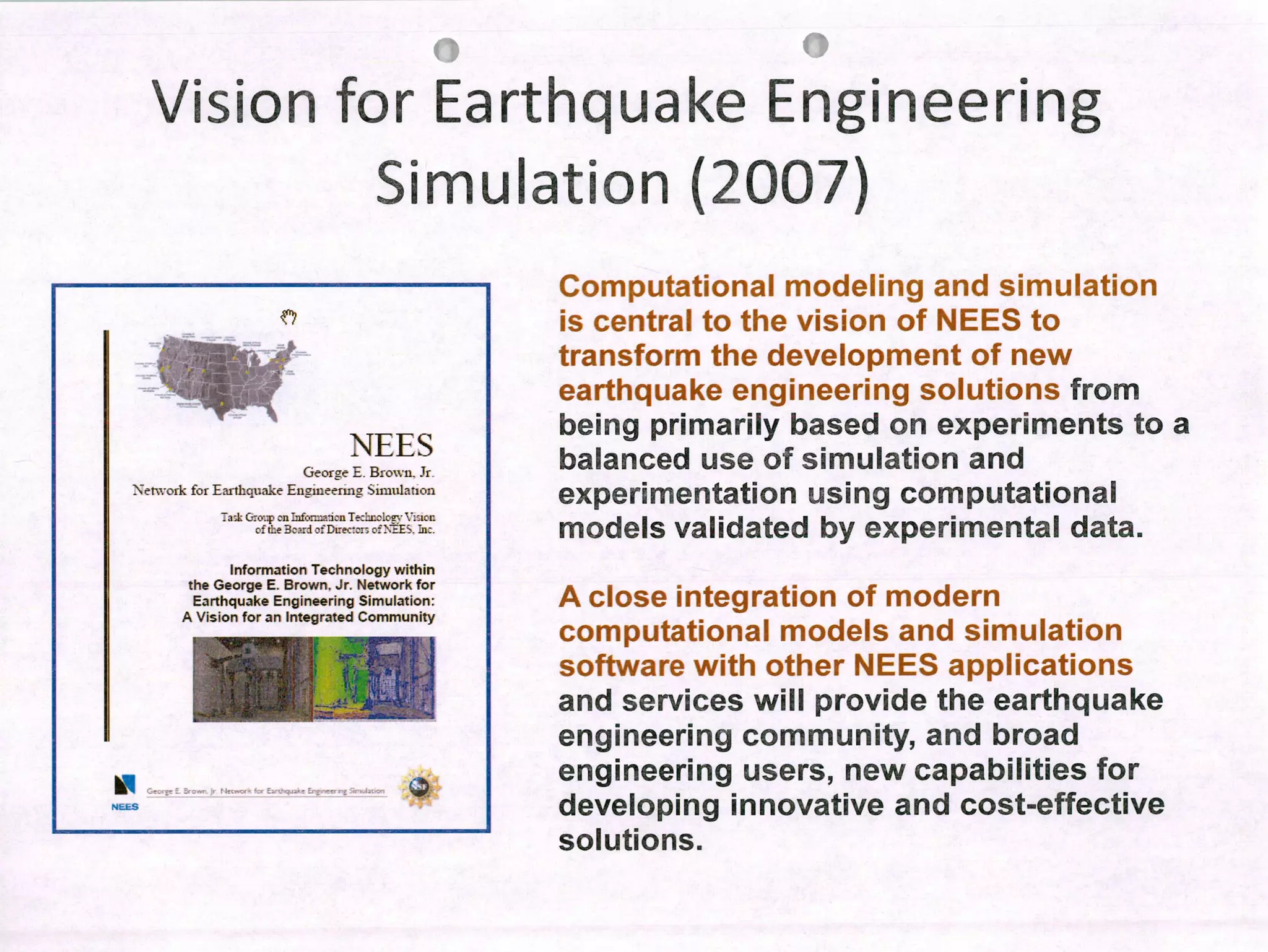
Vision for Earthquake Engineering
Simulation (2007)
NEES
Computational modeling and simulation
is central to the vision of NEES to
transform the development of new
earthquake engineering solutions from
being primarily based on experiments to a
balanced use of simulation and
experimentation using computational
modeis validated by experimental data.
A close integration of modern
computational modeis and simulation
software with other NEES applications
and services will provide the earthquake
engineering community, and broad
engineering users, new capabilities for
developing innovative and cost-effective
solutions.
NEES
George E. Brown. Jr
Network for Earthquake Engineerrng Simuiation
a-1: (op n riu Te±icic.rv V:ir
cf tIe 3.rdfDtec:'r; c'EE". la:.
Information Technology within
the George E. Brown, Jr. Network for
Earthquake Engineering Simulation:
A Vision for an Integrated Community
. 1
t'••_Ç,
. nr;
.-..•' - .•j .
4L 1
v
09
Software Frarnework
• A framework is a set of cooperating software components
for buiiding appIications in a specific domain
• Aframework dictates the architecture of the appiication - it
represents the design decisions common to the appiication
domain
• A frameworks is based on the assumption that an
architecture wili work for most appiications within the
domain
• Loose-coupiing of components within the framework is
essentiai for extensibiiity and re-usability for appiications
• Exam pies: Visualization (GLUT), Hadoop, Googie Apps,
• A framework ¡s not a "code"
o .
J1e
Open System for Earthquake Engineering Simulation
P.tcific 1trtIlthIht Iiigincenng Res..trc h Cc fltcr
• OpenSees has been under
development by PEER since 1998.
NEES supported 2005-2014. PEER
since then.
• Windows application downloaded
over 10,000 times a year.
• Parallel Applications utilize over
1,000,000 CPU hours on NSF XSEDE
compute resources yearly.
• Open-source and royalty free license
for non-commercial use and and
interna 1 commercial use.
• License must be obtained for
software developers including
OpenSees code in their applications.
o Written in C++, C and Fortran
(C++ being the main language)
http://opensees.berkeley.edu
~ ,j 'er) ca, Pr ±,trtJon
HOME
OpenSees 2.45 Released
OPENSEESWIXI
HSAGE
BoRD 'ersion 2.4.5 of tieOe,Sees binarv ¡s now avatiable for Jownioad. Fere is the chanqe loo
OpenSees Days Iy June 19-1 211, 215
)OWN LOAD
An Opensees Days workshop will be heid at the Ce -npus of the Ulihersity of Sa eno in Fiscioro, to
SOLRCE CODE corsttu:e a meeting point 'or researzhers and practitioners Qn topics elev a nt tD rnodding, aralvsis and
clesign in the ficicis of structural and earthquake engineeriig. Deadi nes to relnemDer:
BUG REPORT
• 31 Deceínter 2014 - Aostract submissicn
• 1 March 2015 . Papar submision
• 15 Ma-ch 2015 Early bird egis:ration
For rrore inforna:icxi, please coosult the arochure.
Search Survey — OpenSees rvIissing Pieces
Ir cuSIornzethe
tO 5_C We are conducting a sJrvey to tdenty prabems ans shortcominc associated with OpenSees. 'lease help
by lIIinç c*Jt the sicoy.
OpenSces Days 2011
NEES ard PEER hs:ed this years :wo dab evelt 00 Sep:ernber 2526 at the Richmoid fleld Stat on, liC
Berkeley. The prsetatiDns are now avai ¿tble onhine and can te 'ound .her3
'I .'
' pP .enSces in the CIouds!
- ÚnpnSp'ç iç nrw nvaibh4p for ti-;P ro nl no 'j F"cht h rhrnich ftp OnenSeesLab tnP. rhoçp or vrij
United States 264,504 ..
a China 138,279 r%)
= Irar 80,406
11 Italy 61,838
S. 1'1 Canada 52,019 •3J%)
India 39,757 34%)
• Japan 31,569 21%)
United Kinpdom 30,081 6%)
íE Greece 28,644 i%)
;. South Korea 23,567 3%)
0 Turkey 17,957
Germany 12,957 2%)
0 Taiwan 12,380 6%)
14, a New Zealard 10,691
L. Cnie 10,507 Í%)
Portuga 10,297 3%)
Australa 8,865 .3%)
El Hong Kong 7,948 1%)
(not set) 7,939 1%)
.. France 7,098 2%)
El Mexico 6,272 vv)
= Spain 6,216
Pageviews
1,514,946
4f
.4
264,504
Visitors
94,120
Visits
266,239
¿
río
OpenSees Woridwilde Usage (2014)
1
Ir
OpenSees Approach to Simulation
c
Basic approach:
- Modular software design for
implementing and integrating
modeling, numerical methods, and
IT for scalable, robust simulation
- Focus on capabilities needed for
performance-based engineering
- Programmab!e interfaces
11
Most users: a "code" for nonlinear
analysis. Fully scriptab!e.
• Generaily: a software framework for
developing simulation applications.
Structural Modeling and Simulation
Non-ductile RC frames and calíbration of
buliding code provisions
C. Haselton, G. Delerlein, Stanford
-
Joints with both bond-slip
springs and shear springs
fl..
o
1Column base
ond-sIip springs
Corotational
geometric
transformations
- 11 JU 111
UC San Diego, 2008
wi
lil
Examples of OpenSees Applications
• Parametric studies to examine relationship
between intensity and damage for PBEE and
design procedures
• Computational reliability for PBEE
• Soil-structure-foundation interaction
• Spatial distribution of damage
• Simulation of bridge performance
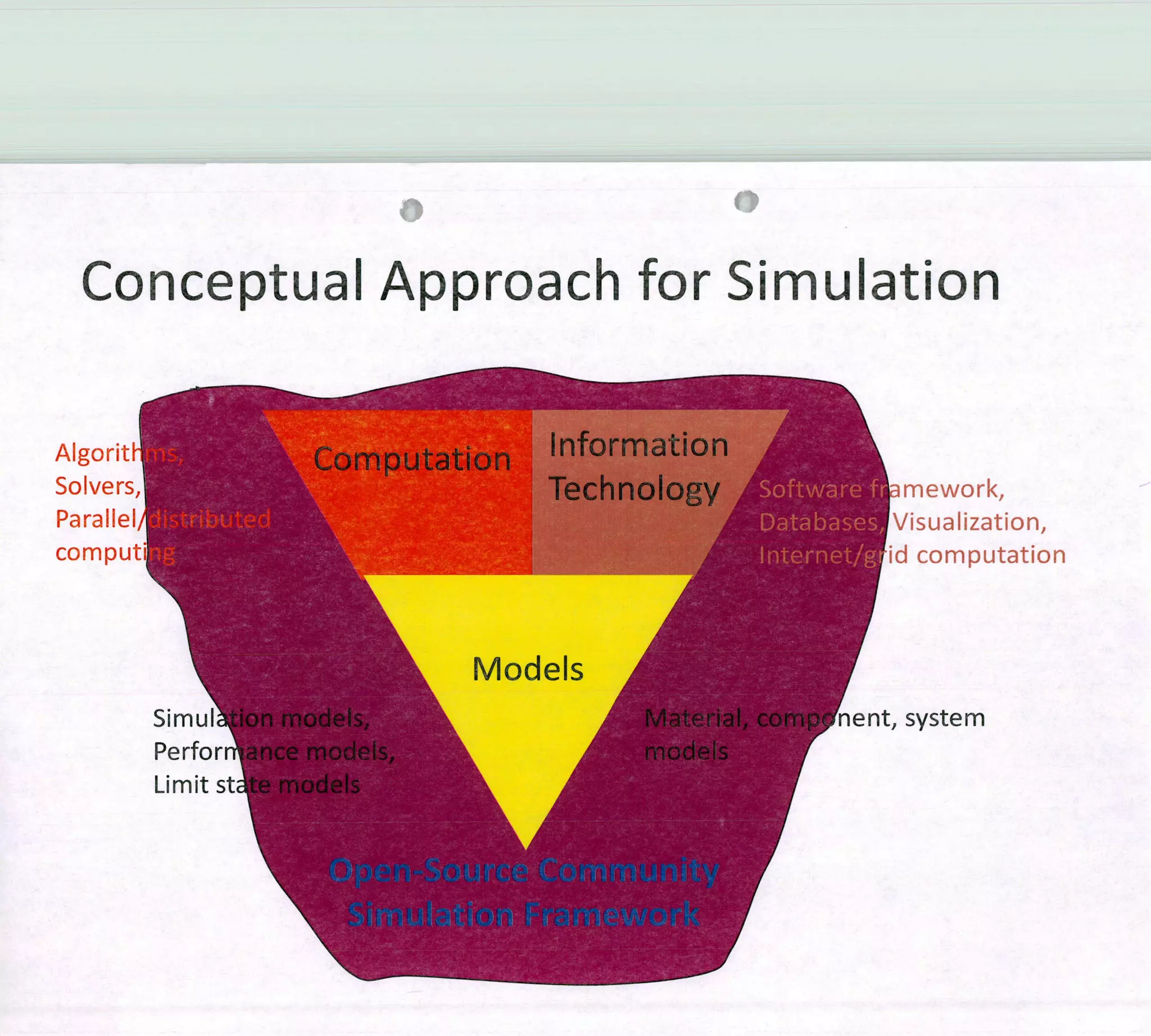
Conceptual Approach for Simulation
Algorit 1
Solvers nework,
ParaIIe sualization,
compu com putation
nent, system
1
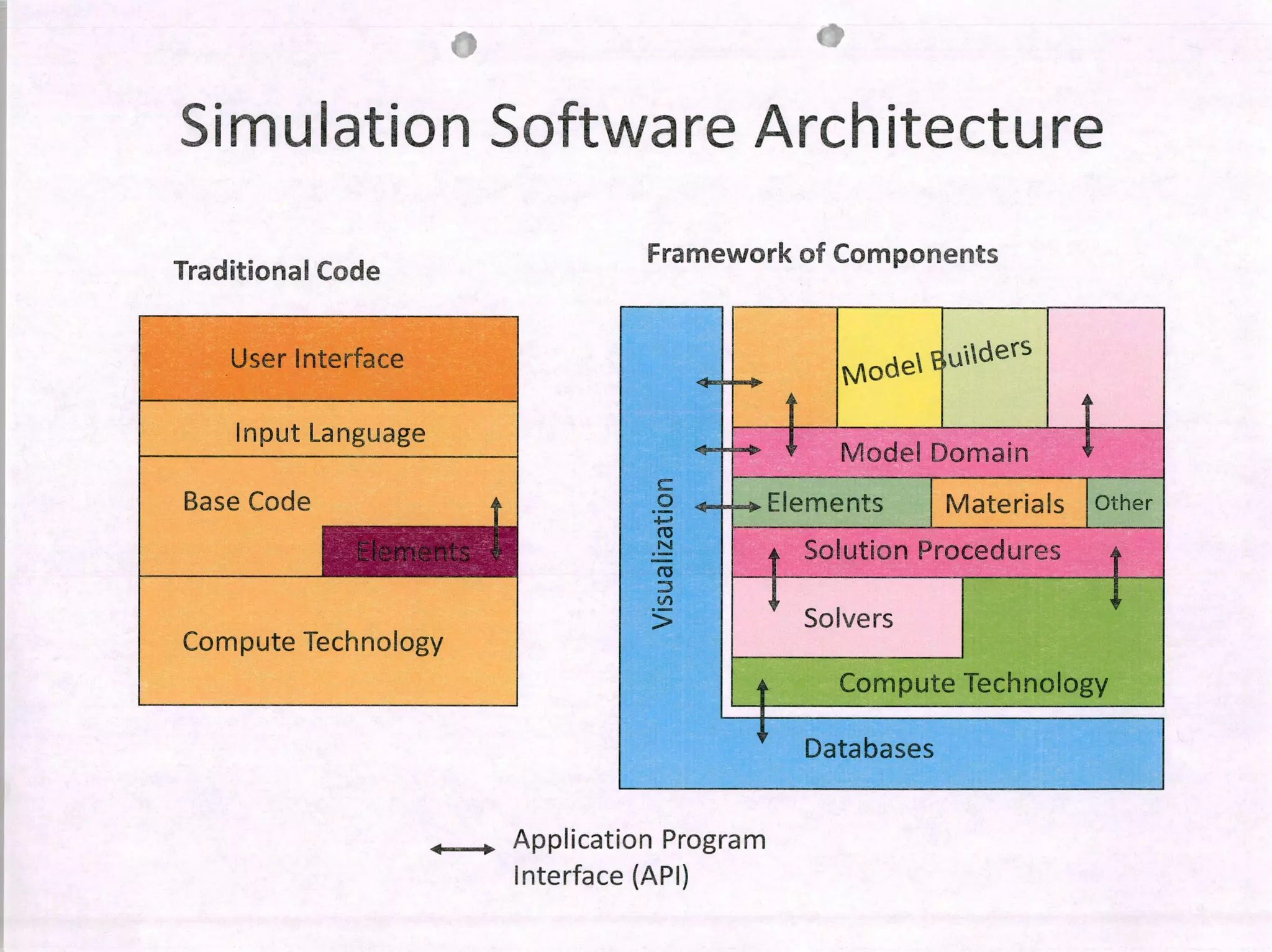
Simulation Software Architecture
Traditional Code
Fra mework of Components
User Interface
Input Language
Base Code
Compute Technology
Applícation Program
Interface (API)
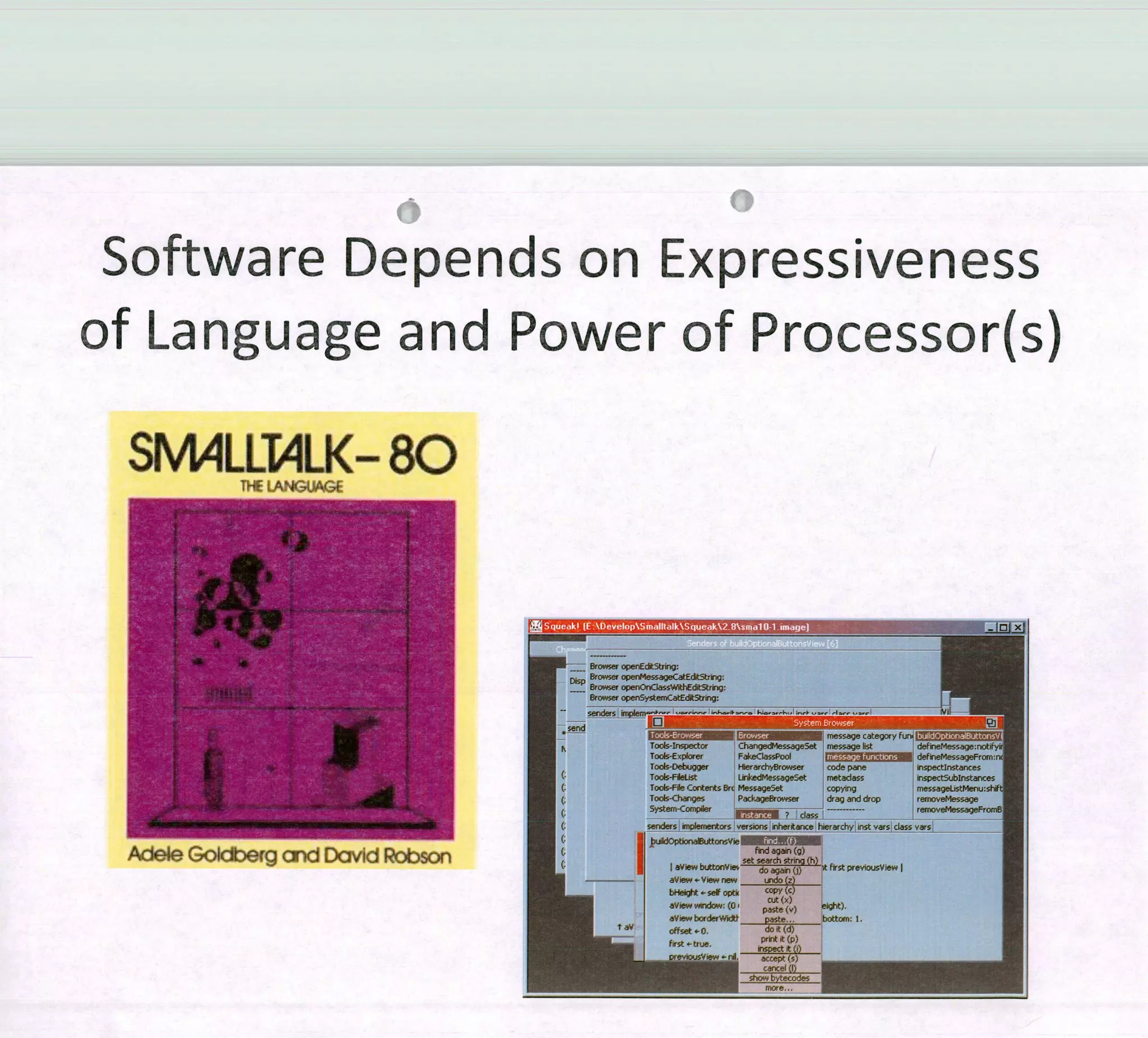
Software Depends on Expressiveness
of Language and Power of Processor(s)
rJJ2
- Brov,,ser operEdit5tnng
Disp Browser operMessa9ecstEdItStrr:
Browser openOnCIassWithEditString
8rowse operysternCatEdit5trinq
sendets em 'o -
send -
- -
Tool-Inspertor CbangedMessaqeset mesoaqe Iist defneMesqe.00tityu
Tocs-Exorer Fakeçlasspool defineMessageFromrs
Toals-Debugger I1ierorchyBroeser codo pene inspectinstances
To -Fkliçt LinkedMessageSet metadaes inspectSubjnstances
(. TooJs-Fe Contente Brc Meseageset copying message1istMenu;sh1t
Tods-Changes PackageBrowser drag and drop removeMeesage
Syetem-Compiler
case
removeMeesegeFromB
(: eedei'e inplernentois versons ehentance hierarchy instvars daes vare
(: IJOptbiFeittoroVie W?j
rid again (g)
set search etrino (h)
W onVie, do again (j) lt fwet previousView 1
eVi,,-VÍew nos,
undo(z)
bt$eiit '- se opt °0PY (c)
L,, CV,ew windoos: (O pate()eight),
aV,ew borderWkjt paste,. bottoçn: 1
offset-O, doit(d)
______________________ print it (p)
firet .-true.
inspect it (i)
pres'iouçS'iew ti4 accept (e)
--
more,..
What is Object-Oriented
SM411I4LK-80
Programming?
• Object-oriented programs are composed of objects that
bind data and operators on data
• Objects are operated upon by sending messages to it.
The public ¡nterface defines the operations on an object
• Object's internal state is encapsulated ¡n the object.
The implementation is private
• Classes define the software behavior of objects.
• Classes and their objects are designed to represent
key abstractions
• A programmer should be able to use a class through
the interface independently of the implementation
Object-Oriented Finite Element
Frametwork
r14'Iltvcl I' nil 4 E 1v In4IIt P rogralnllki ng:
Fra IIk4'<)rk-i for i IIi Iv-i-. A l!.!pri 1 IIH4 a 11(1 Pa ial tul
( )IJhJ)lI 1 III LZ
1•. e. 1 . '1 I.;
I. 1 Uhi% C'Ill'-L I11L1)lIU. III. !III
1 1TI$, (u11I'I F?I1_.1,!I.1'I.1.-i.I l'I
Domm 1
Males
LodCas .W_CoaamT SP_Consti.irnt 1
Ld '
Trus CorntumEimut J '
¡li_u. lii, u_ii 1•'l1 1
1-
"1
od1L1 EktevLiLLd
eaniPLod • •
i _
—E
—L
- iur
lI IlI_1IIjI;,JIl'
i 1 1 i II:, 1 'i . 1IJ1•.I 1
.4MC#S?J ...........
- ls_-»..._.............
- U..-.
t
4
E.. 4..ii.. ... Li.
-
£
£tdO*iS4E
1997
.
Structural Modeis as Aggregation Pattern
1I
1u
E r
Analysis Class for Simulation
Analysi
for per
domair
1 Pattern
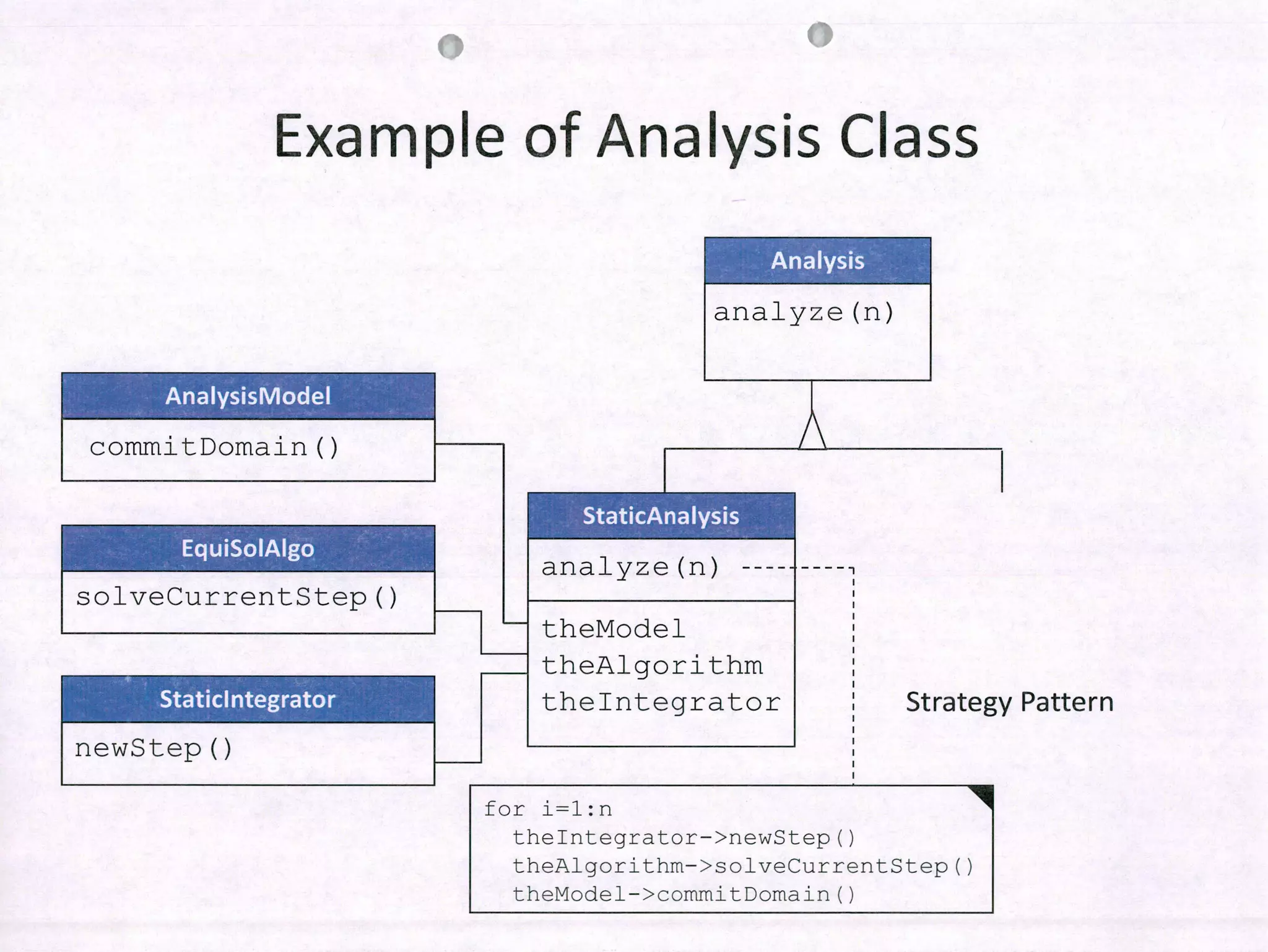
Example of Analysis Class
El ernent
u p
GeometricTran
Basic System
p = af q
715Linear
LinearPD
Corotational
q2,t
1
'0
u=au
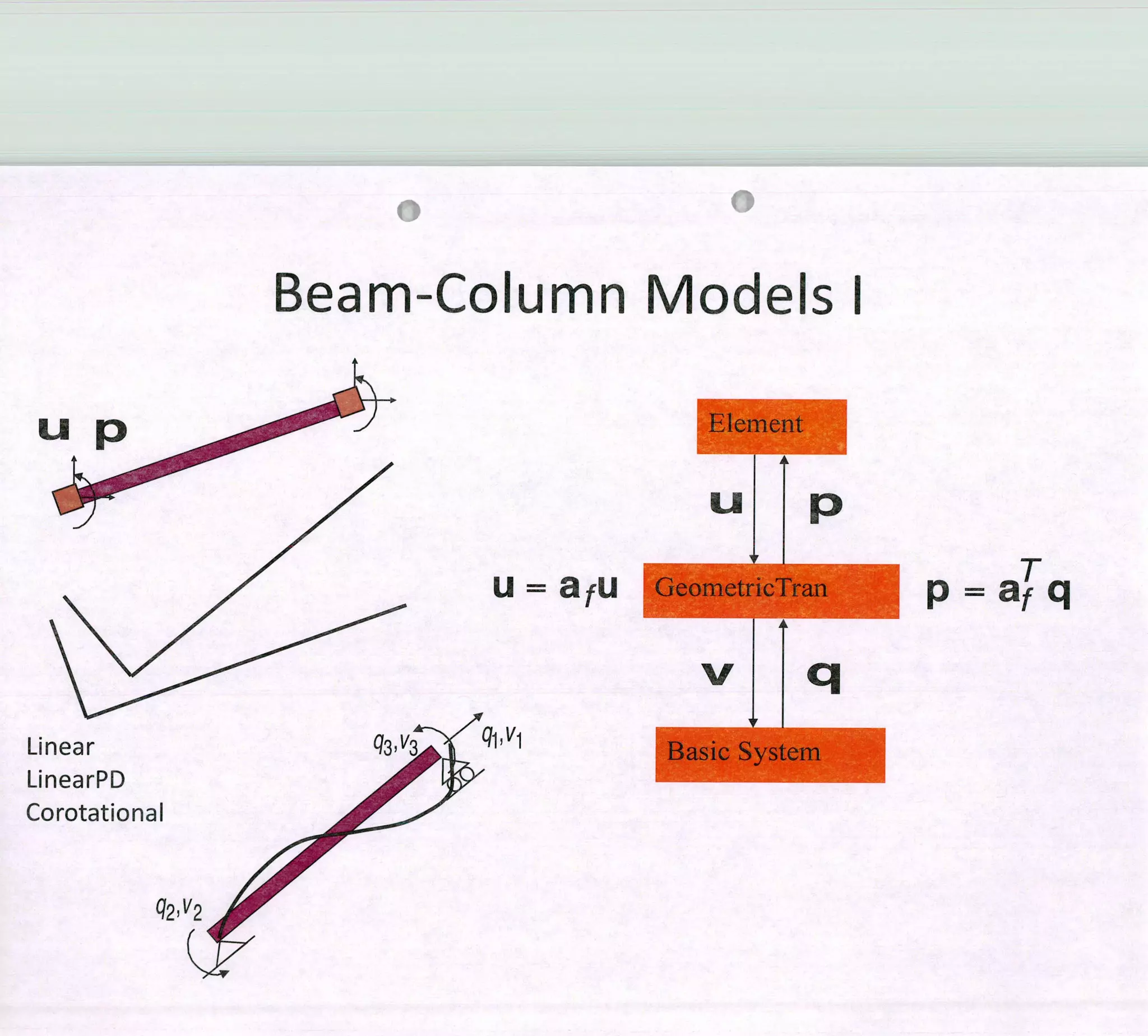
Beam-Column Modeis 1
"11i
q=j aTscix
q2,t
71,V1 Displacement
e=av
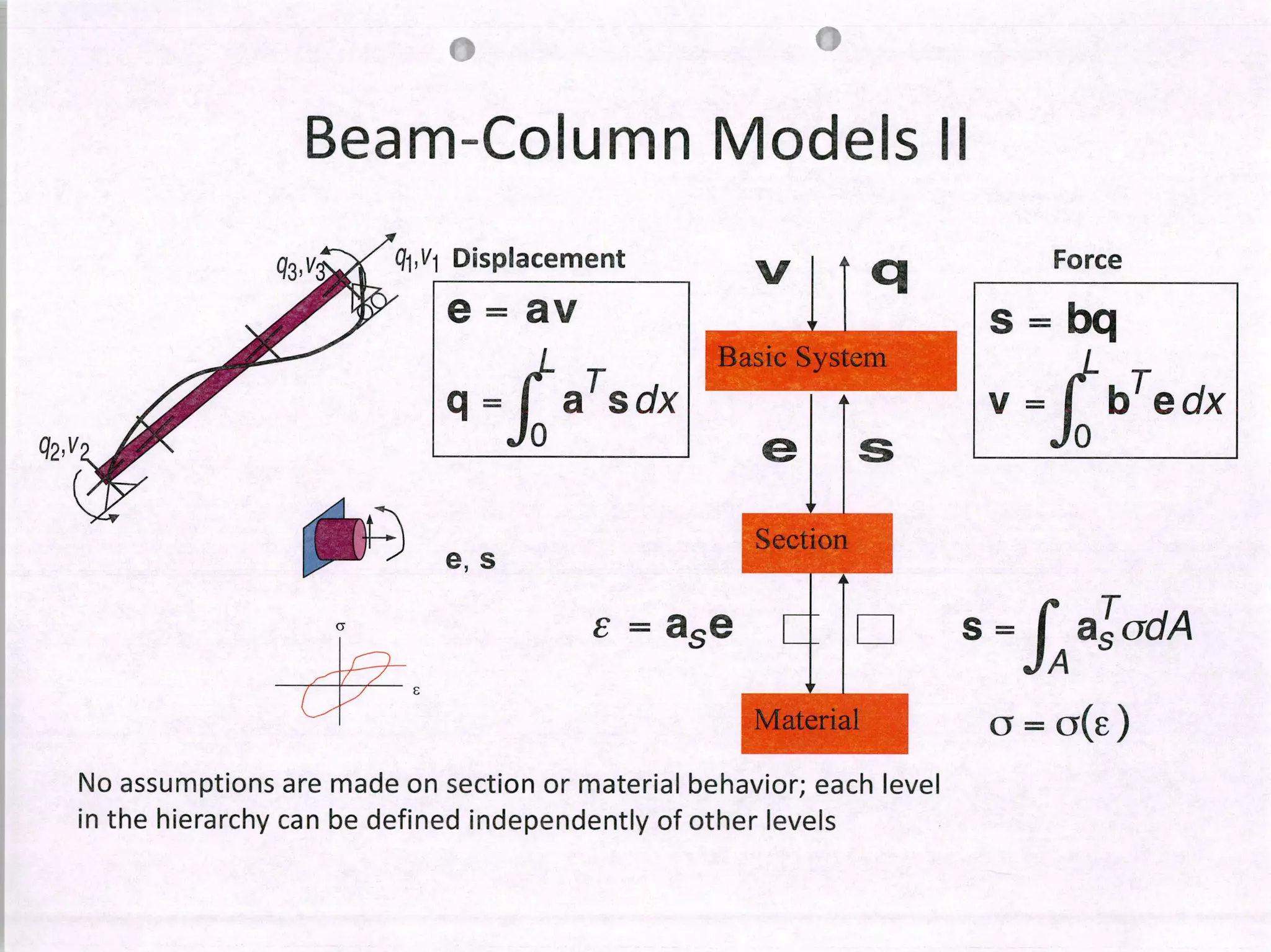
Beam-Column Modeis II
v1 q
Basic System
e lJsS ection
Force
s=bq
y =fbbTedx
L
e = ase s
=fA'
Material o = G(E )
No assumptions are made on section or material behavior; each level
in the hierarchy can be defined independently of other leveis
Form Follows Mechanics
acrdA
LVf
z]
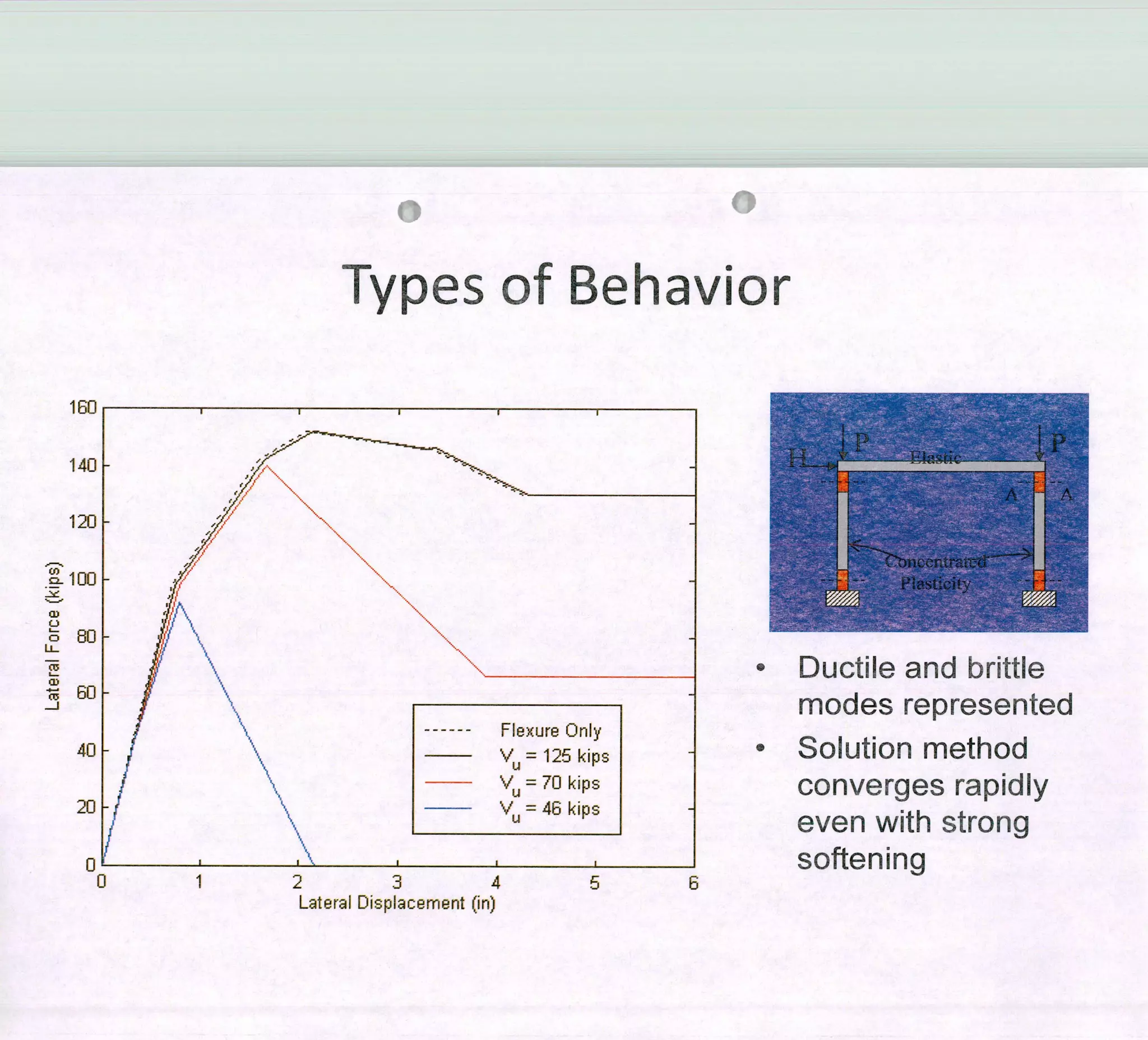
Types of Behavior
Ip
AHA
120
(O
:2 100
Cu
ci
80
u-
-a
60(T5
—J
40
mun
0
Fiexure Orily
Vu = 125 kips
= 70 kips
V1 =4Bkips
1 2 3 4 5 6
Lateral Dispacernent (iri)
[n(er
- 1asticity
• Ductile and brittle
modes represented
• Soution method
converges rapidly
even with strong
softening
160
140
26
26
24
26
26
18
16
14
12
10
O
4
2
24F1 24F2 24F3 24F4 24F5 2426 3403 3404 3405 3608
Expk
2601 2602 2603 2604 2605 2606 3603 3604 3605 3608
Errp1
..
Machine&oker
startActor(chax *thePro
Chanrtel &heChneI
mt comp Demend)
OpenSees Parallel Processing
- NP3 NP4 ~ NP5 ~ NP7
T • •
Ácb.QmeiL :1 •
ÁdiIe:l
1
DomainCompon&t Matrix •
mP Saek€tI a a
[ IO3 •00l - _____________ 1 Subdomain 1
______........:4
rmo
Large-Scale Computing and Visualization
/7•__•
E3 , --v
° 30,237 nodes
• 1,140/280 linear/nonlinear BC elements
* 81 linear shell elements
• 23,556 solid brick elements
• 1,806 zero-length elements
Click en a directory to enter that directory. Click en a file te display ita revision history and
te çjet a chance te display diffs between revisions,
Current directory: [local] / OpenSees / SRC
Ry Acie API Last loa entry
l3SflU
• r
0000k —
0000000 Weloomo! TOis pago conteino (orne 00001,1 :nt,:rnaOoi br IGL] b,e,o 001,10. ono 10000000 olLed 11
tOe codo deveboornent of Openoees
ObOWPLQOQ
Documerttation Broese the Source Code
Refute vou begin and lOO cOno
no ,et stuck 000000 3Ia 100 0:1 GEn 00€ o-:o-ti- o- - ,0000
'1 urnentatOn FO, fleO uSor: 00 1010,0 0[000 01000 001JG e codo
o-
/,-' 
005ees, hav 3 00k 00 Iho OflL'flc
— niceos to gel vourselytmni cro
y' ccc lCr wOk tOe 0:01311 000 , 00,
:000 orograrnm000 who necd
:0 understand toe tone,
uork:ngo of toe (lesees 0303
00k 00 tOe Cipos Seeç'fcçancr 5-
Downiogd CYS
Donboad tf,e source 113 000 licOse Ocio; 3:0 , 0 deslaprnor,t
Oil
IEh;0 :°
oo—
NEESI
ce: Bu,lds Contribute
10,0 of tOe buid wcçtructcon, fo T. Contoibute codo icbrn,t -i al'
finid out bnw 0€ ooecp,le ibiS 0000gev 00 luIsito; bh
bonO en ceo' pIptfo,rn. Reos ,r,000uQutt II tOe codo chpnçlei
are neelcing en e nno pietfenn ,e epproced tOco libo
- cb;00
1
Fi'e
Parent Directory
Ü AtJ/ íDont hidej
converenceTesti/
D coordTransformation/
O damaae/
O deta base,!
docZo
ci __
OQLDQb
O handIr
O machine/
O materiai:
O modelbui[der.í
O nDarray/
O otimization/
O poickacie/
O recorder/
.
OpenSees as Open -Source Software
Open Source ls...
• Roadmap
• Architecture
• Program Interfaces
(APFs)
• Code repository
— Checkout/in
— Branch/merge
— Versioning
• Release engineering
• Testing
• Validation & Verification
# set sorne variables
set gMotion el centro 2 D Steel Moment Frame
set scale 1.
set roofWeight [expr 80*120.*72./l000.]; #kips;
set floorWeight [expr 95*120 . *71/1000 . 1;
set nurnFrameResisting 2.0; #load resisting frames
set percentLoadFrame [expr 15 .1120.]
set dampRatio 0.03
set model 1 ROOF
set mode2 3
set Fy 60. 6
set E 30000. 5
set b 0.03
4
#setuprnylists 3
set floorOffsets {216. 150. 150. 150. 150. 150
set colOffsets {288. 288. 288.}; #inches
2
set colSizes {W30X173 W30X173 W27X11
Load: 95psftypical, roof8Opsf
E=2990009 Fy=50.0, b =0.003
3% Rayleigh Damping lst and 3rd Modes
(1k) (1íi) W24 x 76 (1;),
6h Siory
JW24 x 76
W27 x 94
1W27x94 24 fi -
W30_x_99
n.
2nd Story
W30 x 99
setcoitxizes 1vvI4ÁI9 VV1'4AJi VV14Á1 ' ' •' - '' '' '_•'
set bearnSizes {W30X99 W30X99 W27X94 W2/X94 W24X/b W24X/bÍ;
# build and run the model using standard template file
source SteelMomentFrame2d_UniformExcitation.tcl
5ft
IIr(_ - A 1.1 Af1 '. A II AF-1 A 1.1 AJI r
fi
Concrete Building Study
113 records, 4 intensities
3 hour a record, 1356
hours or 565 days.
Ran on 452 processors
Qn XSEDE in Iess than 5
hours.
- - -
01 ,
set pid [getPIDJ
set np [getNP]
set count O;
source parameters.tcl
source ReadSMDFieNewFormaticI:
foreach GMfIle $...de (
foreach Factcrl248 $iFactorl248
if ([expr $count % $np] == $ph) {
set inFile $G.Md...nS.GMf'ie.AT2
set outFile $GM.d.ir/.$. .M.flç.g3;
ReadSMDFileNewFormat Sin File $outFile dt nDts;
wipe
sou rce GravityAn alysisS cripttc
loacCons: .::me 0.0;
wipeAnalys is
source EQRecorder,tcl
source EQAnaIyssScript.tcl
if($oko{
us "Process S.id $GMfiIe x $Factorl 248 FINSHED OK modelTime [getTirnejj'
} else
Duts Process $GMfile x $Factorl248 FINSHED FAIL modeTíme [getTirne] desredTime S.a.xA..aJysi
}
incr count 1
1
zone f,
': i
/,,ne 4 PGA4OOp1 -
/onc 2
-044
7-7
1
r -...
jprf
Prof Xin-Zheng Lu
Tsinghua University
¡
u
How Does OpenSees Compare With
Commercial Software?
!
!.
1:12
:lo - PGA 40Og -
so
60
40
Shanghai Tower
u H632m, 124 stories
u 53,006 nodes
u 88,089 elements
u 48,774 fiber beam elements
u 39,315 multi-layer shell
elements
u Memory used: 8.9GB
Similar Resul t -(Results
PGA 4O0g1
100
so
0.2 025 03 0.35
Ii
with commercial applications
the same íff model and analysis are the same)
Lessons and Observations
• Many see the benefits of exchanging research and
ideas through software
• Success depends on ability of developers to
understand abstractions in the software design
• "Not invented here" is sometimes an issue
• Computing education and experience of civil
engineers makes the learning curve look steep
• Many users just want the code and are not interested
in open-source
• Documentation is never good enough
• Long-term support of an organization is necessary
• Innovation is possible, but it takes long-term
commitment
.
Using the Internet for Simulation (2001)
MOdl Bud
LMateriais lements Other
o Solution Procedures
N.J
ca Solvers
(1)
>
Compute Technology
Internet
API's
Data bases
Schematic of Simulation in the Future (2002)
aci . modeis org
modelBuiiders cern
E
o
o
-H
o
o
buildingcode. org oomputatiori. com
usgs . gov
o __ o
Cloud Computing
Servers Virtua' Desktop Software Platform
e. a.... .
Router IL í
o o o
líl 101
Cloud as Deployed Services
Sofare
as a Service
(1)
4)
Platform
as a Service
o
4)
(1)
Infrastructure
as a Service
D
o
o
>
1
! 11 U1 I II
1 1 Onf,pp 'oc
jj
Ir 00,
1
//t?9
a.
V
o
o
4)
>
a.
o
o
>'
c
E
E
o
o
Deployment modeis
Key Question for the Future
• How will nonlinear simulation modeis based on
fundamentais be developed for use in
performance-based design?
• How will validation, verification, and uncertainty
quantification (VVUQ) be incorporated in
earthquake engineering simulation?
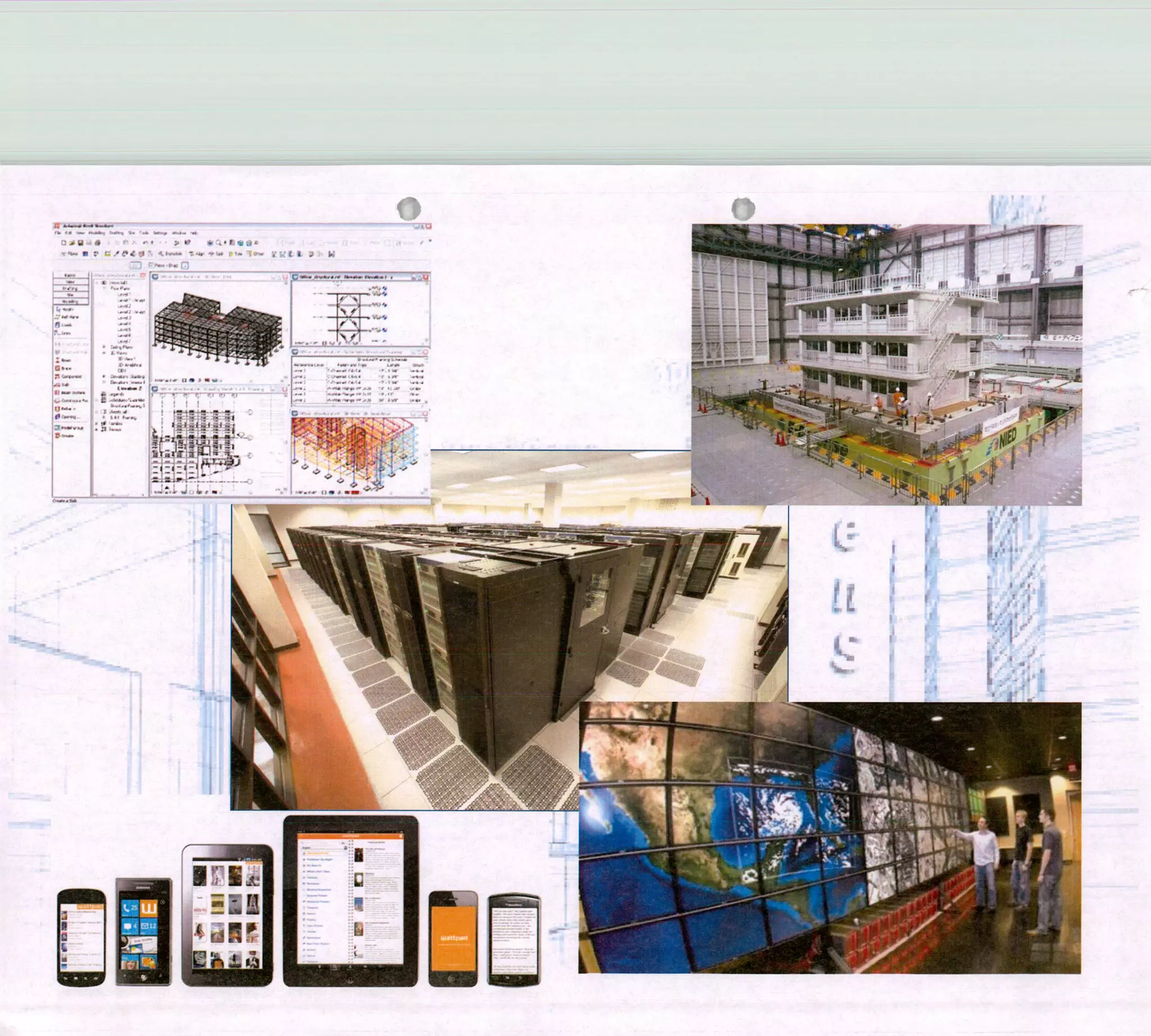
• How will the earthquake engineering industry use
transformational cloud-based services?
t
c
u-. -
1 -
Mi
j
;l'.1• 1. -_ a..-
r - :
IS
..
1
- 1
-
:
1

The Open-Source Approach for Computational Modeling and Simulation for Earthquake Engineering: History, Accomplishments, and Future Needs

  • 1.
    141 The Open-Source Approachfor Computational Modeling and Simulation for Earthquake Engineering: History, Accomplishments, and Future Needs .4 Gregory L. Fenves ¿ Cockrell School of Engineering The University of Texas at Austin 1!Tih, 1 .....- •i E National Autonomous University of Mexico Mexíco City, Feb. 5, 2015 c
  • 2.
    - i) i] - HP-1 i] - (Lr l'LJ 1 Fundamentals Are Timeless 38 C. FLIOaBILIrÍ OF A i-p I'1BBa Considering the slice as the basic elenent of the 1-O camber, the sarne 000rdinate transformation procese discussed aboye can be used te c1cu1tta the flexibjljty of any arbitrary 1-D member. To demonetrate the procedure, the flexjbjljty of a straight, Uaiforni bar will be evaluated. 1. Unifona Bar y - ELAflC PRCPTI.Ç A-nAI P(cg - L -------__ (L OL Kc 4 flne first step ja any flexibility cnolysjs is the seleetion of the forne systen for whjch the fiexlbility is desired. Ifthebarjs te be used ja structure lying and loaded in one plane, the three forces ahovn ja the sketch wouJ.d be saltable. The flexibillty of the bar may now be cbtaned by su=ing up the internet york ja all Slices of length dx caused by unit values of these external jorcas, thus F = . 1 (bi)Tf1b1 JL(bs)Tfsbsdx The alice flexibiljty f 5 is given in Eq. 13. The jorge tran5formatjoa matrix b 5 represente the fornes ja the arbitrary slice at position "x" causeci by unit values of the externel meniber fornes, thus P 1 0 0 mz O1- p M o o o (15) y MIy L L -JBar y T o o Oj nr alice S5 = b5R (15a) Noy ja Calcndatisg the Internet work of t:e &ljce at position "X" Ray Clough, UC Berkeley, 1960s PLEKURAL / ELt)flt.
  • 3.
    But Software EvolvesSlow1y 1 Category 1 Command Basic k Gcometry larc circic 1 spline lcurv,2, 1, 2,3, 0. 0000 4 04084 0.00000000000 0000e+0 1. 000000000000000e+O 1. 000000000000000e+O 1. 000000000000000e+Ü 1. 000000000000000e+ioü 1.0000000 00000000e+000 6. 66666666()666667c-U(JI 1. 000000000000000e+000 Ii 14 &_I ;. !TT1JLS.
  • 4.
    0 Simulation State-of-the-Art 0 "The Good" -Linear structural analysis routine - Good commercial software widely used and ¡ntegrated with BlM - Nonlinear static analysis becoming important - Performance methods becoming more widely used, e.g. ATC 58 9 "The Bad" - Linear analysís with equivalent latera 1 loads is not simulation - Nonlinear static analysis uses very simplified models; it is not simulation - "Performance criteria" not thoroughly investigated, e.g. FEMA 356, nor modeis adequately developed - Long way to go in including uncertainty quantification
  • 5.
    rs ro and theUg1y • Many non linear analysis methods based on concepts from 1980sat often software architecture from 1970-1980s • Underinvestment in research in simulation, and what ¡s done is not well organized Poor Iinkages between fundamental experimental studies and modeling; ¡nsufficient validation and verification of models • Simulation modeis, methods, and computational procedures in earthquake engineering have not kept up with rapid advances in computing hardware, software engineering, databases, network communicatíons - Limited interaction with computer science - Inadequate education of students in computing
  • 6.
    Observations on HistoricalSituation with Simulation Software • Tight binding of modeis in research and commercial codes is an impediment to new research and implementation of modeis for professional practice. • Embedding of computational procedures in codes makes it difficult to experiment and take advantage of computing technology: - Parallel and distributed computers - Computational grids - Now, cloud computing • "Closed-source" ¡s the norm, whereas other fields have adopted "open-source" software for communities users.
  • 7.
    Simulation Needs in EarthquakeEngineering • Performance-based engineering depends on evaluation of damage and estimate of consequences • Rational, validated modeis of behavior of structural and geotechnical materlais, components and systems are needed for simulating performance • Simulation applications: - Assessment of performance - Design using parameterized modeis, including optimization with performance constraints - Reliability-based desígn - Regional loss estimation and disaster planning • Additional applications include structural and system health monitoring for control and operations
  • 8.
    Simulation Has Transformed OtherEngineering and Science Fie1ds £ • Computational chemisiry, Simulation- Based computational bioiogy Englneering Science • F/1 a te r ¡ a 1 s ci e11ce, p a rt ¡ c u 1 a rl y a t Sinn,lo,io,, nano-scale • Computational fluid dynamics S.dE,g,ong - Aerodynamics - Building interior environment - Virtual wind tunnels • Aircraftdesign • Automotive design • U.S. nuclear weapons stewardship (ASCI, PSAAP)
  • 9.
    fN Vision for EarthquakeEngineering Simulation (2007) NEES Computational modeling and simulation is central to the vision of NEES to transform the development of new earthquake engineering solutions from being primarily based on experiments to a balanced use of simulation and experimentation using computational modeis validated by experimental data. A close integration of modern computational modeis and simulation software with other NEES applications and services will provide the earthquake engineering community, and broad engineering users, new capabilities for developing innovative and cost-effective solutions. NEES George E. Brown. Jr Network for Earthquake Engineerrng Simuiation a-1: (op n riu Te±icic.rv V:ir cf tIe 3.rdfDtec:'r; c'EE". la:. Information Technology within the George E. Brown, Jr. Network for Earthquake Engineering Simulation: A Vision for an Integrated Community . 1 t'••_Ç, . nr; .-..•' - .•j . 4L 1
  • 10.
  • 11.
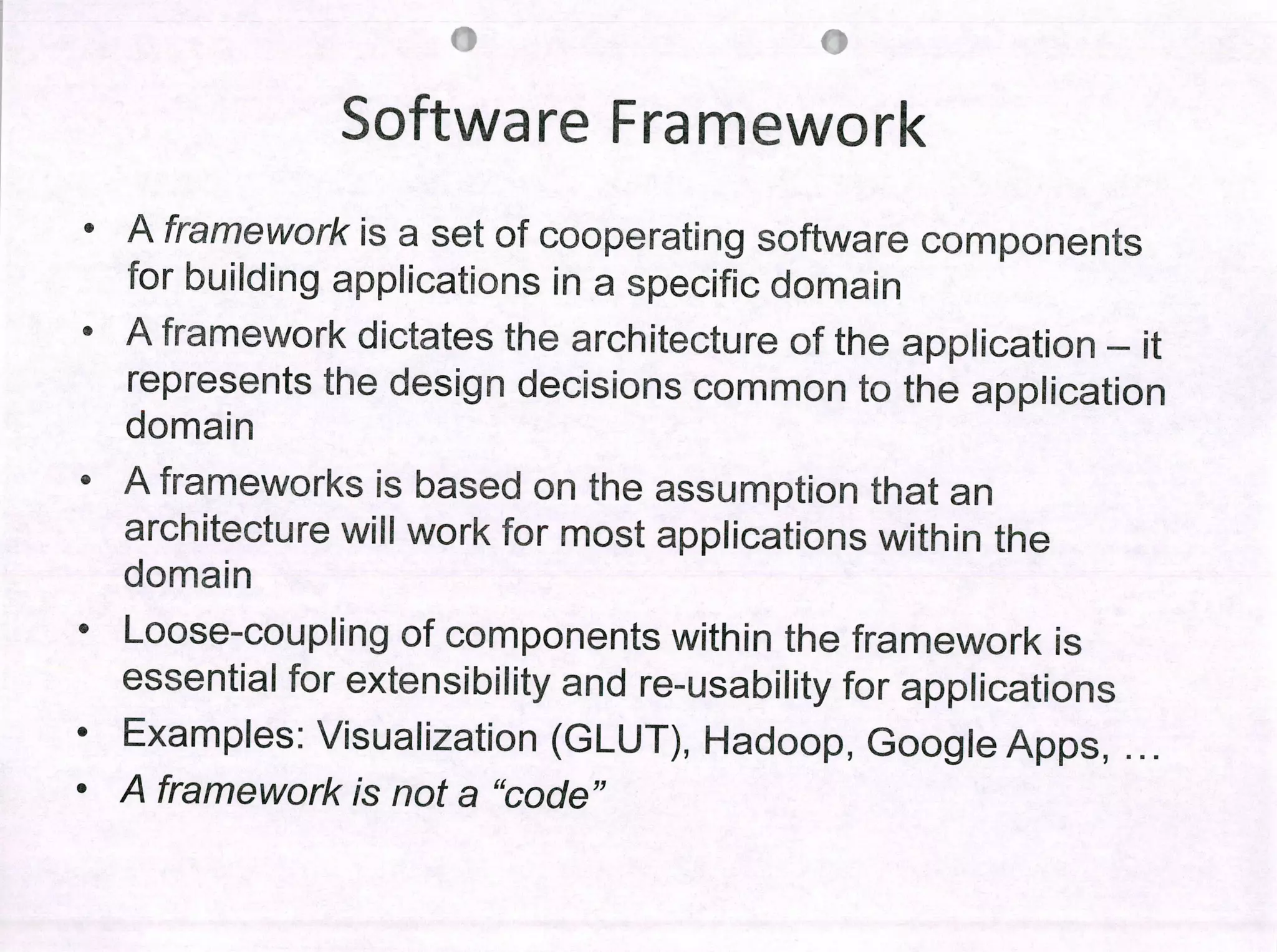
    09 Software Frarnework • Aframework is a set of cooperating software components for buiiding appIications in a specific domain • Aframework dictates the architecture of the appiication - it represents the design decisions common to the appiication domain • A frameworks is based on the assumption that an architecture wili work for most appiications within the domain • Loose-coupiing of components within the framework is essentiai for extensibiiity and re-usability for appiications • Exam pies: Visualization (GLUT), Hadoop, Googie Apps, • A framework ¡s not a "code"
  • 12.
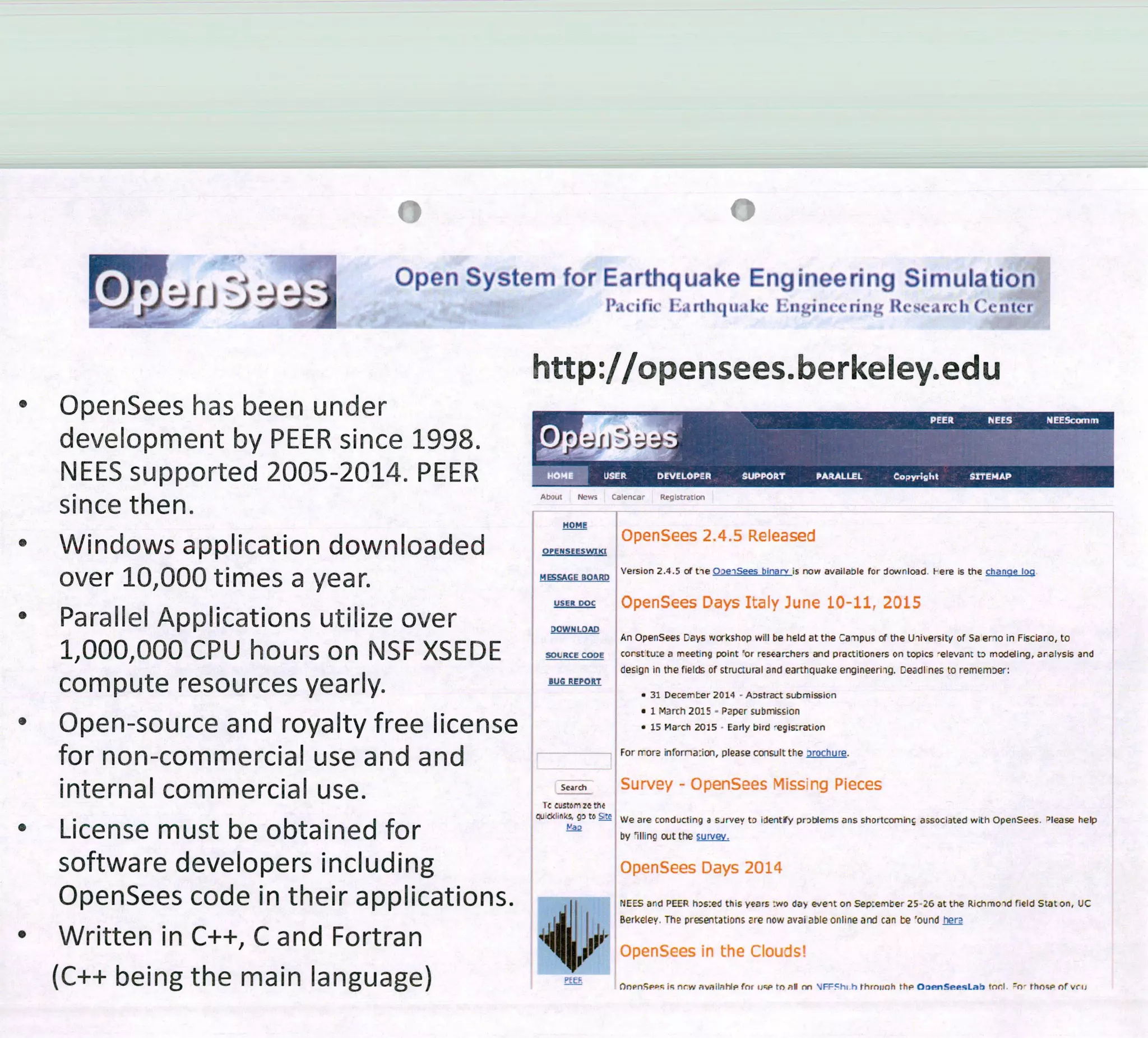
    o . J1e Open Systemfor Earthquake Engineering Simulation P.tcific 1trtIlthIht Iiigincenng Res..trc h Cc fltcr • OpenSees has been under development by PEER since 1998. NEES supported 2005-2014. PEER since then. • Windows application downloaded over 10,000 times a year. • Parallel Applications utilize over 1,000,000 CPU hours on NSF XSEDE compute resources yearly. • Open-source and royalty free license for non-commercial use and and interna 1 commercial use. • License must be obtained for software developers including OpenSees code in their applications. o Written in C++, C and Fortran (C++ being the main language) http://opensees.berkeley.edu ~ ,j 'er) ca, Pr ±,trtJon HOME OpenSees 2.45 Released OPENSEESWIXI HSAGE BoRD 'ersion 2.4.5 of tieOe,Sees binarv ¡s now avatiable for Jownioad. Fere is the chanqe loo OpenSees Days Iy June 19-1 211, 215 )OWN LOAD An Opensees Days workshop will be heid at the Ce -npus of the Ulihersity of Sa eno in Fiscioro, to SOLRCE CODE corsttu:e a meeting point 'or researzhers and practitioners Qn topics elev a nt tD rnodding, aralvsis and clesign in the ficicis of structural and earthquake engineeriig. Deadi nes to relnemDer: BUG REPORT • 31 Deceínter 2014 - Aostract submissicn • 1 March 2015 . Papar submision • 15 Ma-ch 2015 Early bird egis:ration For rrore inforna:icxi, please coosult the arochure. Search Survey — OpenSees rvIissing Pieces Ir cuSIornzethe tO 5_C We are conducting a sJrvey to tdenty prabems ans shortcominc associated with OpenSees. 'lease help by lIIinç c*Jt the sicoy. OpenSces Days 2011 NEES ard PEER hs:ed this years :wo dab evelt 00 Sep:ernber 2526 at the Richmoid fleld Stat on, liC Berkeley. The prsetatiDns are now avai ¿tble onhine and can te 'ound .her3 'I .' ' pP .enSces in the CIouds! - ÚnpnSp'ç iç nrw nvaibh4p for ti-;P ro nl no 'j F"cht h rhrnich ftp OnenSeesLab tnP. rhoçp or vrij
  • 13.
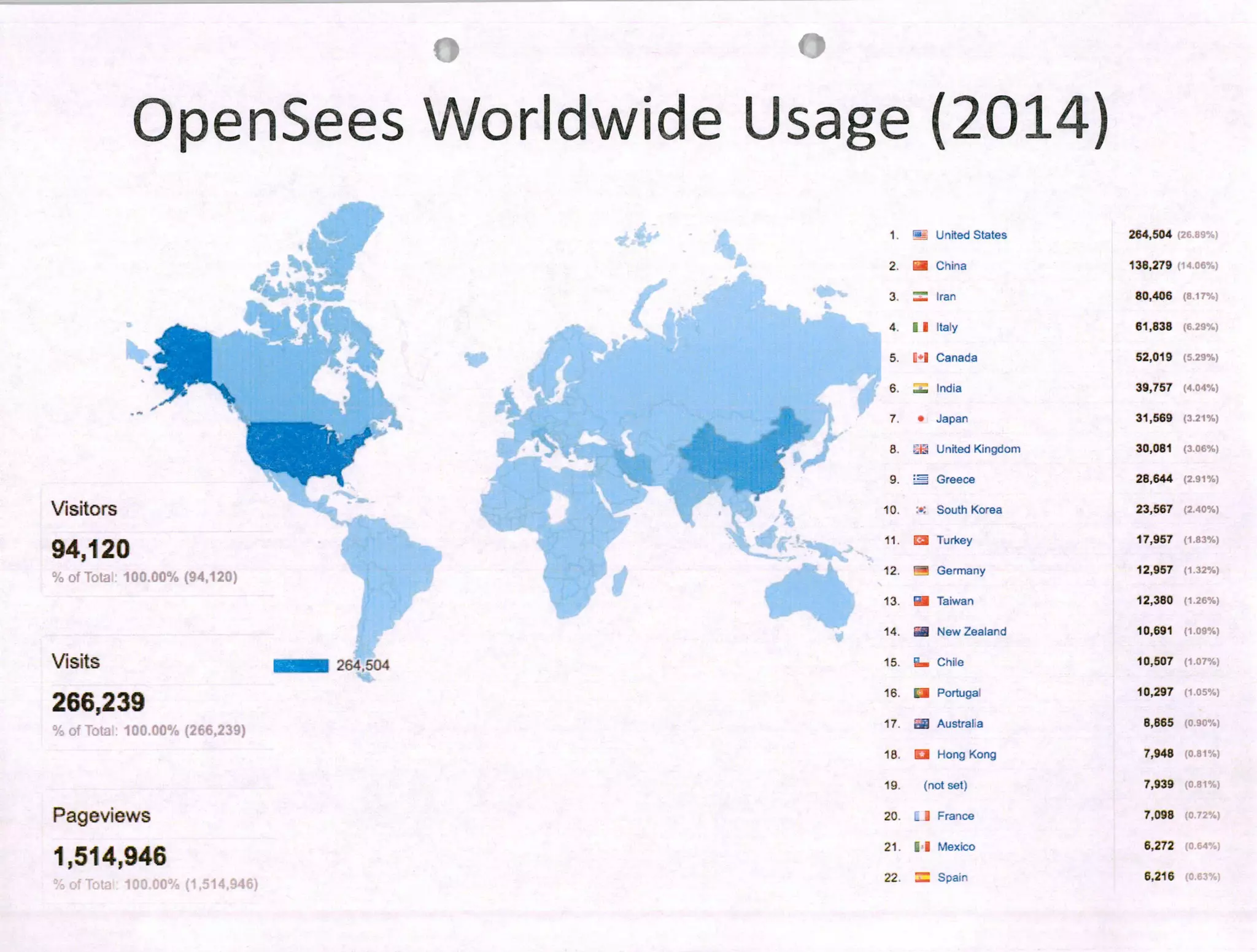
    United States 264,504.. a China 138,279 r%) = Irar 80,406 11 Italy 61,838 S. 1'1 Canada 52,019 •3J%) India 39,757 34%) • Japan 31,569 21%) United Kinpdom 30,081 6%) íE Greece 28,644 i%) ;. South Korea 23,567 3%) 0 Turkey 17,957 Germany 12,957 2%) 0 Taiwan 12,380 6%) 14, a New Zealard 10,691 L. Cnie 10,507 Í%) Portuga 10,297 3%) Australa 8,865 .3%) El Hong Kong 7,948 1%) (not set) 7,939 1%) .. France 7,098 2%) El Mexico 6,272 vv) = Spain 6,216 Pageviews 1,514,946 4f .4 264,504 Visitors 94,120 Visits 266,239 ¿ río OpenSees Woridwilde Usage (2014)
  • 14.
  • 15.
    Ir OpenSees Approach toSimulation c Basic approach: - Modular software design for implementing and integrating modeling, numerical methods, and IT for scalable, robust simulation - Focus on capabilities needed for performance-based engineering - Programmab!e interfaces 11 Most users: a "code" for nonlinear analysis. Fully scriptab!e. • Generaily: a software framework for developing simulation applications.
  • 16.
    Structural Modeling andSimulation Non-ductile RC frames and calíbration of buliding code provisions C. Haselton, G. Delerlein, Stanford - Joints with both bond-slip springs and shear springs fl.. o 1Column base ond-sIip springs Corotational geometric transformations
  • 17.
    - 11 JU111 UC San Diego, 2008
  • 18.
    wi lil Examples of OpenSeesApplications • Parametric studies to examine relationship between intensity and damage for PBEE and design procedures • Computational reliability for PBEE • Soil-structure-foundation interaction • Spatial distribution of damage • Simulation of bridge performance
  • 19.
    Conceptual Approach forSimulation Algorit 1 Solvers nework, ParaIIe sualization, compu com putation nent, system
  • 20.
    1 Simulation Software Architecture TraditionalCode Fra mework of Components User Interface Input Language Base Code Compute Technology Applícation Program Interface (API)
  • 21.
    Software Depends onExpressiveness of Language and Power of Processor(s) rJJ2 - Brov,,ser operEdit5tnng Disp Browser operMessa9ecstEdItStrr: Browser openOnCIassWithEditString 8rowse operysternCatEdit5trinq sendets em 'o - send - - - Tool-Inspertor CbangedMessaqeset mesoaqe Iist defneMesqe.00tityu Tocs-Exorer Fakeçlasspool defineMessageFromrs Toals-Debugger I1ierorchyBroeser codo pene inspectinstances To -Fkliçt LinkedMessageSet metadaes inspectSubjnstances (. TooJs-Fe Contente Brc Meseageset copying message1istMenu;sh1t Tods-Changes PackageBrowser drag and drop removeMeesage Syetem-Compiler case removeMeesegeFromB (: eedei'e inplernentois versons ehentance hierarchy instvars daes vare (: IJOptbiFeittoroVie W?j rid again (g) set search etrino (h) W onVie, do again (j) lt fwet previousView 1 eVi,,-VÍew nos, undo(z) bt$eiit '- se opt °0PY (c) L,, CV,ew windoos: (O pate()eight), aV,ew borderWkjt paste,. bottoçn: 1 offset-O, doit(d) ______________________ print it (p) firet .-true. inspect it (i) pres'iouçS'iew ti4 accept (e) -- more,..
  • 22.
    What is Object-Oriented SM411I4LK-80 Programming? •Object-oriented programs are composed of objects that bind data and operators on data • Objects are operated upon by sending messages to it. The public ¡nterface defines the operations on an object • Object's internal state is encapsulated ¡n the object. The implementation is private • Classes define the software behavior of objects. • Classes and their objects are designed to represent key abstractions • A programmer should be able to use a class through the interface independently of the implementation
  • 23.
    Object-Oriented Finite Element Frametwork r14'IltvclI' nil 4 E 1v In4IIt P rogralnllki ng: Fra IIk4'<)rk-i for i IIi Iv-i-. A l!.!pri 1 IIH4 a 11(1 Pa ial tul ( )IJhJ)lI 1 III LZ 1•. e. 1 . '1 I.; I. 1 Uhi% C'Ill'-L I11L1)lIU. III. !III 1 1TI$, (u11I'I F?I1_.1,!I.1'I.1.-i.I l'I Domm 1 Males LodCas .W_CoaamT SP_Consti.irnt 1 Ld ' Trus CorntumEimut J ' ¡li_u. lii, u_ii 1•'l1 1 1- "1 od1L1 EktevLiLLd eaniPLod • • i _ —E —L - iur lI IlI_1IIjI;,JIl' i 1 1 i II:, 1 'i . 1IJ1•.I 1 .4MC#S?J ........... - ls_-»..._............. - U..-. t 4 E.. 4..ii.. ... Li. - £ £tdO*iS4E 1997
  • 24.
    . Structural Modeis asAggregation Pattern 1I 1u E r
  • 25.
    Analysis Class forSimulation Analysi for per domair
  • 26.
    1 Pattern Example ofAnalysis Class
  • 27.
    El ernent u p GeometricTran BasicSystem p = af q 715Linear LinearPD Corotational q2,t 1 '0 u=au Beam-Column Modeis 1
  • 28.
    "11i q=j aTscix q2,t 71,V1 Displacement e=av Beam-ColumnModeis II v1 q Basic System e lJsS ection Force s=bq y =fbbTedx L e = ase s =fA' Material o = G(E ) No assumptions are made on section or material behavior; each level in the hierarchy can be defined independently of other leveis
  • 29.
  • 30.
    Types of Behavior Ip AHA 120 (O :2100 Cu ci 80 u- -a 60(T5 —J 40 mun 0 Fiexure Orily Vu = 125 kips = 70 kips V1 =4Bkips 1 2 3 4 5 6 Lateral Dispacernent (iri) [n(er - 1asticity • Ductile and brittle modes represented • Soution method converges rapidly even with strong softening 160 140
  • 31.
    26 26 24 26 26 18 16 14 12 10 O 4 2 24F1 24F2 24F324F4 24F5 2426 3403 3404 3405 3608 Expk 2601 2602 2603 2604 2605 2606 3603 3604 3605 3608 Errp1 .. Machine&oker startActor(chax *thePro Chanrtel &heChneI mt comp Demend) OpenSees Parallel Processing - NP3 NP4 ~ NP5 ~ NP7 T • • Ácb.QmeiL :1 • ÁdiIe:l 1 DomainCompon&t Matrix • mP Saek€tI a a [ IO3 •00l - _____________ 1 Subdomain 1 ______........:4
  • 32.
    rmo Large-Scale Computing andVisualization /7•__• E3 , --v ° 30,237 nodes • 1,140/280 linear/nonlinear BC elements * 81 linear shell elements • 23,556 solid brick elements • 1,806 zero-length elements
  • 33.
    Click en adirectory to enter that directory. Click en a file te display ita revision history and te çjet a chance te display diffs between revisions, Current directory: [local] / OpenSees / SRC Ry Acie API Last loa entry l3SflU • r 0000k — 0000000 Weloomo! TOis pago conteino (orne 00001,1 :nt,:rnaOoi br IGL] b,e,o 001,10. ono 10000000 olLed 11 tOe codo deveboornent of Openoees ObOWPLQOQ Documerttation Broese the Source Code Refute vou begin and lOO cOno no ,et stuck 000000 3Ia 100 0:1 GEn 00€ o-:o-ti- o- - ,0000 '1 urnentatOn FO, fleO uSor: 00 1010,0 0[000 01000 001JG e codo o- /,-' 005ees, hav 3 00k 00 Iho OflL'flc — niceos to gel vourselytmni cro y' ccc lCr wOk tOe 0:01311 000 , 00, :000 orograrnm000 who necd :0 understand toe tone, uork:ngo of toe (lesees 0303 00k 00 tOe Cipos Seeç'fcçancr 5- Downiogd CYS Donboad tf,e source 113 000 licOse Ocio; 3:0 , 0 deslaprnor,t Oil IEh;0 :° oo— NEESI ce: Bu,lds Contribute 10,0 of tOe buid wcçtructcon, fo T. Contoibute codo icbrn,t -i al' finid out bnw 0€ ooecp,le ibiS 0000gev 00 luIsito; bh bonO en ceo' pIptfo,rn. Reos ,r,000uQutt II tOe codo chpnçlei are neelcing en e nno pietfenn ,e epproced tOco libo - cb;00 1 Fi'e Parent Directory Ü AtJ/ íDont hidej converenceTesti/ D coordTransformation/ O damaae/ O deta base,! docZo ci __ OQLDQb O handIr O machine/ O materiai: O modelbui[der.í O nDarray/ O otimization/ O poickacie/ O recorder/ . OpenSees as Open -Source Software Open Source ls... • Roadmap • Architecture • Program Interfaces (APFs) • Code repository — Checkout/in — Branch/merge — Versioning • Release engineering • Testing • Validation & Verification
  • 34.
    # set sornevariables set gMotion el centro 2 D Steel Moment Frame set scale 1. set roofWeight [expr 80*120.*72./l000.]; #kips; set floorWeight [expr 95*120 . *71/1000 . 1; set nurnFrameResisting 2.0; #load resisting frames set percentLoadFrame [expr 15 .1120.] set dampRatio 0.03 set model 1 ROOF set mode2 3 set Fy 60. 6 set E 30000. 5 set b 0.03 4 #setuprnylists 3 set floorOffsets {216. 150. 150. 150. 150. 150 set colOffsets {288. 288. 288.}; #inches 2 set colSizes {W30X173 W30X173 W27X11 Load: 95psftypical, roof8Opsf E=2990009 Fy=50.0, b =0.003 3% Rayleigh Damping lst and 3rd Modes (1k) (1íi) W24 x 76 (1;), 6h Siory JW24 x 76 W27 x 94 1W27x94 24 fi - W30_x_99 n. 2nd Story W30 x 99 setcoitxizes 1vvI4ÁI9 VV1'4AJi VV14Á1 ' ' •' - '' '' '_•' set bearnSizes {W30X99 W30X99 W27X94 W2/X94 W24X/b W24X/bÍ; # build and run the model using standard template file source SteelMomentFrame2d_UniformExcitation.tcl 5ft IIr(_ - A 1.1 Af1 '. A II AF-1 A 1.1 AJI r fi
  • 35.
    Concrete Building Study 113records, 4 intensities 3 hour a record, 1356 hours or 565 days. Ran on 452 processors Qn XSEDE in Iess than 5 hours. - - - 01 , set pid [getPIDJ set np [getNP] set count O; source parameters.tcl source ReadSMDFieNewFormaticI: foreach GMfIle $...de ( foreach Factcrl248 $iFactorl248 if ([expr $count % $np] == $ph) { set inFile $G.Md...nS.GMf'ie.AT2 set outFile $GM.d.ir/.$. .M.flç.g3; ReadSMDFileNewFormat Sin File $outFile dt nDts; wipe sou rce GravityAn alysisS cripttc loacCons: .::me 0.0; wipeAnalys is source EQRecorder,tcl source EQAnaIyssScript.tcl if($oko{ us "Process S.id $GMfiIe x $Factorl 248 FINSHED OK modelTime [getTirnejj' } else Duts Process $GMfile x $Factorl248 FINSHED FAIL modeTíme [getTirne] desredTime S.a.xA..aJysi } incr count 1 1
  • 36.
    zone f, ': i /,,ne4 PGA4OOp1 - /onc 2 -044 7-7 1 r -... jprf Prof Xin-Zheng Lu Tsinghua University ¡ u How Does OpenSees Compare With Commercial Software? ! !. 1:12 :lo - PGA 40Og - so 60 40 Shanghai Tower u H632m, 124 stories u 53,006 nodes u 88,089 elements u 48,774 fiber beam elements u 39,315 multi-layer shell elements u Memory used: 8.9GB Similar Resul t -(Results PGA 4O0g1 100 so 0.2 025 03 0.35 Ii with commercial applications the same íff model and analysis are the same)
  • 37.
    Lessons and Observations •Many see the benefits of exchanging research and ideas through software • Success depends on ability of developers to understand abstractions in the software design • "Not invented here" is sometimes an issue • Computing education and experience of civil engineers makes the learning curve look steep • Many users just want the code and are not interested in open-source • Documentation is never good enough • Long-term support of an organization is necessary • Innovation is possible, but it takes long-term commitment
  • 38.
    . Using the Internetfor Simulation (2001) MOdl Bud LMateriais lements Other o Solution Procedures N.J ca Solvers (1) > Compute Technology Internet API's Data bases
  • 39.
    Schematic of Simulationin the Future (2002) aci . modeis org modelBuiiders cern E o o -H o o buildingcode. org oomputatiori. com usgs . gov
  • 40.
    o __ o CloudComputing Servers Virtua' Desktop Software Platform e. a.... . Router IL í o o o
  • 41.
    líl 101 Cloud asDeployed Services Sofare as a Service (1) 4) Platform as a Service o 4) (1) Infrastructure as a Service D o o > 1 ! 11 U1 I II 1 1 Onf,pp 'oc jj Ir 00, 1 //t?9 a. V o o 4) > a. o o >' c E E o o Deployment modeis
  • 42.
    Key Question forthe Future • How will nonlinear simulation modeis based on fundamentais be developed for use in performance-based design? • How will validation, verification, and uncertainty quantification (VVUQ) be incorporated in earthquake engineering simulation? • How will the earthquake engineering industry use transformational cloud-based services?
  • 43.
    t c u-. - 1 - Mi j ;l'.1•1. -_ a..- r - : IS .. 1 - 1 - : 1