www.england.nhs.uk/learningdisabilities
One year on
July 2017
Stopping the over
medication of people
with learning disabilities,
autism or both
www.england.nhs.uk/learningdisabilities
The core message
Public Health England says every day about
30,000 to 35,000 adults with a learning
disability are being given psychotropic
medicines when they do not have a diagnosed
mental health condition. This is often to
manage behaviour which is seen as
challenging.
It includes medicines used to treat psychosis,
depression, anxiety, sleep disorders and
epilepsy medication when it is only used for its
calming effect, rather than to treat epilepsy.
Unnecessary use of these drugs, puts people
at risk of significant weight gain, organ failure
and even premature death.
www.england.nhs.uk/stomp
www.england.nhs.uk/learningdisabilities
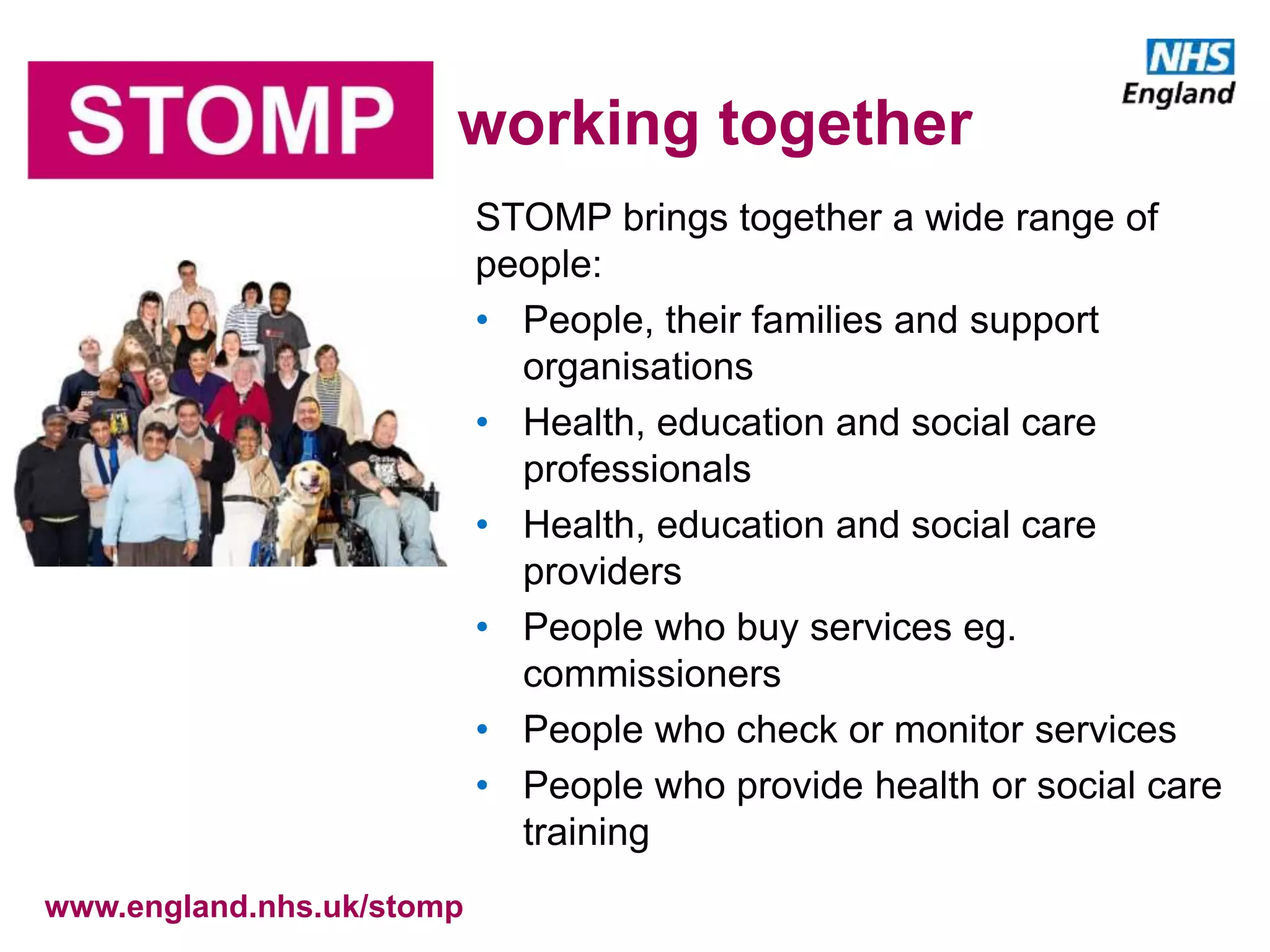
STOMP brings together a wide range of
people:
• People, their families and support
organisations
• Health, education and social care
professionals
• Health, education and social care
providers
• People who buy services eg.
commissioners
• People who check or monitor services
• People who provide health or social care
training
working together
www.england.nhs.uk/stomp
www.england.nhs.uk/learningdisabilities
Aims
1. Improve the quality of life of children, young
people and adults with a learning disability,
autism or both, who are prescribed
psychotropic medicines.
2. Make sure people are only given them
for the right reason, in the right amount,
for as short a time as possible.
3. Improve everyone’s understanding of these
medicines and give everyone the
confidence to ask why they are needed.
4. Improve understanding of non-drug
treatments and support which may help.
5. Make sure the person with their family and
paid carers are involved in any decisions to
start, stop, reduce or continue taking them.
www.england.nhs.uk/stomp
www.england.nhs.uk/learningdisabilities
Why STOMP?
• They are not always the right answer
• They can have major side effects
• They can reduce people’s quality of life
• They can be used as a type of restraint
• When people are drugged up the world
passes them by.
• This is a human rights issue
When are they right?
• Psychotropic medicines can have an
important role in treating many mental
health conditions when they are used well.
• Sometimes they are right if the person is at
severe risk of harming themselves or others
• As long as other treatments and therapy are
happening so that people will not need them
for long
www.england.nhs.uk/stomp
www.england.nhs.uk/learningdisabilities
Pledge
The STOMP pledge was signed in
June 2016 by
• Royal Colleges of Nursing,
Psychiatrists and GPs
• Royal Pharmaceutical Society
• British Psychological Society
• NHS England
• The Minister Alistair Burt
They pledged to work together and
with people with a learning disability
and their families, to take real and
measurable steps to stop over
medication.
3 year campaign up to 2019www.england.nhs.uk/stomp
www.england.nhs.uk/learningdisabilities
• Royal College of Speech and Language
Therapy
• British Association Of Social Workers
• Learning Disability Professional Senate:
Care Quality Commission, Clinical
Commissioning Groups, Challenging Behaviour
Foundation, Department of Health, Health
Education England, clinicians - art therapists,
psychologists, occupational therapists,
physiotherapists, dietitians, psychiatrists, GPs,
social workers, speech therapists and learning
disability nurses
• British Association of Music Therapy
• Voluntary Organisations Disability Group
More pledges made in 2017
www.england.nhs.uk/stomp
www.england.nhs.uk/learningdisabilities
• All the pledge partners are
working with their members to
promote the pledge, raise
awareness and introduce good
practice through methods such as:
• education programmes, pilot
schemes, presentations, articles in
journals, review of professional
roles, national conferences,
sharing guidelines and partnership
work
Reaching people, changing practice
www.england.nhs.uk/stomp
www.england.nhs.uk/learningdisabilities
• Partnership working with health,
social care, voluntary and charity
organisations, family and self
advocacy.
• Partners include the Challenging
Behaviour Foundation (CBF), Care
Management Group (CMG),
Voluntary Organisations Disability
Group (VODG) and the National
Development Team for Inclusion
(NDTi) Learning Disability England,
ARC England, and Skills for Care
www.england.nhs.uk/stomp
partnership working
www.england.nhs.uk/learningdisabilities
• Challenging Behaviour Foundation (CBF)
engaged with over 100 families on their
experiences of over medication and what
information and support they need.
• CBF published a report in May 2017 and have
also been commissioned to develop a
medicines pathway document for families and
online resource that will be launched in 2017
• NHS England has also commissioned Change
to engage with people with learning disabilities
and autism who produced a report
• Easy read materials commissioned and more
being developed
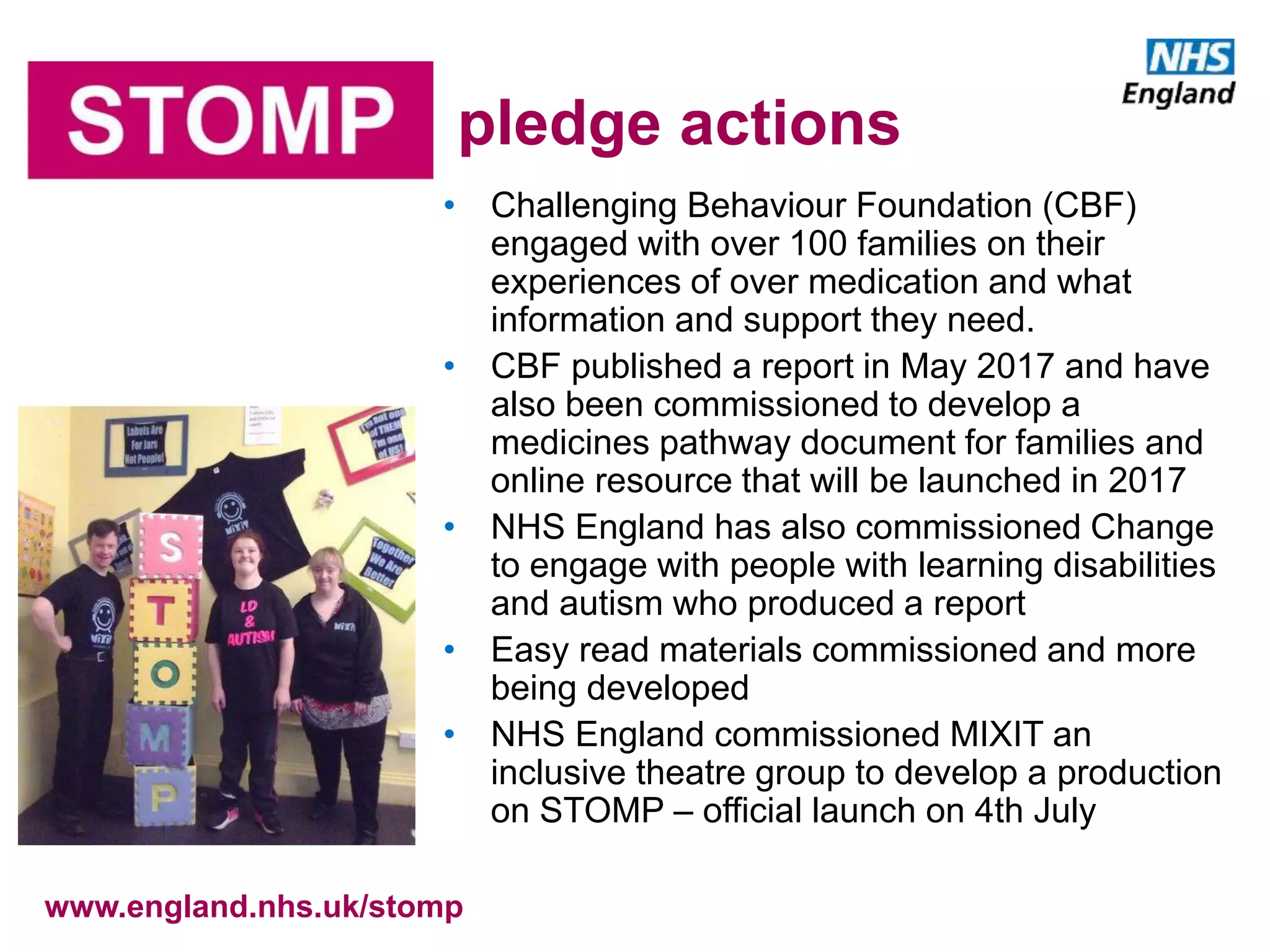
• NHS England commissioned MIXIT an
inclusive theatre group to develop a production
on STOMP – official launch on 4th July
www.england.nhs.uk/stomp
pledge actions
www.england.nhs.uk/learningdisabilities
Pledge for social care providers
A pledge for social care
providers led by VODG was
launched in May 2017
Already, more than 100
organisations have signed up
who support over 40,000
people. The pledge includes a
self-assessment and planning
template and can be
downloaded from the VODG
webpage on STOMP
A best practice guide produced
by the Care Management Group
(CMG) was launched in the
House of Commons on June 13
by Normal Lamb, MP
www.england.nhs.uk/stomp
www.england.nhs.uk/learningdisabilities
• Centre for Pharmacy Post-graduate Education –
online learning for pharmacists launched in October
2016. The course develops awareness,
understanding and key skills to help pharmacists
deliver high quality care to people with learning
disabilities, autism, families and carers. This was
sent to 65,000 pharmacy staff across England and In
2017, over 3000 pharmacists have been trained to
support STOMP
• Five-week pharmacy campaign on learning
disabilities including Facebook live, daily challenges
and Twitter chat. 685 took part.
• Specialist pharmacists and medical colleagues
reviewing prescribing for people with learning
disabilities, autism or both in the North East of
England, Hertfordshire and Manchester
• NHS England has appointed 3 pharmacists to a job-
share role and a family carer is working as a STOMP
adviser
pledge actions
www.england.nhs.uk/stomp
www.england.nhs.uk/learningdisabilities
• Royal College of Nursing (RCN) guidance
for pre-registration education students
(across all branches) on learning
disabilities includes a section on over-
medication. Online and hard copy
resource.
• RCN worked with Royal College of
Psychiatrists on good practice guidance on
psychotropic drug prescribing
• British Psychological Society articles on
STOMP in bulletins, Clinical Psychology
Forum, Division AGM and chair’s report.
Promoting alternatives to medication,
prescribing practice and the use of
Positive Behaviour Support (PBS) to
membership and other professional groups
www.england.nhs.uk/stomp
pledge actions
www.england.nhs.uk/learningdisabilities
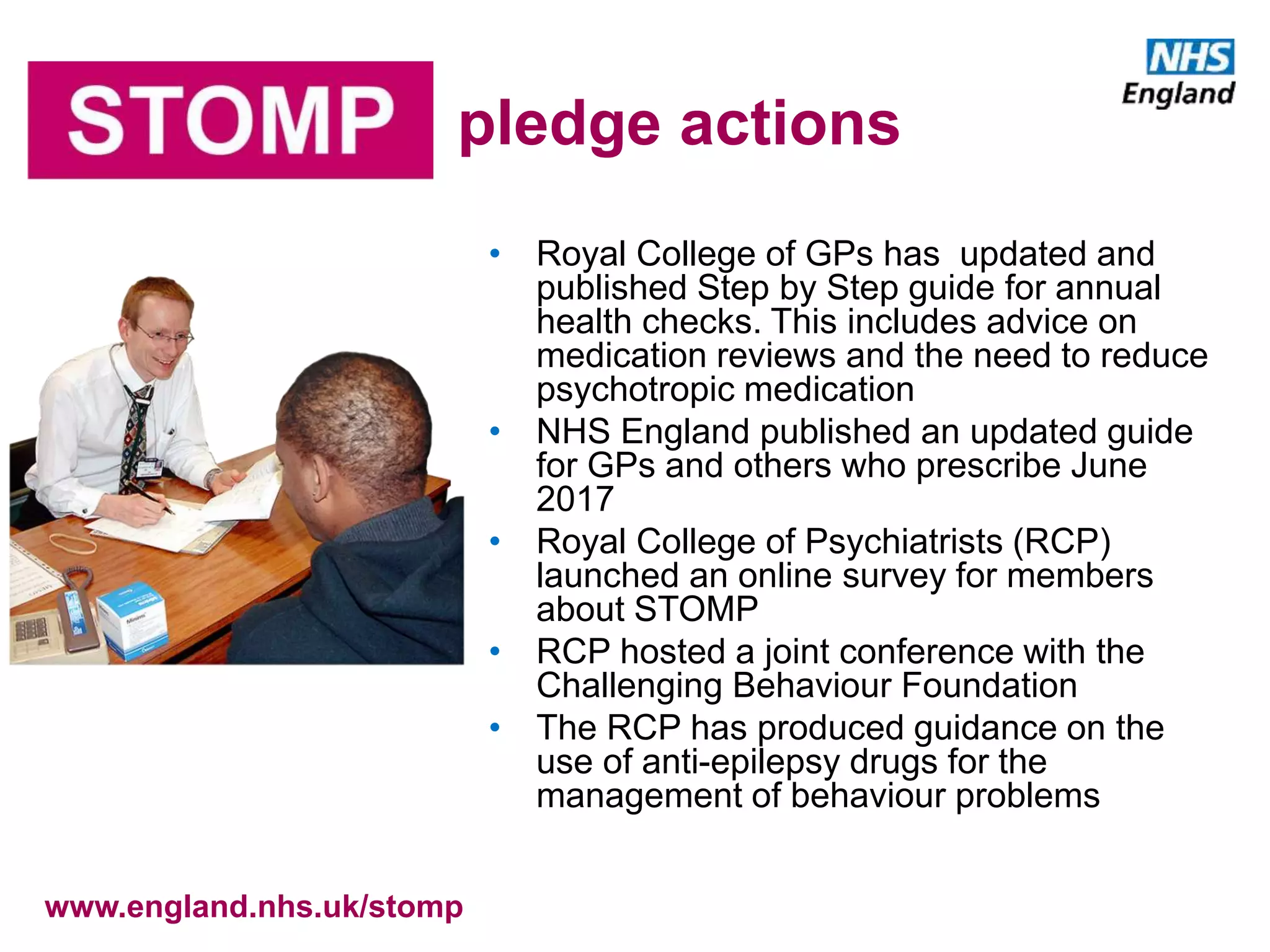
• Royal College of GPs has updated and
published Step by Step guide for annual
health checks. This includes advice on
medication reviews and the need to reduce
psychotropic medication
• NHS England published an updated guide
for GPs and others who prescribe June
2017
• Royal College of Psychiatrists (RCP)
launched an online survey for members
about STOMP
• RCP hosted a joint conference with the
Challenging Behaviour Foundation
• The RCP has produced guidance on the
use of anti-epilepsy drugs for the
management of behaviour problems
www.england.nhs.uk/stomp
pledge actions
www.england.nhs.uk/learningdisabilities
• Care and Treatment Reviews (CTRs) –
New NHS England policy and tools
include a section on reviewing the use of
psychotropic medication
• Annual Health Checks (AHCs) –
NHS England worked with partners to
refresh and publish a new annual health
check template which now includes
psychotropic medication reviews.
• July 2017 launch of ‘Better health for
people with learning disabilities - What
social care providers can do to help
people with learning disabilities get
health checks’
https://www.vodg.org.uk/news/launch-of-
innovative-film-to-support-better-health-
for-people-with-learning-disabilities/
www.england.nhs.uk/stomp
pledge actions
www.england.nhs.uk/learningdisabilities
• Public Health England Learning Disability
Observatory – June 2017. Pharmacy Guidance on
best practice for supporting people with learning
disabilities
• NHS England has commissioned Public Health
England to carry out four studies a year from
autumn 2017. To show if fewer psychotropic drugs
are being prescribed as awareness of STOMP
improves.
• CQC- have reviewed their inspection framework in
light of STOMP to include checking use of
psychotropic medicines
• A Children and Young People’s STOMP sub-group
has been established.
• NHS England Regions each have an action plan on
STOMP working with local areas
www.england.nhs.uk/stomp
pledge actions
www.england.nhs.uk/learningdisabilities
• Raising awareness – STOMP presented at many
national, regional and local events and conferences
eg. in 2017 - One Year On national launch July,
Positive Choices Conference for learning disability
student nurses, STOMP workshop at the NHS
England national ‘Better Health, Better Lives’
conference
• Social media coverage from events and
publications. NHS England has also shared case
studies through Twitter eg.
www.england.nhs.uk/learning-disabilities/stopping-
andrews-psychotropic-medication-in-hertfordshire
• STOMP web information being improved by
NHS England and other pledge partners
www.england.nhs.uk/stomp
pledge actions
www.england.nhs.uk/learningdisabilities
“Every person who is taking psychotropic medication will
have their own STOMP action plan.”
”We will ensure that everyone who is on medication for
behaviours that may present as challenging has a
positive behaviour support plan.”
”We will audit the use of psychotropic medication on a
quarterly basis”.
Quotes: Social Care Pledges
www.england.nhs.uk/learningdisabilities
“Questions about the use of psychotropic medication will
be included in trustee visits to services.”
”We will ensure that everyone has easy-read information
regarding their medication.”
.
“We will include STOMP in our staff induction.”
“We will use video conferencing to involve families who
live far away in decisions about medication.”
Quotes: Social Care Pledges
www.england.nhs.uk/learningdisabilities
“Stomp is important as we have got to make
sure that people aren’t overmedicated. If they
are this can cause physical health problems,
and it can stop people being discharged from
hospital. It can also stop people being able to
take part in decisions about their future life. It’s a
huge issue.”
Jenny Carter- Director- “Together All Are Able” & Expert
by Experience- working with Pathways Associates
statement of support
www.england.nhs.uk/learningdisabilities
“The Royal College of Psychiatrists and the
Learning Disability Professional Senate are
determined to make STOMP happen. We will work
in our Learning Disability Teams and with General
Practice colleagues to reduce the harm caused by
inappropriate use of psychotropic medication. We
will promote comprehensive monitoring of
medication, and the timely use of evidence based
psychosocial interventions.”
Dr Ashok Roy
Chair, Faculty of Intellectual Disability Psychiatry, The Royal College
of Psychiatrists and Co-chair Learning Disability Professional
Senate
statement of support
www.england.nhs.uk/learningdisabilities
The Learning Disability Professional Senate pledges our
commitment to supporting this initiative. This is about
fundamentally rethinking the role of psychotropic drugs
for the management of behaviours that challenge in
learning disabilities.
We fully endorse that it is the role of all professions to
challenge medication issues and to provide alternative
psychological and other therapeutic interventions for
behaviours that challenge, using a Positive Behaviour
Support framework.
pledge commitment
www.england.nhs.uk/learningdisabilities
“ Josh used to be prescribed a number of anti-psychotic
and sedative type medications when he was in hospital
far away from home. He has now come off virtually all of
these drugs. I have seen Josh improve physically and
emotionally. He seems more alert and, in my opinion, his
long term memory, of places and people has improved
greatly.”
Phil Wills, dad of Josh Wills age 16 who has autism and a learning
disability and who was in an assessment and treatment unit for
three year, and who was discharged to a tailored package of
education, health and care in November 2015
statement of support
www.england.nhs.uk/learningdisabilities
Bringing Us Together’s project Stronger Together has been working
with NHS England and families across the country to have their views
listened to, acted upon and for families to take an active part in
changing policy and practice. Families who have loved ones in
Assessment and Treatment Units and hospital settings have been
determined over recent years to make a difference to the lives of their
own children and young people whilst at the same time making sure
that young people don’t end up in crisis, sent out of their communities
and into inappropriate settings where we have heard heart breaking
stories of the overuse of medication leading to a downward
spiral. Families are absolutely behind this campaign as they know
that over reliance on medication may cause substantial side
effects. As one parent told us “STOMP could mean that a person’s
condition is treated respectfully and holistically rather than
automatically given drugs to keep them quiet and sedated”. We will
continue to support STOMP and congratulate all those involved in
raising awareness of this very important issue.
For more information www.bringingustogether.org.uk
statement of support
www.england.nhs.uk/learningdisabilities
Raising awareness of STOMP amongst the Speech &
Language Therapy profession as a whole and in doing
so:
• Promote a better understanding and response to the
communication needs of people with a LD in order to
reduce challenging behaviour and the current over reliance
on medication
• We will use the 5 Good Communication Standards to
empower people in understanding their medication ,
helping carers to know how service users can be
proactively involved in their reviews and therefore
decisions about their medication
RCSLT commitment

Stomp - one year on presentation july 2017

  • 1.
    www.england.nhs.uk/learningdisabilities One year on July2017 Stopping the over medication of people with learning disabilities, autism or both
  • 2.
    www.england.nhs.uk/learningdisabilities The core message PublicHealth England says every day about 30,000 to 35,000 adults with a learning disability are being given psychotropic medicines when they do not have a diagnosed mental health condition. This is often to manage behaviour which is seen as challenging. It includes medicines used to treat psychosis, depression, anxiety, sleep disorders and epilepsy medication when it is only used for its calming effect, rather than to treat epilepsy. Unnecessary use of these drugs, puts people at risk of significant weight gain, organ failure and even premature death. www.england.nhs.uk/stomp
  • 3.
    www.england.nhs.uk/learningdisabilities STOMP brings togethera wide range of people: • People, their families and support organisations • Health, education and social care professionals • Health, education and social care providers • People who buy services eg. commissioners • People who check or monitor services • People who provide health or social care training working together www.england.nhs.uk/stomp
  • 4.
    www.england.nhs.uk/learningdisabilities Aims 1. Improve thequality of life of children, young people and adults with a learning disability, autism or both, who are prescribed psychotropic medicines. 2. Make sure people are only given them for the right reason, in the right amount, for as short a time as possible. 3. Improve everyone’s understanding of these medicines and give everyone the confidence to ask why they are needed. 4. Improve understanding of non-drug treatments and support which may help. 5. Make sure the person with their family and paid carers are involved in any decisions to start, stop, reduce or continue taking them. www.england.nhs.uk/stomp
  • 5.
    www.england.nhs.uk/learningdisabilities Why STOMP? • Theyare not always the right answer • They can have major side effects • They can reduce people’s quality of life • They can be used as a type of restraint • When people are drugged up the world passes them by. • This is a human rights issue When are they right? • Psychotropic medicines can have an important role in treating many mental health conditions when they are used well. • Sometimes they are right if the person is at severe risk of harming themselves or others • As long as other treatments and therapy are happening so that people will not need them for long www.england.nhs.uk/stomp
  • 6.
    www.england.nhs.uk/learningdisabilities Pledge The STOMP pledgewas signed in June 2016 by • Royal Colleges of Nursing, Psychiatrists and GPs • Royal Pharmaceutical Society • British Psychological Society • NHS England • The Minister Alistair Burt They pledged to work together and with people with a learning disability and their families, to take real and measurable steps to stop over medication. 3 year campaign up to 2019www.england.nhs.uk/stomp
  • 7.
    www.england.nhs.uk/learningdisabilities • Royal Collegeof Speech and Language Therapy • British Association Of Social Workers • Learning Disability Professional Senate: Care Quality Commission, Clinical Commissioning Groups, Challenging Behaviour Foundation, Department of Health, Health Education England, clinicians - art therapists, psychologists, occupational therapists, physiotherapists, dietitians, psychiatrists, GPs, social workers, speech therapists and learning disability nurses • British Association of Music Therapy • Voluntary Organisations Disability Group More pledges made in 2017 www.england.nhs.uk/stomp
  • 8.
    www.england.nhs.uk/learningdisabilities • All thepledge partners are working with their members to promote the pledge, raise awareness and introduce good practice through methods such as: • education programmes, pilot schemes, presentations, articles in journals, review of professional roles, national conferences, sharing guidelines and partnership work Reaching people, changing practice www.england.nhs.uk/stomp
  • 9.
    www.england.nhs.uk/learningdisabilities • Partnership workingwith health, social care, voluntary and charity organisations, family and self advocacy. • Partners include the Challenging Behaviour Foundation (CBF), Care Management Group (CMG), Voluntary Organisations Disability Group (VODG) and the National Development Team for Inclusion (NDTi) Learning Disability England, ARC England, and Skills for Care www.england.nhs.uk/stomp partnership working
  • 10.
    www.england.nhs.uk/learningdisabilities • Challenging BehaviourFoundation (CBF) engaged with over 100 families on their experiences of over medication and what information and support they need. • CBF published a report in May 2017 and have also been commissioned to develop a medicines pathway document for families and online resource that will be launched in 2017 • NHS England has also commissioned Change to engage with people with learning disabilities and autism who produced a report • Easy read materials commissioned and more being developed • NHS England commissioned MIXIT an inclusive theatre group to develop a production on STOMP – official launch on 4th July www.england.nhs.uk/stomp pledge actions
  • 11.
    www.england.nhs.uk/learningdisabilities Pledge for socialcare providers A pledge for social care providers led by VODG was launched in May 2017 Already, more than 100 organisations have signed up who support over 40,000 people. The pledge includes a self-assessment and planning template and can be downloaded from the VODG webpage on STOMP A best practice guide produced by the Care Management Group (CMG) was launched in the House of Commons on June 13 by Normal Lamb, MP www.england.nhs.uk/stomp
  • 12.
    www.england.nhs.uk/learningdisabilities • Centre forPharmacy Post-graduate Education – online learning for pharmacists launched in October 2016. The course develops awareness, understanding and key skills to help pharmacists deliver high quality care to people with learning disabilities, autism, families and carers. This was sent to 65,000 pharmacy staff across England and In 2017, over 3000 pharmacists have been trained to support STOMP • Five-week pharmacy campaign on learning disabilities including Facebook live, daily challenges and Twitter chat. 685 took part. • Specialist pharmacists and medical colleagues reviewing prescribing for people with learning disabilities, autism or both in the North East of England, Hertfordshire and Manchester • NHS England has appointed 3 pharmacists to a job- share role and a family carer is working as a STOMP adviser pledge actions www.england.nhs.uk/stomp
  • 13.
    www.england.nhs.uk/learningdisabilities • Royal Collegeof Nursing (RCN) guidance for pre-registration education students (across all branches) on learning disabilities includes a section on over- medication. Online and hard copy resource. • RCN worked with Royal College of Psychiatrists on good practice guidance on psychotropic drug prescribing • British Psychological Society articles on STOMP in bulletins, Clinical Psychology Forum, Division AGM and chair’s report. Promoting alternatives to medication, prescribing practice and the use of Positive Behaviour Support (PBS) to membership and other professional groups www.england.nhs.uk/stomp pledge actions
  • 14.
    www.england.nhs.uk/learningdisabilities • Royal Collegeof GPs has updated and published Step by Step guide for annual health checks. This includes advice on medication reviews and the need to reduce psychotropic medication • NHS England published an updated guide for GPs and others who prescribe June 2017 • Royal College of Psychiatrists (RCP) launched an online survey for members about STOMP • RCP hosted a joint conference with the Challenging Behaviour Foundation • The RCP has produced guidance on the use of anti-epilepsy drugs for the management of behaviour problems www.england.nhs.uk/stomp pledge actions
  • 15.
    www.england.nhs.uk/learningdisabilities • Care andTreatment Reviews (CTRs) – New NHS England policy and tools include a section on reviewing the use of psychotropic medication • Annual Health Checks (AHCs) – NHS England worked with partners to refresh and publish a new annual health check template which now includes psychotropic medication reviews. • July 2017 launch of ‘Better health for people with learning disabilities - What social care providers can do to help people with learning disabilities get health checks’ https://www.vodg.org.uk/news/launch-of- innovative-film-to-support-better-health- for-people-with-learning-disabilities/ www.england.nhs.uk/stomp pledge actions
  • 16.
    www.england.nhs.uk/learningdisabilities • Public HealthEngland Learning Disability Observatory – June 2017. Pharmacy Guidance on best practice for supporting people with learning disabilities • NHS England has commissioned Public Health England to carry out four studies a year from autumn 2017. To show if fewer psychotropic drugs are being prescribed as awareness of STOMP improves. • CQC- have reviewed their inspection framework in light of STOMP to include checking use of psychotropic medicines • A Children and Young People’s STOMP sub-group has been established. • NHS England Regions each have an action plan on STOMP working with local areas www.england.nhs.uk/stomp pledge actions
  • 17.
    www.england.nhs.uk/learningdisabilities • Raising awareness– STOMP presented at many national, regional and local events and conferences eg. in 2017 - One Year On national launch July, Positive Choices Conference for learning disability student nurses, STOMP workshop at the NHS England national ‘Better Health, Better Lives’ conference • Social media coverage from events and publications. NHS England has also shared case studies through Twitter eg. www.england.nhs.uk/learning-disabilities/stopping- andrews-psychotropic-medication-in-hertfordshire • STOMP web information being improved by NHS England and other pledge partners www.england.nhs.uk/stomp pledge actions
  • 18.
    www.england.nhs.uk/learningdisabilities “Every person whois taking psychotropic medication will have their own STOMP action plan.” ”We will ensure that everyone who is on medication for behaviours that may present as challenging has a positive behaviour support plan.” ”We will audit the use of psychotropic medication on a quarterly basis”. Quotes: Social Care Pledges
  • 19.
    www.england.nhs.uk/learningdisabilities “Questions about theuse of psychotropic medication will be included in trustee visits to services.” ”We will ensure that everyone has easy-read information regarding their medication.” . “We will include STOMP in our staff induction.” “We will use video conferencing to involve families who live far away in decisions about medication.” Quotes: Social Care Pledges
  • 20.
    www.england.nhs.uk/learningdisabilities “Stomp is importantas we have got to make sure that people aren’t overmedicated. If they are this can cause physical health problems, and it can stop people being discharged from hospital. It can also stop people being able to take part in decisions about their future life. It’s a huge issue.” Jenny Carter- Director- “Together All Are Able” & Expert by Experience- working with Pathways Associates statement of support
  • 21.
    www.england.nhs.uk/learningdisabilities “The Royal Collegeof Psychiatrists and the Learning Disability Professional Senate are determined to make STOMP happen. We will work in our Learning Disability Teams and with General Practice colleagues to reduce the harm caused by inappropriate use of psychotropic medication. We will promote comprehensive monitoring of medication, and the timely use of evidence based psychosocial interventions.” Dr Ashok Roy Chair, Faculty of Intellectual Disability Psychiatry, The Royal College of Psychiatrists and Co-chair Learning Disability Professional Senate statement of support
  • 22.
    www.england.nhs.uk/learningdisabilities The Learning DisabilityProfessional Senate pledges our commitment to supporting this initiative. This is about fundamentally rethinking the role of psychotropic drugs for the management of behaviours that challenge in learning disabilities. We fully endorse that it is the role of all professions to challenge medication issues and to provide alternative psychological and other therapeutic interventions for behaviours that challenge, using a Positive Behaviour Support framework. pledge commitment
  • 23.
    www.england.nhs.uk/learningdisabilities “ Josh usedto be prescribed a number of anti-psychotic and sedative type medications when he was in hospital far away from home. He has now come off virtually all of these drugs. I have seen Josh improve physically and emotionally. He seems more alert and, in my opinion, his long term memory, of places and people has improved greatly.” Phil Wills, dad of Josh Wills age 16 who has autism and a learning disability and who was in an assessment and treatment unit for three year, and who was discharged to a tailored package of education, health and care in November 2015 statement of support
  • 24.
    www.england.nhs.uk/learningdisabilities Bringing Us Together’sproject Stronger Together has been working with NHS England and families across the country to have their views listened to, acted upon and for families to take an active part in changing policy and practice. Families who have loved ones in Assessment and Treatment Units and hospital settings have been determined over recent years to make a difference to the lives of their own children and young people whilst at the same time making sure that young people don’t end up in crisis, sent out of their communities and into inappropriate settings where we have heard heart breaking stories of the overuse of medication leading to a downward spiral. Families are absolutely behind this campaign as they know that over reliance on medication may cause substantial side effects. As one parent told us “STOMP could mean that a person’s condition is treated respectfully and holistically rather than automatically given drugs to keep them quiet and sedated”. We will continue to support STOMP and congratulate all those involved in raising awareness of this very important issue. For more information www.bringingustogether.org.uk statement of support
  • 25.
    www.england.nhs.uk/learningdisabilities Raising awareness ofSTOMP amongst the Speech & Language Therapy profession as a whole and in doing so: • Promote a better understanding and response to the communication needs of people with a LD in order to reduce challenging behaviour and the current over reliance on medication • We will use the 5 Good Communication Standards to empower people in understanding their medication , helping carers to know how service users can be proactively involved in their reviews and therefore decisions about their medication RCSLT commitment

Editor's Notes

  • #3 CARL Reference: Public Health England (2015) Prescribing of psychotropic medication to people with learning disabilities and/or autism by general practitioners in England, London: Public Health England. In 2015 Public Health England estimated that, on an average day in England, between 30,000 and 35,000 adults with a learning disability are being prescribed an antipsychotic, an antidepressant or both without an appropriate clinical reason. Unnecessary use of these drugs, puts people at risk of significant weight gain, organ failure and premature death. Is one of these 35,000 people your patient? Stop this happening and take action today. Check and review your patients immediately to ensure another day of potential harm doesn’t go by. -Prescribing Observatory for Mental Health: Nationally, over 60% of people with a learning disability who are seeing a psychiatrist, are being prescribed an antipsychotic drug but only half of these have the diagnosis of a psychotic mental illness that these drugs were developed to treat Ask people what they think of this message. Is it strong enough? Should it be stronger?