www.england.nhs.uk
The Model Service
Specification for
Community Based
Forensic Support
Kevin Elliott, Clinical Lead,
Transforming Care, Nursing
Directorate
Diane Stevens, Service
Manager – Forensic Service
18 May 2017
Learning Disabilities:
Share and Learn Webinar
#improvingLD @NHSEnglandSI
www.england.nhs.uk
Community
Forensic
Support
Model Service
Specification
May 2017
www.england.nhs.uk
The Reed and Bradley reports (1992, 2009) outlined clear
principles of support for people with a learning disability
who offend, including through the provision of support and
treatment in the community rather than in hospital
settings, early identification of people in the criminal
justice system and appropriate community-based
treatment and support packages for those at risk, as well
as other community disposal options (such as community
orders) as an alternative to secure settings or prison.
Introduction
www.england.nhs.uk
• To improve quality of care for people with a learning
disability and/or autism
• To improve quality of life for people with a learning
disability and/or autism
• To enhance community capacity, thereby reducing
inappropriate hospital admissions and length of stay
The Programme has three
Key Aims:
Support commissioners to develop local service specifications
which support implementation of the national service model
Build on the service model by providing additional detail for
commissioners about the purpose, functions and intended
outcomes of three aspects of the service model
1. Enhanced/Intensive Support (Principle 7)
2. Community-based Forensic Support (Principle 8)
3. Acute Learning Disability Inpatient Services (Principle 9)
Model Service Specifications
Aims and objectives
• Reduce or safely manage behaviour which may put members of the
public at risk, and would otherwise lead to contact with the criminal
justice system or admission to a secure hospital.
• Ensure a focus on prevention and early intervention through
collaboration with other services.
• A reduction in the behaviours of people with a learning disability and/or
autism that lead to them coming into contact with the criminal justice
system.
• Improved support to people through the criminal justice system
• A reduction in the number of people with a learning disability and/or
autism who require inpatient facilities.
Community Forensic Support
www.england.nhs.uk
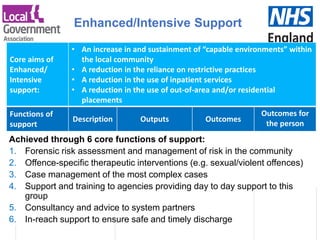
Achieved through 6 core functions of support:
1. Forensic risk assessment and management of risk in the community
2. Offence-specific therapeutic interventions (e.g. sexual/violent offences)
3. Case management of the most complex cases
4. Support and training to agencies providing day to day support to this
group
5. Consultancy and advice to system partners
6. In-reach support to ensure safe and timely discharge
Enhanced/Intensive Support
Core aims of
Enhanced/
Intensive
support:
• An increase in and sustainment of “capable environments” within
the local community
• A reduction in the reliance on restrictive practices
• A reduction in the use of inpatient services
• A reduction in the use of out-of-area and/or residential
placements
Functions of
support
Description Outputs Outcomes
Outcomes for
the person
Key Messages
• Focus on functions
• Functions should be fulfilled by multi agency & multi disciplinary teams
• Increase awareness around prevention within partner agencies (including
Youth Justice Services)
• Relates to adults but must work collaboratively with CYP services(Health and
Justice FCAMHS Specification for children and young people) issues around
transition for most vulnerable group (16-25 year-olds)
• Function required per 1,000,000 population - smaller CCGs should consider co-
commissioning
• Small (dedicated) caseloads within existing CLDTs
• Workforce development/ upskilling
• Developing collaborative working between Inpatient & community support
services
www.england.nhs.uk
Additional Information
www.england.nhs.uk
https://www.england.nhs.uk/learning-
disabilities/care/
For copies of the:
• National Service Model;
• Service Model with Additional Information for
Commissioners
• Model Service Specifications
• And for more information about the NHS England Learning
Disability Programme
www.england.nhs.uk
• People with Learning Disabilities and Offending Behaviours:
Prevalence, Treatment, Risk Assessment and Services – A
Literature review -
https://www.kent.ac.uk/tizard/resources/forensicldservices.pdf
• Working for Justice group – Information & resources -
http://www.keyring.org/cjs/working-for-justice-group
• Ensuring Quality Services – http://www.local.gov.uk/our-
support/our-improvement-offer/care-and-health-
improvement/transforming-care/place-i-call-home/ensuring-quality
• Professional Senate CLDT Paper -
http://acppld.csp.org.uk/documents/national-ld-professional-senate-
briefing-paper
Useful Links
Secure Outreach transitions
Team
Diane Stevens
Service Manager
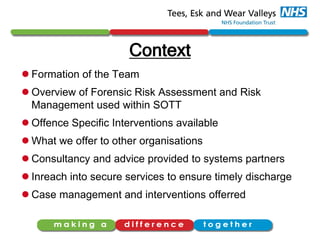
Context
 Formation of the Team
 Overview of Forensic Risk Assessment and Risk
Management used within SOTT
 Offence Specific Interventions available
 What we offer to other organisations
 Consultancy and advice provided to systems partners
 Inreach into secure services to ensure timely discharge
 Case management and interventions offerred
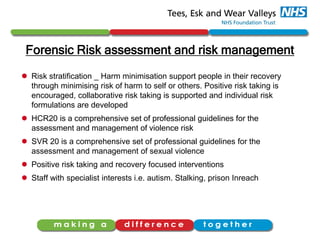
Forensic Risk assessment and risk management
 Risk stratification _ Harm minimisation support people in their recovery
through minimising risk of harm to self or others. Positive risk taking is
encouraged, collaborative risk taking is supported and individual risk
formulations are developed
 HCR20 is a comprehensive set of professional guidelines for the
assessment and management of violence risk
 SVR 20 is a comprehensive set of professional guidelines for the
assessment and management of sexual violence
 Positive risk taking and recovery focused interventions
 Staff with specialist interests i.e. autism. Stalking, prison Inreach
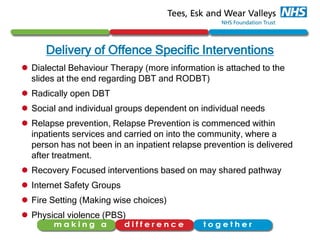
Delivery of Offence Specific Interventions
 Dialectal Behaviour Therapy (more information is attached to the
slides at the end regarding DBT and RODBT)
 Radically open DBT
 Social and individual groups dependent on individual needs
 Relapse prevention, Relapse Prevention is commenced within
inpatients services and carried on into the community, where a
person has not been in an inpatient relapse prevention is delivered
after treatment.
 Recovery Focused interventions based on may shared pathway
 Internet Safety Groups
 Fire Setting (Making wise choices)
 Physical violence (PBS)
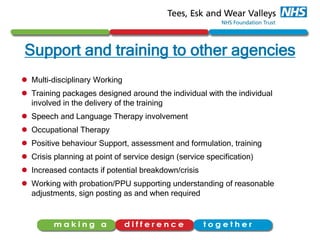
Support and training to other agencies
 Multi-disciplinary Working
 Training packages designed around the individual with the individual
involved in the delivery of the training
 Speech and Language Therapy involvement
 Occupational Therapy
 Positive behaviour Support, assessment and formulation, training
 Crisis planning at point of service design (service specification)
 Increased contacts if potential breakdown/crisis
 Working with probation/PPU supporting understanding of reasonable
adjustments, sign posting as and when required
Consultancy and advice to system partners
 Delivering learning disability and autism awareness sessions to
prison staff
 Identify vulnerable prisoners and sign post for appropriate support
upon release
 Involvement with consultants clinics in prison
 Attendance at adult learning disability meetings
 Advice to prison staff around reasonable adjustments to reduce
vulnerabilities and improve engagement
 Identification of prisoners requiring autism assessments –
signposting for interventions
 Identification of those who maybe at risk when released and
signposting to risk register
Inreach to ensure safe and timely discharge
 Involvement from SOTT at the point of referral to secure inpatient
services for people with a learning disability or autism
 Allocated to a team member at the point of admission
 Maintain contact for the duration of their inpatients stay
 Liaise with the care navigator to support reduction in length of stay
 8-8 service 7 days a week with nurse and psychiatry oncall cover
 Direct involvement with adult mental health services/adult learning
disability services if the person is admitted into a adult mental
health/learning diasability ward, including formulation meeting and
daily contact if required- dependent on the persons needs
Case management and interventions
 Multi-disciplinary formulation meetings post referral or when changes to
the persons presentation
 Daily huddles within the SOTT with added support from the leadership
team
 Professionals meetings
 Support access to meaningful activities and develop activities of daily
living skills to promote independence
 People involved with planning their intervention plans
 Escalation process for those at risk within the community in bed managers
meetings and at the local complex case meeting with commissioners and
the local authority
Next Steps
 Development of pathways
 Review outcome measures relating to quality of life
 Follow up co-production event, what has worked? what
needs to be different?
 Peer support workers
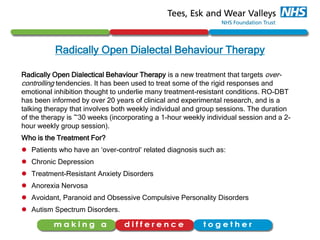
Radically Open Dialectal Behaviour Therapy
Radically Open Dialectical Behaviour Therapy is a new treatment that targets over-
controlling tendencies. It has been used to treat some of the rigid responses and
emotional inhibition thought to underlie many treatment-resistant conditions. RO-DBT
has been informed by over 20 years of clinical and experimental research, and is a
talking therapy that involves both weekly individual and group sessions. The duration
of the therapy is ~30 weeks (incorporating a 1-hour weekly individual session and a 2-
hour weekly group session).
Who is the Treatment For?
 Patients who have an ‘over-control’ related diagnosis such as:
 Chronic Depression
 Treatment-Resistant Anxiety Disorders
 Anorexia Nervosa
 Avoidant, Paranoid and Obsessive Compulsive Personality Disorders
 Autism Spectrum Disorders.
What is Dialectal behaviour Therapy
DBT is a type of therapy for people who find it hard to
deal with their emotions. DBT is helpful for people who:
 experience difficult emotions that are hard to cope with
 might think about hurting themselves or killing
themselves
 do risky things to cope that could get you into trouble
 have lots of problems in relationships
 Have unhelpful thoughts
www.england.nhs.uk
Thank you for listening
Any Questions?
23

Learning Disabilities: Share and Learn Webinar – 18 May 2017

  • 1.
    www.england.nhs.uk The Model Service Specificationfor Community Based Forensic Support Kevin Elliott, Clinical Lead, Transforming Care, Nursing Directorate Diane Stevens, Service Manager – Forensic Service 18 May 2017 Learning Disabilities: Share and Learn Webinar #improvingLD @NHSEnglandSI
  • 2.
  • 3.
    www.england.nhs.uk The Reed andBradley reports (1992, 2009) outlined clear principles of support for people with a learning disability who offend, including through the provision of support and treatment in the community rather than in hospital settings, early identification of people in the criminal justice system and appropriate community-based treatment and support packages for those at risk, as well as other community disposal options (such as community orders) as an alternative to secure settings or prison. Introduction
  • 4.
    www.england.nhs.uk • To improvequality of care for people with a learning disability and/or autism • To improve quality of life for people with a learning disability and/or autism • To enhance community capacity, thereby reducing inappropriate hospital admissions and length of stay The Programme has three Key Aims:
  • 5.
    Support commissioners todevelop local service specifications which support implementation of the national service model Build on the service model by providing additional detail for commissioners about the purpose, functions and intended outcomes of three aspects of the service model 1. Enhanced/Intensive Support (Principle 7) 2. Community-based Forensic Support (Principle 8) 3. Acute Learning Disability Inpatient Services (Principle 9) Model Service Specifications
  • 6.
    Aims and objectives •Reduce or safely manage behaviour which may put members of the public at risk, and would otherwise lead to contact with the criminal justice system or admission to a secure hospital. • Ensure a focus on prevention and early intervention through collaboration with other services. • A reduction in the behaviours of people with a learning disability and/or autism that lead to them coming into contact with the criminal justice system. • Improved support to people through the criminal justice system • A reduction in the number of people with a learning disability and/or autism who require inpatient facilities. Community Forensic Support
  • 7.
    www.england.nhs.uk Achieved through 6core functions of support: 1. Forensic risk assessment and management of risk in the community 2. Offence-specific therapeutic interventions (e.g. sexual/violent offences) 3. Case management of the most complex cases 4. Support and training to agencies providing day to day support to this group 5. Consultancy and advice to system partners 6. In-reach support to ensure safe and timely discharge Enhanced/Intensive Support Core aims of Enhanced/ Intensive support: • An increase in and sustainment of “capable environments” within the local community • A reduction in the reliance on restrictive practices • A reduction in the use of inpatient services • A reduction in the use of out-of-area and/or residential placements Functions of support Description Outputs Outcomes Outcomes for the person
  • 8.
    Key Messages • Focuson functions • Functions should be fulfilled by multi agency & multi disciplinary teams • Increase awareness around prevention within partner agencies (including Youth Justice Services) • Relates to adults but must work collaboratively with CYP services(Health and Justice FCAMHS Specification for children and young people) issues around transition for most vulnerable group (16-25 year-olds) • Function required per 1,000,000 population - smaller CCGs should consider co- commissioning • Small (dedicated) caseloads within existing CLDTs • Workforce development/ upskilling • Developing collaborative working between Inpatient & community support services
  • 9.
  • 10.
    www.england.nhs.uk https://www.england.nhs.uk/learning- disabilities/care/ For copies ofthe: • National Service Model; • Service Model with Additional Information for Commissioners • Model Service Specifications • And for more information about the NHS England Learning Disability Programme
  • 11.
    www.england.nhs.uk • People withLearning Disabilities and Offending Behaviours: Prevalence, Treatment, Risk Assessment and Services – A Literature review - https://www.kent.ac.uk/tizard/resources/forensicldservices.pdf • Working for Justice group – Information & resources - http://www.keyring.org/cjs/working-for-justice-group • Ensuring Quality Services – http://www.local.gov.uk/our- support/our-improvement-offer/care-and-health- improvement/transforming-care/place-i-call-home/ensuring-quality • Professional Senate CLDT Paper - http://acppld.csp.org.uk/documents/national-ld-professional-senate- briefing-paper Useful Links
  • 12.
  • 13.
    Context  Formation ofthe Team  Overview of Forensic Risk Assessment and Risk Management used within SOTT  Offence Specific Interventions available  What we offer to other organisations  Consultancy and advice provided to systems partners  Inreach into secure services to ensure timely discharge  Case management and interventions offerred
  • 14.
    Forensic Risk assessmentand risk management  Risk stratification _ Harm minimisation support people in their recovery through minimising risk of harm to self or others. Positive risk taking is encouraged, collaborative risk taking is supported and individual risk formulations are developed  HCR20 is a comprehensive set of professional guidelines for the assessment and management of violence risk  SVR 20 is a comprehensive set of professional guidelines for the assessment and management of sexual violence  Positive risk taking and recovery focused interventions  Staff with specialist interests i.e. autism. Stalking, prison Inreach
  • 15.
    Delivery of OffenceSpecific Interventions  Dialectal Behaviour Therapy (more information is attached to the slides at the end regarding DBT and RODBT)  Radically open DBT  Social and individual groups dependent on individual needs  Relapse prevention, Relapse Prevention is commenced within inpatients services and carried on into the community, where a person has not been in an inpatient relapse prevention is delivered after treatment.  Recovery Focused interventions based on may shared pathway  Internet Safety Groups  Fire Setting (Making wise choices)  Physical violence (PBS)
  • 16.
    Support and trainingto other agencies  Multi-disciplinary Working  Training packages designed around the individual with the individual involved in the delivery of the training  Speech and Language Therapy involvement  Occupational Therapy  Positive behaviour Support, assessment and formulation, training  Crisis planning at point of service design (service specification)  Increased contacts if potential breakdown/crisis  Working with probation/PPU supporting understanding of reasonable adjustments, sign posting as and when required
  • 17.
    Consultancy and adviceto system partners  Delivering learning disability and autism awareness sessions to prison staff  Identify vulnerable prisoners and sign post for appropriate support upon release  Involvement with consultants clinics in prison  Attendance at adult learning disability meetings  Advice to prison staff around reasonable adjustments to reduce vulnerabilities and improve engagement  Identification of prisoners requiring autism assessments – signposting for interventions  Identification of those who maybe at risk when released and signposting to risk register
  • 18.
    Inreach to ensuresafe and timely discharge  Involvement from SOTT at the point of referral to secure inpatient services for people with a learning disability or autism  Allocated to a team member at the point of admission  Maintain contact for the duration of their inpatients stay  Liaise with the care navigator to support reduction in length of stay  8-8 service 7 days a week with nurse and psychiatry oncall cover  Direct involvement with adult mental health services/adult learning disability services if the person is admitted into a adult mental health/learning diasability ward, including formulation meeting and daily contact if required- dependent on the persons needs
  • 19.
    Case management andinterventions  Multi-disciplinary formulation meetings post referral or when changes to the persons presentation  Daily huddles within the SOTT with added support from the leadership team  Professionals meetings  Support access to meaningful activities and develop activities of daily living skills to promote independence  People involved with planning their intervention plans  Escalation process for those at risk within the community in bed managers meetings and at the local complex case meeting with commissioners and the local authority
  • 20.
    Next Steps  Developmentof pathways  Review outcome measures relating to quality of life  Follow up co-production event, what has worked? what needs to be different?  Peer support workers
  • 21.
    Radically Open DialectalBehaviour Therapy Radically Open Dialectical Behaviour Therapy is a new treatment that targets over- controlling tendencies. It has been used to treat some of the rigid responses and emotional inhibition thought to underlie many treatment-resistant conditions. RO-DBT has been informed by over 20 years of clinical and experimental research, and is a talking therapy that involves both weekly individual and group sessions. The duration of the therapy is ~30 weeks (incorporating a 1-hour weekly individual session and a 2- hour weekly group session). Who is the Treatment For?  Patients who have an ‘over-control’ related diagnosis such as:  Chronic Depression  Treatment-Resistant Anxiety Disorders  Anorexia Nervosa  Avoidant, Paranoid and Obsessive Compulsive Personality Disorders  Autism Spectrum Disorders.
  • 22.
    What is Dialectalbehaviour Therapy DBT is a type of therapy for people who find it hard to deal with their emotions. DBT is helpful for people who:  experience difficult emotions that are hard to cope with  might think about hurting themselves or killing themselves  do risky things to cope that could get you into trouble  have lots of problems in relationships  Have unhelpful thoughts
  • 23.
    www.england.nhs.uk Thank you forlistening Any Questions? 23