Energy & Resilience for
Remote Islands: Vanuatu
(Pacific) Case Study
Thursday 9 March 2017 12:30
Peter Johnston
Environmental & Energy Consultants, Ltd; Suva, Fiji
Smart Villages Initiative
South/Southeast Asia Wrap-Up Workshop
Mandarin Hotel, Bangkok, 7-9 March 2017
This Presentation:
1) Context: 35+ years of Pacific off-grid RE experience
(Many failures and some successes)
2) Case study: development of national off-grid remote island RE
programme & masterplan (with limited time and information)
3) Some Lessons from Pacific Islands Experiences & Wider
Relevance (P Johnston & H Wade)
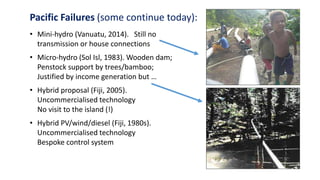
Pacific Failures (some continue today):
• Mini-hydro (Vanuatu, 2014). Still no
transmission or house connections
• Micro-hydro (Sol Isl, 1983). Wooden dam;
Penstock support by trees/bamboo;
Justified by income generation but …
• Hybrid proposal (Fiji, 2005).
Uncommercialised technology
No visit to the island (!)
• Hybrid PV/wind/diesel (Fiji, 1980s).
Uncommercialised technology
Bespoke control system
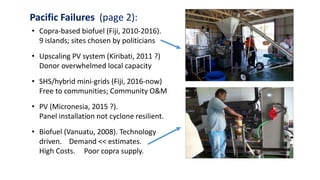
Pacific Failures (page 2):
• Copra-based biofuel (Fiji, 2010-2016).
9 islands; sites chosen by politicians
• Upscaling PV system (Kiribati, 2011 ?)
Donor overwhelmed local capacity
• SHS/hybrid mini-grids (Fiji, 2016-now)
Free to communities; Community O&M
• PV (Micronesia, 2015 ?).
Panel installation not cyclone resilient.
• Biofuel (Vanuatu, 2008). Technology
driven. Demand << estimates.
High Costs. Poor copra supply.
Pacific Failures (page 3):
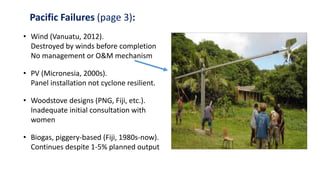
• Wind (Vanuatu, 2012).
Destroyed by winds before completion
No management or O&M mechanism
• PV (Micronesia, 2000s).
Panel installation not cyclone resilient.
• Woodstove designs (PNG, Fiji, etc.).
Inadequate initial consultation with
women
• Biogas, piggery-based (Fiji, 1980s-now).
Continues despite 1-5% planned output
Vanuatu Case Study:
Developing a Renewable Energy-based Off-Grid
Electrification Master Plan for Remote Islands
• Considered several decades of PIC experiences & lessons
• Two-plus field visits to four islands, brief visit to fifth
• Assessed community priorities, Willingness to Pay, Ability to Pay
• Standard, modular PV systems (higher initial cost, lower lifetime cost)
• Preliminary conceptual design
• Emphasis: sustainable financial and management mechanism
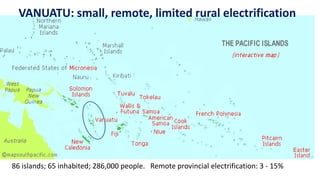
VANUATU: small, remote, limited rural electrification
86 islands; 65 inhabited; 286,000 people. Remote provincial electrification: 3 - 15%
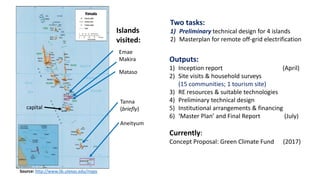
Source: http://www.lib.utexas.edu/maps
Emae
Makira
Mataso
Tanna
(briefly)
Aneityum
Islands
visited:
Two tasks:
1) Preliminary technical design for 4 islands
2) Masterplan for remote off-grid electrification
Outputs:
1) Inception report (April)
2) Site visits & household surveys
(15 communities; 1 tourism site)
3) RE resources & suitable technologies
4) Preliminary technical design
5) Institutional arrangements & financing
6) ‘Master Plan’ and Final Report (July)
Currently:
Concept Proposal: Green Climate Fund (2017)
capital
2 km
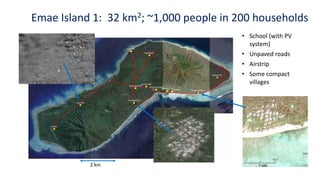
Emae Island 1: 32 km2; ~1,000 people in 200 households
• School (with PV
system)
• Unpaved roads
• Airstrip
• Some compact
villages
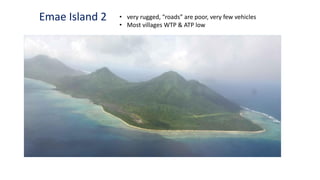
Emae Island 2 • very rugged, “roads” are poor, very few vehicles
• Most villages WTP & ATP low
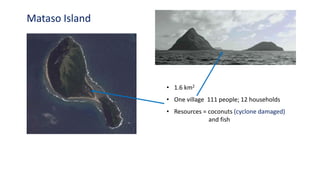
Mataso Island
• 1.6 km2
• One village 111 people; 12 households
• Resources = coconuts (cyclone damaged)
and fish
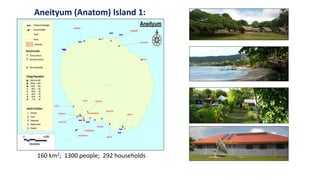
Aneityum (Anatom) Island 1:
160 km2; 1300 people; 292 households
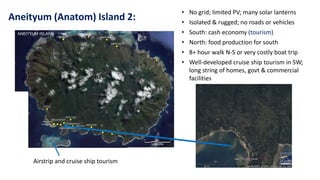
Aneityum (Anatom) Island 2:
• No grid; limited PV; many solar lanterns
• Isolated & rugged; no roads or vehicles
• South: cash economy (tourism)
• North: food production for south
• 8+ hour walk N-S or very costly boat trip
• Well-developed cruise ship tourism in SW;
long string of homes, govt & commercial
facilities
Airstrip and cruise ship tourism
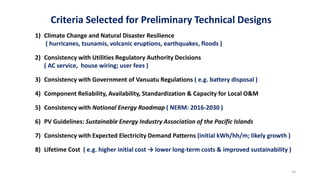
Criteria Selected for Preliminary Technical Designs
1) Climate Change and Natural Disaster Resilience
( hurricanes, tsunamis, volcanic eruptions, earthquakes, floods )
2) Consistency with Utilities Regulatory Authority Decisions
( AC service, house wiring; user fees )
3) Consistency with Government of Vanuatu Regulations ( e.g. battery disposal )
4) Component Reliability, Availability, Standardization & Capacity for Local O&M
5) Consistency with National Energy Roadmap ( NERM: 2016-2030 )
6) PV Guidelines: Sustainable Energy Industry Association of the Pacific Islands
7) Consistency with Expected Electricity Demand Patterns (initial kWh/hh/m; likely growth )
8) Lifetime Cost ( e.g. higher initial cost → lower long-term costs & improved sustainability )
14
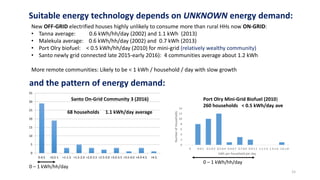
Suitable energy technology depends on UNKNOWN energy demand:
New OFF-GRID electrified houses highly unlikely to consume more than rural HHs now ON-GRID:
• Tanna average: 0.6 kWh/hh/day (2002) and 1.1 kWh (2013)
• Malekula average: 0.6 kWh/hh/day (2002) and 0.7 kWh (2013)
• Port Olry biofuel: < 0.5 kWh/hh/day (2010) for mini-grid (relatively wealthy community)
• Santo newly grid connected late 2015-early 2016): 4 communities average about 1.2 kWh
More remote communities: Likely to be < 1 kWh / household / day with slow growth
and the pattern of energy demand:
0
5
10
15
20
25
30
35
0-0.5 >0,5-1 >1-1.5 >1.5-2.0 >2.0-2.5 >2.5-3.0 >3.0-3.5 >3.5-4.0 >4.0-4.5 >4.5
Santo On-Grid Community 3 (2016)
68 households 1.1 kWh/day average
0
2
4
6
8
10
12
14
0 0-0.1 0.1-0.2 0.2-0.4 0.4-0.7 0.7-0.9 0.9-1.1 1.1-1.3 1.3-1.6 1.6-1.8
NumberofHouseholds
kWh per household per day
Port Olry Mini-Grid Biofuel (2010)
260 households < 0.5 kWh/day ave
0 – 1 kWh/hh/day
15
0 – 1 kWh/hh/day
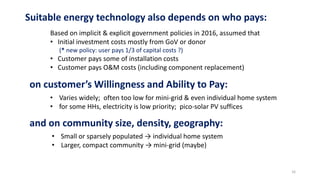
on customer’s Willingness and Ability to Pay:
• Varies widely; often too low for mini-grid & even individual home system
• for some HHs, electricity is low priority; pico-solar PV suffices
Suitable energy technology also depends on who pays:
Based on implicit & explicit government policies in 2016, assumed that
• Initial investment costs mostly from GoV or donor
(* new policy: user pays 1/3 of capital costs ?)
• Customer pays some of installation costs
• Customer pays O&M costs (including component replacement)
and on community size, density, geography:
• Small or sparsely populated → individual home system
• Larger, compact community → mini-grid (maybe)
16
Recommended Renewable Energy Technology
• Reviewed previous & ongoing Pacific island and Vanuatu experience
(Biofuel, PV, Wind, Small Hydro, Solar-Diesel Hybrid)
• Reviewed data on renewable energy resources in Vanuatu
• Considered local expertise and training capacity
• Recommended an approach based on solar PV
(pico-solar; Stand-alone SHS, PV mini-grids)
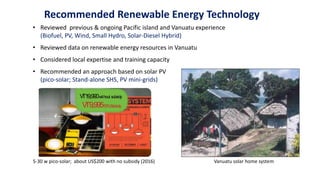
Figure 3.4: Example of VREP Pico-Solar-System
Source: VREP brochure; Dept of Energy
5-30 w pico-solar; about US$200 with no subsidy (2016) Vanuatu solar home system
Some General Issues Faced (page 1)
• History of failed remote off-grid RE (almost none by Govt 2002-2016)
• Ambitious national goal (100% HH electrification by 2030)
• What is RE ? (pico-solar, SHS, micro- mini-grids?)
• Inconsistent poorly-coordinated recent NGO / donor approaches
• No coordination among ministries
• No formal responsibility for RE-based remote island electrification
• Legislation and policies inadequate & unenforced
• Technical standards (regulation; enforcement)
Some General Issues Faced (page 2)
• Non enforcement of disconnections for non-payment (key issue)
• RE training (local language; village level; national level)
• Certification of installers
• No standard policy / charges for initial cost For mgt & O&M
• No mechanisms for O&M and payment of village technicians
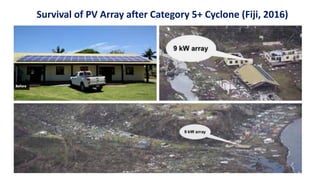
• Designs may be cyclone resilient; installations may not be
(next page)
Survival of PV Array after Category 5+ Cyclone (Fiji, 2016)
Some Issues Specific to the Study
• Do islands and villages chosen accurately represent diversity of remote Vanuatu ?
(village size, resources, leadership, physical layout, skills, opportunities, transport, isolation)
• No information on village or island incomes, expenditures, existing energy facilities (HIES but
aggregated)
• Survey leads to unrealistic expectations ?
• Limited time for site visits (WTP & ATP indicative) & dialogue (women?)
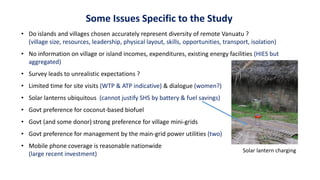
• Solar lanterns ubiquitous (cannot justify SHS by battery & fuel savings)
• Govt preference for coconut-based biofuel
• Govt (and some donor) strong preference for village mini-grids
• Govt preference for management by the main-grid power utilities (two)
• Mobile phone coverage is reasonable nationwide
(large recent investment)
Solar lantern charging
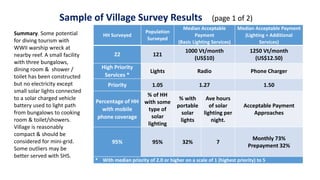
Sample of Village Survey Results (page 1 of 2)
Summary. Some potential
for diving tourism with
WWII warship wreck at
nearby reef. A small facility
with three bungalows,
dining room & shower /
toilet has been constructed
but no electricity except
small solar lights connected
to a solar charged vehicle
battery used to light path
from bungalows to cooking
room & toilet/showers.
Village is reasonably
compact & should be
considered for mini-grid.
Some outliers may be
better served with SHS.
HH Surveyed
Population
Surveyed
Median Acceptable
Payment
(Basic Lighting Services)
Median Acceptable Payment
(Lighting + Additional
Services)
22 121
1000 Vt/month
(US$10)
1250 Vt/month
(US$12.50)
High Priority
Services *
Lights Radio Phone Charger
Priority 1.05 1.27 1.50
Percentage of HH
with mobile
phone coverage
% of HH
with some
type of
solar
lighting
% with
portable
solar
lights
Ave hours
of solar
lighting per
night.
Acceptable Payment
Approaches
95% 95% 32% 7
Monthly 73%
Prepayment 32%
* With median priority of 2.0 or higher on a scale of 1 (highest priority) to 5
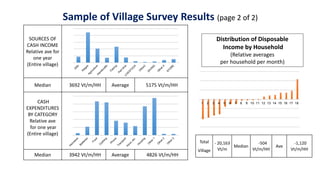
Sample of Village Survey Results (page 2 of 2)
SOURCES OF
CASH INCOME
Relative ave for
one year
(Entire village)
Median 3692 Vt/m/HH Average 5175 Vt/m/HH
CASH
EXPENDITURES
BY CATEGORY
Relative ave
for one year
(Entire village)
Median 3942 Vt/m/HH Average 4826 Vt/m/HH
1 2 3 4 5 6 7 8 9 10 11 12 13 14 15 16 17 18
Distribution of Disposable
Income by Household
(Relative averages
per household per month)
Total
Village
- 20,163
Vt/m
Median
-504
Vt/m/HH
Ave
-1,120
Vt/m/HH
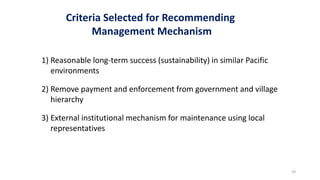
Criteria Selected for Recommending
Management Mechanism
1) Reasonable long-term success (sustainability) in similar Pacific
environments
2) Remove payment and enforcement from government and village
hierarchy
3) External institutional mechanism for maintenance using local
representatives
24
25
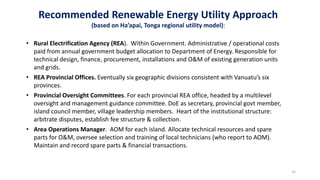
Recommended Renewable Energy Utility Approach
(based on Ha’apai, Tonga regional utility model):
• Rural Electrification Agency (REA). Within Government. Administrative / operational costs
paid from annual government budget allocation to Department of Energy. Responsible for
technical design, finance, procurement, installations and O&M of existing generation units
and grids.
• REA Provincial Offices. Eventually six geographic divisions consistent with Vanuatu’s six
provinces.
• Provincial Oversight Committees. For each provincial REA office, headed by a multilevel
oversight and management guidance committee. DoE as secretary, provincial govt member,
island council member, village leadership members. Heart of the institutional structure:
arbitrate disputes, establish fee structure & collection.
• Area Operations Manager. AOM for each island. Allocate technical resources and spare
parts for O&M, oversee selection and training of local technicians (who report to AOM).
Maintain and record spare parts & financial transactions.
Summary of Results EMAE ISLAND Mini-Grid SHS Pico-solar
Sangava ?
Tongamea ?
Fineonge
Sasake
Marae
Vaitini
Tabakoro
Makatea
Reisu
Siwo
MATASO ISLAND
Na’asang
MAKIRA ISLAND
Makatoto
ANEITYUM ISLAND
Anelcauhat
Umetch ?
Port Patrick ?
Mystery Isl *
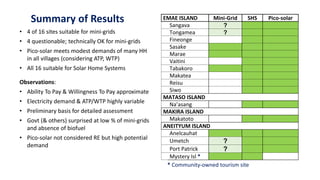
• 4 of 16 sites suitable for mini-grids
• 4 questionable; technically OK for mini-grids
• Pico-solar meets modest demands of many HH
in all villages (considering ATP, WTP)
• All 16 suitable for Solar Home Systems
Observations:
• Ability To Pay & Willingness To Pay approximate
• Electricity demand & ATP/WTP highly variable
• Preliminary basis for detailed assessment
• Govt (& others) surprised at low % of mini-grids
and absence of biofuel
• Pico-solar not considered RE but high potential
demand
* Community-owned tourism site
Lessons from Pacific Off-grid Remote
Renewable Energy Experience ?
Relevance to Smart Village Initiative ?
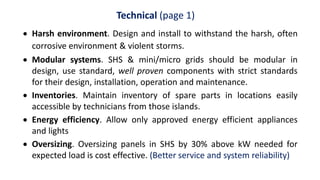
Technical (page 1)
 Harsh environment. Design and install to withstand the harsh, often
corrosive environment & violent storms.
 Modular systems. SHS & mini/micro grids should be modular in
design, use standard, well proven components with strict standards
for their design, installation, operation and maintenance.
 Inventories. Maintain inventory of spare parts in locations easily
accessible by technicians from those islands.
 Energy efficiency. Allow only approved energy efficient appliances
and lights
 Oversizing. Oversizing panels in SHS by 30% above kW needed for
expected load is cost effective. (Better service and system reliability)
Technical (page 2)
 High quality components. For remote sites, cost of replacing components is very
high: only high quality, well proven and reliable components should be used. For
SHS & micro/mini-grid systems battery sizing should provide at least 5 days of
autonomy
 Battery quality. Cost of replacing batteries in remote sites can be >2x cost of the
battery (high import duties; transport; recycling cost). Usually cost effective to
specify very high quality, industrial grade deep discharge batteries
 Open-cell batteries preferred (but technology & costs changing). Open cell lead-
acid batteries have a longer life and lower cost than comparable-quality sealed
batteries if properly maintained & use rain / distilled water. Design for
replacement by lithium-ion.
O&M and Sustainability (page 1)
 Maintenance. Avoid individual & community maintenance, which has not worked.
 Upfront capital investment. PIC experience suggests upfront user financial
investment not required for taking care of system, if equipment is owned by govt or
‘solar utility’ with fee for service (covering O&M) and perhaps amortising capital costs
not covered by donor or govt.
 Disconnections. Cut off power if user fee is not paid within reasonable time (typically
3 months. Otherwise, user payments fall & systems unsustainable. Village-based
technicians must be responsible to an external organization, not to village leadership.
Almost impossible for a village technician to disconnect customers who fail to pay.
 Hybrid mini-grids with 24/7operations need access to trained operator on duty 24/7.
 Training. Repetitive training of local technicians, preferably annually, important to get
& retain high-quality maintenance staff.
O&M and Sustainability (page 1)
 Effective maintenance. Cost-effective good-quality maintenance (SHS and/or mini-grid) requires
about 75 customers per (small) island (minimum) to 125 customers (maximum) per well-trained
technician.
 Keep politicians informed. Newly-elected governments often unaware of ongoing costs of RE
systems. Informal discussions (Members of Parliament, ministers and staff of Prime Minister or
President’s office) should be held after every change of government. This is to help them
understand that RE resources may be free with donors providing equipment, but there is a real
and substantial on-going cost for O&M, particularly large periodic cost of battery replacement.
 Donors. Govts should work closely with donors to ensure that proposed equipment is
appropriate, fits local needs, and can be maintained satisfactorily using local resources. Donors
should be required to provide only designs, materials and installation procedures that meet those
standards.
 Expanding RE. Expanding electrification through new installations should be carefully staged over
time so that the national management system can gradually adapt to the increased
responsibilities that additional installations and new locations will entail.
Thank You
Peter Johnston
Environmental & Energy Consultants, Ltd; Suva, Fiji
johnston@unwired.com.fj
Dr Herb Wade
Renewable Energy & Energy Efficiency Consultant;
Bangkok herbwade@sprynet.com
Sustainable Energy Industry
Association of the Pacific Islands
www.seiapi.com
info@seiapi.com
www.ppa.org.fj
ppafiji@gmail.com
For information on Pacific
Islands off-grid & on-grid RE
guidelines, standards,
training, certification, etc.
contact SEIAPI and/or PPA