Bandaging, Sling, Splinting and binders
Bandaging
•The process of covering a wound or an injured part
•Uses
•To prevent contamination & Securing wound dressing
•To provide support to the part that is injured, ex - splinting
•To provide rest & Immobilization the injured body part
•To prevent or control hemorrhage
•Reducing or preventing edema
•Creating pressure over the body part
•Carelessly or improperly application of bandage can cause discomfort
and harm to patient.
Bandaging material
•Gauze
•Light, soft, thin and porous, Widely use, may be easily adjusted &
applied
•Muslin
•Can be easily torn into strips
•Flannel
•Soft & elastic, absorb moisture, maintain body heat, can apply
smoothly and evenly
•Crinoline
•Use of making plaster of Paris bandage
•Rubber & Elastic webbing
•Use to firm support to body part
Gauze
Rubber and elastic webbing
Crinoline
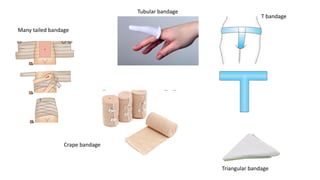
Types of Bandages
•Triangular bandage
•Roller bandage
•Many tailed bandage
•T – bandage
•Tubular bandage
Many tailed bandage
Tubular bandage
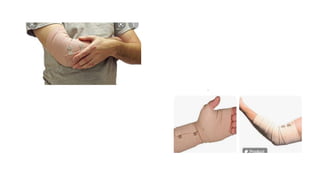
Crape bandage
T bandage
Triangular bandage
Bandaging principles
•Select the bandage of proper size and suitable material
•Put the patient in comfortable position
•Support the injured area while bandaging
•Face the patient except when applying a head (capelin) bandage, ear & eye.
•Exposed wounds or open skin should be covered with a sterile dressing.
•Applying gauze or cotton padding between two skin surfaces (ex- between
toes, axilla, groin…) to prevent friction.
•Never ignore any complaints of pain or discomfort experienced by the
patient.
When applying roller bandage……………
•Partly unrolled bandage – rolled part “head” unrolled part “ tail” and keep
head upper most when bandaging
•Hold the roll of the bandage in the right hand when apply bandage on the
left side vice versa
•Always start bandaging from inner to outward and from below to upward.
•Always start and end with two circular turns
•Apply bandage firmly with equal tension & pressure exerted over each
turn or layer
•Cover the two thirds (2/3) of the previous turn and margin should be
parallel
Cont…
•Cover the area 2 inches above and 2 inches below the affected area
(wound)
•Leave the fingers and toes uncovered to observe circulatory
impairment
•Pallor, cyanosis, decrease or absent pulse, swelling, numbness,
tingling, coolness.
•When completed, fix the bandage with Pin, knot or tie and placed it
away from the wound or tender areas
Fastening the bandage
•Tie reef knot
•Pin
•Clip
•Adhesive tape
Cont…
•Tie Reef knot (Square knot)
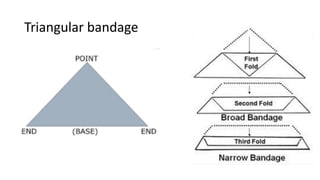
Triangular bandage
Cont…..
•Triangular bandage can be used
•Bandaging wound
•Immobilization fracture or dislocation
•As a sling for supporting injured body part
•Can be improvised from shirt, old sheet, large handkerchief
•Can be used as triangular or cravat bandage
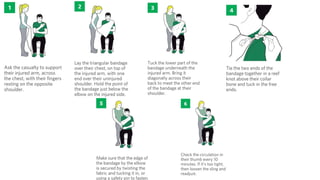
Application of broad arm sling
•An broad arm sling
•Hold the forearm in a raised or horizontal position.
•Can support an injured upper arm, forearm and wrist.
Cont…
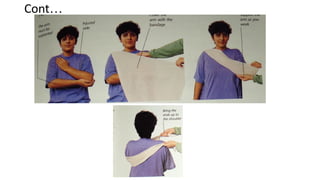
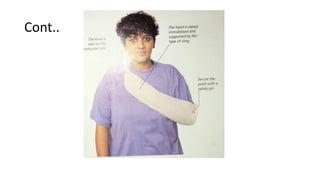
Application of elevation sling
•Elevation sling supports the forearm and hand in a raised position
•The fingertips touching the casualty’s shoulder.
•Use for
•Immobilize Fracture clavicle
•Control bleeding and minimize swelling
Cont…
Cont..
Collar and cuff sling
•Used for immobilization of injured arm and shoulder
•Need a make clove hitch using narrow fold bandage
•Tie the bandage on the uninjured side using a reef knot.
Application of Roller bandage (technique)
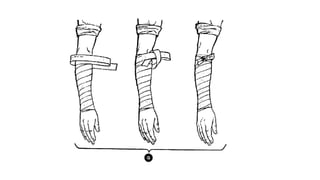
•Basic turns used in roller bandaging
•Simple spiral
•Used for cylindrical body part that is uniform thickness ex –upper arm,
upper leg
Cont….
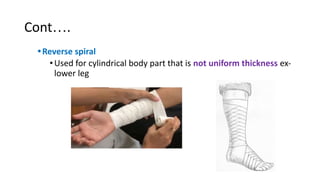
•Reverse spiral
•Used for cylindrical body part that is not uniform thickness ex-
lower leg
Cont…
•Figure of eight
•Used for joint ex –elbow, knee, ankle
Cont….
•Spica
•A forms of figure of eight (one turn is lager than other)
•Used for joint at right angle to the body ex shoulder, hip, thumb
Cont…
•Head, ear and eye bandaging
•Bandaging for stump
•Barrel bandage
Splinting
•Splinting is a long, firm object that use to immobilize the fragment of
broken bone
•Proper splinting will
•Prevent surrounding structure damage by bone fragment
•Reduce pain and promote comfort
Principles of splinting
•All fracture of long bone should be splinted (before any kind of
movement. Ex transport
•Joint above the fracture and joint below the fracture should be
immobilized by splint.
•Splint should not interfere with the circulation –should check for
circulatory impairment ex- cyanosis, coolness, swelling, pain,
numbness…..
•Splint should be padded
•Improvised splint can be used
#. Bandaging and Splinting.pdf

#. Bandaging and Splinting.pdf

  • 1.
  • 2.
    Bandaging •The process ofcovering a wound or an injured part •Uses •To prevent contamination & Securing wound dressing •To provide support to the part that is injured, ex - splinting •To provide rest & Immobilization the injured body part •To prevent or control hemorrhage •Reducing or preventing edema •Creating pressure over the body part •Carelessly or improperly application of bandage can cause discomfort and harm to patient.
  • 3.
    Bandaging material •Gauze •Light, soft,thin and porous, Widely use, may be easily adjusted & applied •Muslin •Can be easily torn into strips •Flannel •Soft & elastic, absorb moisture, maintain body heat, can apply smoothly and evenly •Crinoline •Use of making plaster of Paris bandage •Rubber & Elastic webbing •Use to firm support to body part
  • 4.
    Gauze Rubber and elasticwebbing Crinoline
  • 5.
    Types of Bandages •Triangularbandage •Roller bandage •Many tailed bandage •T – bandage •Tubular bandage
  • 6.
    Many tailed bandage Tubularbandage Crape bandage T bandage Triangular bandage
  • 7.
    Bandaging principles •Select thebandage of proper size and suitable material •Put the patient in comfortable position •Support the injured area while bandaging •Face the patient except when applying a head (capelin) bandage, ear & eye. •Exposed wounds or open skin should be covered with a sterile dressing. •Applying gauze or cotton padding between two skin surfaces (ex- between toes, axilla, groin…) to prevent friction. •Never ignore any complaints of pain or discomfort experienced by the patient.
  • 8.
    When applying rollerbandage…………… •Partly unrolled bandage – rolled part “head” unrolled part “ tail” and keep head upper most when bandaging •Hold the roll of the bandage in the right hand when apply bandage on the left side vice versa •Always start bandaging from inner to outward and from below to upward. •Always start and end with two circular turns •Apply bandage firmly with equal tension & pressure exerted over each turn or layer •Cover the two thirds (2/3) of the previous turn and margin should be parallel
  • 9.
    Cont… •Cover the area2 inches above and 2 inches below the affected area (wound) •Leave the fingers and toes uncovered to observe circulatory impairment •Pallor, cyanosis, decrease or absent pulse, swelling, numbness, tingling, coolness. •When completed, fix the bandage with Pin, knot or tie and placed it away from the wound or tender areas
  • 10.
    Fastening the bandage •Tiereef knot •Pin •Clip •Adhesive tape
  • 11.
  • 15.
  • 16.
    Cont….. •Triangular bandage canbe used •Bandaging wound •Immobilization fracture or dislocation •As a sling for supporting injured body part •Can be improvised from shirt, old sheet, large handkerchief •Can be used as triangular or cravat bandage
  • 18.
    Application of broadarm sling •An broad arm sling •Hold the forearm in a raised or horizontal position. •Can support an injured upper arm, forearm and wrist.
  • 19.
  • 20.
    Application of elevationsling •Elevation sling supports the forearm and hand in a raised position •The fingertips touching the casualty’s shoulder. •Use for •Immobilize Fracture clavicle •Control bleeding and minimize swelling
  • 22.
  • 23.
  • 28.
    Collar and cuffsling •Used for immobilization of injured arm and shoulder •Need a make clove hitch using narrow fold bandage •Tie the bandage on the uninjured side using a reef knot.
  • 30.
    Application of Rollerbandage (technique) •Basic turns used in roller bandaging •Simple spiral •Used for cylindrical body part that is uniform thickness ex –upper arm, upper leg
  • 31.
    Cont…. •Reverse spiral •Used forcylindrical body part that is not uniform thickness ex- lower leg
  • 32.
    Cont… •Figure of eight •Usedfor joint ex –elbow, knee, ankle
  • 33.
    Cont…. •Spica •A forms offigure of eight (one turn is lager than other) •Used for joint at right angle to the body ex shoulder, hip, thumb
  • 34.
    Cont… •Head, ear andeye bandaging •Bandaging for stump •Barrel bandage
  • 35.
    Splinting •Splinting is along, firm object that use to immobilize the fragment of broken bone •Proper splinting will •Prevent surrounding structure damage by bone fragment •Reduce pain and promote comfort
  • 36.
    Principles of splinting •Allfracture of long bone should be splinted (before any kind of movement. Ex transport •Joint above the fracture and joint below the fracture should be immobilized by splint. •Splint should not interfere with the circulation –should check for circulatory impairment ex- cyanosis, coolness, swelling, pain, numbness….. •Splint should be padded •Improvised splint can be used