Bandaging
BSC NURSING FIRST SEMESTER
FON-1
UNIT –XIV
LOKESH PARASHAR
COLLEGE OF NURSING GMCH-32 CHANDIGARH
Introduction to Bandaging
Definition:
Bandaging is the application of a strip of cloth or other
material (called a bandage) to support, immobilize,
compress, or protect a part of the body.
Purpose:
•To maintain dressing in position.
•To immobilize a part (e.g., fracture, sprain).
•To provide compression to control bleeding or reduce swelling.
•To support or relieve strain.
•To prevent and protect wounds from contamination.
•To promote healing.
General Principles of Bandaging
•Wash hands and wear gloves before procedure.
•Explain the procedure to the patient.
•Ensure good lighting and comfortable position of patient.
•Always start bandaging from distal to proximal (e.g., from
fingers towards arm).
General Principles of Bandaging
•Apply bandage with even pressure – not too tight, not too loose.
•Overlap turns by 2/3rd of the previous layer.
•Avoid wrinkles or folds (may cause pressure sores).
•Leave fingers or toes exposed (to check circulation).
•Secure bandage with clips, pins, or adhesive tape.
Types of Bandages
A. According to Material
 Roller Bandages – strips of muslin, gauze, flannel.
 Triangular Bandages – made from cotton cloth
in triangular shape.
 Cravat Bandages – folded form of triangular
bandage.
 Special Bandages – tailed bandages, binder
bandages, elastic bandages.
Types of Bandages
B. According to Function
 Supportive bandages – support joint/muscle.
 Immobilizing bandages – keep fractured part
immobile.
 Retention bandages – hold dressings in place.
 Compression bandages – control bleeding/swelling
Uses of Bandaging
•Control of bleeding.
•Immobilization of joints or bones.
•Fixation of splints.
•Protection of wounds and dressings
•Reduction of edema.
•Support of weak muscles/joints.
Precautions in Bandaging
•Control of bleeding.
•Immobilization of joints or bones.
•Fixation of splints.
•Protection of wounds and dressings.
•Reduction of edema.
•Support of weak muscles/joints.
Complications of Improper
Bandaging
•Impaired circulation → cyanosis, swelling, pain.
•Nerve damage → numbness, tingling.
•Skin maceration or ulcer formation.
•Slippage → ineffective immobilization.
•Infection (if sterile technique not maintained)
Role of Nurse in Bandaging
•Assess wound and surrounding area.
•Select correct size/type of bandage.
•Apply bandage skillfully following principles.
•Educate patient about care of bandage.
•Monitor for complications (swelling, pain, numbness).
•Document the procedure.
Techniques of Bandaging
1. Roller Bandage Techniques
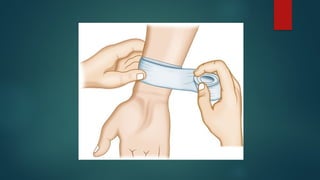
 a) Circular Turn
 Method:
 The bandage is wrapped around the part in a circle, each
turn exactly covering the previous one.
 Use:
 To anchor the bandage at the beginning or end.
 For small, uniformly shaped parts (wrist, ankle, forehead).
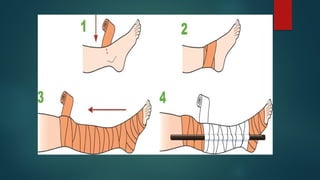
 b) Spiral Turn
 Method:
Bandage is applied spirally upward, each turn
covering 2/3 of the previous one.
 Use:
For cylindrical parts with uniform circumference
(forearm, upper arm, leg).
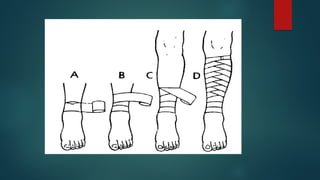
 c) Spiral Reverse Turn
 Method:
Similar to spiral, but after every 1–2 turns, the bandage is
reversed (folded downward) to fit the part snugly.
 Use:
For conical parts (thigh, forearm, calf).
 Note: Prevents gaps and slipping of bandage.
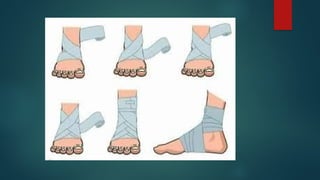
 d) Figure-of-Eight Turn
 Method:
The bandage is alternately passed above and
below a joint, crossing in the shape of “8”.
 Use:
For joints (ankle, knee, wrist, elbow, shoulder).
 Advantage: Provides firm support and allows some
movement.
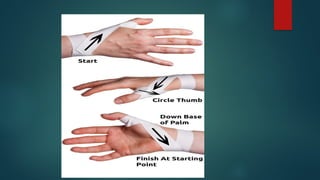
 e) Spica Bandage (a special figure-of-eight)
 Method:
 A variation of figure-of-eight, with one loop covering a
body part and the other spreading upward or downward.
 Types:
 Thumb Spica, Shoulder Spica, Hip Spica.
 Use:
 For thumb, shoulder, or groin.
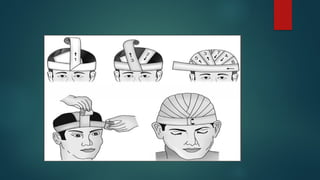
 f) Recurrent Turn
 Method:
Bandage is passed back and forth over the end of a
part, then secured by circular turns.
 Use:
For head, finger, amputated stump.
2. Triangular Bandage Techniques
Made by folding a square cloth diagonally.
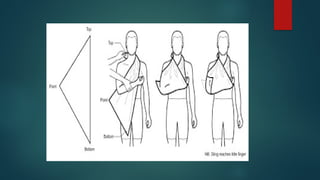
 a) Arm Sling
 Method:
Forearm is placed in sling, apex behind elbow, ends tied
behind neck.
 Use:
Support of injured forearm, wrist, hand.
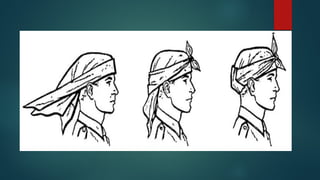
 b) Scalp Bandage
 Method:
Base of triangle placed on forehead, apex at
occiput, ends tied firmly.
 Use:
For scalp wounds.
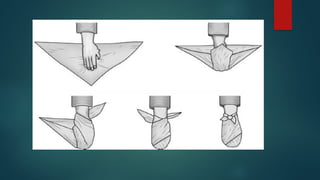
 c) Hand and Foot Bandage
 Method:
Place hand/foot in the middle of bandage, cover with apex,
tie ends around wrist/ankle.
 Use:
For covering hand or foot injuries.
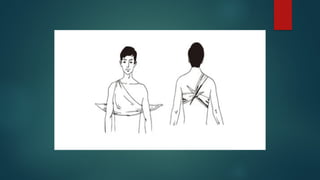
 d) Chest or Back Bandage
 Method:
Wide application of triangular bandage around
chest or back, knot secured on side.
 Use:
To cover large wounds.
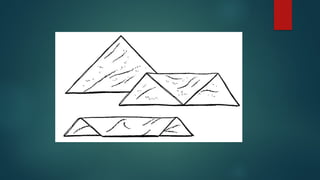
3. Cravat Bandage Techniques
Cravat = Triangular bandage folded into a strip.
Applications:
 Forehead: Wrapped around head and tied at back.
 Eye: Placed over eye, tied at opposite side of head.
 Jaw/Chin: Placed under chin, tied on top of head.
 Arm/Leg: Used like roller to secure dressing.
4. Special Bandage Techniques
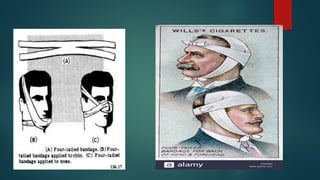
a) Four-Tailed Bandage
 Method:
A strip is split into two tails at each end.
Applied by crossing tails around part and tying
securely.
 Use:
For chin, nose, occiput, breast.
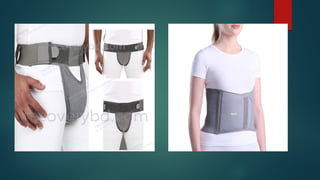
b) Binder
 Types:
Abdominal Binder: Wide cloth wrapped around
abdomen to support after surgery.
Breast Binder: For compressing breasts (postpartum).
Scrotal/Perineal Binder: For genital or rectal area
support.
 Use:
To provide support and retain dressing.
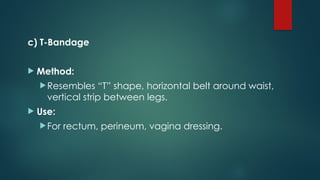
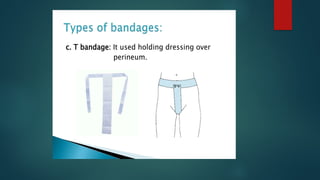
c) T-Bandage
 Method:
Resembles “T” shape, horizontal belt around waist,
vertical strip between legs.
 Use:
For rectum, perineum, vagina dressing.
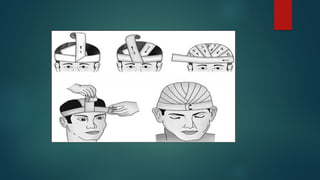
 d) Capeline Bandage (Double-headed roller bandage)
 Method:
Bandage applied to cover scalp in recurrent turns
secured by circular turns.
 Use:
For head wounds.
Important Points in Technique
 Always start with circular anchoring turn.
 Overlap bandage by 2/3rd.
 Work distal to proximal.
 Keep even pressure.
 Check circulation (color, temperature, sensation)
after completion.
 Secure bandage neatly with clip/tape.
bandaging types uses and techniques.pptx

bandaging types uses and techniques.pptx

  • 1.
    Bandaging BSC NURSING FIRSTSEMESTER FON-1 UNIT –XIV LOKESH PARASHAR COLLEGE OF NURSING GMCH-32 CHANDIGARH
  • 2.
    Introduction to Bandaging Definition: Bandagingis the application of a strip of cloth or other material (called a bandage) to support, immobilize, compress, or protect a part of the body.
  • 3.
    Purpose: •To maintain dressingin position. •To immobilize a part (e.g., fracture, sprain). •To provide compression to control bleeding or reduce swelling. •To support or relieve strain. •To prevent and protect wounds from contamination. •To promote healing.
  • 4.
    General Principles ofBandaging •Wash hands and wear gloves before procedure. •Explain the procedure to the patient. •Ensure good lighting and comfortable position of patient. •Always start bandaging from distal to proximal (e.g., from fingers towards arm).
  • 5.
    General Principles ofBandaging •Apply bandage with even pressure – not too tight, not too loose. •Overlap turns by 2/3rd of the previous layer. •Avoid wrinkles or folds (may cause pressure sores). •Leave fingers or toes exposed (to check circulation). •Secure bandage with clips, pins, or adhesive tape.
  • 6.
    Types of Bandages A.According to Material  Roller Bandages – strips of muslin, gauze, flannel.  Triangular Bandages – made from cotton cloth in triangular shape.  Cravat Bandages – folded form of triangular bandage.  Special Bandages – tailed bandages, binder bandages, elastic bandages.
  • 7.
    Types of Bandages B.According to Function  Supportive bandages – support joint/muscle.  Immobilizing bandages – keep fractured part immobile.  Retention bandages – hold dressings in place.  Compression bandages – control bleeding/swelling
  • 8.
    Uses of Bandaging •Controlof bleeding. •Immobilization of joints or bones. •Fixation of splints. •Protection of wounds and dressings •Reduction of edema. •Support of weak muscles/joints.
  • 9.
    Precautions in Bandaging •Controlof bleeding. •Immobilization of joints or bones. •Fixation of splints. •Protection of wounds and dressings. •Reduction of edema. •Support of weak muscles/joints.
  • 10.
    Complications of Improper Bandaging •Impairedcirculation → cyanosis, swelling, pain. •Nerve damage → numbness, tingling. •Skin maceration or ulcer formation. •Slippage → ineffective immobilization. •Infection (if sterile technique not maintained)
  • 11.
    Role of Nursein Bandaging •Assess wound and surrounding area. •Select correct size/type of bandage. •Apply bandage skillfully following principles. •Educate patient about care of bandage. •Monitor for complications (swelling, pain, numbness). •Document the procedure.
  • 12.
    Techniques of Bandaging 1.Roller Bandage Techniques  a) Circular Turn  Method:  The bandage is wrapped around the part in a circle, each turn exactly covering the previous one.  Use:  To anchor the bandage at the beginning or end.  For small, uniformly shaped parts (wrist, ankle, forehead).
  • 14.
     b) SpiralTurn  Method: Bandage is applied spirally upward, each turn covering 2/3 of the previous one.  Use: For cylindrical parts with uniform circumference (forearm, upper arm, leg).
  • 16.
     c) SpiralReverse Turn  Method: Similar to spiral, but after every 1–2 turns, the bandage is reversed (folded downward) to fit the part snugly.  Use: For conical parts (thigh, forearm, calf).  Note: Prevents gaps and slipping of bandage.
  • 18.
     d) Figure-of-EightTurn  Method: The bandage is alternately passed above and below a joint, crossing in the shape of “8”.  Use: For joints (ankle, knee, wrist, elbow, shoulder).  Advantage: Provides firm support and allows some movement.
  • 20.
     e) SpicaBandage (a special figure-of-eight)  Method:  A variation of figure-of-eight, with one loop covering a body part and the other spreading upward or downward.  Types:  Thumb Spica, Shoulder Spica, Hip Spica.  Use:  For thumb, shoulder, or groin.
  • 22.
     f) RecurrentTurn  Method: Bandage is passed back and forth over the end of a part, then secured by circular turns.  Use: For head, finger, amputated stump.
  • 24.
    2. Triangular BandageTechniques Made by folding a square cloth diagonally.  a) Arm Sling  Method: Forearm is placed in sling, apex behind elbow, ends tied behind neck.  Use: Support of injured forearm, wrist, hand.
  • 26.
     b) ScalpBandage  Method: Base of triangle placed on forehead, apex at occiput, ends tied firmly.  Use: For scalp wounds.
  • 28.
     c) Handand Foot Bandage  Method: Place hand/foot in the middle of bandage, cover with apex, tie ends around wrist/ankle.  Use: For covering hand or foot injuries.
  • 30.
     d) Chestor Back Bandage  Method: Wide application of triangular bandage around chest or back, knot secured on side.  Use: To cover large wounds.
  • 32.
    3. Cravat BandageTechniques Cravat = Triangular bandage folded into a strip. Applications:  Forehead: Wrapped around head and tied at back.  Eye: Placed over eye, tied at opposite side of head.  Jaw/Chin: Placed under chin, tied on top of head.  Arm/Leg: Used like roller to secure dressing.
  • 34.
    4. Special BandageTechniques a) Four-Tailed Bandage  Method: A strip is split into two tails at each end. Applied by crossing tails around part and tying securely.  Use: For chin, nose, occiput, breast.
  • 36.
    b) Binder  Types: AbdominalBinder: Wide cloth wrapped around abdomen to support after surgery. Breast Binder: For compressing breasts (postpartum). Scrotal/Perineal Binder: For genital or rectal area support.  Use: To provide support and retain dressing.
  • 38.
    c) T-Bandage  Method: Resembles“T” shape, horizontal belt around waist, vertical strip between legs.  Use: For rectum, perineum, vagina dressing.
  • 40.
     d) CapelineBandage (Double-headed roller bandage)  Method: Bandage applied to cover scalp in recurrent turns secured by circular turns.  Use: For head wounds.
  • 42.
    Important Points inTechnique  Always start with circular anchoring turn.  Overlap bandage by 2/3rd.  Work distal to proximal.  Keep even pressure.  Check circulation (color, temperature, sensation) after completion.  Secure bandage neatly with clip/tape.