Contrastive Rhetoric
Cross-cultural aspects of second-
       language writing


     Presenter: Pei-Hsuan Lin
            ETAP 631
            Fall 2012
                                    1
Outline of this Book
• Ch1: aims, purposes, what is it,
  how it is important
• Ch2-3 : history of the
  development of contrastive
  rhetoric
• Ch4-8: interfaces with other fields
• Ch9-10: practical applications and
  methodological concerns


                                        2
Contrastive Rhetoric
• Contrastive rhetoric is the study of how a person's first
  language and culture influence his/her writing in a
  second language.
• The focus are “the role of first language conventions of
  discourse and rhetoric structure on second language
  usage, as well as cognitive and cultural dimensions of
  transfer, particularly in relation to writing (xi)”.
• How second language writers draw on a range of
  cross-linguistic and cross-cultural influences at both
  the sentence, paragraph, and textual level (cohesion,
  coherence, schematic structure) and culturally bound
  assumptions about the nature and purposes of written
                                                              3
  texts can transfer form one language to another.
Trend of Contrastive Rhetoric
• Research began in the 1960s, started by the American
  applied linguist Robert B. Kaplan.
• Logic and rhetoric are independent and cultural
  specific.
• Classic rhetoric emphasizes on its persuasiveness :
  coherent & convincing (sentence level)
• Expansion of the genre: take a broader, more
  communicative view across interdisciplinary
  boundaries including education, pedagogy, linguistic,
  literacy, and translation studies.
• from “cognitive” and “mental” to “social” and
  “cultural”                                              4
Contrastive Rhetoric Studies in Applied
Linguistics
• Contrastive analysis: mistakes made by L2 learners were
  caused by the native language
• Error analysis: systematic errors in the performance of L2
  learners
• Analysis of interlanguage: “transitional competence of L2
  learner” to create “a system that is distinct from both the
  native and the target language” (p13)
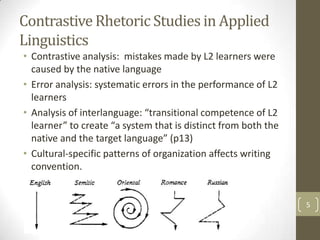
• Cultural-specific patterns of organization affects writing
  convention.


                                                                5
Contrastive Rhetoric Studies in Applied
Linguistics (Count.)
• Ex. Chinese: oriental (indirect, circular) pattern
  • Eight-legged essay: qi-cheng-jun-he model
  Chinese rhetoric lacks of argumentative coherence vs. the
    phrases, sayings, allusions are used to ornament and
    enliven discourse.
  • Confucian cultivation of virtue and maintenance of ethics
    and harmony
  Accept traditional values and social norms vs. non-critical/
    lack of personal insight
  • Implicit expression “suggest”
  Use rhetoric questions, analogies, and anecdotes to reveal
    intentions vs. fuzzy, obscure, vague                          6
Contrastive Rhetoric Studies in Applied
Linguistics (Count.)
• “text” and “discourse” is not clearly distinguished
  • The process that readers and writers go through in their
    attempts to comprehend and produce texts (p19).
• Understanding cultural variation
  • Group good (eastern) vs. individual good (Western)
• “dialogue across the differences” in class
• New directions in contrastive rhetoric: culture and
  sociolinguistics perspectives – discourse analysis and
  processes of writing—considered people, whole text and
  dynamic entities
• Interpretation: socio-cultural aspects toward self, others,
                                                                7
  society, and social interaction
Contrastive Rhetoric & Composition
• Classical rhetoric: “For Aristotle, rhetoric existed
  primarily to persuade.” (p64). “New” rhetoric in 1960s
  suggested that each speaker holds the idea of the
  universal audience.
• Expressionist rhetoric: an opportunity to explore one’s
  inner feeling.
• Cognitive rhetoric: consider writing as a
  complex, recursive process involving
  task, environment, the writer’s long term memory and
  the composing processes.
  • Writing topic, audience, analysis, possible writing plans, and
    writing process.
                                                                     8
• Social constructive rhetoric: context and situation of
  writing
Genre-specific Studies in Contractive
Rhetoric
• Genre: a communicative event that members narrowly
  focus on rhetoric action exhibiting similar patterns of
  structure, style, content, and intended audience.
• “The genre names inherited and produced by discourse
  communities and imported by others constitute valuable
  ethnographic communication”(p127).
• Berkenkotter and Huckin’s idea that humans as social
  actors learn, monitor, and reproduce knowledge of genre
  is a form of situated cognition embedded in disciplinary
  activities (p128).
• Bakhtin’s idea consider genre as a dynamic and social
  text which is a ongoing process of discourse production
                                                             9
  tied to other utterance in a culture (p128).
Genre-specific Studies in Contractive
Rhetoric (Count.)
• Student writing (different levels): different language use
  with various cultural backgrounds
• Academic writing(research articles and grant proposals):
  • explain research motivation and justify publication (CARS
    model)
  • classical rhetoric :persuade based on ethical and logical
    arguments
• professional writing (letters, resume, job
  application, business writing, editorials) : different
  cultural expressions
• More studies need to be conducted.                            10
Research in Contractive Rhetoric
• “The primary impetus of for contractive rhetoric is
  finding solutions to immediate pedagogical problems, in
  which explain why contractive studies deal with the
  English writing of non-English students” (p156).
• Methods: reflective inquiry, quantitative descriptive
  research, prediction and classification studies, surveys,
  case studies and ethnography, true and quasi
  experiments
• Interdisciplinary involving social and cultural aspects in
  L1 and L2, it is mostly lack of described steps of analysis.
• Design flows: small sample size, a mix of genre,               11
  generalizing from L2 to L1 behavior.
Conclusion
• Contrastive rhetoric is a knowledge and awareness about
  differences in writing patterns across cultures.
• Contrastive rhetoric research shows that different
  cultures have different expectations of writing and that
  these different expectations are internalized as different
  patterns of discourse.
• Understanding contrastive rhetoric well makes people
  realize explicitly how writing in different languages works.


                                                                 12

Contrastive rhetoric

  • 1.
    Contrastive Rhetoric Cross-cultural aspectsof second- language writing Presenter: Pei-Hsuan Lin ETAP 631 Fall 2012 1
  • 2.
    Outline of thisBook • Ch1: aims, purposes, what is it, how it is important • Ch2-3 : history of the development of contrastive rhetoric • Ch4-8: interfaces with other fields • Ch9-10: practical applications and methodological concerns 2
  • 3.
    Contrastive Rhetoric • Contrastiverhetoric is the study of how a person's first language and culture influence his/her writing in a second language. • The focus are “the role of first language conventions of discourse and rhetoric structure on second language usage, as well as cognitive and cultural dimensions of transfer, particularly in relation to writing (xi)”. • How second language writers draw on a range of cross-linguistic and cross-cultural influences at both the sentence, paragraph, and textual level (cohesion, coherence, schematic structure) and culturally bound assumptions about the nature and purposes of written 3 texts can transfer form one language to another.
  • 4.
    Trend of ContrastiveRhetoric • Research began in the 1960s, started by the American applied linguist Robert B. Kaplan. • Logic and rhetoric are independent and cultural specific. • Classic rhetoric emphasizes on its persuasiveness : coherent & convincing (sentence level) • Expansion of the genre: take a broader, more communicative view across interdisciplinary boundaries including education, pedagogy, linguistic, literacy, and translation studies. • from “cognitive” and “mental” to “social” and “cultural” 4
  • 5.
    Contrastive Rhetoric Studiesin Applied Linguistics • Contrastive analysis: mistakes made by L2 learners were caused by the native language • Error analysis: systematic errors in the performance of L2 learners • Analysis of interlanguage: “transitional competence of L2 learner” to create “a system that is distinct from both the native and the target language” (p13) • Cultural-specific patterns of organization affects writing convention. 5
  • 6.
    Contrastive Rhetoric Studiesin Applied Linguistics (Count.) • Ex. Chinese: oriental (indirect, circular) pattern • Eight-legged essay: qi-cheng-jun-he model Chinese rhetoric lacks of argumentative coherence vs. the phrases, sayings, allusions are used to ornament and enliven discourse. • Confucian cultivation of virtue and maintenance of ethics and harmony Accept traditional values and social norms vs. non-critical/ lack of personal insight • Implicit expression “suggest” Use rhetoric questions, analogies, and anecdotes to reveal intentions vs. fuzzy, obscure, vague 6
  • 7.
    Contrastive Rhetoric Studiesin Applied Linguistics (Count.) • “text” and “discourse” is not clearly distinguished • The process that readers and writers go through in their attempts to comprehend and produce texts (p19). • Understanding cultural variation • Group good (eastern) vs. individual good (Western) • “dialogue across the differences” in class • New directions in contrastive rhetoric: culture and sociolinguistics perspectives – discourse analysis and processes of writing—considered people, whole text and dynamic entities • Interpretation: socio-cultural aspects toward self, others, 7 society, and social interaction
  • 8.
    Contrastive Rhetoric &Composition • Classical rhetoric: “For Aristotle, rhetoric existed primarily to persuade.” (p64). “New” rhetoric in 1960s suggested that each speaker holds the idea of the universal audience. • Expressionist rhetoric: an opportunity to explore one’s inner feeling. • Cognitive rhetoric: consider writing as a complex, recursive process involving task, environment, the writer’s long term memory and the composing processes. • Writing topic, audience, analysis, possible writing plans, and writing process. 8 • Social constructive rhetoric: context and situation of writing
  • 9.
    Genre-specific Studies inContractive Rhetoric • Genre: a communicative event that members narrowly focus on rhetoric action exhibiting similar patterns of structure, style, content, and intended audience. • “The genre names inherited and produced by discourse communities and imported by others constitute valuable ethnographic communication”(p127). • Berkenkotter and Huckin’s idea that humans as social actors learn, monitor, and reproduce knowledge of genre is a form of situated cognition embedded in disciplinary activities (p128). • Bakhtin’s idea consider genre as a dynamic and social text which is a ongoing process of discourse production 9 tied to other utterance in a culture (p128).
  • 10.
    Genre-specific Studies inContractive Rhetoric (Count.) • Student writing (different levels): different language use with various cultural backgrounds • Academic writing(research articles and grant proposals): • explain research motivation and justify publication (CARS model) • classical rhetoric :persuade based on ethical and logical arguments • professional writing (letters, resume, job application, business writing, editorials) : different cultural expressions • More studies need to be conducted. 10
  • 11.
    Research in ContractiveRhetoric • “The primary impetus of for contractive rhetoric is finding solutions to immediate pedagogical problems, in which explain why contractive studies deal with the English writing of non-English students” (p156). • Methods: reflective inquiry, quantitative descriptive research, prediction and classification studies, surveys, case studies and ethnography, true and quasi experiments • Interdisciplinary involving social and cultural aspects in L1 and L2, it is mostly lack of described steps of analysis. • Design flows: small sample size, a mix of genre, 11 generalizing from L2 to L1 behavior.
  • 12.
    Conclusion • Contrastive rhetoricis a knowledge and awareness about differences in writing patterns across cultures. • Contrastive rhetoric research shows that different cultures have different expectations of writing and that these different expectations are internalized as different patterns of discourse. • Understanding contrastive rhetoric well makes people realize explicitly how writing in different languages works. 12

Editor's Notes