Research,
language (read: linguistics),
and education
A ONE-DAY WORKSHOP
28 APRIL 2015
English Language Education VS Linguistics?
keywords
• Research
• Language (linguistics)
• Education
Education is
• A form of learning in which the knowledge,
skills, and habits of a group of people are
transferred from one generation to the next
through teaching, training, or research
(longman)
• All a matter of building bridges (Ellison)
Linguistics is
A systematic study of language (Aitchison)
Main studies:
◦Phonetics
◦Phonology
◦Morphology
◦Syntax
◦Semantic
◦Pragmatics
Other related studies:
◦Sociolinguistics
◦Psycholinguistics
◦applied linguistics
◦Computational linguistics
◦stylistics
Education + linguistics?
Applied linguistics:
◦ using what we know about language,
◦ how it is learned, and
◦ how it is used,
in order to achieve some purpose or solve
some problem in the real world
Areas of applied linguistics
◦ second language acquisition
◦ second language pedagogy
◦ authorship identification
◦ forensic linguistics
◦ language-related disorders (aphasic,
autistic speakers)
Topics in applied linguistics
Language teaching methods
Published teaching materials & proficiency,
motivation
How extracurricular exposure contributes to
proficiency
Impact of internet and IT – autonomous learning
Work abroad
Topics in applied linguistics – cont’d
 Teachers’ cooperation
 learner and teacher language in context
 Learners’ and teachers’ L1 in interaction with target L
 Corpus linguistics – authentic language
 Vocabulary, chunks
 Standards & curricula – assessment
Task 1
Identify the topics related with
education and linguistics.
What is research?
Something that we do when
◦We are in search for knowledge, e.g. what is language?
◦We have questions to answer, e.g. why do many Indonesian
people say /enᶦdonesja/ rather than /ɪndonesja/?
◦We have problems to solve, e.g. the implication of scientific
approach as required in curriculum 2013 to English language
teaching.
◦We want to prove some assumptions, e.g. students who get
more reading aloud practice have better pronunciation accuracy.
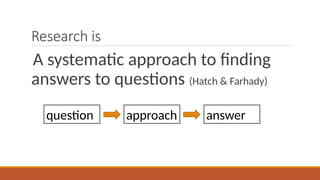
Research is
A systematic approach to finding
answers to questions (Hatch & Farhady)
question approach answer
Step 1: asking question
• Remember choosing topic for writing a composition?
• Choosing any topic for research papers or theses?
• Research ideas need time, thought, and attention in order to
develop.
• Do not jump too quickly on the first suggestion made by
someone (even your professors)
• No fast or shortcut way to topics: spend some time to observe
the world of reality
Start with interest
I’ll do research on
second language
acquisition!
Narrow down the topic
• Which linguistic factor: the acquisition of phonology, morphology, syntax,
semantic, or discourse?
• Which linguistic feature:
• segmental/suprasegmental phoneme (phonology),
• inflectional/derivational morpheme (morphology),
• noun/verb/adjective phrase (syntax),
• definite/indefinite article (semantic),
• maxims of speech (discourse)
• Other factors influencing the learning: teacher, learner, instruction,
motivation
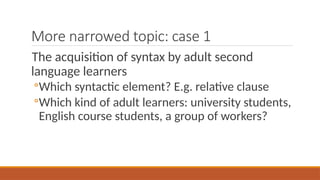
More narrowed topic: case 1
The acquisition of syntax by adult second
language learners
◦Which syntactic element? E.g. relative clause
◦Which kind of adult learners: university students,
English course students, a group of workers?
Formulated topic: case 1
The relationship between the similarity of the
structures of relative clause in first and second
language and the subjects’ performance in
relative clause
Research question: case 1
What is the relationship between the similarity
of the structures of relative clause in first and
second language and the subjects’ performance
in relative clause?
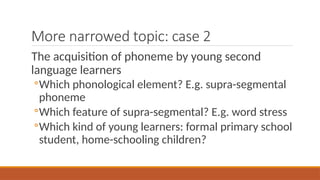
More narrowed topic: case 2
The acquisition of phoneme by young second
language learners
◦Which phonological element? E.g. supra-segmental
phoneme
◦Which feature of supra-segmental? E.g. word stress
◦Which kind of young learners: formal primary school
student, home-schooling children?
Formulated topic: case 2
The acquisition of English word stress
among EFL grade 5 students of X primary
school
Research question: case 2
How do EFL grade 5 students of X
primary school acquire English word
stress?
More narrowed topic: case 3
The acquisition of semantic by adult second language
learners
◦Which semantic element? E.g. word meaning
◦Which class of word? E.g. determiner
◦Which determiner? E.g. article
◦Which article? E.g definite article
◦Which kind of adult learners: university students, English
course students, a group of workers?
Formulated topic: case 3
The perception of the English speakers of
Indonesia on the semantic functions of the
definite article
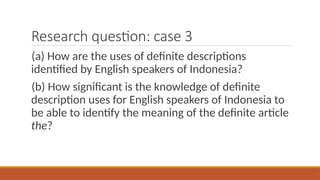
Research question: case 3
(a) How are the uses of definite descriptions
identified by English speakers of Indonesia?
(b) How significant is the knowledge of definite
description uses for English speakers of Indonesia to
be able to identify the meaning of the definite article
the?
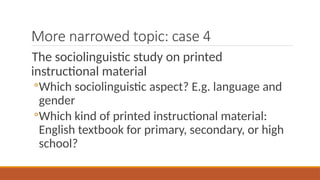
More narrowed topic: case 4
The sociolinguistic study on printed
instructional material
◦Which sociolinguistic aspect? E.g. language and
gender
◦Which kind of printed instructional material:
English textbook for primary, secondary, or high
school?
Formulated topic: case 4
Gender and its visual representation in
English textbook for primary school
students
Research question: case 4
How is gender visually represented in
English textbook for primary school
students?
More narrowed topic: case 5
The sociolinguistic study on language repertoire
◦ Whose repertoire: an English teacher of high
school
Formulated topic: case 5
The language repertoire of a Jambinese
English teacher at Batanghari village
Research question: case 5
1. How does the teacher use different
languages?
2. When are the languages used?
3. In what condition are the languages used?
4. To whom are the languages used?
5. Why are the languages used?
Let’s formulate the topic
• Observe your world of reality
• Identify a research problem
• Narrow down the topic down as much as possible
• Review the literature on the topic as completely
as possible
• State the problem in a question form
Step 2: designing the research
Approaches in research (Creswell):
◦Quantitative
◦Qualitative
◦Mixed methods
Quantitative approach
• Postpositive knowledge claims: challenging the traditional
notion of absolute truth, cannot be ‘positive’ about the claim
of knowledge when studying behaviour and actions of human
• Deterministic philosophy: causes probably determine effect or
outcomes.
• Reductionistic: to reduce the ideas into small, discrete set of
ideas to test, such as variables that form hypotheses and
research questions.
Quantitative approach – cont’d
• The knowledge developed: based on careful observation
and measurement which result in numeric measures
• Laws and theories need to be tested or verified and refined
in order to understand the world
Qualitative approach
• Primarily constructivism: individuals seek understanding of the
world in which they live and work, develop subjective meanings of
their experiences – meanings are varied and multiple.
• Advocay/participatory perspective: related with political agenda –
the research should contain action for reform that may change the
lives of the participant.
• The goal: to rely as much as possible on the participants’ views of
the matter being studied .
• Open-ended questions: the more open-ended questioning, the
better, the participants can express their views more.
Mixed method
• Pragmatic knowledge claims: instead of methods being important,
the problem is most important, all approaches are used to
understand the problem.
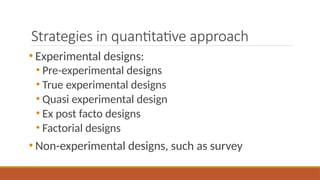
Strategies in quantitative approach
• Experimental designs:
• Pre-experimental designs
• True experimental designs
• Quasi experimental design
• Ex post facto designs
• Factorial designs
• Non-experimental designs, such as survey
Strategies in qualitative approach
• Narrative
• Phenomenology
• Ethnographies
• Grounded theory
• Case studies
Strategies in quantitative studies
Pre-experimental designs
• One-shot case study: a group of students are given some
instructional treatment for a period of time, then tested.
• One group pretest posttest design: similar with one-shot case
study but with pretest.
• Intact group design: two group of students who are not
assigned randomly (but based on performance, placement
test, or even time availibity), one group (experimental group)
receives treatment while the other (control group) does not.
Then, both groups are tested.
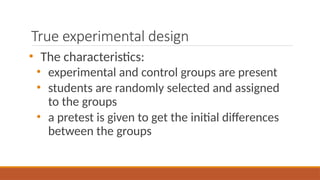
True experimental design
• The characteristics:
• experimental and control groups are present
• students are randomly selected and assigned
to the groups
• a pretest is given to get the initial differences
between the groups
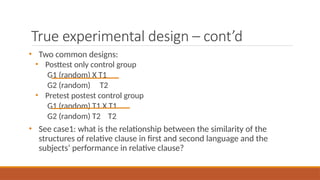
True experimental design – cont’d
• Two common designs:
• Posttest only control group
G1 (random) X T1
G2 (random) T2
• Pretest postest control group
G1 (random) T1 X T1
G2 (random) T2 T2
• See case1: what is the relationship between the similarity of the
structures of relative clause in first and second language and the
subjects’ performance in relative clause?
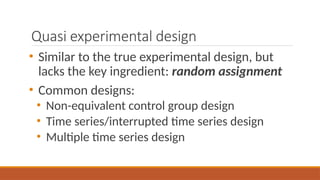
Quasi experimental design
• Similar to the true experimental design, but
lacks the key ingredient: random assignment
• Common designs:
• Non-equivalent control group design
• Time series/interrupted time series design
• Multiple time series design
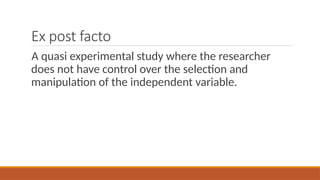
Ex post facto
A quasi experimental study where the researcher
does not have control over the selection and
manipulation of the independent variable.
Factorial design
An experimental design with more variables, more
than one independent variable, and the variables
may have one or many levels.
Surveys
• Cross-sectional surveys: using questionnaire or structured
interview to record information about the subjects at a
single point of time, can be used to compare different
group of population.
• Longitudinal surveys: researchers conduct several
observations of the same subjects over a period of time,
sometimes lasting many years.
Independent and dependent variables
You want to investigate the effect of your instruction on
reading scores of your students.
• The independent variable: the instruction, i.e. the
variable that is investigated, the variable that is selected,
manipulated, and measured.
• The dependent variable: the reading score, i.e. the
variable which is observed and measured to determine
the effect of the independent variable.
Internal validity
Research question: Is the reading ability of EFL students improved over
the use of the speed reading strategy?
Internal validity: can the speed reading strategy account for the progress
the students made, i.e. the extent to which the outcome is a function of
the factor you have selected
Factors influencing internal validity: maturity (e.g. giving picture to
people of different ages), test effect (pretest may contribute result),
subject selection (one group may have received different treatment than
the others), history factor (some students have different treatment at the
same time)
External validity
Would the outcome of the research apply to other similar
situations in the real world?
E.g. carrying out a research on English pronunciation in a
sophisticated language laboratory would yield different
result, than if it is in different condition
Strategies in qualitative studies
Narrative research
• The researcher studies the lives of individual and asks one
or more individuals to provide stories about their lives.
• The information is retold by the researcher into a narrative
chronology.
• In the end, the narrative combine views from the
participant’s life with those of the researcher’s life.
• The study will report the stories of…
Phenomenology
• The researcher identifies the essence of human experiences
concerning a phenomenon (a fact, occurrence, or circumstance
observed or observable).
• A small number of subjects is studied through extensive and
prolonged engagement.
• The researcher ‘bracket’ her own experience.
• The study will describe the experiences of…
• See case 5
Case studies
• The researcher explores in depth a program, an even, an
activity, a process, or one or more individuals.
• The case is bounded by time and activity.
• Researcher uses a variety of data collection procedure.
• The study will explore the process of…
Grounded theory
• The researcher attempts to derive a general, abstract
theory of a process, action, or interaction grounded in the
views of participants.
• The study uses multiple stages of data collection.
• The study will discover…
Ethnographies
• The researcher studies an intact cultural group in a natural
setting over a prolonged period of time by collecting,
primarily, observational data.
• The process is flexible.
• The study will seek to understand…
Task 2
•Prediction task.
• Predict the approach and method of
the research titles
• Check the abstracts
Any questions?

Research, language and teaching and education.pptx

  • 1.
    Research, language (read: linguistics), andeducation A ONE-DAY WORKSHOP 28 APRIL 2015
  • 2.
  • 3.
    keywords • Research • Language(linguistics) • Education
  • 4.
    Education is • Aform of learning in which the knowledge, skills, and habits of a group of people are transferred from one generation to the next through teaching, training, or research (longman) • All a matter of building bridges (Ellison)
  • 5.
    Linguistics is A systematicstudy of language (Aitchison) Main studies: ◦Phonetics ◦Phonology ◦Morphology ◦Syntax ◦Semantic ◦Pragmatics
  • 6.
    Other related studies: ◦Sociolinguistics ◦Psycholinguistics ◦appliedlinguistics ◦Computational linguistics ◦stylistics
  • 7.
    Education + linguistics? Appliedlinguistics: ◦ using what we know about language, ◦ how it is learned, and ◦ how it is used, in order to achieve some purpose or solve some problem in the real world
  • 8.
    Areas of appliedlinguistics ◦ second language acquisition ◦ second language pedagogy ◦ authorship identification ◦ forensic linguistics ◦ language-related disorders (aphasic, autistic speakers)
  • 9.
    Topics in appliedlinguistics Language teaching methods Published teaching materials & proficiency, motivation How extracurricular exposure contributes to proficiency Impact of internet and IT – autonomous learning Work abroad
  • 10.
    Topics in appliedlinguistics – cont’d  Teachers’ cooperation  learner and teacher language in context  Learners’ and teachers’ L1 in interaction with target L  Corpus linguistics – authentic language  Vocabulary, chunks  Standards & curricula – assessment
  • 11.
    Task 1 Identify thetopics related with education and linguistics.
  • 12.
    What is research? Somethingthat we do when ◦We are in search for knowledge, e.g. what is language? ◦We have questions to answer, e.g. why do many Indonesian people say /enᶦdonesja/ rather than /ɪndonesja/? ◦We have problems to solve, e.g. the implication of scientific approach as required in curriculum 2013 to English language teaching. ◦We want to prove some assumptions, e.g. students who get more reading aloud practice have better pronunciation accuracy.
  • 13.
    Research is A systematicapproach to finding answers to questions (Hatch & Farhady) question approach answer
  • 14.
    Step 1: askingquestion • Remember choosing topic for writing a composition? • Choosing any topic for research papers or theses? • Research ideas need time, thought, and attention in order to develop. • Do not jump too quickly on the first suggestion made by someone (even your professors) • No fast or shortcut way to topics: spend some time to observe the world of reality
  • 15.
    Start with interest I’lldo research on second language acquisition!
  • 16.
    Narrow down thetopic • Which linguistic factor: the acquisition of phonology, morphology, syntax, semantic, or discourse? • Which linguistic feature: • segmental/suprasegmental phoneme (phonology), • inflectional/derivational morpheme (morphology), • noun/verb/adjective phrase (syntax), • definite/indefinite article (semantic), • maxims of speech (discourse) • Other factors influencing the learning: teacher, learner, instruction, motivation
  • 17.
    More narrowed topic:case 1 The acquisition of syntax by adult second language learners ◦Which syntactic element? E.g. relative clause ◦Which kind of adult learners: university students, English course students, a group of workers?
  • 18.
    Formulated topic: case1 The relationship between the similarity of the structures of relative clause in first and second language and the subjects’ performance in relative clause
  • 19.
    Research question: case1 What is the relationship between the similarity of the structures of relative clause in first and second language and the subjects’ performance in relative clause?
  • 20.
    More narrowed topic:case 2 The acquisition of phoneme by young second language learners ◦Which phonological element? E.g. supra-segmental phoneme ◦Which feature of supra-segmental? E.g. word stress ◦Which kind of young learners: formal primary school student, home-schooling children?
  • 21.
    Formulated topic: case2 The acquisition of English word stress among EFL grade 5 students of X primary school
  • 22.
    Research question: case2 How do EFL grade 5 students of X primary school acquire English word stress?
  • 23.
    More narrowed topic:case 3 The acquisition of semantic by adult second language learners ◦Which semantic element? E.g. word meaning ◦Which class of word? E.g. determiner ◦Which determiner? E.g. article ◦Which article? E.g definite article ◦Which kind of adult learners: university students, English course students, a group of workers?
  • 24.
    Formulated topic: case3 The perception of the English speakers of Indonesia on the semantic functions of the definite article
  • 25.
    Research question: case3 (a) How are the uses of definite descriptions identified by English speakers of Indonesia? (b) How significant is the knowledge of definite description uses for English speakers of Indonesia to be able to identify the meaning of the definite article the?
  • 26.
    More narrowed topic:case 4 The sociolinguistic study on printed instructional material ◦Which sociolinguistic aspect? E.g. language and gender ◦Which kind of printed instructional material: English textbook for primary, secondary, or high school?
  • 27.
    Formulated topic: case4 Gender and its visual representation in English textbook for primary school students
  • 28.
    Research question: case4 How is gender visually represented in English textbook for primary school students?
  • 29.
    More narrowed topic:case 5 The sociolinguistic study on language repertoire ◦ Whose repertoire: an English teacher of high school
  • 30.
    Formulated topic: case5 The language repertoire of a Jambinese English teacher at Batanghari village
  • 31.
    Research question: case5 1. How does the teacher use different languages? 2. When are the languages used? 3. In what condition are the languages used? 4. To whom are the languages used? 5. Why are the languages used?
  • 32.
    Let’s formulate thetopic • Observe your world of reality • Identify a research problem • Narrow down the topic down as much as possible • Review the literature on the topic as completely as possible • State the problem in a question form
  • 33.
    Step 2: designingthe research Approaches in research (Creswell): ◦Quantitative ◦Qualitative ◦Mixed methods
  • 34.
    Quantitative approach • Postpositiveknowledge claims: challenging the traditional notion of absolute truth, cannot be ‘positive’ about the claim of knowledge when studying behaviour and actions of human • Deterministic philosophy: causes probably determine effect or outcomes. • Reductionistic: to reduce the ideas into small, discrete set of ideas to test, such as variables that form hypotheses and research questions.
  • 35.
    Quantitative approach –cont’d • The knowledge developed: based on careful observation and measurement which result in numeric measures • Laws and theories need to be tested or verified and refined in order to understand the world
  • 36.
    Qualitative approach • Primarilyconstructivism: individuals seek understanding of the world in which they live and work, develop subjective meanings of their experiences – meanings are varied and multiple. • Advocay/participatory perspective: related with political agenda – the research should contain action for reform that may change the lives of the participant. • The goal: to rely as much as possible on the participants’ views of the matter being studied . • Open-ended questions: the more open-ended questioning, the better, the participants can express their views more.
  • 37.
    Mixed method • Pragmaticknowledge claims: instead of methods being important, the problem is most important, all approaches are used to understand the problem.
  • 38.
    Strategies in quantitativeapproach • Experimental designs: • Pre-experimental designs • True experimental designs • Quasi experimental design • Ex post facto designs • Factorial designs • Non-experimental designs, such as survey
  • 39.
    Strategies in qualitativeapproach • Narrative • Phenomenology • Ethnographies • Grounded theory • Case studies
  • 40.
  • 41.
    Pre-experimental designs • One-shotcase study: a group of students are given some instructional treatment for a period of time, then tested. • One group pretest posttest design: similar with one-shot case study but with pretest. • Intact group design: two group of students who are not assigned randomly (but based on performance, placement test, or even time availibity), one group (experimental group) receives treatment while the other (control group) does not. Then, both groups are tested.
  • 42.
    True experimental design •The characteristics: • experimental and control groups are present • students are randomly selected and assigned to the groups • a pretest is given to get the initial differences between the groups
  • 43.
    True experimental design– cont’d • Two common designs: • Posttest only control group G1 (random) X T1 G2 (random) T2 • Pretest postest control group G1 (random) T1 X T1 G2 (random) T2 T2 • See case1: what is the relationship between the similarity of the structures of relative clause in first and second language and the subjects’ performance in relative clause?
  • 44.
    Quasi experimental design •Similar to the true experimental design, but lacks the key ingredient: random assignment • Common designs: • Non-equivalent control group design • Time series/interrupted time series design • Multiple time series design
  • 45.
    Ex post facto Aquasi experimental study where the researcher does not have control over the selection and manipulation of the independent variable.
  • 46.
    Factorial design An experimentaldesign with more variables, more than one independent variable, and the variables may have one or many levels.
  • 47.
    Surveys • Cross-sectional surveys:using questionnaire or structured interview to record information about the subjects at a single point of time, can be used to compare different group of population. • Longitudinal surveys: researchers conduct several observations of the same subjects over a period of time, sometimes lasting many years.
  • 48.
    Independent and dependentvariables You want to investigate the effect of your instruction on reading scores of your students. • The independent variable: the instruction, i.e. the variable that is investigated, the variable that is selected, manipulated, and measured. • The dependent variable: the reading score, i.e. the variable which is observed and measured to determine the effect of the independent variable.
  • 49.
    Internal validity Research question:Is the reading ability of EFL students improved over the use of the speed reading strategy? Internal validity: can the speed reading strategy account for the progress the students made, i.e. the extent to which the outcome is a function of the factor you have selected Factors influencing internal validity: maturity (e.g. giving picture to people of different ages), test effect (pretest may contribute result), subject selection (one group may have received different treatment than the others), history factor (some students have different treatment at the same time)
  • 50.
    External validity Would theoutcome of the research apply to other similar situations in the real world? E.g. carrying out a research on English pronunciation in a sophisticated language laboratory would yield different result, than if it is in different condition
  • 51.
  • 52.
    Narrative research • Theresearcher studies the lives of individual and asks one or more individuals to provide stories about their lives. • The information is retold by the researcher into a narrative chronology. • In the end, the narrative combine views from the participant’s life with those of the researcher’s life. • The study will report the stories of…
  • 53.
    Phenomenology • The researcheridentifies the essence of human experiences concerning a phenomenon (a fact, occurrence, or circumstance observed or observable). • A small number of subjects is studied through extensive and prolonged engagement. • The researcher ‘bracket’ her own experience. • The study will describe the experiences of… • See case 5
  • 54.
    Case studies • Theresearcher explores in depth a program, an even, an activity, a process, or one or more individuals. • The case is bounded by time and activity. • Researcher uses a variety of data collection procedure. • The study will explore the process of…
  • 55.
    Grounded theory • Theresearcher attempts to derive a general, abstract theory of a process, action, or interaction grounded in the views of participants. • The study uses multiple stages of data collection. • The study will discover…
  • 56.
    Ethnographies • The researcherstudies an intact cultural group in a natural setting over a prolonged period of time by collecting, primarily, observational data. • The process is flexible. • The study will seek to understand…
  • 57.
    Task 2 •Prediction task. •Predict the approach and method of the research titles • Check the abstracts
  • 58.