Language Issues
in Qualitative Research
Shiyuan Zhou
EDRD 60002018-3-11
Instructor: Helen Hambly
EDRD 6000
Cross-culture Qualitative Research1
Fundamental Problems2
Recommendations
Discussion Question & References
3
5
CONTENTS
2018-3-11
Example: A Research Review4
Cross-culture Qualitative Research
The use of multiple languages in research study has increased since
• Multiple languages increase comprehensiveness of education
materials and survey questionnaires especially when researchers
have different background
• Multiple languages can also promote ethnic minorities' participation
in research
Source: ‘Practical issues in multi-lingual research,’ 2016
Cross-culture Qualitative Research
The Role of Language in Qualitative Research (Nes, Abma & Jonsson, 2010)
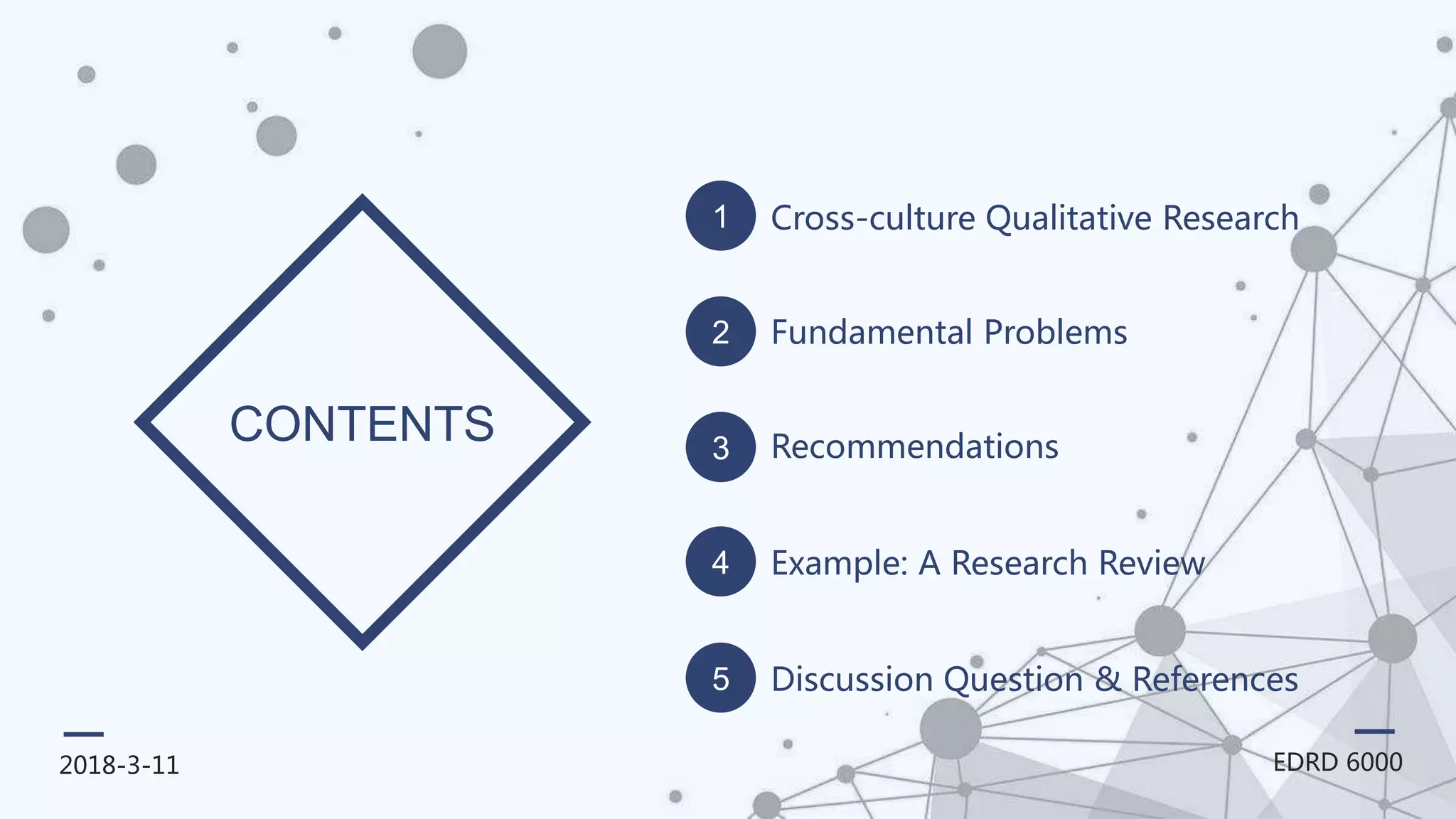
• Language: Qualitative research seek to study meanings in subjective
experience. The relation between subjective experience and language is two-way
process: it is used to express meaning, but also influence how meaning is
constructed.
• Understand: Giving words to experience is a complicated process as the
meaning of experience is often not completely accessible for subjects and difficult
to express in language. People use narratives and metaphors to capture the
richness pf experience
• Interpretation: the message communicated in the source language has to be
interpreted by the translator and transferred into the target language in such a
way that the receiver of the message understands what was meant
• Valid Qualitative Research: the distance between the meanings as
interpreted in the findings is as close as possible.
Cross-culture Qualitative Research
Examples (‘Practical issues in multi-lingual research,’ 2016)
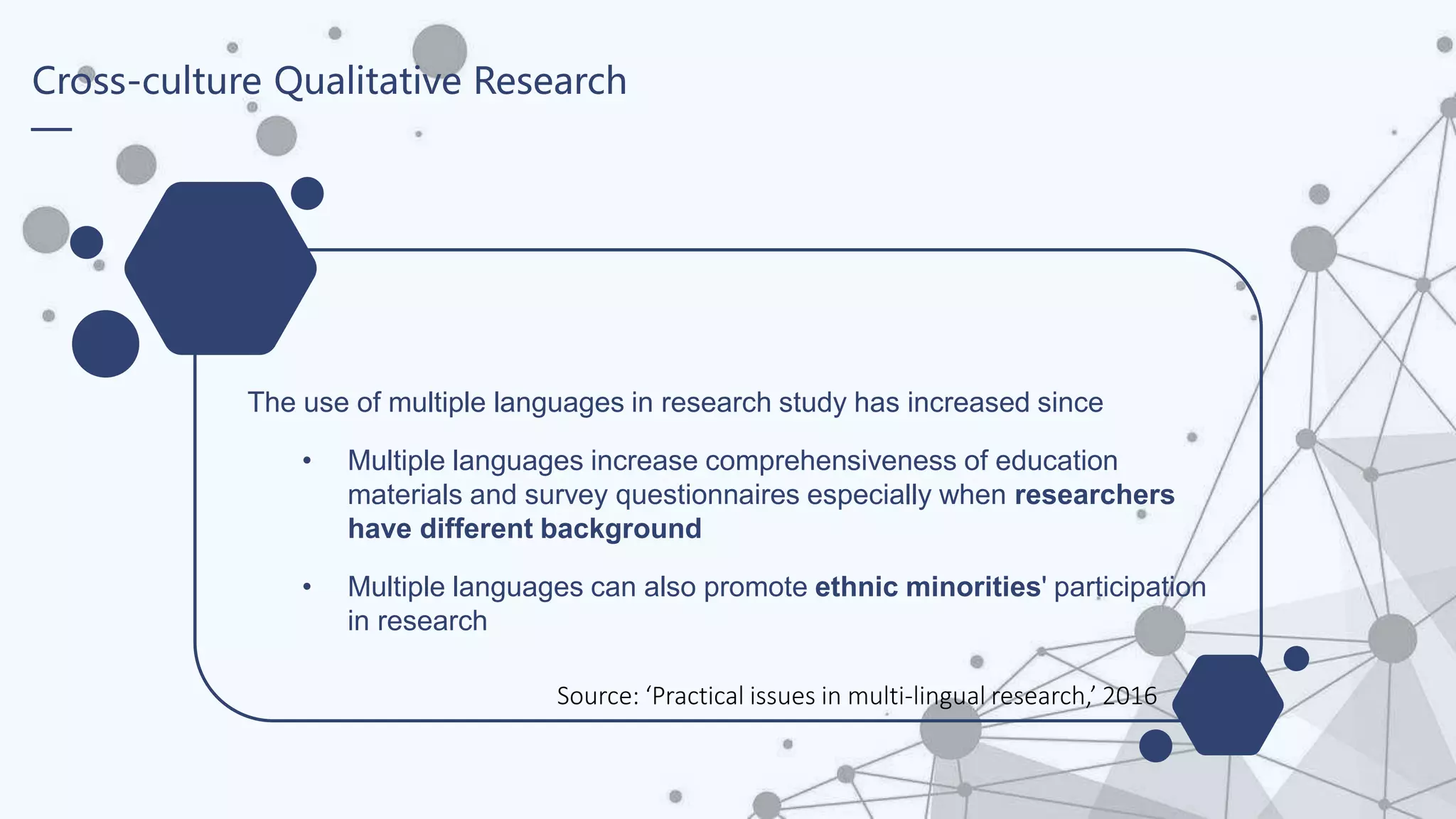
Common-law partner
cannot be expressed in a
concise single word in Korean
because such a relationship is
not commonly accepted in
Korean culture
Common-law partner
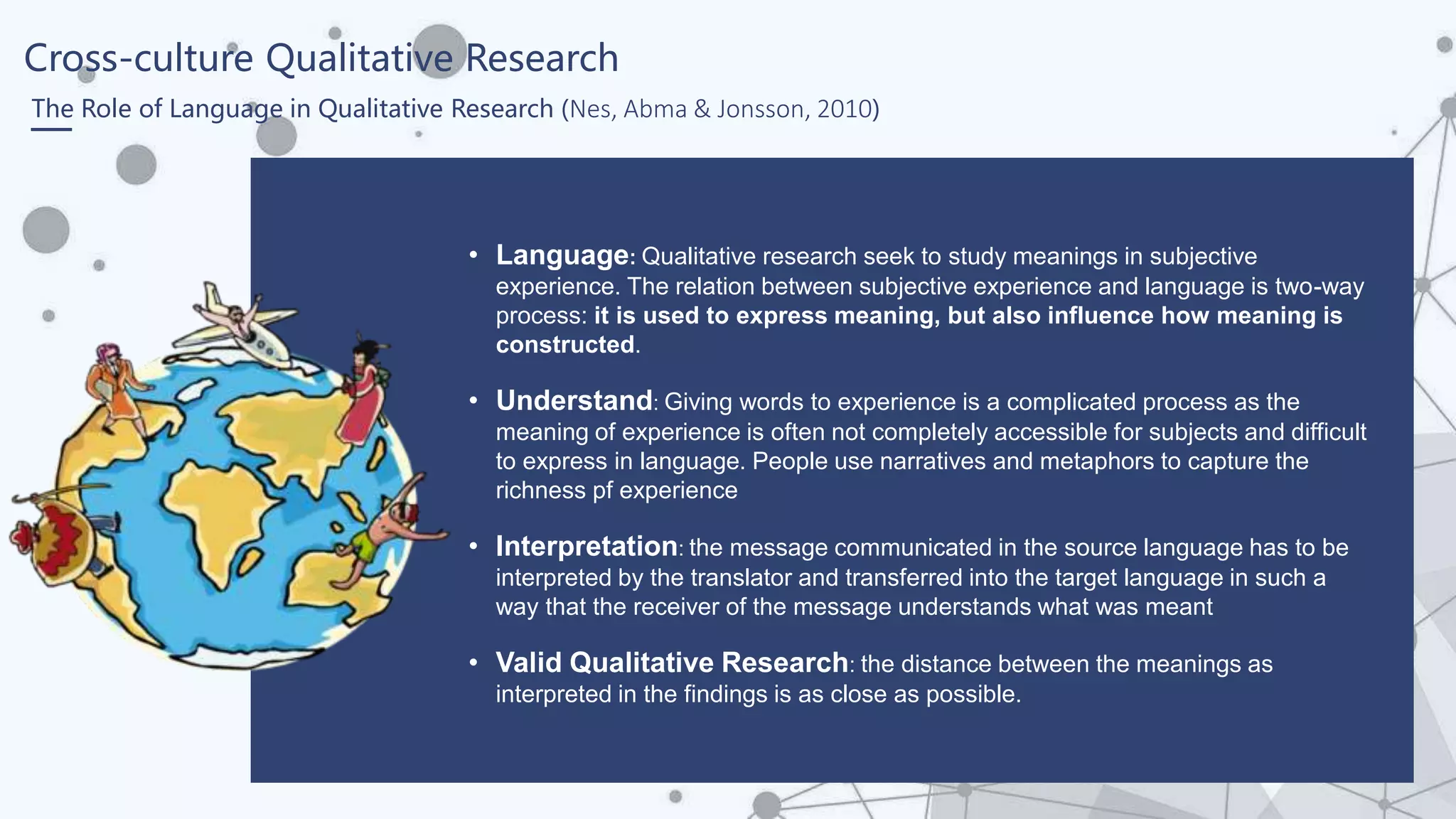
The term ‘spiritual’ based
on Christianity is not-applicable
to Japanese patients, and it is
difficult to translate the terms
related to spirituality into
Japanese cultural context
‘Spiritual’
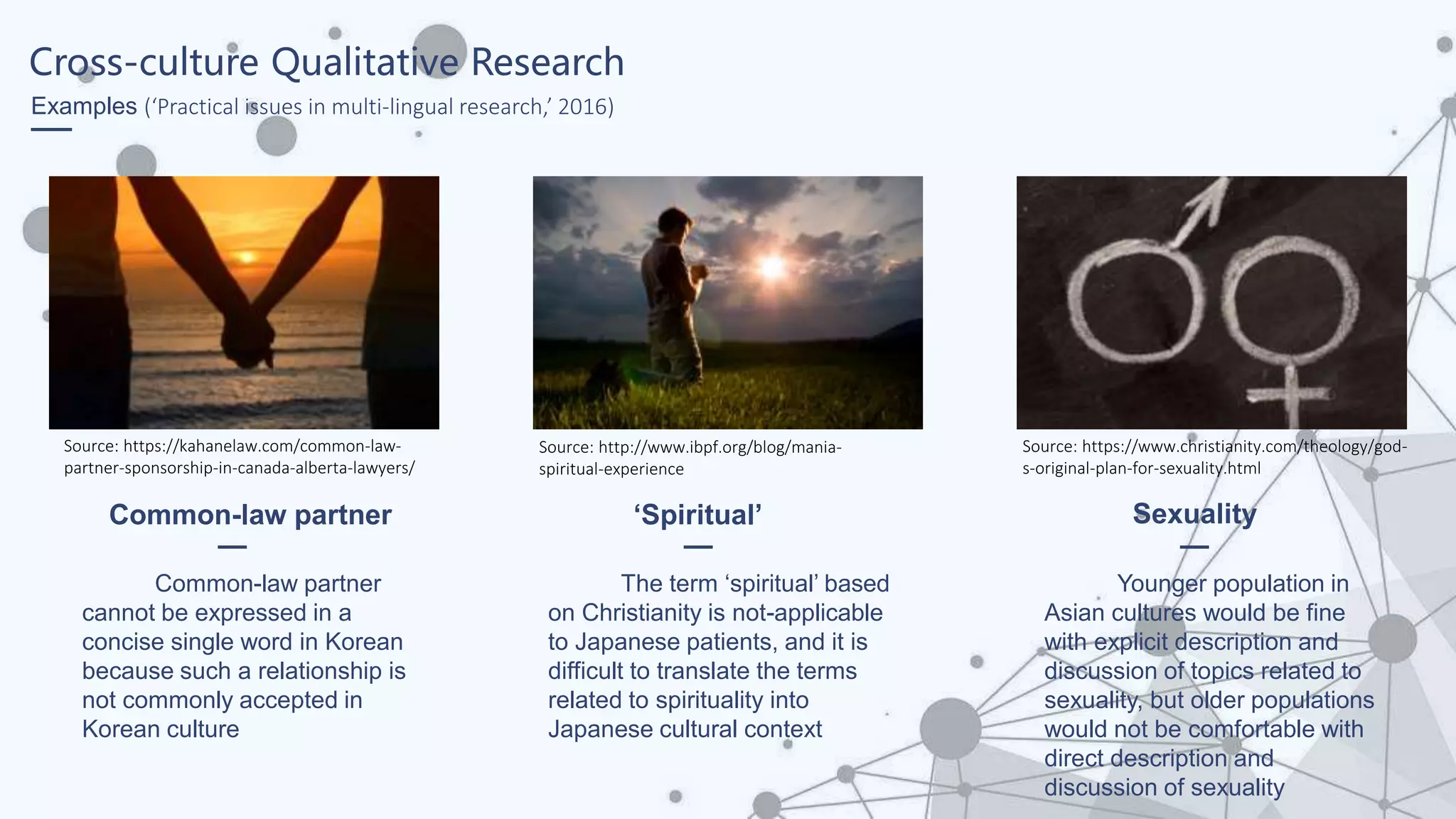
Younger population in
Asian cultures would be fine
with explicit description and
discussion of topics related to
sexuality, but older populations
would not be comfortable with
direct description and
discussion of sexuality
Sexuality
Source: https://kahanelaw.com/common-law-
partner-sponsorship-in-canada-alberta-lawyers/
Source: http://www.ibpf.org/blog/mania-
spiritual-experience
Source: https://www.christianity.com/theology/god-
s-original-plan-for-sexuality.html
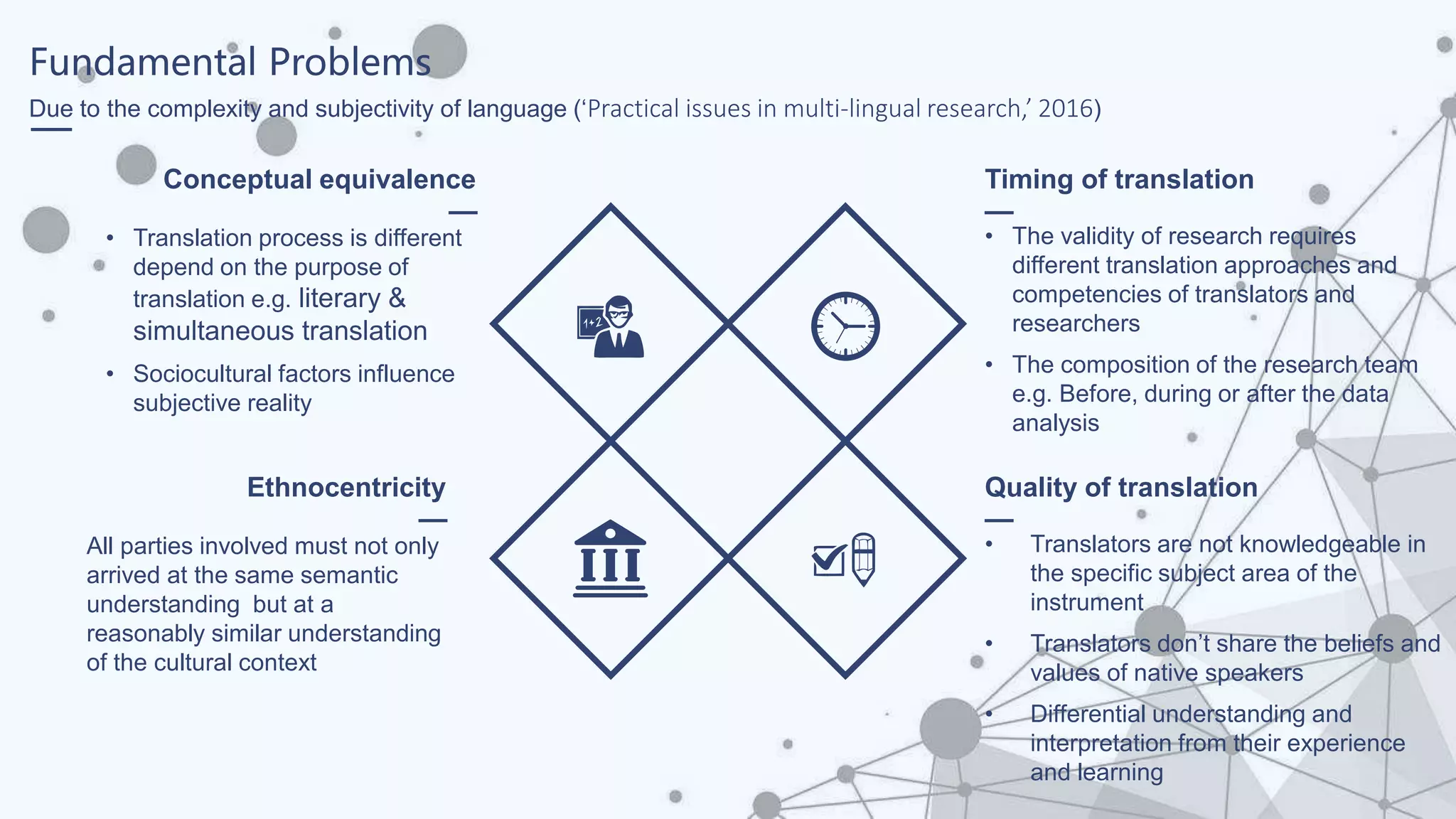
Fundamental Problems
Due to the complexity and subjectivity of language (‘Practical issues in multi-lingual research,’ 2016)
Conceptual equivalence
• Translation process is different
depend on the purpose of
translation e.g. literary &
simultaneous translation
• Sociocultural factors influence
subjective reality
Ethnocentricity
All parties involved must not only
arrived at the same semantic
understanding but at a
reasonably similar understanding
of the cultural context
Quality of translation
• Translators are not knowledgeable in
the specific subject area of the
instrument
• Translators don’t share the beliefs and
values of native speakers
• Differential understanding and
interpretation from their experience
and learning
Timing of translation
• The validity of research requires
different translation approaches and
competencies of translators and
researchers
• The composition of the research team
e.g. Before, during or after the data
analysis
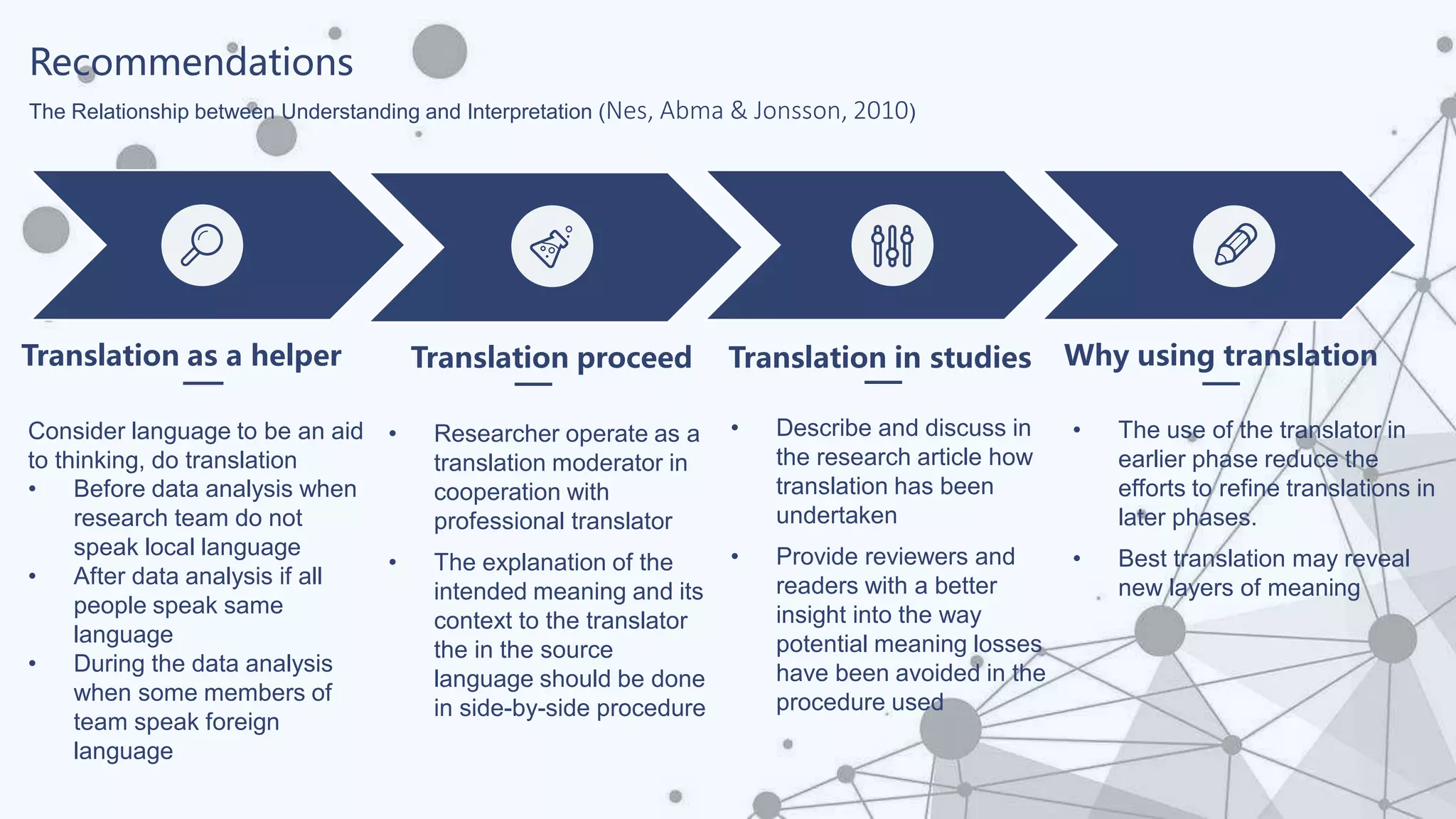
Recommendations
The Relationship between Understanding and Interpretation (Nes, Abma & Jonsson, 2010)
Consider language to be an aid
to thinking, do translation
• Before data analysis when
research team do not
speak local language
• After data analysis if all
people speak same
language
• During the data analysis
when some members of
team speak foreign
language
Translation as a helper
• Researcher operate as a
translation moderator in
cooperation with
professional translator
• The explanation of the
intended meaning and its
context to the translator
the in the source
language should be done
in side-by-side procedure
Translation proceed
• Describe and discuss in
the research article how
translation has been
undertaken
• Provide reviewers and
readers with a better
insight into the way
potential meaning losses
have been avoided in the
procedure used
Translation in studies
Result
• The use of the translator in
earlier phase reduce the
efforts to refine translations in
later phases.
• Best translation may reveal
new layers of meaning
Why using translation
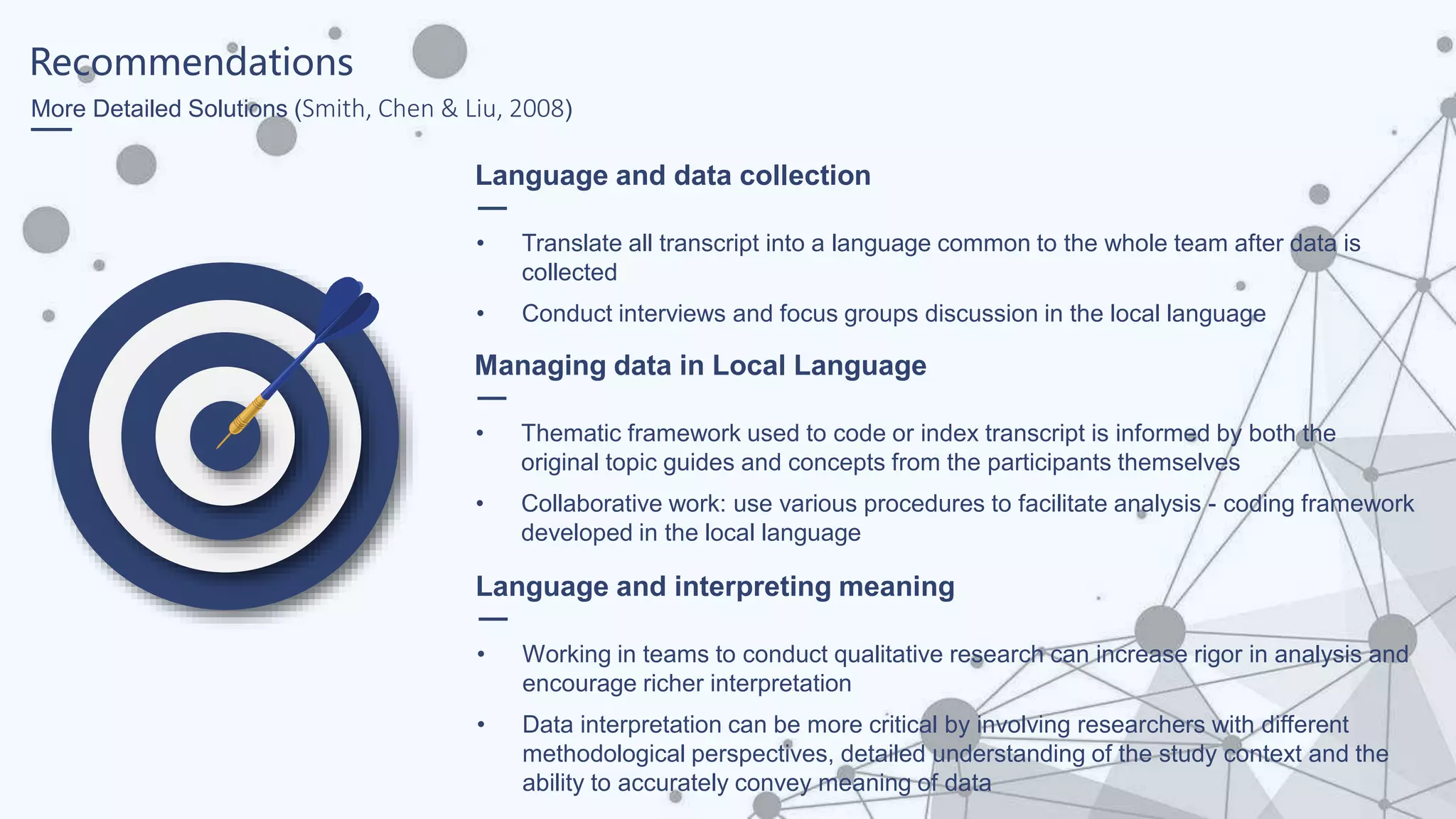
Recommendations
More Detailed Solutions (Smith, Chen & Liu, 2008)
Language and data collection
• Translate all transcript into a language common to the whole team after data is
collected
• Conduct interviews and focus groups discussion in the local language
Managing data in Local Language
• Thematic framework used to code or index transcript is informed by both the
original topic guides and concepts from the participants themselves
• Collaborative work: use various procedures to facilitate analysis - coding framework
developed in the local language
Language and interpreting meaning
• Working in teams to conduct qualitative research can increase rigor in analysis and
encourage richer interpretation
• Data interpretation can be more critical by involving researchers with different
methodological perspectives, detailed understanding of the study context and the
ability to accurately convey meaning of data
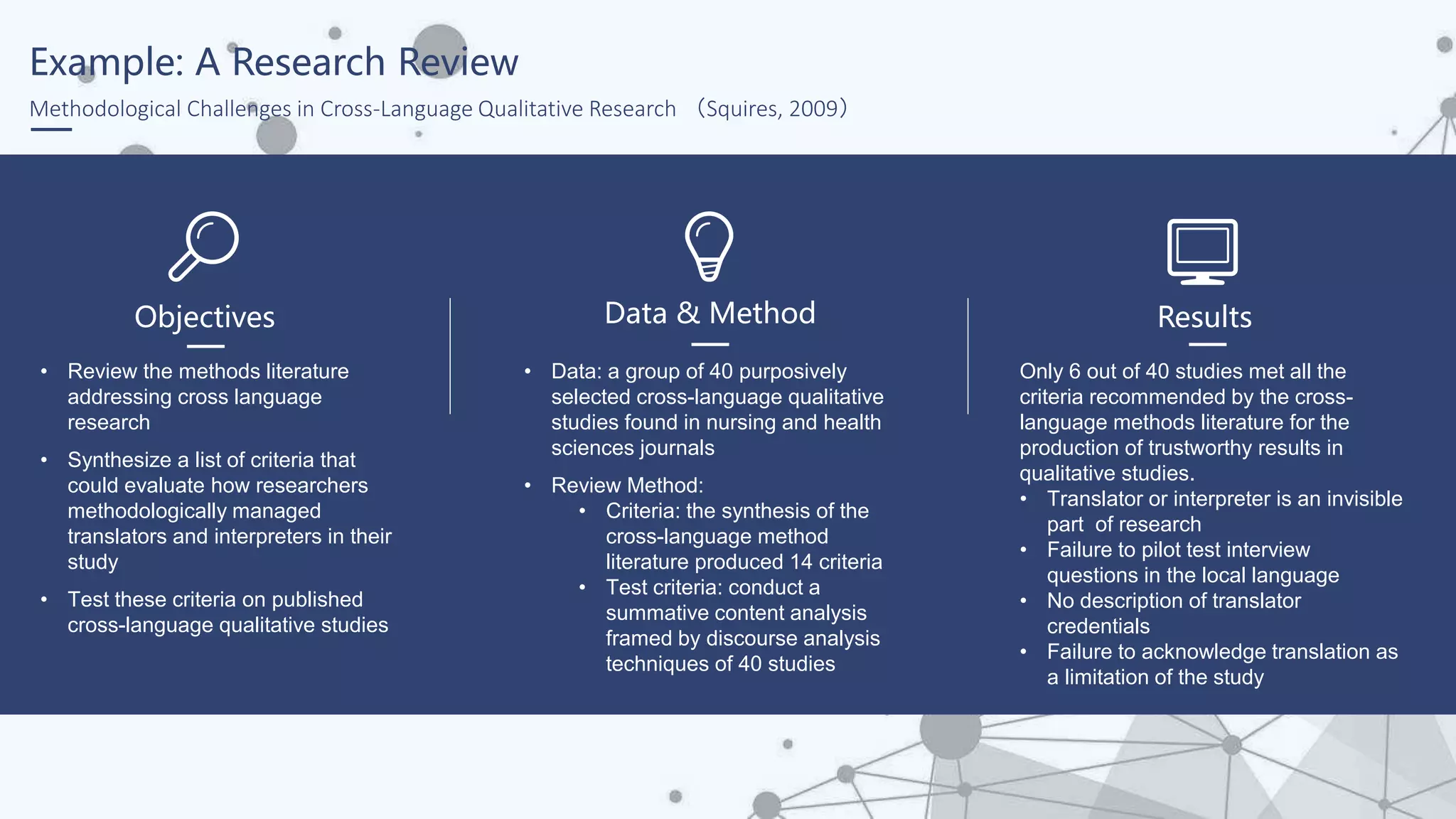
Example: A Research Review
Methodological Challenges in Cross-Language Qualitative Research (Squires, 2009)
• Review the methods literature
addressing cross language
research
• Synthesize a list of criteria that
could evaluate how researchers
methodologically managed
translators and interpreters in their
study
• Test these criteria on published
cross-language qualitative studies
Objectives
• Data: a group of 40 purposively
selected cross-language qualitative
studies found in nursing and health
sciences journals
• Review Method:
• Criteria: the synthesis of the
cross-language method
literature produced 14 criteria
• Test criteria: conduct a
summative content analysis
framed by discourse analysis
techniques of 40 studies
Data & Method
Only 6 out of 40 studies met all the
criteria recommended by the cross-
language methods literature for the
production of trustworthy results in
qualitative studies.
• Translator or interpreter is an invisible
part of research
• Failure to pilot test interview
questions in the local language
• No description of translator
credentials
• Failure to acknowledge translation as
a limitation of the study
Results
Discussion Question
References
Questions
1. Most of the references in this slide are from health and nursing area, what do you think the language barriers in
social development area?
2. As a CDE student, what do you think can be solutions for the language barrier when we do research in a non-
English country?
References
Im, E., Kim, S., Tsai, H., Nishigaki, M., Yeo, S., Chee, W., . . . Mao, J. J. (2016). Practical issues in multi-lingual
research. International Journals of Nursing Studies,54, 141-149.
Nes, F. V., Abma, T., Jonsson, H., & Deeg, D. (2010). Language differences in qualitative research: is meaning lost
in translation? European Journal of Ageing,7(4), 313-316. doi:10.1007/s10433-010-0168-y
Smith, H. J., Chen, J., & Liu, X. (2008). Language and rigour in qualitative research: Problems and principles in
analyzing data collected in Mandarin. BMC Medical Research Methodology,8(1). doi:10.1186/1471-2288-8-44
Squires, A. (2009). Methodological challenges in cross-language qualitative research: A research
review. International Journal of Nursing Studies,46(2), 277-287. doi:10.1016/j.ijnurstu.2008.08.006

EDRD 6000 - Language issues in qualitative research shiyuan zhou

  • 1.
    Language Issues in QualitativeResearch Shiyuan Zhou EDRD 60002018-3-11 Instructor: Helen Hambly
  • 2.
    EDRD 6000 Cross-culture QualitativeResearch1 Fundamental Problems2 Recommendations Discussion Question & References 3 5 CONTENTS 2018-3-11 Example: A Research Review4
  • 3.
    Cross-culture Qualitative Research Theuse of multiple languages in research study has increased since • Multiple languages increase comprehensiveness of education materials and survey questionnaires especially when researchers have different background • Multiple languages can also promote ethnic minorities' participation in research Source: ‘Practical issues in multi-lingual research,’ 2016
  • 4.
    Cross-culture Qualitative Research TheRole of Language in Qualitative Research (Nes, Abma & Jonsson, 2010) • Language: Qualitative research seek to study meanings in subjective experience. The relation between subjective experience and language is two-way process: it is used to express meaning, but also influence how meaning is constructed. • Understand: Giving words to experience is a complicated process as the meaning of experience is often not completely accessible for subjects and difficult to express in language. People use narratives and metaphors to capture the richness pf experience • Interpretation: the message communicated in the source language has to be interpreted by the translator and transferred into the target language in such a way that the receiver of the message understands what was meant • Valid Qualitative Research: the distance between the meanings as interpreted in the findings is as close as possible.
  • 5.
    Cross-culture Qualitative Research Examples(‘Practical issues in multi-lingual research,’ 2016) Common-law partner cannot be expressed in a concise single word in Korean because such a relationship is not commonly accepted in Korean culture Common-law partner The term ‘spiritual’ based on Christianity is not-applicable to Japanese patients, and it is difficult to translate the terms related to spirituality into Japanese cultural context ‘Spiritual’ Younger population in Asian cultures would be fine with explicit description and discussion of topics related to sexuality, but older populations would not be comfortable with direct description and discussion of sexuality Sexuality Source: https://kahanelaw.com/common-law- partner-sponsorship-in-canada-alberta-lawyers/ Source: http://www.ibpf.org/blog/mania- spiritual-experience Source: https://www.christianity.com/theology/god- s-original-plan-for-sexuality.html
  • 6.
    Fundamental Problems Due tothe complexity and subjectivity of language (‘Practical issues in multi-lingual research,’ 2016) Conceptual equivalence • Translation process is different depend on the purpose of translation e.g. literary & simultaneous translation • Sociocultural factors influence subjective reality Ethnocentricity All parties involved must not only arrived at the same semantic understanding but at a reasonably similar understanding of the cultural context Quality of translation • Translators are not knowledgeable in the specific subject area of the instrument • Translators don’t share the beliefs and values of native speakers • Differential understanding and interpretation from their experience and learning Timing of translation • The validity of research requires different translation approaches and competencies of translators and researchers • The composition of the research team e.g. Before, during or after the data analysis
  • 7.
    Recommendations The Relationship betweenUnderstanding and Interpretation (Nes, Abma & Jonsson, 2010) Consider language to be an aid to thinking, do translation • Before data analysis when research team do not speak local language • After data analysis if all people speak same language • During the data analysis when some members of team speak foreign language Translation as a helper • Researcher operate as a translation moderator in cooperation with professional translator • The explanation of the intended meaning and its context to the translator the in the source language should be done in side-by-side procedure Translation proceed • Describe and discuss in the research article how translation has been undertaken • Provide reviewers and readers with a better insight into the way potential meaning losses have been avoided in the procedure used Translation in studies Result • The use of the translator in earlier phase reduce the efforts to refine translations in later phases. • Best translation may reveal new layers of meaning Why using translation
  • 8.
    Recommendations More Detailed Solutions(Smith, Chen & Liu, 2008) Language and data collection • Translate all transcript into a language common to the whole team after data is collected • Conduct interviews and focus groups discussion in the local language Managing data in Local Language • Thematic framework used to code or index transcript is informed by both the original topic guides and concepts from the participants themselves • Collaborative work: use various procedures to facilitate analysis - coding framework developed in the local language Language and interpreting meaning • Working in teams to conduct qualitative research can increase rigor in analysis and encourage richer interpretation • Data interpretation can be more critical by involving researchers with different methodological perspectives, detailed understanding of the study context and the ability to accurately convey meaning of data
  • 9.
    Example: A ResearchReview Methodological Challenges in Cross-Language Qualitative Research (Squires, 2009) • Review the methods literature addressing cross language research • Synthesize a list of criteria that could evaluate how researchers methodologically managed translators and interpreters in their study • Test these criteria on published cross-language qualitative studies Objectives • Data: a group of 40 purposively selected cross-language qualitative studies found in nursing and health sciences journals • Review Method: • Criteria: the synthesis of the cross-language method literature produced 14 criteria • Test criteria: conduct a summative content analysis framed by discourse analysis techniques of 40 studies Data & Method Only 6 out of 40 studies met all the criteria recommended by the cross- language methods literature for the production of trustworthy results in qualitative studies. • Translator or interpreter is an invisible part of research • Failure to pilot test interview questions in the local language • No description of translator credentials • Failure to acknowledge translation as a limitation of the study Results
  • 10.
    Discussion Question References Questions 1. Mostof the references in this slide are from health and nursing area, what do you think the language barriers in social development area? 2. As a CDE student, what do you think can be solutions for the language barrier when we do research in a non- English country? References Im, E., Kim, S., Tsai, H., Nishigaki, M., Yeo, S., Chee, W., . . . Mao, J. J. (2016). Practical issues in multi-lingual research. International Journals of Nursing Studies,54, 141-149. Nes, F. V., Abma, T., Jonsson, H., & Deeg, D. (2010). Language differences in qualitative research: is meaning lost in translation? European Journal of Ageing,7(4), 313-316. doi:10.1007/s10433-010-0168-y Smith, H. J., Chen, J., & Liu, X. (2008). Language and rigour in qualitative research: Problems and principles in analyzing data collected in Mandarin. BMC Medical Research Methodology,8(1). doi:10.1186/1471-2288-8-44 Squires, A. (2009). Methodological challenges in cross-language qualitative research: A research review. International Journal of Nursing Studies,46(2), 277-287. doi:10.1016/j.ijnurstu.2008.08.006