BALANCED OCCLUSION
PART-II
Dr Athira K Nair
1st
Year MDS
Department of Prosthodontics, crown and
bridge and Oral Implantology.
BharatiVidyapeeth Dental College, Pune.
DATE: 27/04/2022
CONCEPTS ABOUT BALANCED OCCLUSION
 GYSI’S CONCEPT
 SEARS’S CONCEPT
 FRENCH’S CONCEPT
 PLEASURE’S CONCEPT
 FRUSH’S CONCEPT
 HANAU’S QUINT
 TRAPAZZANO’S CONCEPT
 LOTT’S CONCEPT
 BOUCHER’S CONCEPT
 LEVIN’S CONCEPT
GYSI’S CONCEPT
 Dr Alfred Gysi – first anatomic porcelain tooth – function harmoniously with incisal
and condylar guidance.
 He proposed the 1st concept towards balanced occlusion in 1914.
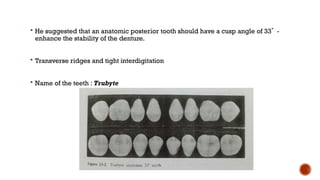
 He suggested that an anatomic posterior tooth should have a cusp angle of 33˚ -
enhance the stability of the denture.
 Transverse ridges and tight interdigitation
 Name of the teeth : Trubyte
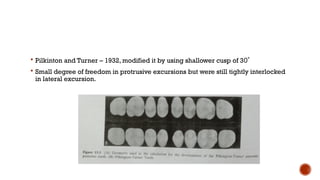
 Pilkinton and Turner – 1932, modified it by using shallower cusp of 30˚
 Small degree of freedom in protrusive excursions but were still tightly interlocked
in lateral excursion.
SEARS’S CONCEPT(1922)
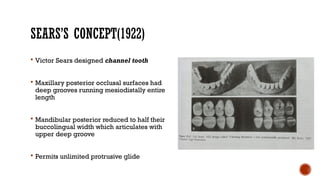
 Victor Sears designed channel tooth
 Maxillary posterior occlusal surfaces had
deep grooves running mesiodistally entire
length
 Mandibular posterior reduced to half their
buccolingual width which articulates with
upper deep groove
 Permits unlimited protrusive glide
 Modified by Avery brothers
 Scissor- bite technique
 Grinding of teeth such that movements free in lateral excursion and locked
anteroposteriorly.
 Not marketed commercially
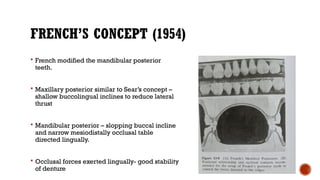
FRENCH’S CONCEPT (1954)
 French modified the mandibular posterior
teeth.
 Maxillary posterior similar to Sear’s concept –
shallow buccolingual inclines to reduce lateral
thrust
 Mandibular posterior – slopping buccal incline
and narrow mesiodistally occlusal table
directed lingually.
 Occlusal forces exerted lingually- good stability
of denture
PLEASURE’S CONCEPT (1937)
 Max Pleasure tilted lower teeth buccally which did not provide balanced contact in
lateral and protrusive excursion.
 Modified it by giving –
(1) reverse curve – premolar
(2) flat occlusion – first molar
(3) lingual tilt/monsoon curve – second molar
FRUSH’S CONCEPT (1967)
 Linear occlusal concept - arbitrary articular balance followed by intraoral
corrections to obtain balance.
 A single mesiodistal ridge on the lower posterior teeth contacted a flat occlusal
surface of the upper posterior teeth set at an angle to the horizontal.
 In CO, contact forces are directed towards the ridges
 Eliminated deflective occlusal contacts and increase stability.
HANAU’S QUINT (1925)
Rudolph L. Hanau proposed nine factors that govern the articulation of artificial teeth.They
are:
 Horizontal condylar inclination
 Compensating curve
 Protrusive incisal guidance
 Plane of orientation
 Buccolingual inclination of tooth axis
 Sagittal condylar pathway
 Sagittal incisal guidance
 Tooth alignment
 Relative cusp height
Hanau later condensed these nine factors and formulated five factors, which are
commonly known as Hanau’s quint:
 Condylar guidance
 Incisal guidance
 Compensating curves
 Relative cusp height
 Plane of orientation of the occlusal plane
TRAPOZZANO’S CONCEPT OF OCCLUSION
 He reviewed and simplified Hanau’s quint and proposed his Triad of Occlusion.
 According to him, only three factors are necessary to produce balanced occlusion.
 Eliminated compensating curves – obsolete since cuspal angulation will produce
balanced occlusion
 Eliminated plane of orientation – since its location is highly variable within the
available inner ridge space.
BOUCHER’S CONCEPT
 Three fixed factors for balanced occlusion.
1. Orientation of the occlusal plane, the incisal guidance and the condylar
guidance.
2. The angulation of the cusp is more important than the height of the cusp.
3. The compensating curve enables one to increase the height of the cusp without
changing the form of the teeth.
 He also stated that,“the plane of occlusion should be oriented exactly as it was
when natural teeth were present”. According to him, the plane of occlusion cannot
be changed to favor weak ridges and that the teeth should be located in their
original position.
LOTT’S CONCEPT
Lott clarified Hanau’s laws of occlusion by relating them to the posterior separation
that is a resultant of the guiding factors-
 The greater the angle of the condylar path, the greater is the posterior separation
during protrusion.
 The greater the angle of the overbite, the greater is the separation in the anterior
and posterior regions irrespective of the angle of the condylar path.
 The greater the separation of the posterior teeth the greater or higher must be the
compensating curve.
 Posterior separation beyond the balancing ability of the compensating curve can
be balanced by the introduction of the plane of orientation.
 The greater the separation of the teeth, the greater must be the height of the cusps
of the posterior teeth.
LEVIN’S CONCEPT
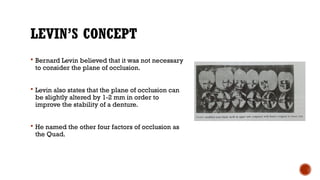
 Bernard Levin believed that it was not necessary
to consider the plane of occlusion.
 Levin also states that the plane of occlusion can
be slightly altered by 1-2 mm in order to
improve the stability of a denture.
 He named the other four factors of occlusion as
the Quad.
The essentials of a quad are:-
1. The condylar guidance is fixed and is recorded from the patient. le.This may or
may not affect the lateral balance.
2. The incisal guidance is usually obtained from patient’s aesthetic and phonetic
requirements.
3. The compensating curve is the most important factor in obtaining occlusal
balance.
4. Cusp teeth have the inclines necessary for balanced occlusion but nearly always
are used with a compensating curve.
SELECTIVE GRINDING IN BILATERAL
BALANCED COMPLETE DENTURES
OBJECTIVES:
Eliminate premature contacts that prevent multiple points of contact
between upper and lower teeth in anterior and posterior areas on the
right and left during working, balancing and protrusive movements.
BULL PRINCIPLE
Buccal Upper Lower Lingual
 In posterior teeth, buccal cusps of upper teeth and lingual cusps of lower teeth
 In anterior teeth, lingual of upper & labial surface of lower teeth are modified to
eliminate any interference.
 Final result should be smooth gliding lateral excursion with working& balancing
contacts.
 The multiple contacts should be smooth, uniform& in harmony with the TMJ & the
neuro-muscular activity
ARRANGEMENT OF POSTERIOR TEETH IN
BALANCED OCCLUSION
 MANDIBULAR POSTERIOR TEETH
1. Must be set such that the occlusal surfaces are horizontal
2. The plane of occlusion must have a proper orientation
3. Compensating curve must be set
4. Teeth must be such that there are no interlocking transverse ridges
MAXILLARY POSTERIOR TEETH
1. Modified to eliminate buccal cusp contact
2. Set so that the upper lingual cusps have a positive but static centric occlusion
contact
3. Have no buccal cusp contact in lateral excursions
Arrangement of anatomic type artificial teeth into balanced occlusion:
 Amount of overjet should not be less than 2mm in centric relation. Anterior teeth set
according to best possible esthetics, phonetics and function.
 Steep condylar guidance or steep incisal guidance and combination of them suggest
prominent compensating curve with steep anteroposterior and lateral cusp height.
This is detrimental to the stability of denture. Condylar guidance must be accepted
as recorded but the incisal guidance should be kept as flat as possible.
 The upper premolars should be positioned so as to present a normal dental arch
outline. Practically a straight line from the canines to the mesio-buccal cusp of upper
first molar, thus, contributing to esthetics. In other words, the buccal vestibule should
be in evidence when the patient smiles.
 The lower first premolars may be positioned buccally to the crest of the ridge
occasionally in order to occlude correctly with the upper premolars.
 Before cusp inclines are altered by grinding, the inclinations of long axes of the
opposing teeth should be rotated about centric occlusal contact in an attempt to
establish the desired balancing contact.
 After artificial teeth have been satisfactorily arranged, the final waxing should be
done in a manner which will provide the desired buccal, labial and lingual
contours without destroying the occlusion, already established.
 Once the bases are sealed to their respective casts, all routine laboratory
procedures are carried out.
CONTACTS IN BALANCED OCCLUSION
IN CENTRIC RELATION
Anterior teeth - no contact
Posterior teeth - multiple, uniform occlusal contacts.
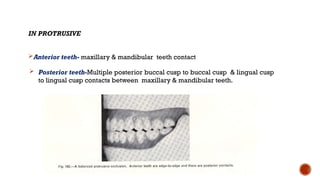
IN PROTRUSIVE
Anterior teeth- maxillary & mandibular teeth contact
 Posterior teeth-Multiple posterior buccal cusp to buccal cusp & lingual cusp
to lingual cusp contacts between maxillary & mandibular teeth.
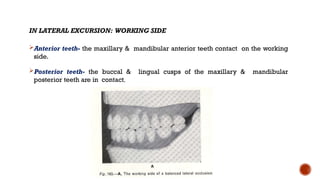
IN LATERAL EXCURSION: WORKING SIDE
Anterior teeth- the maxillary & mandibular anterior teeth contact on the working
side.
Posterior teeth- the buccal & lingual cusps of the maxillary & mandibular
posterior teeth are in contact.
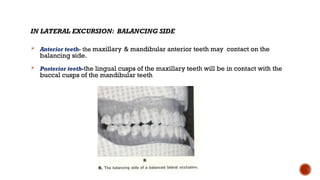
IN LATERAL EXCURSION: BALANCING SIDE
 Anterior teeth- the maxillary & mandibular anterior teeth may contact on the
balancing side.
 Posterior teeth-the lingual cusps of the maxillary teeth will be in contact with the
buccal cusps of the mandibular teeth
CONCLUSION
 The importance of occlusion and articulation for maintenance of complete denture
stability has never been underestimated, but overlooked.
 The occlusion we are going to provide gives more stability which indirectly gives
the retention.
 As prosthodontists, we should provide an occlusion, which should compatible with
the stomatognathic system and should provide a efficient mastication and
esthetics, without any physiologic abnormality.
REFERENCES
 Essentials of Complete Denture Prosthodotics, 2nd
Edition, Sheldon-Winkler.
 Boucher’s Prosthodontic Treatment for Edentulous Patient
 Text Book of Complete Dentures, 5th
edition, Rahn, Charles Heartwell.
 Med J Armed Forces India. 2010 Oct; 66(4): 362–366
 Journal of Prosthetic Dentistry 1977; 38:601.
 Journal of Prosthetic Dentistry 1972; 25:94-100.
THANK YOU

BALANCED OCCLUSION in teeth - part 2.pptx

  • 1.
    BALANCED OCCLUSION PART-II Dr AthiraK Nair 1st Year MDS Department of Prosthodontics, crown and bridge and Oral Implantology. BharatiVidyapeeth Dental College, Pune. DATE: 27/04/2022
  • 2.
    CONCEPTS ABOUT BALANCEDOCCLUSION  GYSI’S CONCEPT  SEARS’S CONCEPT  FRENCH’S CONCEPT  PLEASURE’S CONCEPT  FRUSH’S CONCEPT  HANAU’S QUINT  TRAPAZZANO’S CONCEPT  LOTT’S CONCEPT  BOUCHER’S CONCEPT  LEVIN’S CONCEPT
  • 3.
    GYSI’S CONCEPT  DrAlfred Gysi – first anatomic porcelain tooth – function harmoniously with incisal and condylar guidance.  He proposed the 1st concept towards balanced occlusion in 1914.
  • 4.
     He suggestedthat an anatomic posterior tooth should have a cusp angle of 33˚ - enhance the stability of the denture.  Transverse ridges and tight interdigitation  Name of the teeth : Trubyte
  • 5.
     Pilkinton andTurner – 1932, modified it by using shallower cusp of 30˚  Small degree of freedom in protrusive excursions but were still tightly interlocked in lateral excursion.
  • 6.
    SEARS’S CONCEPT(1922)  VictorSears designed channel tooth  Maxillary posterior occlusal surfaces had deep grooves running mesiodistally entire length  Mandibular posterior reduced to half their buccolingual width which articulates with upper deep groove  Permits unlimited protrusive glide
  • 7.
     Modified byAvery brothers  Scissor- bite technique  Grinding of teeth such that movements free in lateral excursion and locked anteroposteriorly.  Not marketed commercially
  • 8.
    FRENCH’S CONCEPT (1954) French modified the mandibular posterior teeth.  Maxillary posterior similar to Sear’s concept – shallow buccolingual inclines to reduce lateral thrust  Mandibular posterior – slopping buccal incline and narrow mesiodistally occlusal table directed lingually.  Occlusal forces exerted lingually- good stability of denture
  • 9.
    PLEASURE’S CONCEPT (1937) Max Pleasure tilted lower teeth buccally which did not provide balanced contact in lateral and protrusive excursion.  Modified it by giving – (1) reverse curve – premolar (2) flat occlusion – first molar (3) lingual tilt/monsoon curve – second molar
  • 10.
    FRUSH’S CONCEPT (1967) Linear occlusal concept - arbitrary articular balance followed by intraoral corrections to obtain balance.  A single mesiodistal ridge on the lower posterior teeth contacted a flat occlusal surface of the upper posterior teeth set at an angle to the horizontal.  In CO, contact forces are directed towards the ridges  Eliminated deflective occlusal contacts and increase stability.
  • 11.
    HANAU’S QUINT (1925) RudolphL. Hanau proposed nine factors that govern the articulation of artificial teeth.They are:  Horizontal condylar inclination  Compensating curve  Protrusive incisal guidance  Plane of orientation  Buccolingual inclination of tooth axis  Sagittal condylar pathway  Sagittal incisal guidance  Tooth alignment  Relative cusp height
  • 12.
    Hanau later condensedthese nine factors and formulated five factors, which are commonly known as Hanau’s quint:  Condylar guidance  Incisal guidance  Compensating curves  Relative cusp height  Plane of orientation of the occlusal plane
  • 13.
    TRAPOZZANO’S CONCEPT OFOCCLUSION  He reviewed and simplified Hanau’s quint and proposed his Triad of Occlusion.  According to him, only three factors are necessary to produce balanced occlusion.  Eliminated compensating curves – obsolete since cuspal angulation will produce balanced occlusion  Eliminated plane of orientation – since its location is highly variable within the available inner ridge space.
  • 14.
    BOUCHER’S CONCEPT  Threefixed factors for balanced occlusion. 1. Orientation of the occlusal plane, the incisal guidance and the condylar guidance. 2. The angulation of the cusp is more important than the height of the cusp. 3. The compensating curve enables one to increase the height of the cusp without changing the form of the teeth.
  • 15.
     He alsostated that,“the plane of occlusion should be oriented exactly as it was when natural teeth were present”. According to him, the plane of occlusion cannot be changed to favor weak ridges and that the teeth should be located in their original position.
  • 16.
    LOTT’S CONCEPT Lott clarifiedHanau’s laws of occlusion by relating them to the posterior separation that is a resultant of the guiding factors-  The greater the angle of the condylar path, the greater is the posterior separation during protrusion.  The greater the angle of the overbite, the greater is the separation in the anterior and posterior regions irrespective of the angle of the condylar path.
  • 17.
     The greaterthe separation of the posterior teeth the greater or higher must be the compensating curve.  Posterior separation beyond the balancing ability of the compensating curve can be balanced by the introduction of the plane of orientation.  The greater the separation of the teeth, the greater must be the height of the cusps of the posterior teeth.
  • 18.
    LEVIN’S CONCEPT  BernardLevin believed that it was not necessary to consider the plane of occlusion.  Levin also states that the plane of occlusion can be slightly altered by 1-2 mm in order to improve the stability of a denture.  He named the other four factors of occlusion as the Quad.
  • 19.
    The essentials ofa quad are:- 1. The condylar guidance is fixed and is recorded from the patient. le.This may or may not affect the lateral balance. 2. The incisal guidance is usually obtained from patient’s aesthetic and phonetic requirements. 3. The compensating curve is the most important factor in obtaining occlusal balance. 4. Cusp teeth have the inclines necessary for balanced occlusion but nearly always are used with a compensating curve.
  • 20.
    SELECTIVE GRINDING INBILATERAL BALANCED COMPLETE DENTURES OBJECTIVES: Eliminate premature contacts that prevent multiple points of contact between upper and lower teeth in anterior and posterior areas on the right and left during working, balancing and protrusive movements.
  • 21.
    BULL PRINCIPLE Buccal UpperLower Lingual  In posterior teeth, buccal cusps of upper teeth and lingual cusps of lower teeth  In anterior teeth, lingual of upper & labial surface of lower teeth are modified to eliminate any interference.  Final result should be smooth gliding lateral excursion with working& balancing contacts.  The multiple contacts should be smooth, uniform& in harmony with the TMJ & the neuro-muscular activity
  • 22.
    ARRANGEMENT OF POSTERIORTEETH IN BALANCED OCCLUSION  MANDIBULAR POSTERIOR TEETH 1. Must be set such that the occlusal surfaces are horizontal 2. The plane of occlusion must have a proper orientation 3. Compensating curve must be set 4. Teeth must be such that there are no interlocking transverse ridges
  • 23.
    MAXILLARY POSTERIOR TEETH 1.Modified to eliminate buccal cusp contact 2. Set so that the upper lingual cusps have a positive but static centric occlusion contact 3. Have no buccal cusp contact in lateral excursions
  • 24.
    Arrangement of anatomictype artificial teeth into balanced occlusion:  Amount of overjet should not be less than 2mm in centric relation. Anterior teeth set according to best possible esthetics, phonetics and function.  Steep condylar guidance or steep incisal guidance and combination of them suggest prominent compensating curve with steep anteroposterior and lateral cusp height. This is detrimental to the stability of denture. Condylar guidance must be accepted as recorded but the incisal guidance should be kept as flat as possible.  The upper premolars should be positioned so as to present a normal dental arch outline. Practically a straight line from the canines to the mesio-buccal cusp of upper first molar, thus, contributing to esthetics. In other words, the buccal vestibule should be in evidence when the patient smiles.
  • 25.
     The lowerfirst premolars may be positioned buccally to the crest of the ridge occasionally in order to occlude correctly with the upper premolars.  Before cusp inclines are altered by grinding, the inclinations of long axes of the opposing teeth should be rotated about centric occlusal contact in an attempt to establish the desired balancing contact.  After artificial teeth have been satisfactorily arranged, the final waxing should be done in a manner which will provide the desired buccal, labial and lingual contours without destroying the occlusion, already established.  Once the bases are sealed to their respective casts, all routine laboratory procedures are carried out.
  • 26.
    CONTACTS IN BALANCEDOCCLUSION IN CENTRIC RELATION Anterior teeth - no contact Posterior teeth - multiple, uniform occlusal contacts.
  • 27.
    IN PROTRUSIVE Anterior teeth-maxillary & mandibular teeth contact  Posterior teeth-Multiple posterior buccal cusp to buccal cusp & lingual cusp to lingual cusp contacts between maxillary & mandibular teeth.
  • 28.
    IN LATERAL EXCURSION:WORKING SIDE Anterior teeth- the maxillary & mandibular anterior teeth contact on the working side. Posterior teeth- the buccal & lingual cusps of the maxillary & mandibular posterior teeth are in contact.
  • 29.
    IN LATERAL EXCURSION:BALANCING SIDE  Anterior teeth- the maxillary & mandibular anterior teeth may contact on the balancing side.  Posterior teeth-the lingual cusps of the maxillary teeth will be in contact with the buccal cusps of the mandibular teeth
  • 30.
    CONCLUSION  The importanceof occlusion and articulation for maintenance of complete denture stability has never been underestimated, but overlooked.  The occlusion we are going to provide gives more stability which indirectly gives the retention.  As prosthodontists, we should provide an occlusion, which should compatible with the stomatognathic system and should provide a efficient mastication and esthetics, without any physiologic abnormality.
  • 31.
    REFERENCES  Essentials ofComplete Denture Prosthodotics, 2nd Edition, Sheldon-Winkler.  Boucher’s Prosthodontic Treatment for Edentulous Patient  Text Book of Complete Dentures, 5th edition, Rahn, Charles Heartwell.  Med J Armed Forces India. 2010 Oct; 66(4): 362–366  Journal of Prosthetic Dentistry 1977; 38:601.  Journal of Prosthetic Dentistry 1972; 25:94-100.
  • 32.