Balanced scorecard
What is balanced scorecard?

   It was developed to communicate the multiple linked
    objectives that companies must achieve to compete on the
    basis of innovation, not just tangible physical assets

   It translates the mission and strategy into objectives and
    measures, organized into four perspectives
Strategies
   Financial perspective
   Customer perspective
   Internal business perspective
   Learning and growth perspective
Financial perspective
   Measures the financial performance and economic actions

   It indicates whether the company’s strategy , implementation
    and execution are contributing to the bottom line customers

   Related to: profitability, EVA, sales growth, generation of
    cash flows
Customer perspective
   Identifying customers market segments
   Measuring the performance in the market segments
   Measures like customer satisfaction, customer retention ,new
    customer acquisition, customer profitability, market and
    account share in segment
   Attributes that organizes the value proposition
   Product and service attributes
   Customer relationship
   Image and reputation
Internal business process perspective
Identifies the critical internal process in which organizations
   must excel.

   Deliver the value proposition that will attract and retain
    customers in targeted market segments
   Satisfy shareholder expectation of excellent financial returns
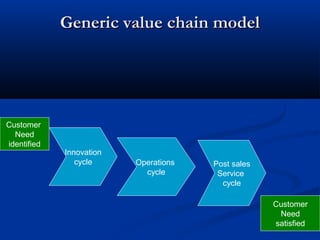
Generic value chain model


Customer
  Need
identified
             Innovation
                cycle     Operations   Post sales
                            cycle       Service
                                         cycle

                                                    Customer
                                                     Need
                                                    satisfied
Learning and growth perspective
   Identifies the infrastructure that the organization must build to
    create long term growth and improvement
   Three principle sources
   People
   Systems
   Organization
   Reskilling employees, enhancing information technology and
    systems, aligning organizational procedures and routine
Objectives
Strategic financial objectives

   Improve return on spending
   Reduce costs
   Increase revenues
   Reduce risk
Strategic customer objectives
   Offer customized value proposition to targeted customer
    segments
   Define proposition through different customer values
   Understand the economic fulfilling various propositions
   Target customers whose value propositions can be fulfilled
    profitably
   Differentiators act
   Perform consistently in the eyes of the customer
   Service customers expediently
   Eliminate mistakes
Internal business objectives
   Innovation
   Make the market
   Create the product

   Delivery
   Market and sell
   Distribute and service
Learning and growth objectives
   Creating information assets

   Reskilling: strategic job and competencies

   Accountability and reward linkage

   Focus our resources
Linking of multiple score card measures into a single
                      strategy

   Cause and effect relationship

   Performance drivers

Balance score card

  • 1.
  • 2.
    What is balancedscorecard?  It was developed to communicate the multiple linked objectives that companies must achieve to compete on the basis of innovation, not just tangible physical assets  It translates the mission and strategy into objectives and measures, organized into four perspectives
  • 3.
    Strategies  Financial perspective  Customer perspective  Internal business perspective  Learning and growth perspective
  • 4.
    Financial perspective  Measures the financial performance and economic actions  It indicates whether the company’s strategy , implementation and execution are contributing to the bottom line customers  Related to: profitability, EVA, sales growth, generation of cash flows
  • 5.
    Customer perspective  Identifying customers market segments  Measuring the performance in the market segments  Measures like customer satisfaction, customer retention ,new customer acquisition, customer profitability, market and account share in segment  Attributes that organizes the value proposition  Product and service attributes  Customer relationship  Image and reputation
  • 6.
    Internal business processperspective Identifies the critical internal process in which organizations must excel.  Deliver the value proposition that will attract and retain customers in targeted market segments  Satisfy shareholder expectation of excellent financial returns
  • 7.
    Generic value chainmodel Customer Need identified Innovation cycle Operations Post sales cycle Service cycle Customer Need satisfied
  • 8.
    Learning and growthperspective  Identifies the infrastructure that the organization must build to create long term growth and improvement  Three principle sources  People  Systems  Organization  Reskilling employees, enhancing information technology and systems, aligning organizational procedures and routine
  • 9.
    Objectives Strategic financial objectives  Improve return on spending  Reduce costs  Increase revenues  Reduce risk
  • 10.
    Strategic customer objectives  Offer customized value proposition to targeted customer segments  Define proposition through different customer values  Understand the economic fulfilling various propositions  Target customers whose value propositions can be fulfilled profitably  Differentiators act  Perform consistently in the eyes of the customer  Service customers expediently  Eliminate mistakes
  • 11.
    Internal business objectives  Innovation  Make the market  Create the product  Delivery  Market and sell  Distribute and service
  • 12.
    Learning and growthobjectives  Creating information assets  Reskilling: strategic job and competencies  Accountability and reward linkage  Focus our resources
  • 13.
    Linking of multiplescore card measures into a single strategy  Cause and effect relationship  Performance drivers