Structure .
Useful or harmful
Components .
What are Bacteria ?
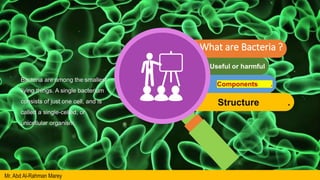
Bacteria are among the smallest
living things. A single bacterium
consists of just one cell, and is
called a single-celled, or
unicellular organism.
Mr. Abd Al-Rahman Marey
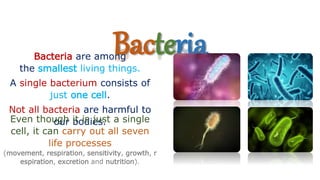
BacteriaBacteria are among
the smallest living things.
A single bacterium consists of
just one cell.
Not all bacteria are harmful to
our bodies.Even though it is just a single
cell, it can carry out all seven
life processes
(movement, respiration, sensitivity, growth, r
espiration, excretion and nutrition).
Useful or harmful ??
yoghurt and cheese makers use
bacteria to make their products.
Bacteria like intestinal flora
E.coli
May be useful and may be harmful …
Useful like :
Harmful like :
there are millions of bacteria in
your digestive system. Having the
right mix of bacteria here is vital. Gut
bacteria help to digest food. They also
help to prevent diabetes, obesity and
some types of cancer.
What’s in a bacterium?
- Cell membrane
- Cell wall
- Cytoplasm
No nucleus
so, the DNA is in the cytoplasm as form of
( chromosomal DNA – Plasmids )
Flagella
which are tail-like structures that allow
bacteria to move through liquids.
slime capsule
outside the cell wall, to protect them and
stop the bacterium drying out.
Cellulos
e
What is
cellulose?
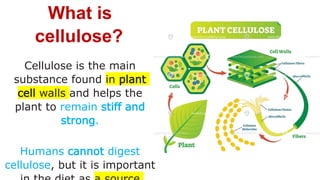
Cellulose is the main
substance found in plant
cell walls and helps the
plant to remain stiff and
strong.
Humans cannot digest
cellulose, but it is important
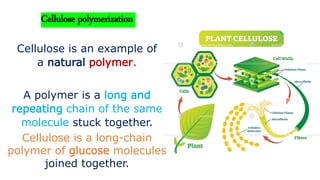
Cellulose is an example of
a natural polymer.
A polymer is a long and
repeating chain of the same
molecule stuck together.
Cellulose is a long-chain
polymer of glucose molecules
joined together.
Cellulose polymerization
Cellulose is a molecule,
consisting of hundreds – and
sometimes even thousands –
of carbon, hydrogen and
oxygen atoms.
Cellulose is the main substance in
the walls of plant cells, helping
plants to remain stiff and upright.
Humans cannot digest cellulose,
but it is important in the diet as
fiber. Fiber assists your digestive
Animals, such as cows, sheep
and horses, can digest
cellulose, which is why they
can get the energy and
nutrients they need from
grass.
Cellulose has many uses. In
cotton, it makes clothes like
t-shirts and jeans. Paper-
making needs huge quantities
How is cellulose useful?

Bacteria and cellulose

  • 1.
    Structure . Useful orharmful Components . What are Bacteria ? Bacteria are among the smallest living things. A single bacterium consists of just one cell, and is called a single-celled, or unicellular organism. Mr. Abd Al-Rahman Marey
  • 2.
    BacteriaBacteria are among thesmallest living things. A single bacterium consists of just one cell. Not all bacteria are harmful to our bodies.Even though it is just a single cell, it can carry out all seven life processes (movement, respiration, sensitivity, growth, r espiration, excretion and nutrition).
  • 3.
    Useful or harmful?? yoghurt and cheese makers use bacteria to make their products. Bacteria like intestinal flora E.coli May be useful and may be harmful … Useful like : Harmful like : there are millions of bacteria in your digestive system. Having the right mix of bacteria here is vital. Gut bacteria help to digest food. They also help to prevent diabetes, obesity and some types of cancer.
  • 4.
    What’s in abacterium? - Cell membrane - Cell wall - Cytoplasm No nucleus so, the DNA is in the cytoplasm as form of ( chromosomal DNA – Plasmids ) Flagella which are tail-like structures that allow bacteria to move through liquids. slime capsule outside the cell wall, to protect them and stop the bacterium drying out.
  • 5.
  • 6.
    What is cellulose? Cellulose isthe main substance found in plant cell walls and helps the plant to remain stiff and strong. Humans cannot digest cellulose, but it is important
  • 7.
    Cellulose is anexample of a natural polymer. A polymer is a long and repeating chain of the same molecule stuck together. Cellulose is a long-chain polymer of glucose molecules joined together. Cellulose polymerization
  • 8.
    Cellulose is amolecule, consisting of hundreds – and sometimes even thousands – of carbon, hydrogen and oxygen atoms. Cellulose is the main substance in the walls of plant cells, helping plants to remain stiff and upright. Humans cannot digest cellulose, but it is important in the diet as fiber. Fiber assists your digestive Animals, such as cows, sheep and horses, can digest cellulose, which is why they can get the energy and nutrients they need from grass. Cellulose has many uses. In cotton, it makes clothes like t-shirts and jeans. Paper- making needs huge quantities How is cellulose useful?