Sara Bennett, Ligia Paina, Christine Kim, Irene Agyepong,
Somsak Chunharas, Di McIntyre, Stefan Nachuk
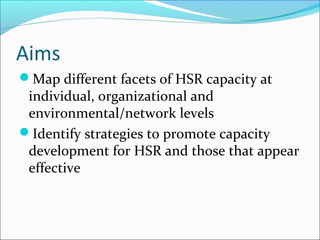
Aims
Map different facets of HSR capacity at
individual, organizational and
environmental/network levels
Identify strategies to promote capacity
development for HSR and those that appear
effective
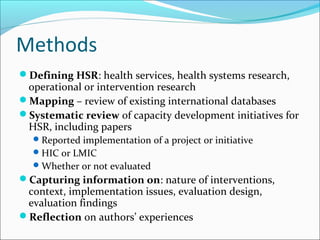
Methods
Defining HSR: health services, health systems research,
operational or intervention research
Mapping – review of existing international databases
Systematic review of capacity development initiatives for
HSR, including papers
Reported implementation of a project or initiative
HIC or LMIC
Whether or not evaluated
Capturing information on: nature of interventions,
context, implementation issues, evaluation design,
evaluation findings
Reflection on authors’ experiences
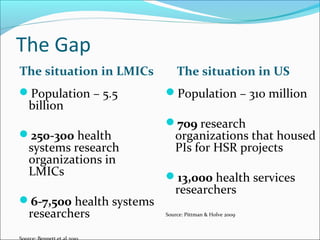
The Gap
The situation in LMICs The situation in US
Population – 5.5
billion
250-300 health
systems research
organizations in
LMICs
6-7,500 health systems
researchers
Population – 310 million
709 research
organizations that housed
PIs for HSR projects
13,000 health services
researchers
Source: Pittman & Holve 2009
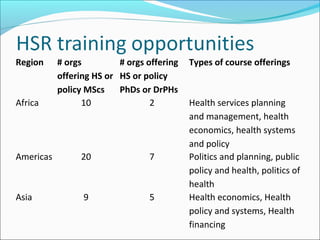
Region # orgs
offering HS or
policy MScs
# orgs offering
HS or policy
PhDs or DrPHs
Types of course offerings
Africa 10 2 Health services planning
and management, health
economics, health systems
and policy
Americas 20 7 Politics and planning, public
policy and health, politics of
health
Asia 9 5 Health economics, Health
policy and systems, Health
financing
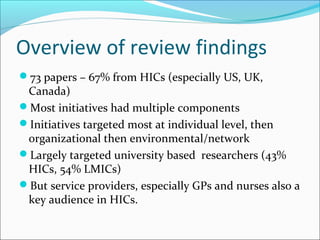
Overview of review findings
73 papers – 67% from HICs (especially US, UK,
Canada)
Most initiatives had multiple components
Initiatives targeted most at individual level, then
organizational then environmental/network
Largely targeted university based researchers (43%
HICs, 54% LMICs)
But service providers, especially GPs and nurses also a
key audience in HICs.
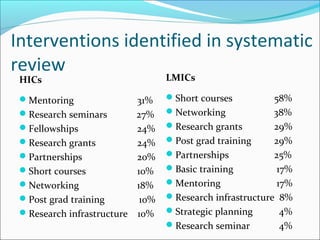
Interventions identified in systematic
review
HICs
Mentoring 31%
Research seminars 27%
Fellowships 24%
Research grants 24%
Partnerships 20%
Short courses 10%
Networking 18%
Post grad training 10%
Research infrastructure 10%
LMICs
Short courses 58%
Networking 38%
Research grants 29%
Post grad training 29%
Partnerships 25%
Basic training 17%
Mentoring 17%
Research infrastructure 8%
Strategic planning 4%
Research seminar 4%
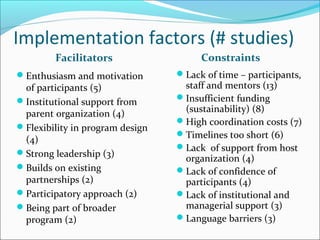
Implementation factors (# studies)
Facilitators Constraints
Enthusiasm and motivation
of participants (5)
Institutional support from
parent organization (4)
Flexibility in program design
(4)
Strong leadership (3)
Builds on existing
partnerships (2)
Participatory approach (2)
Being part of broader
program (2)
Lack of time – participants,
staff and mentors (13)
Insufficient funding
(sustainability) (8)
High coordination costs (7)
Timelines too short (6)
Lack of support from host
organization (4)
Lack of confidence of
participants (4)
Lack of institutional and
managerial support (3)
Language barriers (3)
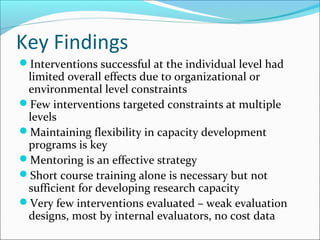
Key Findings
Interventions successful at the individual level had
limited overall effects due to organizational or
environmental level constraints
Few interventions targeted constraints at multiple
levels
Maintaining flexibility in capacity development
programs is key
Mentoring is an effective strategy
Short course training alone is necessary but not
sufficient for developing research capacity
Very few interventions evaluated – weak evaluation
designs, most by internal evaluators, no cost data
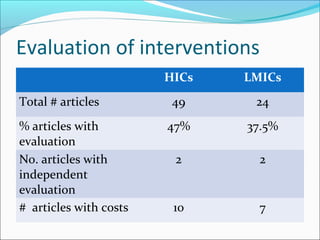
Evaluation of interventions
HICs LMICs
Total # articles 49 24
% articles with
evaluation
47% 37.5%
No. articles with
independent
evaluation
2 2
# articles with costs 10 7
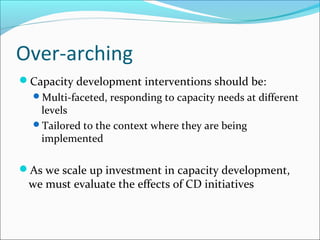
Over-arching
Capacity development interventions should be:
Multi-faceted, responding to capacity needs at different
levels
Tailored to the context where they are being
implemented
As we scale up investment in capacity development,
we must evaluate the effects of CD initiatives
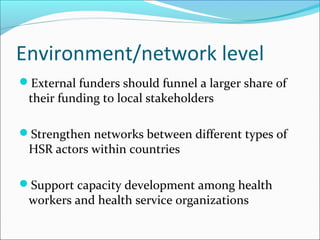
Environment/network level
External funders should funnel a larger share of
their funding to local stakeholders
Strengthen networks between different types of
HSR actors within countries
Support capacity development among health
workers and health service organizations
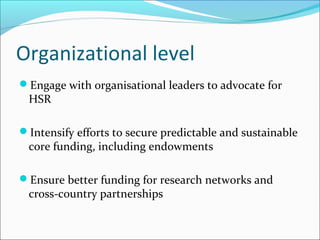
Organizational level
Engage with organisational leaders to advocate for
HSR
Intensify efforts to secure predictable and sustainable
core funding, including endowments
Ensure better funding for research networks and
cross-country partnerships
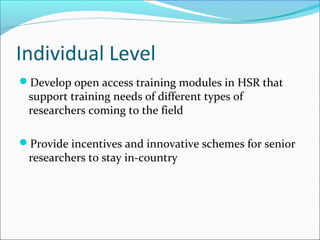
Individual Level
Develop open access training modules in HSR that
support training needs of different types of
researchers coming to the field
Provide incentives and innovative schemes for senior
researchers to stay in-country

What must be done to ehance capacity for health systems research?

  • 1.
    Sara Bennett, LigiaPaina, Christine Kim, Irene Agyepong, Somsak Chunharas, Di McIntyre, Stefan Nachuk
  • 2.
    Aims Map different facetsof HSR capacity at individual, organizational and environmental/network levels Identify strategies to promote capacity development for HSR and those that appear effective
  • 3.
    Methods Defining HSR: healthservices, health systems research, operational or intervention research Mapping – review of existing international databases Systematic review of capacity development initiatives for HSR, including papers Reported implementation of a project or initiative HIC or LMIC Whether or not evaluated Capturing information on: nature of interventions, context, implementation issues, evaluation design, evaluation findings Reflection on authors’ experiences
  • 4.
    The Gap The situationin LMICs The situation in US Population – 5.5 billion 250-300 health systems research organizations in LMICs 6-7,500 health systems researchers Population – 310 million 709 research organizations that housed PIs for HSR projects 13,000 health services researchers Source: Pittman & Holve 2009
  • 5.
    Region # orgs offeringHS or policy MScs # orgs offering HS or policy PhDs or DrPHs Types of course offerings Africa 10 2 Health services planning and management, health economics, health systems and policy Americas 20 7 Politics and planning, public policy and health, politics of health Asia 9 5 Health economics, Health policy and systems, Health financing
  • 6.
    Overview of reviewfindings 73 papers – 67% from HICs (especially US, UK, Canada) Most initiatives had multiple components Initiatives targeted most at individual level, then organizational then environmental/network Largely targeted university based researchers (43% HICs, 54% LMICs) But service providers, especially GPs and nurses also a key audience in HICs.
  • 7.
    Interventions identified insystematic review HICs Mentoring 31% Research seminars 27% Fellowships 24% Research grants 24% Partnerships 20% Short courses 10% Networking 18% Post grad training 10% Research infrastructure 10% LMICs Short courses 58% Networking 38% Research grants 29% Post grad training 29% Partnerships 25% Basic training 17% Mentoring 17% Research infrastructure 8% Strategic planning 4% Research seminar 4%
  • 8.
    Implementation factors (#studies) Facilitators Constraints Enthusiasm and motivation of participants (5) Institutional support from parent organization (4) Flexibility in program design (4) Strong leadership (3) Builds on existing partnerships (2) Participatory approach (2) Being part of broader program (2) Lack of time – participants, staff and mentors (13) Insufficient funding (sustainability) (8) High coordination costs (7) Timelines too short (6) Lack of support from host organization (4) Lack of confidence of participants (4) Lack of institutional and managerial support (3) Language barriers (3)
  • 9.
    Key Findings Interventions successfulat the individual level had limited overall effects due to organizational or environmental level constraints Few interventions targeted constraints at multiple levels Maintaining flexibility in capacity development programs is key Mentoring is an effective strategy Short course training alone is necessary but not sufficient for developing research capacity Very few interventions evaluated – weak evaluation designs, most by internal evaluators, no cost data
  • 10.
    Evaluation of interventions HICsLMICs Total # articles 49 24 % articles with evaluation 47% 37.5% No. articles with independent evaluation 2 2 # articles with costs 10 7
  • 12.
    Over-arching Capacity development interventionsshould be: Multi-faceted, responding to capacity needs at different levels Tailored to the context where they are being implemented As we scale up investment in capacity development, we must evaluate the effects of CD initiatives
  • 13.
    Environment/network level External fundersshould funnel a larger share of their funding to local stakeholders Strengthen networks between different types of HSR actors within countries Support capacity development among health workers and health service organizations
  • 14.
    Organizational level Engage withorganisational leaders to advocate for HSR Intensify efforts to secure predictable and sustainable core funding, including endowments Ensure better funding for research networks and cross-country partnerships
  • 15.
    Individual Level Develop openaccess training modules in HSR that support training needs of different types of researchers coming to the field Provide incentives and innovative schemes for senior researchers to stay in-country

Editor's Notes

  • #8 49 articles HICs, 24 articles LMICs
  • #11 Problems: no baseline data, no comparison groups……