Evaluation of the Grant
Review Process
September 2019
Research on Research 2019
Richard Nakamura, Ph.D., Retired
Former Director, Center for Scientific Review, NIH
• Receives all NIH applications
• Reviews for scientific merit
about 75% of all NIH
applications
• >500 employees, $125M budget
• NIH spends more than $30B per
year on research
The Center for Scientific Review (CSR)
Gateway for All NIH Grant Applications
If the goal is to have grant funding
resources maximally advance
knowledge of living systems and
increase ability to understand and
treat disorders then finding the most
productive and efficient methods to
allocate resources to achieve those
goals is important. Experimental and
comparative methods are likely to be
most useful.
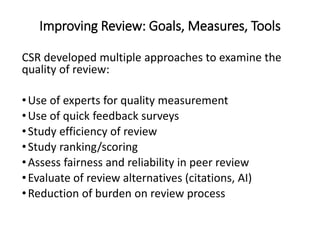
Improving Review: Goals, Measures, Tools
CSR developed multiple approaches to examine the
quality of review:
•Use of experts for quality measurement
•Use of quick feedback surveys
•Study efficiency of review
•Study ranking/scoring
•Assess fairness and reliability in peer review
•Evaluate of review alternatives (citations, AI)
•Reduction of burden on review process
4
Example: Fairness of Review
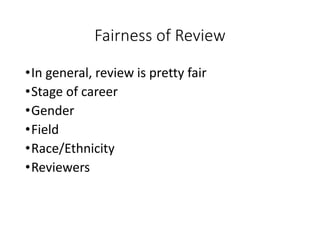
Fairness of Review
•In general, review is pretty fair
•Stage of career
•Gender
•Field
•Race/Ethnicity
•Reviewers
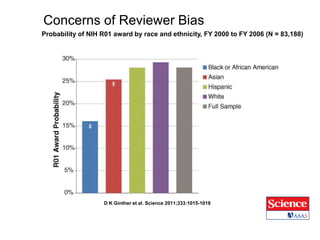
Probability of NIH R01 award by race and ethnicity, FY 2000 to FY 2006 (N = 83,188)
D K Ginther et al. Science 2011;333:1015-1019
Concerns of Reviewer Bias
The Hunt for Bias:
An Anonymizing Study
Anonymization Experiments –
Basic Assumptions
•Racial disparities in grant funding exists (Ginther et
al): AAs award rates much lower than Whites.
Other biases are suspected.
•Average preliminary overall impact scores account
for variance in final scores that account for award
disparity.
•The major hypotheses for score disparity were: a)
reviewer bias and/or, b) difference in quality of
application submission
•If there is bias, anonymizing applications should
reduce disparities.
9
Results and Lessons Learned
Need for Outcome Measures
Discussion
ORCID and interoperable vita systems
should be encouraged universally for
utility as long-term outcome
measures of scientific and technical
human capital.
Discussion
The Review Process at NIH
Spending
at NIH
NIH Extramural & Intramural Funding
FY 2017 Enacted: $33.4 Billion
83%
17%
Spending Outside NIH
$27.7 B
– Supports over 300,000 Scientists &
Research Personnel
– Supports over 2,500 Institutions
– $3.8 B Intramural Research
– $1.9 B Research Management & Support and
Other
$5.7 B
CSR Peer Review – Fiscal Year 2017
• 90,000 NIH applications received
• 61,000 applications reviewed by CSR
• 18,000 reviewers
• 247 Scientific Review Officers
• >200 standing and recurring study sections
• 1,600 review meetings
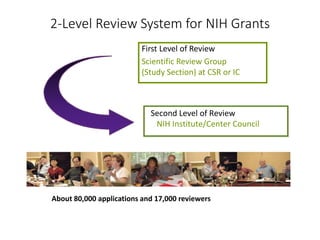
2-Level Review System for NIH Grants
First Level of Review
Scientific Review Group
(Study Section) at CSR or IC
Second Level of Review
NIH Institute/Center Council
About 80,000 applications and 17,000 reviewers
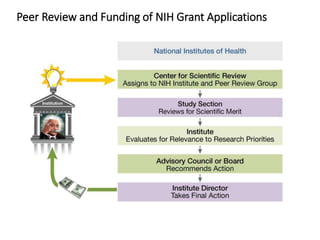
Peer Review and Funding of NIH Grant Applications
The Study Section Meeting
The SRO Convenes the Study Section Meeting

RoRILaunch 5 DECISIONS Nakamura

  • 1.
    Evaluation of theGrant Review Process September 2019 Research on Research 2019 Richard Nakamura, Ph.D., Retired Former Director, Center for Scientific Review, NIH
  • 2.
    • Receives allNIH applications • Reviews for scientific merit about 75% of all NIH applications • >500 employees, $125M budget • NIH spends more than $30B per year on research The Center for Scientific Review (CSR) Gateway for All NIH Grant Applications
  • 3.
    If the goalis to have grant funding resources maximally advance knowledge of living systems and increase ability to understand and treat disorders then finding the most productive and efficient methods to allocate resources to achieve those goals is important. Experimental and comparative methods are likely to be most useful.
  • 4.
    Improving Review: Goals,Measures, Tools CSR developed multiple approaches to examine the quality of review: •Use of experts for quality measurement •Use of quick feedback surveys •Study efficiency of review •Study ranking/scoring •Assess fairness and reliability in peer review •Evaluate of review alternatives (citations, AI) •Reduction of burden on review process 4
  • 5.
  • 6.
    Fairness of Review •Ingeneral, review is pretty fair •Stage of career •Gender •Field •Race/Ethnicity •Reviewers
  • 7.
    Probability of NIHR01 award by race and ethnicity, FY 2000 to FY 2006 (N = 83,188) D K Ginther et al. Science 2011;333:1015-1019 Concerns of Reviewer Bias
  • 8.
    The Hunt forBias: An Anonymizing Study
  • 9.
    Anonymization Experiments – BasicAssumptions •Racial disparities in grant funding exists (Ginther et al): AAs award rates much lower than Whites. Other biases are suspected. •Average preliminary overall impact scores account for variance in final scores that account for award disparity. •The major hypotheses for score disparity were: a) reviewer bias and/or, b) difference in quality of application submission •If there is bias, anonymizing applications should reduce disparities. 9
  • 10.
  • 11.
  • 12.
  • 13.
    ORCID and interoperablevita systems should be encouraged universally for utility as long-term outcome measures of scientific and technical human capital.
  • 14.
  • 15.
  • 16.
    Spending at NIH NIH Extramural& Intramural Funding FY 2017 Enacted: $33.4 Billion 83% 17% Spending Outside NIH $27.7 B – Supports over 300,000 Scientists & Research Personnel – Supports over 2,500 Institutions – $3.8 B Intramural Research – $1.9 B Research Management & Support and Other $5.7 B
  • 17.
    CSR Peer Review– Fiscal Year 2017 • 90,000 NIH applications received • 61,000 applications reviewed by CSR • 18,000 reviewers • 247 Scientific Review Officers • >200 standing and recurring study sections • 1,600 review meetings
  • 18.
    2-Level Review Systemfor NIH Grants First Level of Review Scientific Review Group (Study Section) at CSR or IC Second Level of Review NIH Institute/Center Council About 80,000 applications and 17,000 reviewers
  • 19.
    Peer Review andFunding of NIH Grant Applications
  • 20.
    The Study SectionMeeting The SRO Convenes the Study Section Meeting