1
Learning by Doing and
Applying our Learning
Institutional Options
First Global Symposium on Health
Systems Research
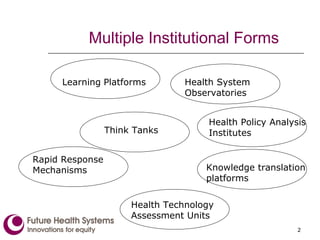
Multiple Institutional Forms
2
Learning Platforms Health System
Observatories
Think Tanks
Knowledge translation
platforms
Rapid Response
Mechanisms
Health Technology
Assessment Units
Health Policy Analysis
Institutes
Lack of clarity about
 What are the differences between these
institutional forms?
 How do their operational approaches
differ?
 How do they engage with policy and
decision makers?
 What types of evidence do they use?
 What learning processes do they use?
 Are some institutional forms more
appropriate than others for particular
purposes?
3
Questions to Panelists
 What are the objectives/mission of
your organization?
 Which strategies has your
organization employed to
implement these objectives?
 What have been the key successes
and what are key constraints?
4
Panelists
 Ms Becky Dodd, WHO WPRO, Asian
Observatory on Health Systems
 Mr Joe Kasonde, Zambian Forum for
Health Research (Zamfohr), Zambia
 Dr Sripen Tantivess, Health Intervention
and Technology Assessment Program,
Thailand
 Wang Yunping, China National Health
Development Research Center
 Dr Gerry Bloom, Future Health Systems
Consortium, IDS, University of Sussex
5
Panelists
 Ms Becky Dodd, WHO WPRO, Asian
Observatory on Health Systems
 Mr Joe Kasonde, Zambian Forum for
Health Research (Zamfohr), Zambia
 Dr Sripen Tantivess, Health Intervention
and Technology Assessment Program,
Thailand
 Wang Yunping, China National Health
Development Research Center
 Dr Gerry Bloom, Future Health Systems
Consortium, IDS, University of Sussex
5

Learning by Doing and Applying our Learning

  • 1.
    1 Learning by Doingand Applying our Learning Institutional Options First Global Symposium on Health Systems Research
  • 2.
    Multiple Institutional Forms 2 LearningPlatforms Health System Observatories Think Tanks Knowledge translation platforms Rapid Response Mechanisms Health Technology Assessment Units Health Policy Analysis Institutes
  • 3.
    Lack of clarityabout  What are the differences between these institutional forms?  How do their operational approaches differ?  How do they engage with policy and decision makers?  What types of evidence do they use?  What learning processes do they use?  Are some institutional forms more appropriate than others for particular purposes? 3
  • 4.
    Questions to Panelists What are the objectives/mission of your organization?  Which strategies has your organization employed to implement these objectives?  What have been the key successes and what are key constraints? 4
  • 5.
    Panelists  Ms BeckyDodd, WHO WPRO, Asian Observatory on Health Systems  Mr Joe Kasonde, Zambian Forum for Health Research (Zamfohr), Zambia  Dr Sripen Tantivess, Health Intervention and Technology Assessment Program, Thailand  Wang Yunping, China National Health Development Research Center  Dr Gerry Bloom, Future Health Systems Consortium, IDS, University of Sussex 5
  • 6.
    Panelists  Ms BeckyDodd, WHO WPRO, Asian Observatory on Health Systems  Mr Joe Kasonde, Zambian Forum for Health Research (Zamfohr), Zambia  Dr Sripen Tantivess, Health Intervention and Technology Assessment Program, Thailand  Wang Yunping, China National Health Development Research Center  Dr Gerry Bloom, Future Health Systems Consortium, IDS, University of Sussex 5