Back Bay Battery Inc.
ANDREW MARSHA MULIA (AMM657)
Collaborator: Shalabh Jhalawad
Executive Summary
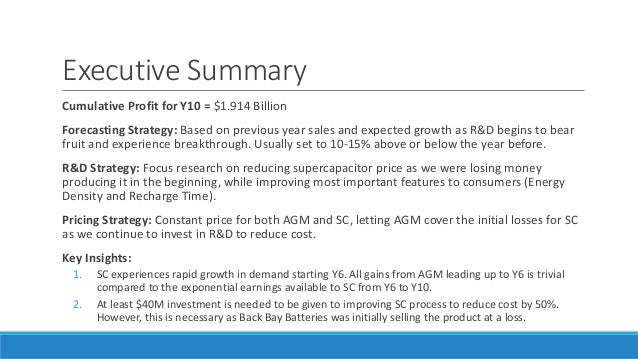
Cumulative Profit for Y10 = $1.914 Billion
Forecasting Strategy: Based on previous year sales and expected growth as R&D begins to bear
fruit and experience breakthrough. Usually set to 10-15% above or below the year before.
R&D Strategy: Focus research on reducing supercapacitor price as we were losing money
producing it in the beginning, while improving most important features to consumers (Energy
Density and Recharge Time).
Pricing Strategy: Constant price for both AGM and SC, letting AGM cover the initial losses for SC
as we continue to invest in R&D to reduce cost.
Key Insights:
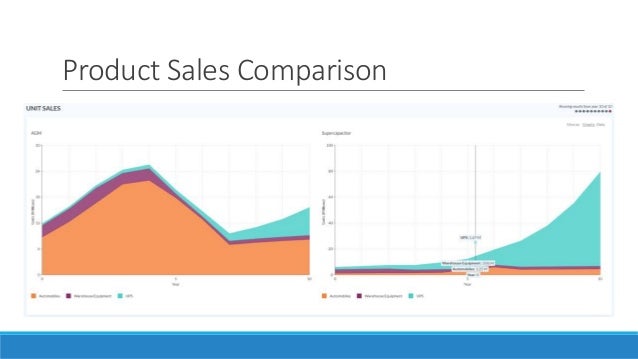
1. SC experiences rapid growth in demand starting Y6. All gains from AGM leading up to Y6 is trivial
compared to the exponential earnings available to SC from Y6 to Y10.
2. At least $40M investment is needed to be given to improving SC process to reduce cost by 50%.
However, this is necessary as Back Bay Batteries was initially selling the product at a loss.
Timeline and Key Events
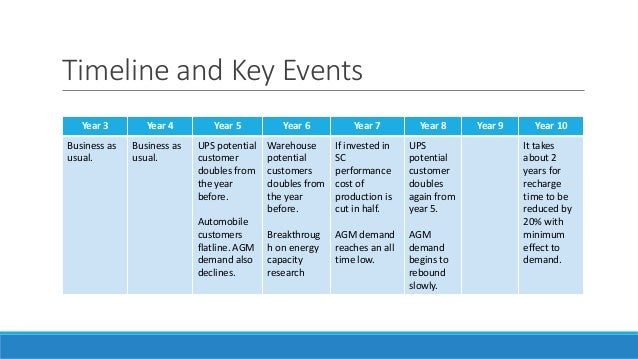
Year 3 Year 4 Year 5 Year 6 Year 7 Year 8 Year 9 Year 10
Business as
usual.
Business as
usual.
UPS potential
customer
doubles from
the year
before.
Automobile
customers
flatline. AGM
demand also
declines.
Warehouse
potential
customers
doubles from
the year
before.
Breakthroug
h on energy
capacity
research
If invested in
SC
performance
cost of
production is
cut in half.
AGM demand
reaches an all
time low.
UPS
potential
customer
doubles
again from
year 5.
AGM
demand
begins to
rebound
slowly.
It takes
about 2
years for
recharge
time to be
reduced by
20% with
minimum
effect to
demand.
Next Steps
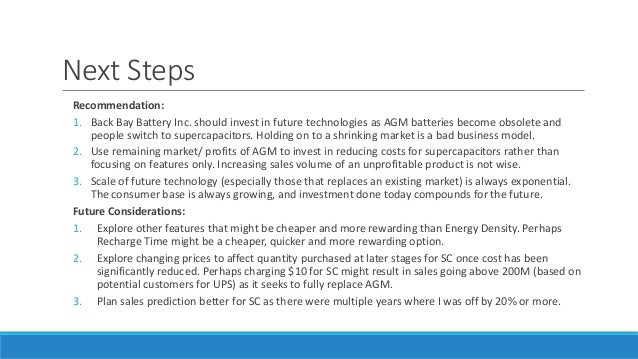
Recommendation:
1. Back Bay Battery Inc. should invest in future technologies as AGM batteries become obsolete and
people switch to supercapacitors. Holding on to a shrinking market is a bad business model.
2. Use remaining market/ profits of AGM to invest in reducing costs for supercapacitors rather than
focusing on features only. Increasing sales volume of an unprofitable product is not wise.
3. Scale of future technology (especially those that replaces an existing market) is always exponential.
The consumer base is always growing, and investment done today compounds for the future.
Future Considerations:
1. Explore other features that might be cheaper and more rewarding than Energy Density. Perhaps
Recharge Time might be a cheaper, quicker and more rewarding option.
2. Explore changing prices to affect quantity purchased at later stages for SC once cost has been
significantly reduced. Perhaps charging $10 for SC might result in sales going above 200M (based on
potential customers for UPS) as it seeks to fully replace AGM.
3. Plan sales prediction better for SC as there were multiple years where I was off by 20% or more.
Product Sales Comparison

Back Bay Battery Inc Case Study

  • 1.
    Back Bay BatteryInc. ANDREW MARSHA MULIA (AMM657) Collaborator: Shalabh Jhalawad
  • 2.
    Executive Summary Cumulative Profitfor Y10 = $1.914 Billion Forecasting Strategy: Based on previous year sales and expected growth as R&D begins to bear fruit and experience breakthrough. Usually set to 10-15% above or below the year before. R&D Strategy: Focus research on reducing supercapacitor price as we were losing money producing it in the beginning, while improving most important features to consumers (Energy Density and Recharge Time). Pricing Strategy: Constant price for both AGM and SC, letting AGM cover the initial losses for SC as we continue to invest in R&D to reduce cost. Key Insights: 1. SC experiences rapid growth in demand starting Y6. All gains from AGM leading up to Y6 is trivial compared to the exponential earnings available to SC from Y6 to Y10. 2. At least $40M investment is needed to be given to improving SC process to reduce cost by 50%. However, this is necessary as Back Bay Batteries was initially selling the product at a loss.
  • 3.
    Timeline and KeyEvents Year 3 Year 4 Year 5 Year 6 Year 7 Year 8 Year 9 Year 10 Business as usual. Business as usual. UPS potential customer doubles from the year before. Automobile customers flatline. AGM demand also declines. Warehouse potential customers doubles from the year before. Breakthroug h on energy capacity research If invested in SC performance cost of production is cut in half. AGM demand reaches an all time low. UPS potential customer doubles again from year 5. AGM demand begins to rebound slowly. It takes about 2 years for recharge time to be reduced by 20% with minimum effect to demand.
  • 4.
    Next Steps Recommendation: 1. BackBay Battery Inc. should invest in future technologies as AGM batteries become obsolete and people switch to supercapacitors. Holding on to a shrinking market is a bad business model. 2. Use remaining market/ profits of AGM to invest in reducing costs for supercapacitors rather than focusing on features only. Increasing sales volume of an unprofitable product is not wise. 3. Scale of future technology (especially those that replaces an existing market) is always exponential. The consumer base is always growing, and investment done today compounds for the future. Future Considerations: 1. Explore other features that might be cheaper and more rewarding than Energy Density. Perhaps Recharge Time might be a cheaper, quicker and more rewarding option. 2. Explore changing prices to affect quantity purchased at later stages for SC once cost has been significantly reduced. Perhaps charging $10 for SC might result in sales going above 200M (based on potential customers for UPS) as it seeks to fully replace AGM. 3. Plan sales prediction better for SC as there were multiple years where I was off by 20% or more.
  • 5.