Challenging your Business Model  BizCamp Southeast June 12, 2010 Eugene Crehan Director of Programmes - CEDRE School of Business Waterford Institute of Technology [email_address]
Agenda / Objectives Introduction, EC, CEDRE, SEEPP,  Refining your offering Designing a business model 4 things that REALLY matter Templates to help design a business model right for your business? Questions & Feedback
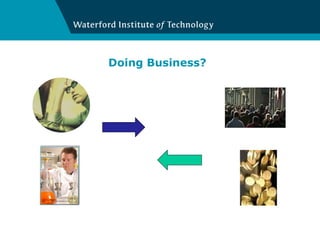
Doing Business?
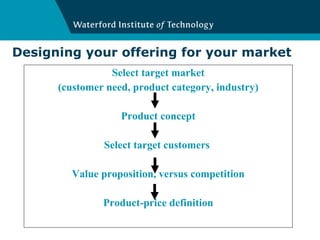
Designing your offering for your market Select target market (customer need, product category, industry) Product concept Select target customers  Value proposition, versus competition Product-price definition
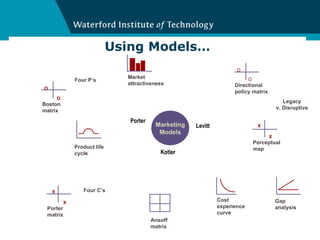
Using Models… Porter Levitt Kotler Four C’s Marketing Models Ansoff matrix Market attractiveness Cost experience curve Boston matrix O O Directional policy matrix O O Four P’s Legacy v. Disruptive Product life cycle Perceptual map X X Porter matrix X X Gap analysis
There Are 4 Things That Really Matter
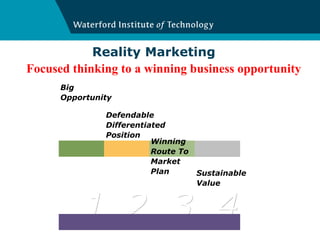
Reality Marketing Focused  thinking  to a winning business opportunity 3 Winning  Route  To  Market Plan 2 Defendable Differentiated Position 1 Big Opportunity 4 Sustainable Value
1. Reality Check Big Opportunity Is there sufficient pain to generate a compelling reason to buy? Are there enough customers that meet this profile to make a big and growing category?
2.  Reality Check Do you have a defendable, differentiated position? Can you clearly articulate it?
3. Reality Check Winning Execution Do you understand your target customer and the purchase dynamics? Do you have a complete offering at the right price? Do you have the right distribution channel?  Does your value chain work? Have you thought through the entire go-to-market execution?
4.  Reality Check Sustainable Value Can this be a profitable, sustainable business? What are your next expansion opportunities?
Show me the money!! What is your revenue generating  asset ?  Product?  IP?  People? Other? What category are you in? What are the market drivers? Any trade-offs?
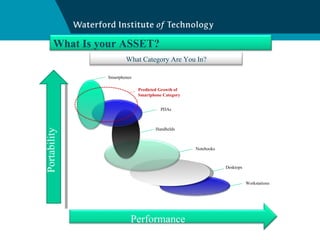
What Is your ASSET?  Portability Performance  Capability Smartphones Predicted Growth of Smartphone Category PDAs Handhelds Notebooks Desktops Workstations What Category Are You In?
Describe your customers Descriptors Their needs / Decision making process Quantify Gross value of market Your slice of that market See 10 Questions to profile your typical customer
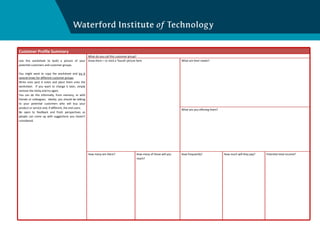
Customer Profile Summary Use this worksheet to build a picture of your potential customers and customer groups. You might want to copy the worksheet and  try it several times for different customer groups . Write onto post it notes and place them onto the worksheet.  If you want to change it later, simply remove the sticky and try again. You can do this informally, from memory, or with friends or colleagues.  Ideally, you should be talking to your potential customers who will buy your product or service and, if different, the end users. Be open to feedback and fresh perspectives as people can come up with suggestions you haven’t considered. What do you call this customer group? Draw them – or stick a ‘found’ picture here What are their needs? What are you offering them? How many are there? How many of those will you reach? How frequently? How much will they pay? Potential total income?
Competitors Direct & indirect What’s their business model? Are you different / better? Where is your added value?
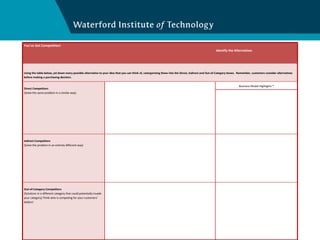
You’ve Got Competition! Identify the Alternatives Using the table below, jot down every possible alternative to your idea that you can think of, catergorising these into the Direct, Indirect and Out-of-Category boxes.  Remember, customers consider alternatives before making a purchasing decision. Direct Competitors (Solve the same problem in a similar way) Business Model Highlights * Indirect Competitors (Solve the problem in an entirely different way) Out-of-Category Competitors (Solutions in a different category that could potentially invade your category) Think who is competing for your customers’ dollars!
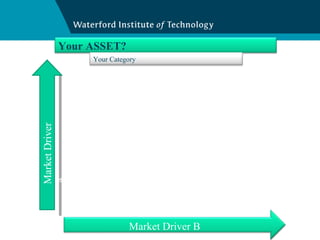
Your ASSET?  Market Driver A Market Driver B Your Category
Route to Market Direct or indirect Impact on profitability? Distributors Value Added Resellers How do they add value? Key Accounts
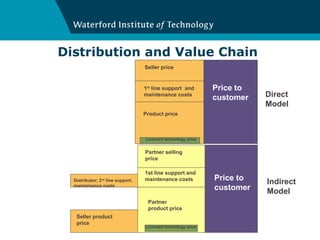
Distribution and Value Chain Licensed technology price Direct Model Licensed technology price Price to  customer Product price Seller price  1 st  line support  and  maintenance costs Indirect Model Seller product price Partner  product price Partner selling  price  Price to  customer Distributor;  2 nd  line support, maint ainence costs 1st line support and maintenance costs
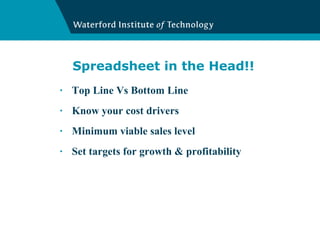
Spreadsheet in the Head!! Top Line Vs Bottom Line Know your cost drivers Minimum viable sales level Set targets for growth & profitability
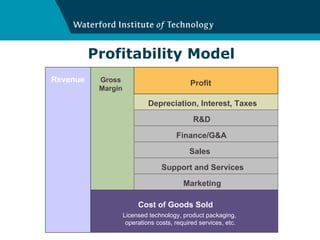
Profitability Model Cost of Goods Sold Licensed technology, product packaging,  operations costs, required services, etc. Gross Margin Marketing Sales Finance/G&A R&D Support and Services Depreciation, Interest, Taxes Revenue Profit
Does your idea matter? An excellent solution or just nice? Killer App? Adds value? Customers, Owners, Investors Revenue & Profit potential Market reactions?
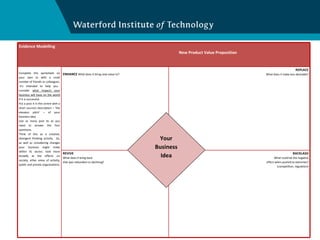
Your Business Idea Evidence Modelling New Product Value Proposition Complete this worksheet on your own or with a small number of friends or colleagues.  It’s intended to help you consider  what impacts your business will have on the world  if it is successful. Put a post it in the centre with a short succinct description – ‘the elevator pitch’ – of your business idea. Use as many post its as you need to answer the four questions. Think of this as a creative, divergent thinking activity.  So, as well as considering changes your business might make within its sector, look more broadly at the effects on society, other areas of activity, public and private organisations .  ENHANCE   What does it bring new value to? REPLACE What does it make less desirable? REVIVE What does it bring back  that was redundant or declining? BACKLASH What could be the negative effect when pushed to extremes? (competition, regulation)
Good Luck  &  Thank you Eugene Crehan Director of Programmes Centre for Enterprise Development & Regional Economy  School of Business Waterford Institute of Technology [email_address] www.seepp.ie  Twitter & LinkedIn

Eugene Crehan - Understanding Your Business Model

  • 1.
    Challenging your BusinessModel BizCamp Southeast June 12, 2010 Eugene Crehan Director of Programmes - CEDRE School of Business Waterford Institute of Technology [email_address]
  • 2.
    Agenda / ObjectivesIntroduction, EC, CEDRE, SEEPP, Refining your offering Designing a business model 4 things that REALLY matter Templates to help design a business model right for your business? Questions & Feedback
  • 3.
  • 4.
    Designing your offeringfor your market Select target market (customer need, product category, industry) Product concept Select target customers Value proposition, versus competition Product-price definition
  • 5.
    Using Models… PorterLevitt Kotler Four C’s Marketing Models Ansoff matrix Market attractiveness Cost experience curve Boston matrix O O Directional policy matrix O O Four P’s Legacy v. Disruptive Product life cycle Perceptual map X X Porter matrix X X Gap analysis
  • 6.
    There Are 4Things That Really Matter
  • 7.
    Reality Marketing Focused thinking to a winning business opportunity 3 Winning Route To Market Plan 2 Defendable Differentiated Position 1 Big Opportunity 4 Sustainable Value
  • 8.
    1. Reality CheckBig Opportunity Is there sufficient pain to generate a compelling reason to buy? Are there enough customers that meet this profile to make a big and growing category?
  • 9.
    2. RealityCheck Do you have a defendable, differentiated position? Can you clearly articulate it?
  • 10.
    3. Reality CheckWinning Execution Do you understand your target customer and the purchase dynamics? Do you have a complete offering at the right price? Do you have the right distribution channel? Does your value chain work? Have you thought through the entire go-to-market execution?
  • 11.
    4. RealityCheck Sustainable Value Can this be a profitable, sustainable business? What are your next expansion opportunities?
  • 12.
    Show me themoney!! What is your revenue generating asset ? Product? IP? People? Other? What category are you in? What are the market drivers? Any trade-offs?
  • 13.
    What Is yourASSET? Portability Performance Capability Smartphones Predicted Growth of Smartphone Category PDAs Handhelds Notebooks Desktops Workstations What Category Are You In?
  • 14.
    Describe your customersDescriptors Their needs / Decision making process Quantify Gross value of market Your slice of that market See 10 Questions to profile your typical customer
  • 15.
    Customer Profile SummaryUse this worksheet to build a picture of your potential customers and customer groups. You might want to copy the worksheet and try it several times for different customer groups . Write onto post it notes and place them onto the worksheet. If you want to change it later, simply remove the sticky and try again. You can do this informally, from memory, or with friends or colleagues. Ideally, you should be talking to your potential customers who will buy your product or service and, if different, the end users. Be open to feedback and fresh perspectives as people can come up with suggestions you haven’t considered. What do you call this customer group? Draw them – or stick a ‘found’ picture here What are their needs? What are you offering them? How many are there? How many of those will you reach? How frequently? How much will they pay? Potential total income?
  • 16.
    Competitors Direct &indirect What’s their business model? Are you different / better? Where is your added value?
  • 17.
    You’ve Got Competition!Identify the Alternatives Using the table below, jot down every possible alternative to your idea that you can think of, catergorising these into the Direct, Indirect and Out-of-Category boxes. Remember, customers consider alternatives before making a purchasing decision. Direct Competitors (Solve the same problem in a similar way) Business Model Highlights * Indirect Competitors (Solve the problem in an entirely different way) Out-of-Category Competitors (Solutions in a different category that could potentially invade your category) Think who is competing for your customers’ dollars!
  • 18.
    Your ASSET? Market Driver A Market Driver B Your Category
  • 19.
    Route to MarketDirect or indirect Impact on profitability? Distributors Value Added Resellers How do they add value? Key Accounts
  • 20.
    Distribution and ValueChain Licensed technology price Direct Model Licensed technology price Price to customer Product price Seller price 1 st line support and maintenance costs Indirect Model Seller product price Partner product price Partner selling price Price to customer Distributor; 2 nd line support, maint ainence costs 1st line support and maintenance costs
  • 21.
    Spreadsheet in theHead!! Top Line Vs Bottom Line Know your cost drivers Minimum viable sales level Set targets for growth & profitability
  • 22.
    Profitability Model Costof Goods Sold Licensed technology, product packaging, operations costs, required services, etc. Gross Margin Marketing Sales Finance/G&A R&D Support and Services Depreciation, Interest, Taxes Revenue Profit
  • 23.
    Does your ideamatter? An excellent solution or just nice? Killer App? Adds value? Customers, Owners, Investors Revenue & Profit potential Market reactions?
  • 24.
    Your Business IdeaEvidence Modelling New Product Value Proposition Complete this worksheet on your own or with a small number of friends or colleagues. It’s intended to help you consider what impacts your business will have on the world if it is successful. Put a post it in the centre with a short succinct description – ‘the elevator pitch’ – of your business idea. Use as many post its as you need to answer the four questions. Think of this as a creative, divergent thinking activity. So, as well as considering changes your business might make within its sector, look more broadly at the effects on society, other areas of activity, public and private organisations . ENHANCE What does it bring new value to? REPLACE What does it make less desirable? REVIVE What does it bring back that was redundant or declining? BACKLASH What could be the negative effect when pushed to extremes? (competition, regulation)
  • 25.
    Good Luck & Thank you Eugene Crehan Director of Programmes Centre for Enterprise Development & Regional Economy School of Business Waterford Institute of Technology [email_address] www.seepp.ie Twitter & LinkedIn