By the Waters of Babylon
Stephen Vincent Benet English II
Clzianoski
LESSON OBJECTIVES
• Analyze narrative devices
• Define foreshadowing and
flashbacks
• Identify point of view
in a story
#GOALS
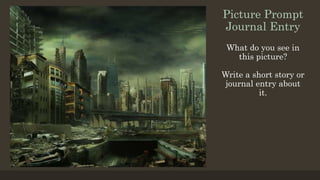
Picture Prompt
Journal Entry
What do you see in
this picture?
Write a short story or
journal entry about
it.
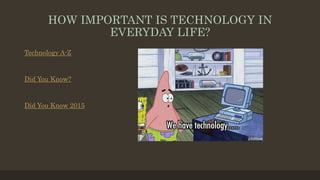
HOW IMPORTANT IS TECHNOLOGY IN
EVERYDAY LIFE?
Technology A-Z
Did You Know?
Did You Know 2015
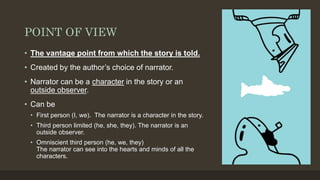
POINT OF VIEW
• The vantage point from which the story is told.
• Created by the author’s choice of narrator.
• Narrator can be a character in the story or an
outside observer.
• Can be
• First person (I, we). The narrator is a character in the story.
• Third person limited (he, she, they). The narrator is an
outside observer.
• Omniscient third person (he, we, they)
The narrator can see into the hearts and minds of all the
characters.
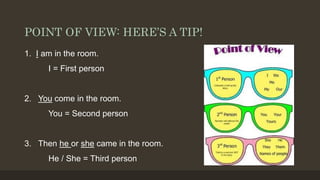
POINT OF VIEW: HERE’S A TIP!
1. I am in the room.
I = First person
2. You come in the room.
You = Second person
3. Then he or she came in the room.
He / She = Third person
NAÏVE NARRATOR
• A kind of first person point of view
• The narrator doesn’t understand
what he or she is seeing or
experiencing
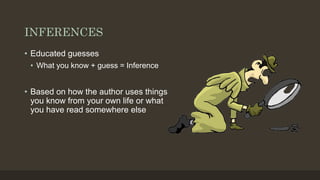
INFERENCES
• Educated guesses
• What you know + guess = Inference
• Based on how the author uses things
you know from your own life or what
you have read somewhere else
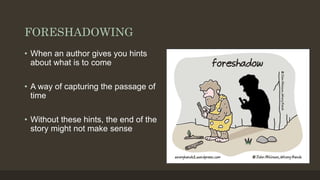
FORESHADOWING
• When an author gives you hints
about what is to come
• A way of capturing the passage of
time
• Without these hints, the end of the
story might not make sense
FLASHBACK
• a scene in a movie, novel, etc., set in
a time earlier than the main story.
• A sudden and disturbing vivid memory
of an event in the past.
ALLUSION
• An indirect reference to a famous
person, place, event, or literary work.
• The title of Stephen Vincent Bent’s
story, “By the Waters of Babylon,” is
an allusion to Psalm 137 which begins
with “By the waters of Babylon”
• Don McLean – “Waters of Babylon”

By the Waters of Babylon

  • 1.
    By the Watersof Babylon Stephen Vincent Benet English II Clzianoski
  • 2.
    LESSON OBJECTIVES • Analyzenarrative devices • Define foreshadowing and flashbacks • Identify point of view in a story #GOALS
  • 3.
    Picture Prompt Journal Entry Whatdo you see in this picture? Write a short story or journal entry about it.
  • 4.
    HOW IMPORTANT ISTECHNOLOGY IN EVERYDAY LIFE? Technology A-Z Did You Know? Did You Know 2015
  • 5.
    POINT OF VIEW •The vantage point from which the story is told. • Created by the author’s choice of narrator. • Narrator can be a character in the story or an outside observer. • Can be • First person (I, we). The narrator is a character in the story. • Third person limited (he, she, they). The narrator is an outside observer. • Omniscient third person (he, we, they) The narrator can see into the hearts and minds of all the characters.
  • 6.
    POINT OF VIEW:HERE’S A TIP! 1. I am in the room. I = First person 2. You come in the room. You = Second person 3. Then he or she came in the room. He / She = Third person
  • 7.
    NAÏVE NARRATOR • Akind of first person point of view • The narrator doesn’t understand what he or she is seeing or experiencing
  • 8.
    INFERENCES • Educated guesses •What you know + guess = Inference • Based on how the author uses things you know from your own life or what you have read somewhere else
  • 9.
    FORESHADOWING • When anauthor gives you hints about what is to come • A way of capturing the passage of time • Without these hints, the end of the story might not make sense
  • 10.
    FLASHBACK • a scenein a movie, novel, etc., set in a time earlier than the main story. • A sudden and disturbing vivid memory of an event in the past.
  • 11.
    ALLUSION • An indirectreference to a famous person, place, event, or literary work. • The title of Stephen Vincent Bent’s story, “By the Waters of Babylon,” is an allusion to Psalm 137 which begins with “By the waters of Babylon” • Don McLean – “Waters of Babylon”