WELCOME ABOARD!
Hello! My name is Shardul Parulekar.
I am a Business Analyst with
expertise in Capital Markets,
Core Banking and Risk
management.
Currently I am working in TATA
Consultancy Services for one
of the leading European
Bank. I hold a Bachelor of
Engineering degree from one
of the premium Government
Institutes in India.
My core competencies are
• Requirement Gathering
• Process Modelling
• Gap Analysis
• Process Optimization
• Agile – SCRUM
• Estimations – Function Point
I like to keep myself updated with ongoing
changes in Banking as well Information and
Technology. Compliances like Basel III, IFRS or
SEPA instant payments as well as Business
Intelligence or Hadoop are to mention a few.
Risk management is one of the focused areas in
banking and I find it as a new challenge to
master.
Apart from work, I like drawing pencil sketches,
blogging, watching science fiction movies and
cooking.
2
Who is a Business Analyst?
Why is he so important?
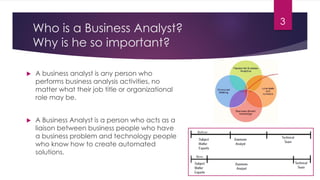
 A business analyst is any person who
performs business analysis activities, no
matter what their job title or organizational
role may be.
 A Business Analyst is a person who acts as a
liaison between business people who have
a business problem and technology people
who know how to create automated
solutions.
3
But, what’s exactly does he do?
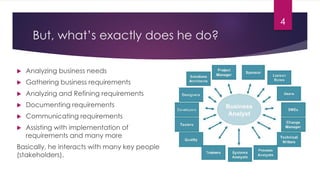
 Analyzing business needs
 Gathering business requirements
 Analyzing and Refining requirements
 Documenting requirements
 Communicating requirements
 Assisting with implementation of
requirements and many more
Basically, he interacts with many key people
(stakeholders).
4
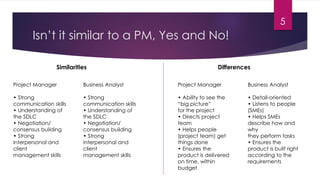
Isn’t it similar to a PM, Yes and No!
Project Manager
• Strong
communication skills
• Understanding of
the SDLC
• Negotiation/
consensus building
• Strong
interpersonal and
client
management skills
Business Analyst
• Strong
communication skills
• Understanding of
the SDLC
• Negotiation/
consensus building
• Strong
interpersonal and
client
management skills
Project Manager
• Ability to see the
“big picture”
for the project
• Directs project
team
• Helps people
(project team) get
things done
• Ensures the
product is delivered
on time, within
budget
Business Analyst
• Detail-oriented
• Listens to people
(SMEs)
• Helps SMEs
describe how and
why
they perform tasks
• Ensures the
product is built right
according to the
requirements
Similarities Differences
5
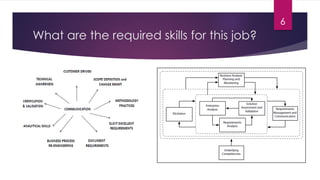
What are the required skills for this job?
6
How does BABOK fit in here?
What BABOK isn't
1. A training book
2. A compliance
3. A process (SDLC)
4. A methodology
What BABOK is
1. It identifies knowledge areas accepted as best practices
2. It allows for discussions amongst professionals using
common, agreed to vocabulary
3. It provides basic reference document to all practitioners
4. It identifies fundamental knowledge required of an
effective BA professional
5. It provides basic reference for anyone interested in the
profession of BA
7
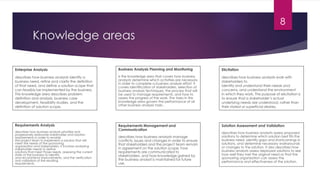
Knowledge areas
Enterprise Analysis
describes how business analysts identify a
business need, refine and clarify the definition
of that need, and define a solution scope that
can feasibly be implemented by the business.
This knowledge area describes problem
definition and analysis, business case
development, feasibility studies, and the
definition of solution scope.
Business Analysis Planning and Monitoring
is the knowledge area that covers how business
analysts determine which activities are necessary
in order to complete a business analysis effort. It
covers identification of stakeholders, selection of
business analysis techniques, the process that will
be used to manage requirements, and how to
assess the progress of the work. The tasks in this
knowledge area govern the performance of all
other business analysis tasks.
Elicitation
describes how business analysts work with
stakeholders to
identify and understand their needs and
concerns, and understand the environment
in which they work. The purpose of elicitation is
to ensure that a stakeholder’s actual
underlying needs are understood, rather than
their stated or superficial desires.
Requirements Analysis
describes how business analysts prioritize and
progressively elaborate stakeholder and solution
requirements in order to enable
the project team to implement a solution that will
meet the needs of the sponsoring
organization and stakeholders. It involves analyzing
stakeholder needs to define
solutions that meet those needs, assessing the current
state of the business to identify
and recommend improvements, and the verification
and validation of the resulting
requirements.
Requirements Management and
Communication
describes how business analysts manage
conflicts, issues and changes in order to ensure
that stakeholders and the project team remain
in agreement on the solution scope, how
requirements are communicated to
stakeholders, and how knowledge gained by
the business analyst is maintained for future
use.
Solution Assessment and Validation
describes how business analysts assess proposed
solutions to determine which solution best fits the
business need, identify gaps and shortcomings in
solutions, and determine necessary workarounds
or changes to the solution. It also describes how
business analysts assess deployed solutions to see
how well they met the original need so that the
sponsoring organization can assess the
performance and effectiveness of the solution.
8
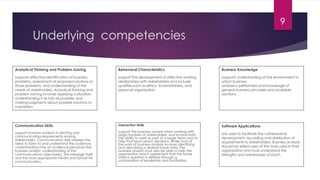
Underlying competencies
Analytical Thinking and Problem Solving
supports effective identification of business
problems, assessment of proposed solutions to
those problems, and understanding of the
needs of stakeholders. Analytical thinking and
problem solving involves assessing a situation,
understanding it as fully as possible, and
making judgments about possible solutions to
a problem.
Behavioral Characteristics
support the development of effective working
relationships with stakeholders and include
qualities such as ethics, trustworthiness, and
personal organization.
Business Knowledge
supports understanding of the environment in
which business
analysis is performed and knowledge of
general business principles and available
solutions.
Communication Skills
support business analysts in eliciting and
communicating requirements among
stakeholders. Communication skills address the
need to listen to and understand the audience,
understanding how an audience perceives the
business analyst, understanding of the
communications objective(s), the message itself,
and the most appropriate media and format for
communication.
Interaction Skills
support the business analyst when working with
large numbers of stakeholders, and involve both
the ability to work as part of a larger team and to
help that team reach decisions. While most of
the work of business analysis involves identifying
and describing a desired future state, the
business analyst must also be able to help the
organization reach agreement that the future
state in question is desired through a
combination of leadership and facilitation.
Software Applications
are used to facilitate the collaborative
development, recording and distribution of
requirements to stakeholders. Business analysts
should be skilled users of the tools used in their
organization and must understand the
strengths and weaknesses of each.
9
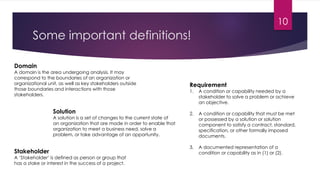
Some important definitions!
Domain
A domain is the area undergoing analysis. It may
correspond to the boundaries of an organization or
organizational unit, as well as key stakeholders outside
those boundaries and interactions with those
stakeholders.
Solution
A solution is a set of changes to the current state of
an organization that are made in order to enable that
organization to meet a business need, solve a
problem, or take advantage of an opportunity.
Requirement
1. A condition or capability needed by a
stakeholder to solve a problem or achieve
an objective.
2. A condition or capability that must be met
or possessed by a solution or solution
component to satisfy a contract, standard,
specification, or other formally imposed
documents.
3. A documented representation of a
condition or capability as in (1) or (2).Stakeholder
A ‘Stakeholder’ is defined as person or group that
has a stake or interest in the success of a project.
10
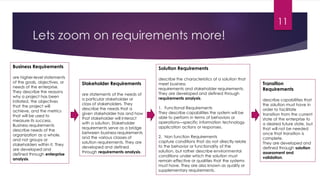
Lets zoom on requirements more!
Business Requirements
are higher-level statements
of the goals, objectives, or
needs of the enterprise.
They describe the reasons
why a project has been
initiated, the objectives
that the project will
achieve, and the metrics
that will be used to
measure its success.
Business requirements
describe needs of the
organization as a whole,
and not groups or
stakeholders within it. They
are developed and
defined through enterprise
analysis.
Stakeholder Requirements
are statements of the needs of
a particular stakeholder or
class of stakeholders. They
describe the needs that a
given stakeholder has and how
that stakeholder will interact
with a solution. Stakeholder
requirements serve as a bridge
between business requirements
and the various classes of
solution requirements. They are
developed and defined
through requirements analysis.
Solution Requirements
describe the characteristics of a solution that
meet business
requirements and stakeholder requirements.
They are developed and defined through
requirements analysis.
1. Functional Requirements
They describe capabilities the system will be
able to perform in terms of behaviors or
operations—specific information technology
application actions or responses.
2. Non function Requirements
capture conditions that do not directly relate
to the behavior or functionality of the
solution, but rather describe environmental
conditions under which the solution must
remain effective or qualities that the systems
must have. They are also known as quality or
supplementary requirements.
Transition
Requirements
describe capabilities that
the solution must have in
order to facilitate
transition from the current
state of the enterprise to
a desired future state, but
that will not be needed
once that transition is
complete.
They are developed and
defined through solution
assessment and
validation.
11
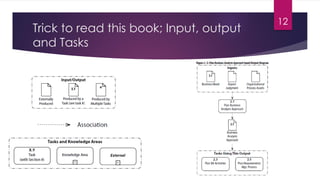
Trick to read this book; Input, output
and Tasks
12
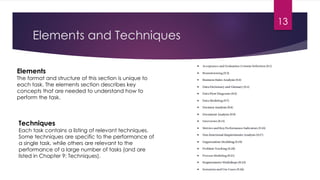
Elements and Techniques
Elements
The format and structure of this section is unique to
each task. The elements section describes key
concepts that are needed to understand how to
perform the task.
Techniques
Each task contains a listing of relevant techniques.
Some techniques are specific to the performance of
a single task, while others are relevant to the
performance of a large number of tasks (and are
listed in Chapter 9: Techniques).
13
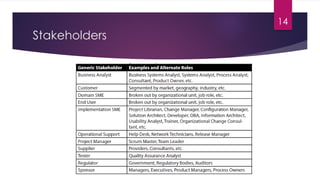
Stakeholders
14
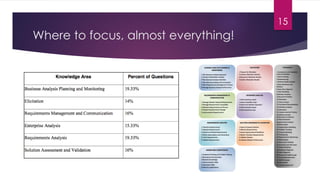
Where to focus, almost everything!
15
It’s a bumpy ride, but you have our help!
16

Cbap babok 2.0 ppt introduction

  • 1.
  • 2.
    Hello! My nameis Shardul Parulekar. I am a Business Analyst with expertise in Capital Markets, Core Banking and Risk management. Currently I am working in TATA Consultancy Services for one of the leading European Bank. I hold a Bachelor of Engineering degree from one of the premium Government Institutes in India. My core competencies are • Requirement Gathering • Process Modelling • Gap Analysis • Process Optimization • Agile – SCRUM • Estimations – Function Point I like to keep myself updated with ongoing changes in Banking as well Information and Technology. Compliances like Basel III, IFRS or SEPA instant payments as well as Business Intelligence or Hadoop are to mention a few. Risk management is one of the focused areas in banking and I find it as a new challenge to master. Apart from work, I like drawing pencil sketches, blogging, watching science fiction movies and cooking. 2
  • 3.
    Who is aBusiness Analyst? Why is he so important?  A business analyst is any person who performs business analysis activities, no matter what their job title or organizational role may be.  A Business Analyst is a person who acts as a liaison between business people who have a business problem and technology people who know how to create automated solutions. 3
  • 4.
    But, what’s exactlydoes he do?  Analyzing business needs  Gathering business requirements  Analyzing and Refining requirements  Documenting requirements  Communicating requirements  Assisting with implementation of requirements and many more Basically, he interacts with many key people (stakeholders). 4
  • 5.
    Isn’t it similarto a PM, Yes and No! Project Manager • Strong communication skills • Understanding of the SDLC • Negotiation/ consensus building • Strong interpersonal and client management skills Business Analyst • Strong communication skills • Understanding of the SDLC • Negotiation/ consensus building • Strong interpersonal and client management skills Project Manager • Ability to see the “big picture” for the project • Directs project team • Helps people (project team) get things done • Ensures the product is delivered on time, within budget Business Analyst • Detail-oriented • Listens to people (SMEs) • Helps SMEs describe how and why they perform tasks • Ensures the product is built right according to the requirements Similarities Differences 5
  • 6.
    What are therequired skills for this job? 6
  • 7.
    How does BABOKfit in here? What BABOK isn't 1. A training book 2. A compliance 3. A process (SDLC) 4. A methodology What BABOK is 1. It identifies knowledge areas accepted as best practices 2. It allows for discussions amongst professionals using common, agreed to vocabulary 3. It provides basic reference document to all practitioners 4. It identifies fundamental knowledge required of an effective BA professional 5. It provides basic reference for anyone interested in the profession of BA 7
  • 8.
    Knowledge areas Enterprise Analysis describeshow business analysts identify a business need, refine and clarify the definition of that need, and define a solution scope that can feasibly be implemented by the business. This knowledge area describes problem definition and analysis, business case development, feasibility studies, and the definition of solution scope. Business Analysis Planning and Monitoring is the knowledge area that covers how business analysts determine which activities are necessary in order to complete a business analysis effort. It covers identification of stakeholders, selection of business analysis techniques, the process that will be used to manage requirements, and how to assess the progress of the work. The tasks in this knowledge area govern the performance of all other business analysis tasks. Elicitation describes how business analysts work with stakeholders to identify and understand their needs and concerns, and understand the environment in which they work. The purpose of elicitation is to ensure that a stakeholder’s actual underlying needs are understood, rather than their stated or superficial desires. Requirements Analysis describes how business analysts prioritize and progressively elaborate stakeholder and solution requirements in order to enable the project team to implement a solution that will meet the needs of the sponsoring organization and stakeholders. It involves analyzing stakeholder needs to define solutions that meet those needs, assessing the current state of the business to identify and recommend improvements, and the verification and validation of the resulting requirements. Requirements Management and Communication describes how business analysts manage conflicts, issues and changes in order to ensure that stakeholders and the project team remain in agreement on the solution scope, how requirements are communicated to stakeholders, and how knowledge gained by the business analyst is maintained for future use. Solution Assessment and Validation describes how business analysts assess proposed solutions to determine which solution best fits the business need, identify gaps and shortcomings in solutions, and determine necessary workarounds or changes to the solution. It also describes how business analysts assess deployed solutions to see how well they met the original need so that the sponsoring organization can assess the performance and effectiveness of the solution. 8
  • 9.
    Underlying competencies Analytical Thinkingand Problem Solving supports effective identification of business problems, assessment of proposed solutions to those problems, and understanding of the needs of stakeholders. Analytical thinking and problem solving involves assessing a situation, understanding it as fully as possible, and making judgments about possible solutions to a problem. Behavioral Characteristics support the development of effective working relationships with stakeholders and include qualities such as ethics, trustworthiness, and personal organization. Business Knowledge supports understanding of the environment in which business analysis is performed and knowledge of general business principles and available solutions. Communication Skills support business analysts in eliciting and communicating requirements among stakeholders. Communication skills address the need to listen to and understand the audience, understanding how an audience perceives the business analyst, understanding of the communications objective(s), the message itself, and the most appropriate media and format for communication. Interaction Skills support the business analyst when working with large numbers of stakeholders, and involve both the ability to work as part of a larger team and to help that team reach decisions. While most of the work of business analysis involves identifying and describing a desired future state, the business analyst must also be able to help the organization reach agreement that the future state in question is desired through a combination of leadership and facilitation. Software Applications are used to facilitate the collaborative development, recording and distribution of requirements to stakeholders. Business analysts should be skilled users of the tools used in their organization and must understand the strengths and weaknesses of each. 9
  • 10.
    Some important definitions! Domain Adomain is the area undergoing analysis. It may correspond to the boundaries of an organization or organizational unit, as well as key stakeholders outside those boundaries and interactions with those stakeholders. Solution A solution is a set of changes to the current state of an organization that are made in order to enable that organization to meet a business need, solve a problem, or take advantage of an opportunity. Requirement 1. A condition or capability needed by a stakeholder to solve a problem or achieve an objective. 2. A condition or capability that must be met or possessed by a solution or solution component to satisfy a contract, standard, specification, or other formally imposed documents. 3. A documented representation of a condition or capability as in (1) or (2).Stakeholder A ‘Stakeholder’ is defined as person or group that has a stake or interest in the success of a project. 10
  • 11.
    Lets zoom onrequirements more! Business Requirements are higher-level statements of the goals, objectives, or needs of the enterprise. They describe the reasons why a project has been initiated, the objectives that the project will achieve, and the metrics that will be used to measure its success. Business requirements describe needs of the organization as a whole, and not groups or stakeholders within it. They are developed and defined through enterprise analysis. Stakeholder Requirements are statements of the needs of a particular stakeholder or class of stakeholders. They describe the needs that a given stakeholder has and how that stakeholder will interact with a solution. Stakeholder requirements serve as a bridge between business requirements and the various classes of solution requirements. They are developed and defined through requirements analysis. Solution Requirements describe the characteristics of a solution that meet business requirements and stakeholder requirements. They are developed and defined through requirements analysis. 1. Functional Requirements They describe capabilities the system will be able to perform in terms of behaviors or operations—specific information technology application actions or responses. 2. Non function Requirements capture conditions that do not directly relate to the behavior or functionality of the solution, but rather describe environmental conditions under which the solution must remain effective or qualities that the systems must have. They are also known as quality or supplementary requirements. Transition Requirements describe capabilities that the solution must have in order to facilitate transition from the current state of the enterprise to a desired future state, but that will not be needed once that transition is complete. They are developed and defined through solution assessment and validation. 11
  • 12.
    Trick to readthis book; Input, output and Tasks 12
  • 13.
    Elements and Techniques Elements Theformat and structure of this section is unique to each task. The elements section describes key concepts that are needed to understand how to perform the task. Techniques Each task contains a listing of relevant techniques. Some techniques are specific to the performance of a single task, while others are relevant to the performance of a large number of tasks (and are listed in Chapter 9: Techniques). 13
  • 14.
  • 15.
    Where to focus,almost everything! 15
  • 16.
    It’s a bumpyride, but you have our help! 16