HOW TO BUILD A
BUSINESS CASE
Annalisa Caponera
Photo:“Spirale”byMiaFelicitaBertelli
Summary
1. Definition and purpose
2. The journey to develop a
Business case
3. The Canadian Template
Flickr: “Iron Crystal” by Michael Dales,
Part 1
Definition
and
Purpose
Flickr: “Pen and Ink” by Heather,
A Business Case is...
“An assessment of the costs
and benefits associated with
a proposed initiative”
The Business Analysis Body of Knowledge®
Flickr:“Dictionary”bysAeroZar,
Purpose
Justify the project in terms of the value added to
the business:
[1] The Business Analysis Body of Knowledge®
1. as a result of the deployed
solution
2. as compared to the cost
to develop and operate
the solution[1]
Flickr:“Money!“byHansSplinter
Purpose also may[1]
 Include
 qualitative and quantitative benefits
 estimates of cost and time
 Present
 expected cash flow consequences
of the action over time
 the used methods for quantifying
benefits and costs.
[1] The Business Analysis Body of Knowledge®
Flickr: “Dictionary: time“ by Cat
It must be...
1. clear
2. accurate
3. realistic
4. credible
5. objective
6. tailored on the investor
goals
Photo by Flickr
And also it has to...
1. Respect the requirements
2. Quantify the value of
investment in term of cost
and benefits
3. Target the right goals
Photo by Flickr
Part 2
The journey to
develop a
Business Case
Flickr: “Pen and Ink” by Heather,
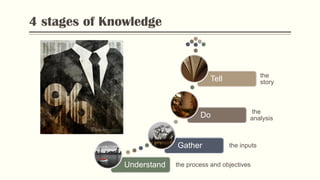
4 stages of Knowledge
Understand the process and objectives
Gather the inputs
Do the
analysis
Tell the
story
Photo by Flickr
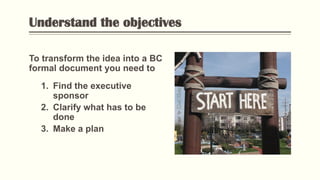
Understand the objectives
To transform the idea into a BC
formal document you need to
1. Find the executive
sponsor
2. Clarify what has to be
done
3. Make a plan
Flickr:“”Golflandstart”byToddDailey
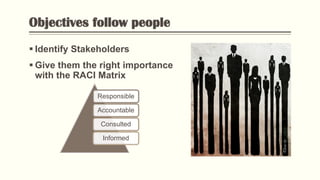
Objectives follow people
 Identify Stakeholders
 Give them the right importance
with the RACI Matrix
Responsible
Accountable
Consulted
Informed
PhotobyFlickr
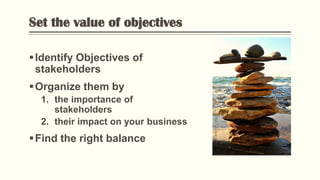
Set the value of objectives
Identify Objectives of
stakeholders
Organize them by
1. the importance of
stakeholders
2. their impact on your business
Find the right balance
PhotobyFlickr
Gather the inputs
Collect what you know
Assume what you can’t
collect
Keep it:
 realistic
 credible
 objective
PhotobyFlickr
Involve People
 Stakeholders helps to
 gather data and
 validate assumptions
 Data and assumptions
come
 from experts across the
company or
 independent research
Do the analysis
1. Study the gathered
inputs to build a detailed
model of
1. your product
2. your development project
2. Model various scenarios
3. Calculate the project
value in term of
1. costs, income, profits and
payback
PhotobyFlickr
And finally... Tell the story
Keep it:
1. Clear
2. Objective
3. Believable
4. Tailored on
preferences and
targets of people who
judge it
Photo by Flickr
Part 3
The Canadian
Method
Flickr: “Pen and Ink” by Heather,
What is it?
A method written by the Treasury
Board of Canada
“to support the development of a
strong business case that links
investments with program results
and, ultimately, with the strategic
outcomes of the organization”
PhotobyFlickr
Main characteristics
1. Completeness
2. Simplicity
3. Financial focus
4. Standard template
world-wide recognized
Photo by Flickr
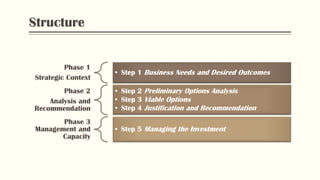
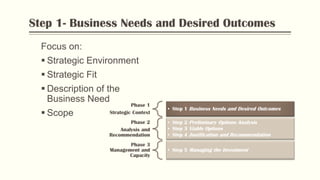
Structure
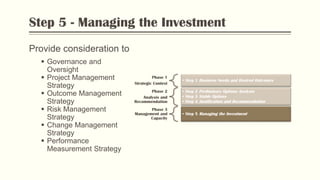
Phase 1
Strategic Context
• Step 1 Business Needs and Desired Outcomes
Phase 2
Analysis and
Recommendation
• Step 2 Preliminary Options Analysis
• Step 3 Viable Options
• Step 4 Justification and Recommendation
Phase 3
Management and
Capacity
• Step 5 Managing the Investment
Phase 1: Strategic Context
Establish the case for
change
Clearly define the need for
the investment
PhotobyFlickr
Step 1- Business Needs and Desired Outcomes
Focus on:
 Strategic Environment
 Strategic Fit
 Description of the
Business Need
 Scope
Phase 1
Strategic Context
• Step 1 Business Needs and Desired Outcomes
Phase 2
Analysis and
Recommendation
• Step 2 Preliminary Options Analysis
• Step 3 Viable Options
• Step 4 Justification and Recommendation
Phase 3
Management and
Capacity
• Step 5 Managing the Investment
Phase 2: Analysis and Recommendation
It’s the heart of the business case
Provide answers to the following key
questions :
1. How will we get there?
a) viable options
b) associated costs and benefits
2. What is the best option?
a) financial appraisal to ascertain
funding
b) affordability
c) cost balancing in relation to
benefits and risks.
PhotobyFlickr
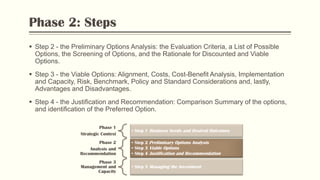
Phase 2: Steps
 Step 2 - the Preliminary Options Analysis: the Evaluation Criteria, a List of Possible
Options, the Screening of Options, and the Rationale for Discounted and Viable
Options.
 Step 3 - the Viable Options: Alignment, Costs, Cost-Benefit Analysis, Implementation
and Capacity, Risk, Benchmark, Policy and Standard Considerations and, lastly,
Advantages and Disadvantages.
 Step 4 - the Justification and Recommendation: Comparison Summary of the options,
and identification of the Preferred Option.
Phase 1
Strategic Context
• Step 1 Business Needs and Desired Outcomes
Phase 2
Analysis and
Recommendation
• Step 2 Preliminary Options Analysis
• Step 3 Viable Options
• Step 4 Justification and Recommendation
Phase 3
Management and
Capacity
• Step 5 Managing the Investment
Phase 3: Management and Capacity
Demonstrate the investment will be
managed effectively:
1. Assuring that all the appropriate
project and outcome management
strategies are in place
2. Showing how those strategies will be
used to guide the project through a
controlled environment to achieve
the desired business outcomes.
Photo by Flickr
Step 5 - Managing the Investment
Provide consideration to
 Governance and
Oversight
 Project Management
Strategy
 Outcome Management
Strategy
 Risk Management
Strategy
 Change Management
Strategy
 Performance
Measurement Strategy
Phase 1
Strategic Context
• Step 1 Business Needs and Desired Outcomes
Phase 2
Analysis and
Recommendation
• Step 2 Preliminary Options Analysis
• Step 3 Viable Options
• Step 4 Justification and Recommendation
Phase 3
Management and
Capacity
• Step 5 Managing the Investment
Photo by Flickr Contact me on

Business case a_caponera

  • 1.
    HOW TO BUILDA BUSINESS CASE Annalisa Caponera Photo:“Spirale”byMiaFelicitaBertelli
  • 2.
    Summary 1. Definition andpurpose 2. The journey to develop a Business case 3. The Canadian Template Flickr: “Iron Crystal” by Michael Dales,
  • 3.
  • 4.
    A Business Caseis... “An assessment of the costs and benefits associated with a proposed initiative” The Business Analysis Body of Knowledge® Flickr:“Dictionary”bysAeroZar,
  • 5.
    Purpose Justify the projectin terms of the value added to the business: [1] The Business Analysis Body of Knowledge® 1. as a result of the deployed solution 2. as compared to the cost to develop and operate the solution[1] Flickr:“Money!“byHansSplinter
  • 6.
    Purpose also may[1] Include  qualitative and quantitative benefits  estimates of cost and time  Present  expected cash flow consequences of the action over time  the used methods for quantifying benefits and costs. [1] The Business Analysis Body of Knowledge® Flickr: “Dictionary: time“ by Cat
  • 7.
    It must be... 1.clear 2. accurate 3. realistic 4. credible 5. objective 6. tailored on the investor goals Photo by Flickr
  • 8.
    And also ithas to... 1. Respect the requirements 2. Quantify the value of investment in term of cost and benefits 3. Target the right goals Photo by Flickr
  • 9.
    Part 2 The journeyto develop a Business Case Flickr: “Pen and Ink” by Heather,
  • 10.
    4 stages ofKnowledge Understand the process and objectives Gather the inputs Do the analysis Tell the story Photo by Flickr
  • 11.
    Understand the objectives Totransform the idea into a BC formal document you need to 1. Find the executive sponsor 2. Clarify what has to be done 3. Make a plan Flickr:“”Golflandstart”byToddDailey
  • 12.
    Objectives follow people Identify Stakeholders  Give them the right importance with the RACI Matrix Responsible Accountable Consulted Informed PhotobyFlickr
  • 13.
    Set the valueof objectives Identify Objectives of stakeholders Organize them by 1. the importance of stakeholders 2. their impact on your business Find the right balance PhotobyFlickr
  • 14.
    Gather the inputs Collectwhat you know Assume what you can’t collect Keep it:  realistic  credible  objective PhotobyFlickr
  • 15.
    Involve People  Stakeholdershelps to  gather data and  validate assumptions  Data and assumptions come  from experts across the company or  independent research
  • 16.
    Do the analysis 1.Study the gathered inputs to build a detailed model of 1. your product 2. your development project 2. Model various scenarios 3. Calculate the project value in term of 1. costs, income, profits and payback PhotobyFlickr
  • 17.
    And finally... Tellthe story Keep it: 1. Clear 2. Objective 3. Believable 4. Tailored on preferences and targets of people who judge it Photo by Flickr
  • 18.
    Part 3 The Canadian Method Flickr:“Pen and Ink” by Heather,
  • 19.
    What is it? Amethod written by the Treasury Board of Canada “to support the development of a strong business case that links investments with program results and, ultimately, with the strategic outcomes of the organization” PhotobyFlickr
  • 20.
    Main characteristics 1. Completeness 2.Simplicity 3. Financial focus 4. Standard template world-wide recognized Photo by Flickr
  • 21.
    Structure Phase 1 Strategic Context •Step 1 Business Needs and Desired Outcomes Phase 2 Analysis and Recommendation • Step 2 Preliminary Options Analysis • Step 3 Viable Options • Step 4 Justification and Recommendation Phase 3 Management and Capacity • Step 5 Managing the Investment
  • 22.
    Phase 1: StrategicContext Establish the case for change Clearly define the need for the investment PhotobyFlickr
  • 23.
    Step 1- BusinessNeeds and Desired Outcomes Focus on:  Strategic Environment  Strategic Fit  Description of the Business Need  Scope Phase 1 Strategic Context • Step 1 Business Needs and Desired Outcomes Phase 2 Analysis and Recommendation • Step 2 Preliminary Options Analysis • Step 3 Viable Options • Step 4 Justification and Recommendation Phase 3 Management and Capacity • Step 5 Managing the Investment
  • 24.
    Phase 2: Analysisand Recommendation It’s the heart of the business case Provide answers to the following key questions : 1. How will we get there? a) viable options b) associated costs and benefits 2. What is the best option? a) financial appraisal to ascertain funding b) affordability c) cost balancing in relation to benefits and risks. PhotobyFlickr
  • 25.
    Phase 2: Steps Step 2 - the Preliminary Options Analysis: the Evaluation Criteria, a List of Possible Options, the Screening of Options, and the Rationale for Discounted and Viable Options.  Step 3 - the Viable Options: Alignment, Costs, Cost-Benefit Analysis, Implementation and Capacity, Risk, Benchmark, Policy and Standard Considerations and, lastly, Advantages and Disadvantages.  Step 4 - the Justification and Recommendation: Comparison Summary of the options, and identification of the Preferred Option. Phase 1 Strategic Context • Step 1 Business Needs and Desired Outcomes Phase 2 Analysis and Recommendation • Step 2 Preliminary Options Analysis • Step 3 Viable Options • Step 4 Justification and Recommendation Phase 3 Management and Capacity • Step 5 Managing the Investment
  • 26.
    Phase 3: Managementand Capacity Demonstrate the investment will be managed effectively: 1. Assuring that all the appropriate project and outcome management strategies are in place 2. Showing how those strategies will be used to guide the project through a controlled environment to achieve the desired business outcomes. Photo by Flickr
  • 27.
    Step 5 -Managing the Investment Provide consideration to  Governance and Oversight  Project Management Strategy  Outcome Management Strategy  Risk Management Strategy  Change Management Strategy  Performance Measurement Strategy Phase 1 Strategic Context • Step 1 Business Needs and Desired Outcomes Phase 2 Analysis and Recommendation • Step 2 Preliminary Options Analysis • Step 3 Viable Options • Step 4 Justification and Recommendation Phase 3 Management and Capacity • Step 5 Managing the Investment
  • 28.
    Photo by FlickrContact me on