
Business Analysis
需求導出與協同合作
Moris, CBAP, PMP, PMI-PBA
2015.05.21
商業分析知識體系 (IIBA BABOK v3)
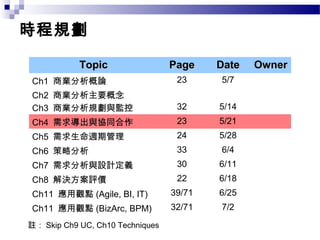
時程規劃
TopicTopic PagePage DateDate OwnerOwner
Ch1 商業分析概論
Ch2 商業分析主要概念
23 5/7
Ch3 商業分析規劃與監控 32 5/14
Ch4 需求導出與協同合作 23 5/21
Ch5 需求生命週期管理 24 5/28
Ch6 策略分析 33 6/4
Ch7 需求分析與設計定義 30 6/11
Ch8 解決方案評價 22 6/18
Ch11 應用觀點 (Agile, BI, IT) 39/71 6/25
Ch11 應用觀點 (BizArc, BPM) 32/71 7/2
註: Skip Ch9 UC, Ch10 Techniques
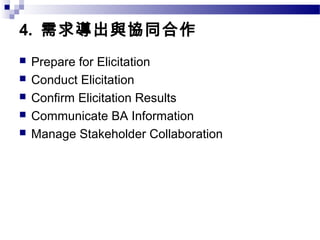
4. 需求導出與協同合作
 Prepare for Elicitation
 Conduct Elicitation
 Confirm Elicitation Results
 Communicate BA Information
 Manage Stakeholder Collaboration
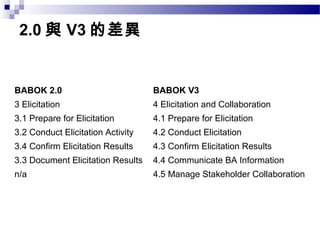
2.0 與 V3 的差異
BABOK 2.0 BABOK V3
3 Elicitation 4 Elicitation and Collaboration
3.1 Prepare for Elicitation 4.1 Prepare for Elicitation
3.2 Conduct Elicitation Activity 4.2 Conduct Elicitation
3.4 Confirm Elicitation Results 4.3 Confirm Elicitation Results
3.3 Document Elicitation Results 4.4 Communicate BA Information
n/a 4.5 Manage Stakeholder Collaboration
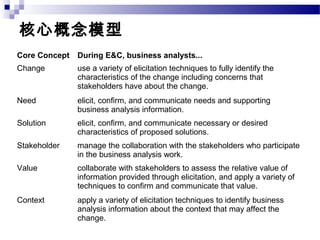
核心概念模型
Core Concept During E&C, business analysts...
Change use a variety of elicitation techniques to fully identify the
characteristics of the change including concerns that
stakeholders have about the change.
Need elicit, confirm, and communicate needs and supporting
business analysis information.
Solution elicit, confirm, and communicate necessary or desired
characteristics of proposed solutions.
Stakeholder manage the collaboration with the stakeholders who participate
in the business analysis work.
Value collaborate with stakeholders to assess the relative value of
information provided through elicitation, and apply a variety of
techniques to confirm and communicate that value.
Context apply a variety of elicitation techniques to identify business
analysis information about the context that may affect the
change.
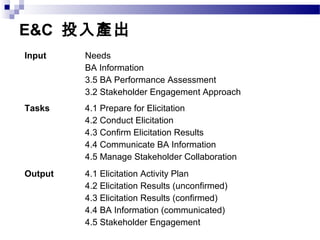
E&C 投入產出
Input Needs
BA Information
3.5 BA Performance Assessment
3.2 Stakeholder Engagement Approach
Tasks 4.1 Prepare for Elicitation
4.2 Conduct Elicitation
4.3 Confirm Elicitation Results
4.4 Communicate BA Information
4.5 Manage Stakeholder Collaboration
Output 4.1 Elicitation Activity Plan
4.2 Elicitation Results (unconfirmed)
4.3 Elicitation Results (confirmed)
4.4 BA Information (communicated)
4.5 Stakeholder Engagement
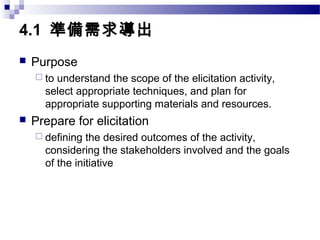
4.1 準備需求導出
 Purpose
 to understand the scope of the elicitation activity,
select appropriate techniques, and plan for
appropriate supporting materials and resources.
 Prepare for elicitation
 defining the desired outcomes of the activity,
considering the stakeholders involved and the goals
of the initiative
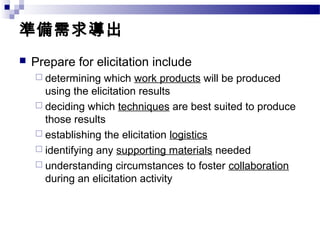
準備需求導出
 Prepare for elicitation include
 determining which work products will be produced
using the elicitation results
 deciding which techniques are best suited to produce
those results
 establishing the elicitation logistics
 identifying any supporting materials needed
 understanding circumstances to foster collaboration
during an elicitation activity
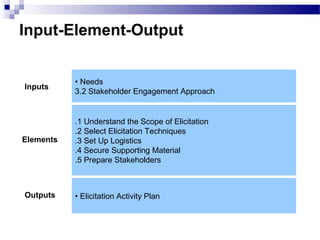
Input-Element-Output
• Needs
3.2 Stakeholder Engagement Approach
.1 Understand the Scope of Elicitation
.2 Select Elicitation Techniques
.3 Set Up Logistics
.4 Secure Supporting Material
.5 Prepare Stakeholders
• Elicitation Activity Plan
Inputs
Elements
Outputs
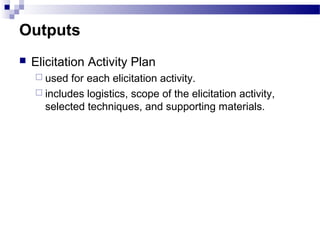
Outputs
 Elicitation Activity Plan
 used for each elicitation activity.
 includes logistics, scope of the elicitation activity,
selected techniques, and supporting materials.
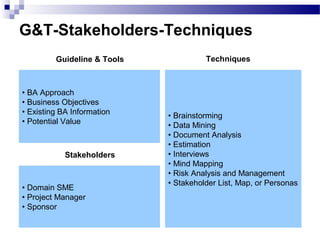
G&T-Stakeholders-Techniques
• BA Approach
• Business Objectives
• Existing BA Information
• Potential Value
• Brainstorming
• Data Mining
• Document Analysis
• Estimation
• Interviews
• Mind Mapping
• Risk Analysis and Management
• Stakeholder List, Map, or Personas
• Domain SME
• Project Manager
• Sponsor
Guideline & Tools
Stakeholders
Techniques
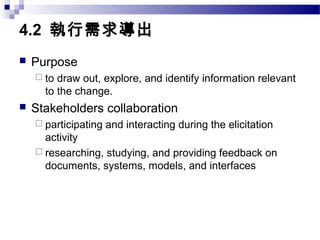
4.2 執行需求導出
 Purpose
 to draw out, explore, and identify information relevant
to the change.
 Stakeholders collaboration
 participating and interacting during the elicitation
activity
 researching, studying, and providing feedback on
documents, systems, models, and interfaces
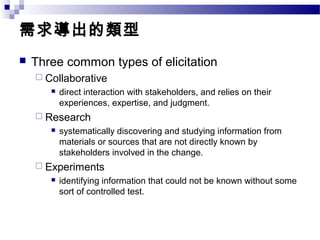
需求導出的類型
 Three common types of elicitation
 Collaborative
 direct interaction with stakeholders, and relies on their
experiences, expertise, and judgment.
 Research
 systematically discovering and studying information from
materials or sources that are not directly known by
stakeholders involved in the change.
 Experiments
 identifying information that could not be known without some
sort of controlled test.
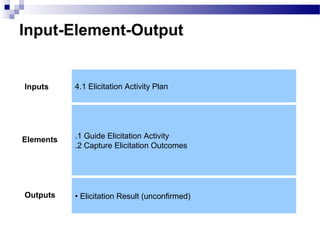
Input-Element-Output
4.1 Elicitation Activity Plan
.1 Guide Elicitation Activity
.2 Capture Elicitation Outcomes
• Elicitation Result (unconfirmed)
Inputs
Elements
Outputs
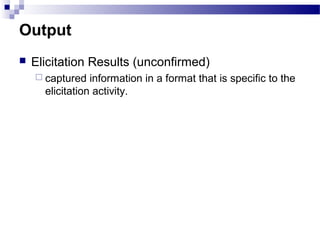
Output
 Elicitation Results (unconfirmed)
 captured information in a format that is specific to the
elicitation activity.
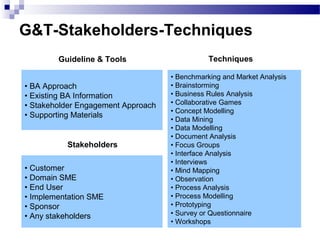
G&T-Stakeholders-Techniques
• BA Approach
• Existing BA Information
• Stakeholder Engagement Approach
• Supporting Materials
• Benchmarking and Market Analysis
• Brainstorming
• Business Rules Analysis
• Collaborative Games
• Concept Modelling
• Data Mining
• Data Modelling
• Document Analysis
• Focus Groups
• Interface Analysis
• Interviews
• Mind Mapping
• Observation
• Process Analysis
• Process Modelling
• Prototyping
• Survey or Questionnaire
• Workshops
• Customer
• Domain SME
• End User
• Implementation SME
• Sponsor
• Any stakeholders
Guideline & Tools
Stakeholders
Techniques
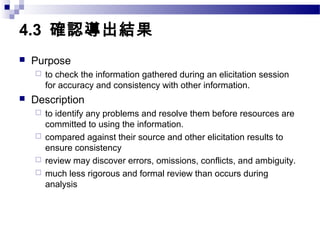
4.3 確認導出結果
 Purpose
 to check the information gathered during an elicitation session
for accuracy and consistency with other information.
 Description
 to identify any problems and resolve them before resources are
committed to using the information.
 compared against their source and other elicitation results to
ensure consistency
 review may discover errors, omissions, conflicts, and ambiguity.
 much less rigorous and formal review than occurs during
analysis
Input-Element-Output
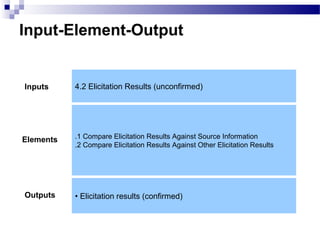
4.2 Elicitation Results (unconfirmed)
.1 Compare Elicitation Results Against Source Information
.2 Compare Elicitation Results Against Other Elicitation Results
• Elicitation results (confirmed)
Inputs
Elements
Outputs
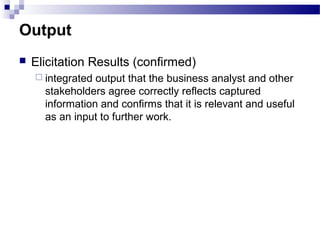
Output
 Elicitation Results (confirmed)
 integrated output that the business analyst and other
stakeholders agree correctly reflects captured
information and confirms that it is relevant and useful
as an input to further work.
G&T-Stakeholders-Techniques
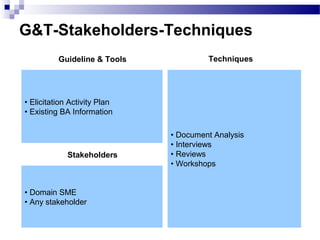
• Elicitation Activity Plan
• Existing BA Information
• Document Analysis
• Interviews
• Reviews
• Workshops
• Domain SME
• Any stakeholder
Guideline & Tools
Stakeholders
Techniques
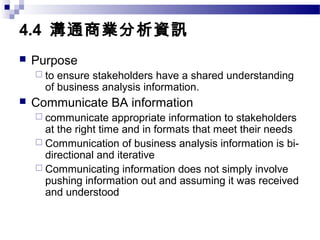
4.4 溝通商業分析資訊
 Purpose
 to ensure stakeholders have a shared understanding
of business analysis information.
 Communicate BA information
 communicate appropriate information to stakeholders
at the right time and in formats that meet their needs
 Communication of business analysis information is bi-
directional and iterative
 Communicating information does not simply involve
pushing information out and assuming it was received
and understood
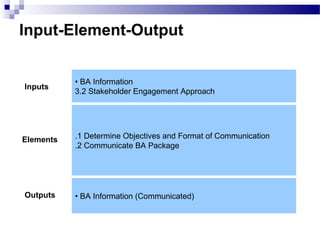
Input-Element-Output
• BA Information
3.2 Stakeholder Engagement Approach
.1 Determine Objectives and Format of Communication
.2 Communicate BA Package
• BA Information (Communicated)
Inputs
Elements
Outputs
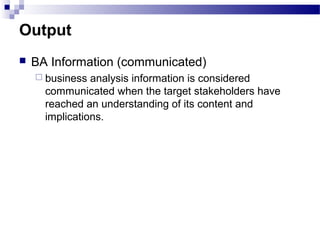
Output
 BA Information (communicated)
 business analysis information is considered
communicated when the target stakeholders have
reached an understanding of its content and
implications.
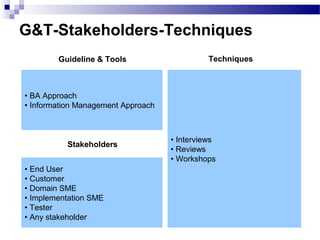
G&T-Stakeholders-Techniques
• BA Approach
• Information Management Approach
• Interviews
• Reviews
• Workshops
• End User
• Customer
• Domain SME
• Implementation SME
• Tester
• Any stakeholder
Guideline & Tools
Stakeholders
Techniques
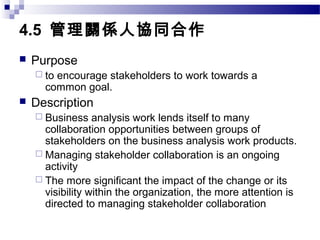
4.5 管理關係人協同合作
 Purpose
 to encourage stakeholders to work towards a
common goal.
 Description
 Business analysis work lends itself to many
collaboration opportunities between groups of
stakeholders on the business analysis work products.
 Managing stakeholder collaboration is an ongoing
activity
 The more significant the impact of the change or its
visibility within the organization, the more attention is
directed to managing stakeholder collaboration
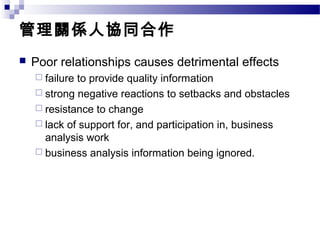
管理關係人協同合作
 Poor relationships causes detrimental effects
 failure to provide quality information
 strong negative reactions to setbacks and obstacles
 resistance to change
 lack of support for, and participation in, business
analysis work
 business analysis information being ignored.
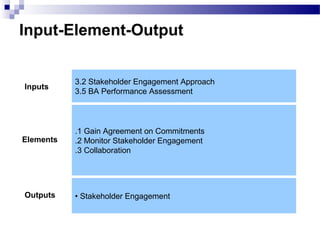
Input-Element-Output
3.2 Stakeholder Engagement Approach
3.5 BA Performance Assessment
.1 Gain Agreement on Commitments
.2 Monitor Stakeholder Engagement
.3 Collaboration
• Stakeholder Engagement
Inputs
Elements
Outputs
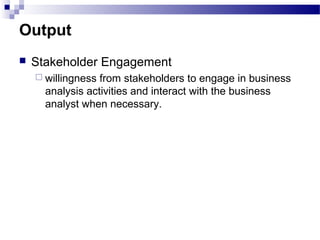
Output
 Stakeholder Engagement
 willingness from stakeholders to engage in business
analysis activities and interact with the business
analyst when necessary.
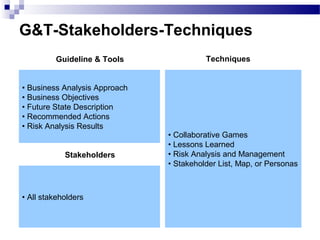
G&T-Stakeholders-Techniques
• Business Analysis Approach
• Business Objectives
• Future State Description
• Recommended Actions
• Risk Analysis Results
• Collaborative Games
• Lessons Learned
• Risk Analysis and Management
• Stakeholder List, Map, or Personas
• All stakeholders
Guideline & Tools
Stakeholders
Techniques
感謝您的參與
Spyglass Rooftop Bar - Manhattan Sideways

BABOK v3 讀書會 CH4 20150521

  • 1.
    Business Analysis 需求導出與協同合作 Moris, CBAP,PMP, PMI-PBA 2015.05.21 商業分析知識體系 (IIBA BABOK v3)
  • 2.
    時程規劃 TopicTopic PagePage DateDateOwnerOwner Ch1 商業分析概論 Ch2 商業分析主要概念 23 5/7 Ch3 商業分析規劃與監控 32 5/14 Ch4 需求導出與協同合作 23 5/21 Ch5 需求生命週期管理 24 5/28 Ch6 策略分析 33 6/4 Ch7 需求分析與設計定義 30 6/11 Ch8 解決方案評價 22 6/18 Ch11 應用觀點 (Agile, BI, IT) 39/71 6/25 Ch11 應用觀點 (BizArc, BPM) 32/71 7/2 註: Skip Ch9 UC, Ch10 Techniques
  • 3.
    4. 需求導出與協同合作  Preparefor Elicitation  Conduct Elicitation  Confirm Elicitation Results  Communicate BA Information  Manage Stakeholder Collaboration
  • 4.
    2.0 與 V3的差異 BABOK 2.0 BABOK V3 3 Elicitation 4 Elicitation and Collaboration 3.1 Prepare for Elicitation 4.1 Prepare for Elicitation 3.2 Conduct Elicitation Activity 4.2 Conduct Elicitation 3.4 Confirm Elicitation Results 4.3 Confirm Elicitation Results 3.3 Document Elicitation Results 4.4 Communicate BA Information n/a 4.5 Manage Stakeholder Collaboration
  • 5.
    核心概念模型 Core Concept DuringE&C, business analysts... Change use a variety of elicitation techniques to fully identify the characteristics of the change including concerns that stakeholders have about the change. Need elicit, confirm, and communicate needs and supporting business analysis information. Solution elicit, confirm, and communicate necessary or desired characteristics of proposed solutions. Stakeholder manage the collaboration with the stakeholders who participate in the business analysis work. Value collaborate with stakeholders to assess the relative value of information provided through elicitation, and apply a variety of techniques to confirm and communicate that value. Context apply a variety of elicitation techniques to identify business analysis information about the context that may affect the change.
  • 6.
    E&C 投入產出 Input Needs BAInformation 3.5 BA Performance Assessment 3.2 Stakeholder Engagement Approach Tasks 4.1 Prepare for Elicitation 4.2 Conduct Elicitation 4.3 Confirm Elicitation Results 4.4 Communicate BA Information 4.5 Manage Stakeholder Collaboration Output 4.1 Elicitation Activity Plan 4.2 Elicitation Results (unconfirmed) 4.3 Elicitation Results (confirmed) 4.4 BA Information (communicated) 4.5 Stakeholder Engagement
  • 7.
    4.1 準備需求導出  Purpose to understand the scope of the elicitation activity, select appropriate techniques, and plan for appropriate supporting materials and resources.  Prepare for elicitation  defining the desired outcomes of the activity, considering the stakeholders involved and the goals of the initiative
  • 8.
    準備需求導出  Prepare forelicitation include  determining which work products will be produced using the elicitation results  deciding which techniques are best suited to produce those results  establishing the elicitation logistics  identifying any supporting materials needed  understanding circumstances to foster collaboration during an elicitation activity
  • 9.
    Input-Element-Output • Needs 3.2 StakeholderEngagement Approach .1 Understand the Scope of Elicitation .2 Select Elicitation Techniques .3 Set Up Logistics .4 Secure Supporting Material .5 Prepare Stakeholders • Elicitation Activity Plan Inputs Elements Outputs
  • 10.
    Outputs  Elicitation ActivityPlan  used for each elicitation activity.  includes logistics, scope of the elicitation activity, selected techniques, and supporting materials.
  • 11.
    G&T-Stakeholders-Techniques • BA Approach •Business Objectives • Existing BA Information • Potential Value • Brainstorming • Data Mining • Document Analysis • Estimation • Interviews • Mind Mapping • Risk Analysis and Management • Stakeholder List, Map, or Personas • Domain SME • Project Manager • Sponsor Guideline & Tools Stakeholders Techniques
  • 12.
    4.2 執行需求導出  Purpose to draw out, explore, and identify information relevant to the change.  Stakeholders collaboration  participating and interacting during the elicitation activity  researching, studying, and providing feedback on documents, systems, models, and interfaces
  • 13.
    需求導出的類型  Three commontypes of elicitation  Collaborative  direct interaction with stakeholders, and relies on their experiences, expertise, and judgment.  Research  systematically discovering and studying information from materials or sources that are not directly known by stakeholders involved in the change.  Experiments  identifying information that could not be known without some sort of controlled test.
  • 14.
    Input-Element-Output 4.1 Elicitation ActivityPlan .1 Guide Elicitation Activity .2 Capture Elicitation Outcomes • Elicitation Result (unconfirmed) Inputs Elements Outputs
  • 15.
    Output  Elicitation Results(unconfirmed)  captured information in a format that is specific to the elicitation activity.
  • 16.
    G&T-Stakeholders-Techniques • BA Approach •Existing BA Information • Stakeholder Engagement Approach • Supporting Materials • Benchmarking and Market Analysis • Brainstorming • Business Rules Analysis • Collaborative Games • Concept Modelling • Data Mining • Data Modelling • Document Analysis • Focus Groups • Interface Analysis • Interviews • Mind Mapping • Observation • Process Analysis • Process Modelling • Prototyping • Survey or Questionnaire • Workshops • Customer • Domain SME • End User • Implementation SME • Sponsor • Any stakeholders Guideline & Tools Stakeholders Techniques
  • 17.
    4.3 確認導出結果  Purpose to check the information gathered during an elicitation session for accuracy and consistency with other information.  Description  to identify any problems and resolve them before resources are committed to using the information.  compared against their source and other elicitation results to ensure consistency  review may discover errors, omissions, conflicts, and ambiguity.  much less rigorous and formal review than occurs during analysis
  • 18.
    Input-Element-Output 4.2 Elicitation Results(unconfirmed) .1 Compare Elicitation Results Against Source Information .2 Compare Elicitation Results Against Other Elicitation Results • Elicitation results (confirmed) Inputs Elements Outputs
  • 19.
    Output  Elicitation Results(confirmed)  integrated output that the business analyst and other stakeholders agree correctly reflects captured information and confirms that it is relevant and useful as an input to further work.
  • 20.
    G&T-Stakeholders-Techniques • Elicitation ActivityPlan • Existing BA Information • Document Analysis • Interviews • Reviews • Workshops • Domain SME • Any stakeholder Guideline & Tools Stakeholders Techniques
  • 21.
    4.4 溝通商業分析資訊  Purpose to ensure stakeholders have a shared understanding of business analysis information.  Communicate BA information  communicate appropriate information to stakeholders at the right time and in formats that meet their needs  Communication of business analysis information is bi- directional and iterative  Communicating information does not simply involve pushing information out and assuming it was received and understood
  • 22.
    Input-Element-Output • BA Information 3.2Stakeholder Engagement Approach .1 Determine Objectives and Format of Communication .2 Communicate BA Package • BA Information (Communicated) Inputs Elements Outputs
  • 23.
    Output  BA Information(communicated)  business analysis information is considered communicated when the target stakeholders have reached an understanding of its content and implications.
  • 24.
    G&T-Stakeholders-Techniques • BA Approach •Information Management Approach • Interviews • Reviews • Workshops • End User • Customer • Domain SME • Implementation SME • Tester • Any stakeholder Guideline & Tools Stakeholders Techniques
  • 25.
    4.5 管理關係人協同合作  Purpose to encourage stakeholders to work towards a common goal.  Description  Business analysis work lends itself to many collaboration opportunities between groups of stakeholders on the business analysis work products.  Managing stakeholder collaboration is an ongoing activity  The more significant the impact of the change or its visibility within the organization, the more attention is directed to managing stakeholder collaboration
  • 26.
    管理關係人協同合作  Poor relationshipscauses detrimental effects  failure to provide quality information  strong negative reactions to setbacks and obstacles  resistance to change  lack of support for, and participation in, business analysis work  business analysis information being ignored.
  • 27.
    Input-Element-Output 3.2 Stakeholder EngagementApproach 3.5 BA Performance Assessment .1 Gain Agreement on Commitments .2 Monitor Stakeholder Engagement .3 Collaboration • Stakeholder Engagement Inputs Elements Outputs
  • 28.
    Output  Stakeholder Engagement willingness from stakeholders to engage in business analysis activities and interact with the business analyst when necessary.
  • 29.
    G&T-Stakeholders-Techniques • Business AnalysisApproach • Business Objectives • Future State Description • Recommended Actions • Risk Analysis Results • Collaborative Games • Lessons Learned • Risk Analysis and Management • Stakeholder List, Map, or Personas • All stakeholders Guideline & Tools Stakeholders Techniques
  • 30.

Editor's Notes

  • #5 1.發生在非正式的對話, 沒有事先計畫的導出, 也都是被承認的 2.商業分析資訊應該可以貫通整個過程被使用, 而非只有需求可以這樣
  • #6 變更 使用多樣的導出技術來識別變更的特質, 包含要了解關係人對變更的考量. 變更本身會決定導出和合作的類型和程度. 需要 導出, 確認, 和溝通需要, 與支援性的商業分析資訊 方案 關係人 價值 背景
  • #8 定義適當方法來執行商業分析活動 執行商業分析工作要遵循的方法, 工作如何和何時執行, 交付物如何產生. 可能透過方法論或組織標準來定義. 如果沒有組織標準, 就和適合的關係人一起決定該怎嚜做.
  • #9 校準變更的整體目標 協調工作和交付物 管理風險的工作, 對可能降低品質或阻礙效率 利用方法, 和選擇過去效果不錯的技術和工具
  • #11 包含關係人清單, 他們的特徵, 以及角色和職責. 識別協同合作和溝通方法
  • #22 P: 確保關係人對商業分析資訊有共同的了解