Presenter: Joe Newbert
Title: Beyond Stakeholder Analysis And Management
Date: Wednesday, 8 November 2017
PMI Business Analysis Virtual Conference 2017
@newbert
/newbert
Beyond Stakeholder Analysis & Management
Tactics for building
relationships that satisfy
your stakeholder,
organization and self
Activities for
performing practical
stakeholder analysis
and management
Context for business
analysis, project delivery
and change management
Project Success
Business analysis must be
strategically managed,
focused on achieving
business result.
Synchronise through a
holistic framework
where strategy and
tactics intertwine.
Project delivery must be
tactically managed,
focused on implementing
operational capability.
Stakeholder
Quality
Stakeholder
Quality
Scope
Budget Schedule
Benefits
Change
Activities
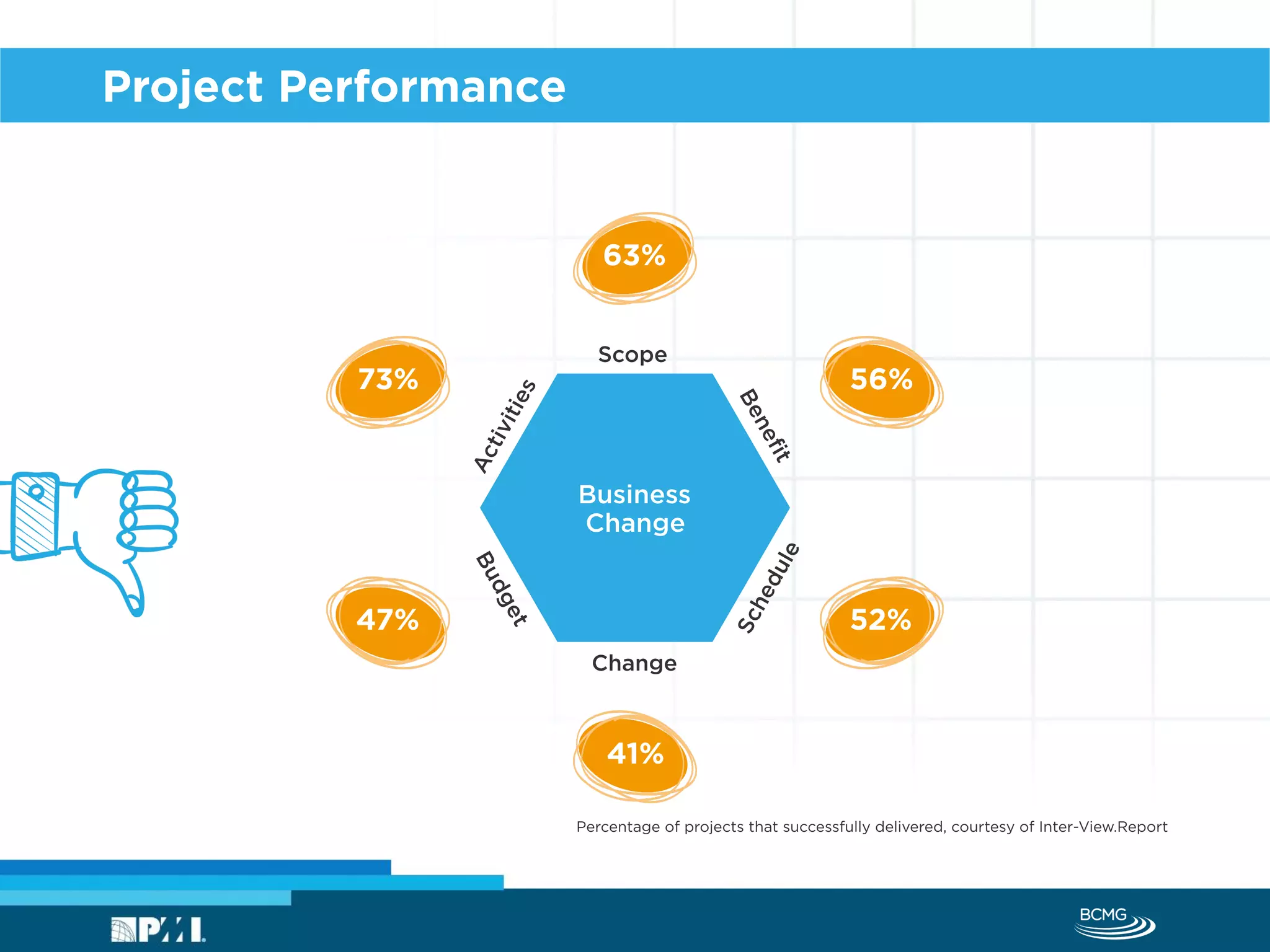
Project Performance
Business
Change
63%
56%73%
47%
Percentage of projects that successfully delivered, courtesy of Inter-View.Report
Scope
Budget
Schedule
Benefit
Change
Activities
52%
41%
Project Challenges
Only 47% of business analysts and projects
managers FEEL they are responsible for
stakeholder analysis & management
5 top reasons why projects fail, courtesy of Inter-View.Report
Stakeholder
engagement LIVES at
heart of project
success
Dysfunctional business and IT relationships
Lack of business involvement
Missed and misunderstood requirements
Poor stakeholder management
Lack of executive leadership
1
2
3
4
5
7. Know Where To Improve
Do remarkable things by continually
striving to improve the value that you
serve to your stakeholders.
• Establish baseline:
– Delivery plan
– Company standards
– Performance metrics
What should
We keep
doing?
What should
we stop
doing?
What should
we start
doing?
• Draw perspective:
– Self-review
– Stakeholder feedback
– Group consensus
• Understand situation:
– Performance results
– Working practices
– Achievable expectations
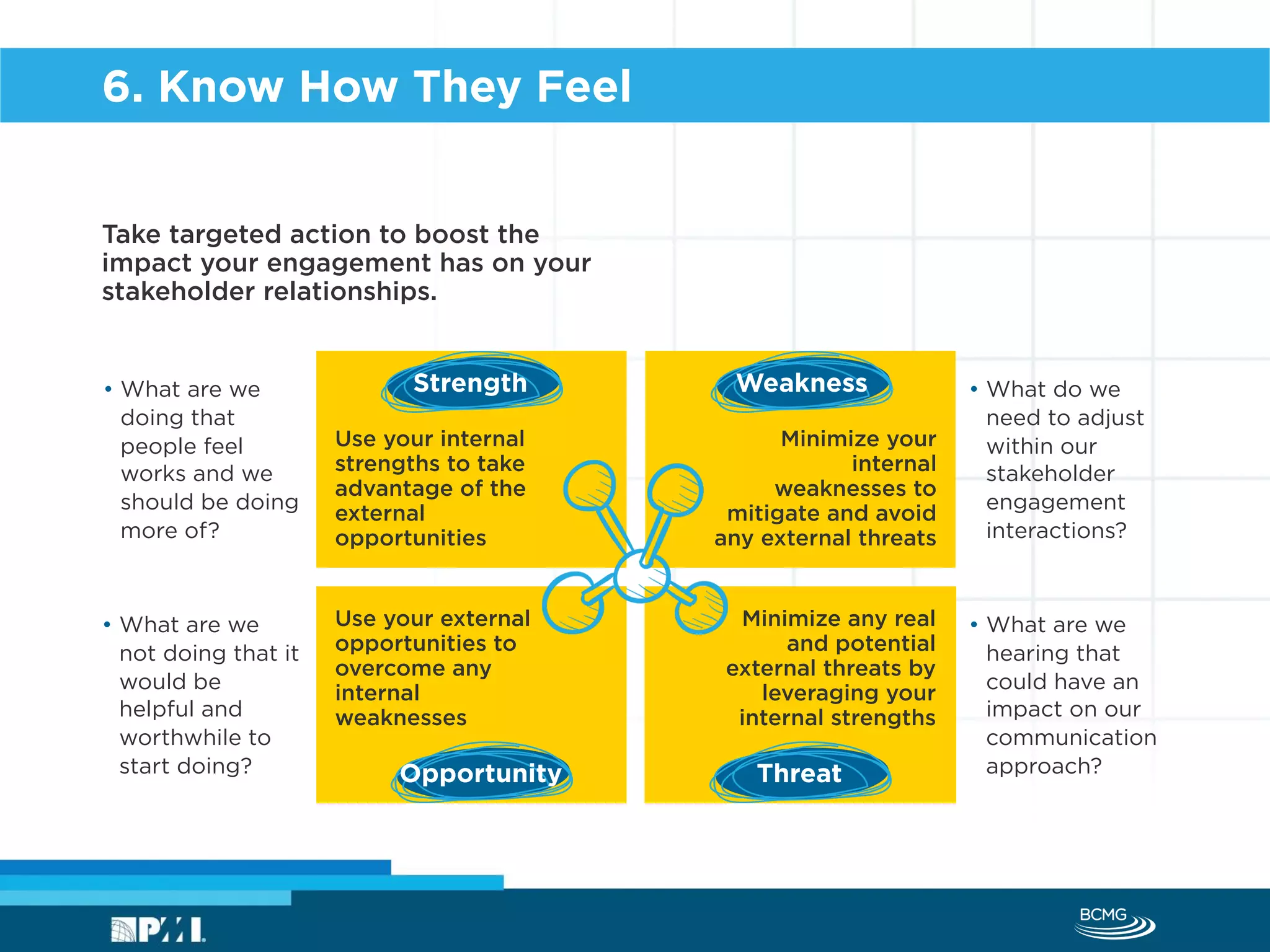
6. Know How They Feel
Take targeted action to boost the
impact your engagement has on your
stakeholder relationships.
• What are we
not doing that it
would be
helpful and
worthwhile to
start doing?
• What do we
need to adjust
within our
stakeholder
engagement
interactions?
• What are we
doing that
people feel
works and we
should be doing
more of?
• What are we
hearing that
could have an
impact on our
communication
approach?
WeaknessStrength
ThreatOpportunity
Minimize any real
and potential
external threats by
leveraging your
internal strengths
Use your internal
strengths to take
advantage of the
external
opportunities
Use your external
opportunities to
overcome any
internal
weaknesses
Minimize your
internal
weaknesses to
mitigate and avoid
any external threats
5. Know When To Focus
Awareness
• What is it about?
Refocus/Refine
• How can we make improvements?
Collaboration
• How can I help others change?
Consequences
• What are the benefits to business?
Management
• How will this be accomplished?
Personal
• How will the change affect me?
Information
• How does it work?
0
1
2
3
4
5
6
Live empathy to help stakeholders
successfully transition through the
changes happening around them.
People Processes
Information &
Technology
Organisation
• Communication
• Policies
• Training
• Rollout
4. Know Which To Engage
Solution evaluation
Stakeholder engagement and communication
Requirements elicitation
Requirements analysis
Traceability and monitoring
Responsible
Accountable
Supportive
Consulted
Informed
Bring people along on a journey that
shows them the sights and sounds
that they need to see and hear.
R
A
S
C
I
Task
R IA S C
Roles Effort Priority DependencyComplexity…
3. Know Why They Care
• Activity
involvement
• Level of
involvement
• Approval
approach
• Communication
medium
Customer
Actor
World-View
Owner
Environment
Transformation
Who has the authority to change
the business system, or not? 
Why does the business system exist
and what it should be doing?
Who are the beneficiaries of the
outputs from the business system.
Which role will perform the activities
carried out in the transformation?
What is the core process that delivers
the services to the customer.
What conditions does the business
system operates under?
Make your engagement more powerful by talking directly to the stakeholders
business perspective.
Attitude
• How willing is the stakeholder to
engage or likely to meddle?
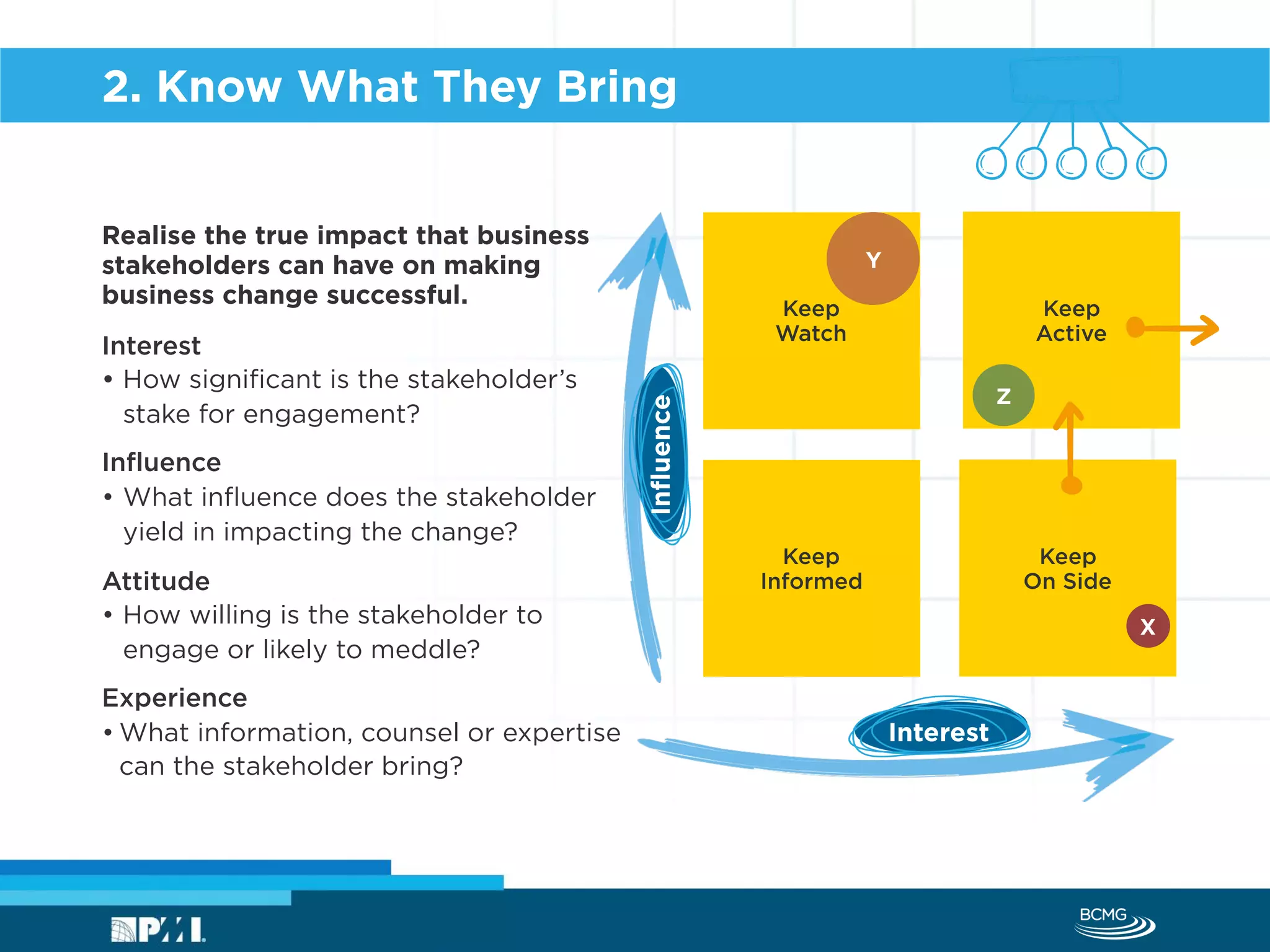
2. Know What They Bring
Experience
• What information, counsel or expertise
can the stakeholder bring?
Influence
Interest
Keep
Watch
Keep
Active
Keep
Informed
Keep
On Side
Realise the true impact that business
stakeholders can have on making
business change successful.
Interest
• How significant is the stakeholder’s
stake for engagement?
Influence
• What influence does the stakeholder
yield in impacting the change?
X
Y
Z
• Background research
• Organisational modelling
• Stakeholder nomination
1. Know Who They Are
Give consideration to each person or
group that may affect, or be affected
no matter their viewpoint.
Owners
Partners
Employees
Regulators
Suppliers
Competitors
Custom
ers
Involved
Impacted
Interact
Inspect
Stakeholder
Wheel
Managers
Other
Satisfy Your Stakeholder
Identify
Stakeholders
1
Analyse
Stakeholders
2
Determine
Approach
3
Conduct
Planning
4
Prepare
Transition
5
Manage
Communication
6
Assess
Performance
7
KNOW
WHO
THEY
ARE
KNOW
WHEN
TO
FOCUS
KNOW
WHICH
TO
ENGAGE
KNOW
WHAT
THEY
BRING
KNOW
WHY
THEY
CARE
• Stakeholder
Register
KNOW
WHERE
TO
IMPROVE
• Updated
Stakeholder
Register
• Stakeholder
Engagement &
Communication
Approach
Business Analysis & Change Planning Project Delivery
• Performance
Assessment
• Updated
practices
• Improved
Engagement &
Communication
• Readiness
Assessment
• Transition Plan
• Business
Analysis
Plan
KNOW
HOW
THEY
FEEL
Conduct
Planning
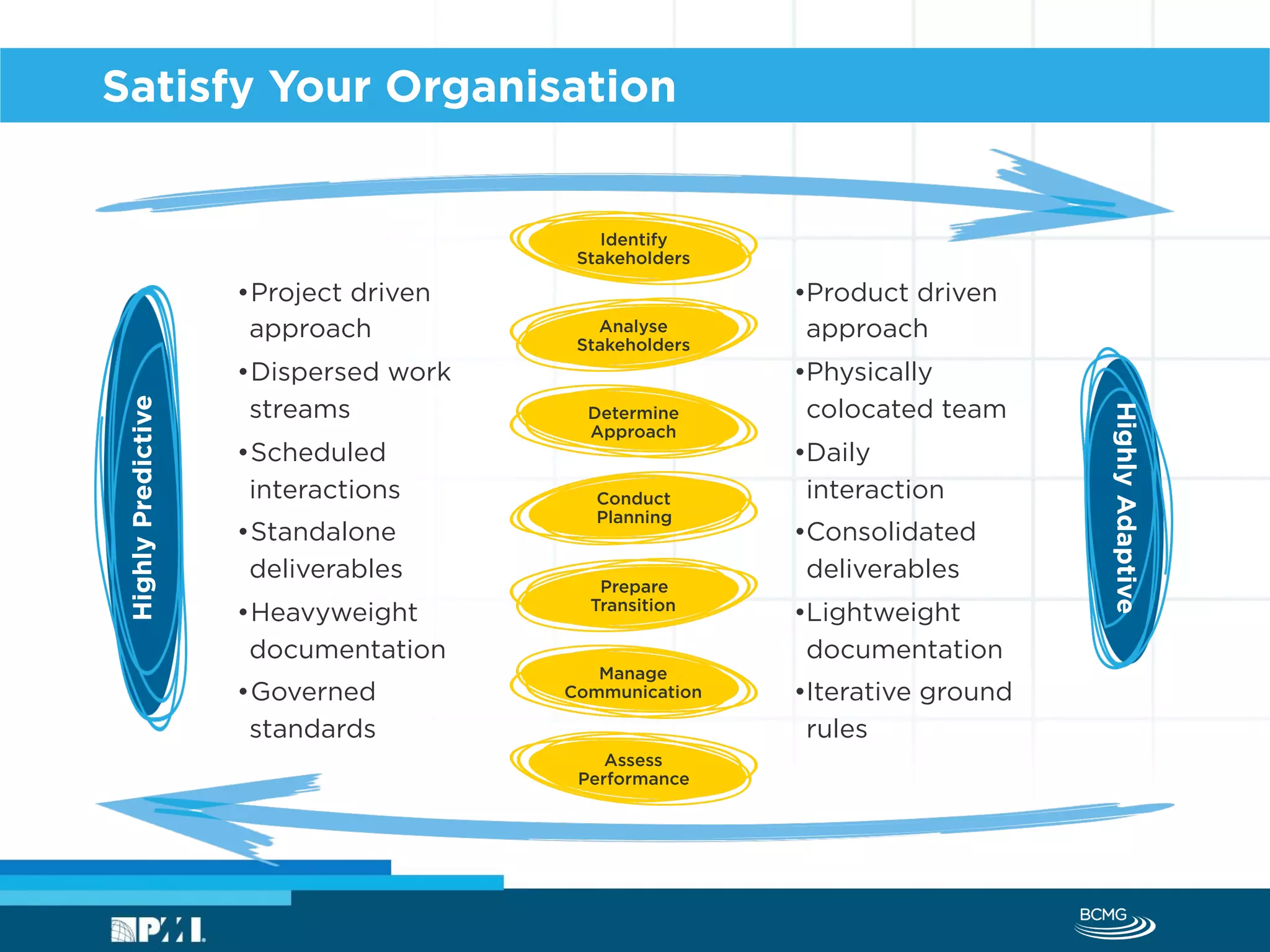
Satisfy Your Organisation
Identify
Stakeholders
Analyse
Stakeholders
Determine
Approach
Prepare
Transition
Manage
Communication
Assess
Performance
•Product driven
approach
•Physically
colocated team
•Daily
interaction
•Consolidated
deliverables
•Lightweight
documentation
•Iterative ground
rules
HighlyPredictive
HighlyAdaptive
•Project driven
approach
•Dispersed work
streams
•Scheduled
interactions
•Standalone
deliverables
•Heavyweight
documentation
•Governed
standards
Satisfy Your Self
SWOT analysis
Stakeholder analysis, management and consensus technique usage statistics courtesy of Inter-View.Report
Stakeholder nomination
Background research
RASCI charts
Stakeholder wheel
Power / interest grid
Stakeholder map
CATWOE analysis
15%
29%
5%
10%
4%
43%
31%
1%
63%
35%Lessons learned
Four-View Model
Beyond Stakeholder Analysis & Management
@businesschange/businesschangewww.businesschange.co.za

Beyond Stakeholder Analysis And Management

  • 1.
    Presenter: Joe Newbert Title:Beyond Stakeholder Analysis And Management Date: Wednesday, 8 November 2017 PMI Business Analysis Virtual Conference 2017 @newbert /newbert
  • 2.
    Beyond Stakeholder Analysis& Management Tactics for building relationships that satisfy your stakeholder, organization and self Activities for performing practical stakeholder analysis and management Context for business analysis, project delivery and change management
  • 3.
    Project Success Business analysismust be strategically managed, focused on achieving business result. Synchronise through a holistic framework where strategy and tactics intertwine. Project delivery must be tactically managed, focused on implementing operational capability. Stakeholder Quality Stakeholder Quality Scope Budget Schedule Benefits Change Activities
  • 4.
    Project Performance Business Change 63% 56%73% 47% Percentage ofprojects that successfully delivered, courtesy of Inter-View.Report Scope Budget Schedule Benefit Change Activities 52% 41%
  • 5.
    Project Challenges Only 47%of business analysts and projects managers FEEL they are responsible for stakeholder analysis & management 5 top reasons why projects fail, courtesy of Inter-View.Report Stakeholder engagement LIVES at heart of project success Dysfunctional business and IT relationships Lack of business involvement Missed and misunderstood requirements Poor stakeholder management Lack of executive leadership 1 2 3 4 5
  • 6.
    7. Know WhereTo Improve Do remarkable things by continually striving to improve the value that you serve to your stakeholders. • Establish baseline: – Delivery plan – Company standards – Performance metrics What should We keep doing? What should we stop doing? What should we start doing? • Draw perspective: – Self-review – Stakeholder feedback – Group consensus • Understand situation: – Performance results – Working practices – Achievable expectations
  • 7.
    6. Know HowThey Feel Take targeted action to boost the impact your engagement has on your stakeholder relationships. • What are we not doing that it would be helpful and worthwhile to start doing? • What do we need to adjust within our stakeholder engagement interactions? • What are we doing that people feel works and we should be doing more of? • What are we hearing that could have an impact on our communication approach? WeaknessStrength ThreatOpportunity Minimize any real and potential external threats by leveraging your internal strengths Use your internal strengths to take advantage of the external opportunities Use your external opportunities to overcome any internal weaknesses Minimize your internal weaknesses to mitigate and avoid any external threats
  • 8.
    5. Know WhenTo Focus Awareness • What is it about? Refocus/Refine • How can we make improvements? Collaboration • How can I help others change? Consequences • What are the benefits to business? Management • How will this be accomplished? Personal • How will the change affect me? Information • How does it work? 0 1 2 3 4 5 6 Live empathy to help stakeholders successfully transition through the changes happening around them. People Processes Information & Technology Organisation • Communication • Policies • Training • Rollout
  • 9.
    4. Know WhichTo Engage Solution evaluation Stakeholder engagement and communication Requirements elicitation Requirements analysis Traceability and monitoring Responsible Accountable Supportive Consulted Informed Bring people along on a journey that shows them the sights and sounds that they need to see and hear. R A S C I Task R IA S C Roles Effort Priority DependencyComplexity…
  • 10.
    3. Know WhyThey Care • Activity involvement • Level of involvement • Approval approach • Communication medium Customer Actor World-View Owner Environment Transformation Who has the authority to change the business system, or not?  Why does the business system exist and what it should be doing? Who are the beneficiaries of the outputs from the business system. Which role will perform the activities carried out in the transformation? What is the core process that delivers the services to the customer. What conditions does the business system operates under? Make your engagement more powerful by talking directly to the stakeholders business perspective.
  • 11.
    Attitude • How willingis the stakeholder to engage or likely to meddle? 2. Know What They Bring Experience • What information, counsel or expertise can the stakeholder bring? Influence Interest Keep Watch Keep Active Keep Informed Keep On Side Realise the true impact that business stakeholders can have on making business change successful. Interest • How significant is the stakeholder’s stake for engagement? Influence • What influence does the stakeholder yield in impacting the change? X Y Z
  • 12.
    • Background research •Organisational modelling • Stakeholder nomination 1. Know Who They Are Give consideration to each person or group that may affect, or be affected no matter their viewpoint. Owners Partners Employees Regulators Suppliers Competitors Custom ers Involved Impacted Interact Inspect Stakeholder Wheel Managers Other
  • 13.
    Satisfy Your Stakeholder Identify Stakeholders 1 Analyse Stakeholders 2 Determine Approach 3 Conduct Planning 4 Prepare Transition 5 Manage Communication 6 Assess Performance 7 KNOW WHO THEY ARE KNOW WHEN TO FOCUS KNOW WHICH TO ENGAGE KNOW WHAT THEY BRING KNOW WHY THEY CARE •Stakeholder Register KNOW WHERE TO IMPROVE • Updated Stakeholder Register • Stakeholder Engagement & Communication Approach Business Analysis & Change Planning Project Delivery • Performance Assessment • Updated practices • Improved Engagement & Communication • Readiness Assessment • Transition Plan • Business Analysis Plan KNOW HOW THEY FEEL
  • 14.
    Conduct Planning Satisfy Your Organisation Identify Stakeholders Analyse Stakeholders Determine Approach Prepare Transition Manage Communication Assess Performance •Productdriven approach •Physically colocated team •Daily interaction •Consolidated deliverables •Lightweight documentation •Iterative ground rules HighlyPredictive HighlyAdaptive •Project driven approach •Dispersed work streams •Scheduled interactions •Standalone deliverables •Heavyweight documentation •Governed standards
  • 15.
    Satisfy Your Self SWOTanalysis Stakeholder analysis, management and consensus technique usage statistics courtesy of Inter-View.Report Stakeholder nomination Background research RASCI charts Stakeholder wheel Power / interest grid Stakeholder map CATWOE analysis 15% 29% 5% 10% 4% 43% 31% 1% 63% 35%Lessons learned Four-View Model
  • 16.
    Beyond Stakeholder Analysis& Management @businesschange/businesschangewww.businesschange.co.za