The Invention of the Microprocessor
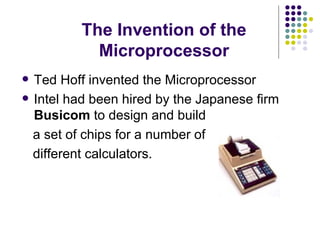
The Invention of the Microprocessor Ted Hoff invented the Microprocessor Intel had been hired by the Japanese firm  Busicom  to design and build  a set of chips for a number of  different calculators.
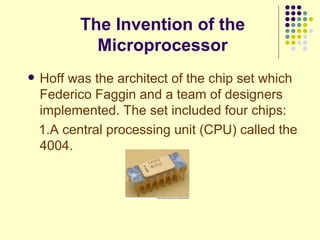
The Invention of the Microprocessor Hoff was the architect of the chip set which Federico Faggin and a team of designers implemented. The set included four chips:  1.A central processing unit (CPU) called the 4004.
The Invention of the Microprocessor 2.A read-only memory (ROM) with  custom instructions for  calculator operation. 3.A random-access memory (RAM). 4.A shift register for input/output buffering
The Invention of the Microprocessor Early 1970,Intel signed a $60,000 contract which gave Busicom   proprietary rights to design.The CPU chip,4004, was eventually called a  Microprocessor . While Intel produced chips for Busicom which were successfully made into 100,000 calculators.
The Invention of the Microprocessor 4004 – The 4004 was introduced in 1971. It contained 2,300 MOS transistors  and could  execute 60,000  instructions per second.
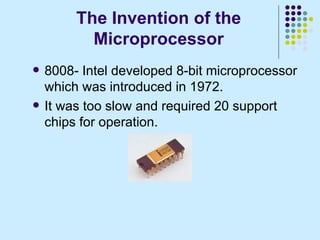
The Invention of the Microprocessor 8008- Intel developed 8-bit microprocessor which was introduced in 1972. It was too slow and required 20 support chips for operation.
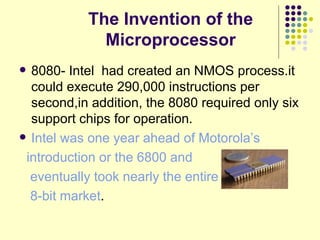
The Invention of the Microprocessor 8080- Intel  had created an NMOS process.it could execute 290,000 instructions per second,in addition, the 8080 required only six support chips for operation. Intel was one year ahead of Motorola’s  introduction or the 6800 and  eventually took nearly the entire 8-bit market .
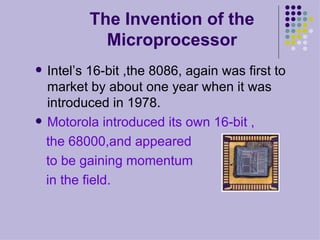
The Invention of the Microprocessor Intel’s 16-bit ,the 8086, again was first to market by about one year when it was introduced in 1978. Motorola introduced its own 16-bit , the 68000,and appeared  to be gaining momentum  in the field.
The Invention of the Microprocessor Intel created a task force to attack the 68000.The project was called operation  CRUSH. The CRUSH campaign emphasized Intel the most notable win was IBM’s decision  to  use the 8088 in their first PC.
The Invention of the Microprocessor The 80186 and 80286 were designed  to  increased integration, internal  memory management ,and advanced  software  protection capability. Motorola- project CHECKMATE paralleled  the earlier project CHUSH in concept.
Synergies Between EPROMs  and Microprocessor
Synergies Between EPROMs and Microprocessor EPROM  better than   ROM - develop and revise   program.  - could not effort the expense of a custom  ROM could substitute off-the-shelf  EPROMS .
Synergies Between EPROMs and Microprocessor Intel had a competitive advantage in the EPROM  - EPROM’s Intel had floating gate process.  - Packaging, testing and reliability engineering.
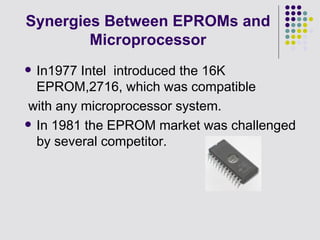
Synergies Between EPROMs and Microprocessor In1977 Intel  introduced the 16K EPROM,2716,   which was compatible with any microprocessor system. In 1981 the EPROM market was challenged by several competitor.
Synergies Between EPROMs and Microprocessor Intel 64K EPROM   “   2764”  met  very aggressive yield goals  and was again leading the  world in EPROM.
Technology Development
Technology Development 3 groups of Intel Technology Development -  DRAM -  EPROM -  Logic/SRAM
Technology Development Groups DRAM EPROM and EEPROM Logic/SRAM Location Aloha, Oregon Santa Clara, California Livermore, California Focus Linewidth reduction Process Step  Ex.increased polysilicon process for floating gate Process critical to logic devices
Technology Development The memory  technology development group represented Intel’s best corporate resource for process development. There is more of a connection between the designer and the process engineer.

Ba401 Intel Corporation Part2

  • 1.
    The Invention ofthe Microprocessor
  • 2.
    The Invention ofthe Microprocessor Ted Hoff invented the Microprocessor Intel had been hired by the Japanese firm Busicom to design and build a set of chips for a number of different calculators.
  • 3.
    The Invention ofthe Microprocessor Hoff was the architect of the chip set which Federico Faggin and a team of designers implemented. The set included four chips: 1.A central processing unit (CPU) called the 4004.
  • 4.
    The Invention ofthe Microprocessor 2.A read-only memory (ROM) with custom instructions for calculator operation. 3.A random-access memory (RAM). 4.A shift register for input/output buffering
  • 5.
    The Invention ofthe Microprocessor Early 1970,Intel signed a $60,000 contract which gave Busicom proprietary rights to design.The CPU chip,4004, was eventually called a Microprocessor . While Intel produced chips for Busicom which were successfully made into 100,000 calculators.
  • 6.
    The Invention ofthe Microprocessor 4004 – The 4004 was introduced in 1971. It contained 2,300 MOS transistors and could execute 60,000 instructions per second.
  • 7.
    The Invention ofthe Microprocessor 8008- Intel developed 8-bit microprocessor which was introduced in 1972. It was too slow and required 20 support chips for operation.
  • 8.
    The Invention ofthe Microprocessor 8080- Intel had created an NMOS process.it could execute 290,000 instructions per second,in addition, the 8080 required only six support chips for operation. Intel was one year ahead of Motorola’s introduction or the 6800 and eventually took nearly the entire 8-bit market .
  • 9.
    The Invention ofthe Microprocessor Intel’s 16-bit ,the 8086, again was first to market by about one year when it was introduced in 1978. Motorola introduced its own 16-bit , the 68000,and appeared to be gaining momentum in the field.
  • 10.
    The Invention ofthe Microprocessor Intel created a task force to attack the 68000.The project was called operation CRUSH. The CRUSH campaign emphasized Intel the most notable win was IBM’s decision to use the 8088 in their first PC.
  • 11.
    The Invention ofthe Microprocessor The 80186 and 80286 were designed to increased integration, internal memory management ,and advanced software protection capability. Motorola- project CHECKMATE paralleled the earlier project CHUSH in concept.
  • 12.
    Synergies Between EPROMs and Microprocessor
  • 13.
    Synergies Between EPROMsand Microprocessor EPROM better than ROM - develop and revise program. - could not effort the expense of a custom ROM could substitute off-the-shelf EPROMS .
  • 14.
    Synergies Between EPROMsand Microprocessor Intel had a competitive advantage in the EPROM - EPROM’s Intel had floating gate process. - Packaging, testing and reliability engineering.
  • 15.
    Synergies Between EPROMsand Microprocessor In1977 Intel introduced the 16K EPROM,2716, which was compatible with any microprocessor system. In 1981 the EPROM market was challenged by several competitor.
  • 16.
    Synergies Between EPROMsand Microprocessor Intel 64K EPROM “ 2764” met very aggressive yield goals and was again leading the world in EPROM.
  • 17.
  • 18.
    Technology Development 3groups of Intel Technology Development - DRAM - EPROM - Logic/SRAM
  • 19.
    Technology Development GroupsDRAM EPROM and EEPROM Logic/SRAM Location Aloha, Oregon Santa Clara, California Livermore, California Focus Linewidth reduction Process Step Ex.increased polysilicon process for floating gate Process critical to logic devices
  • 20.
    Technology Development Thememory technology development group represented Intel’s best corporate resource for process development. There is more of a connection between the designer and the process engineer.