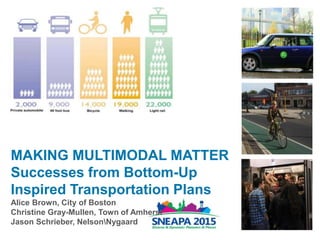
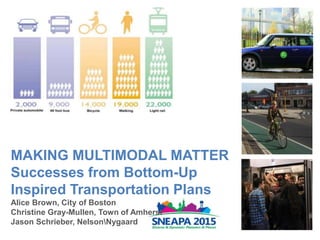
MAKING MULTIMODAL MATTER
Successes from Bottom-Up
Inspired Transportation Plans
Alice Brown, City of Boston
Christine Gray-Mullen, Town of Amherst
Jason Schrieber, NelsonNygaard
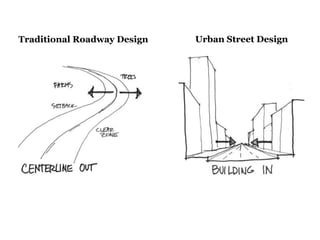
Traditional Roadway Design Urban Street Design
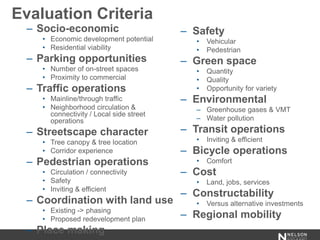
Evaluation Criteria
– Socio-economic
• Economic development potential
• Residential viability
– Parking opportunities
• Number of on-street spaces
• Proximity to commercial
– Traffic operations
• Mainline/through traffic
• Neighborhood circulation &
connectivity / Local side street
operations
– Streetscape character
• Tree canopy & tree location
• Corridor experience
– Pedestrian operations
• Circulation / connectivity
• Safety
• Inviting & efficient
– Coordination with land use
• Existing -> phasing
• Proposed redevelopment plan
– Place making
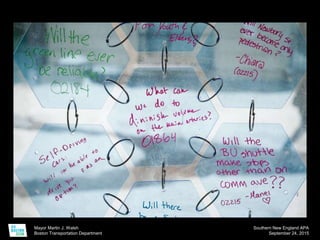
– Safety
• Vehicular
• Pedestrian
– Green space
• Quantity
• Quality
• Opportunity for variety
– Environmental
– Greenhouse gases & VMT
– Water pollution
– Transit operations
• Inviting & efficient
– Bicycle operations
• Comfort
– Cost
• Land, jobs, services
– Constructability
• Versus alternative investments
– Regional mobility
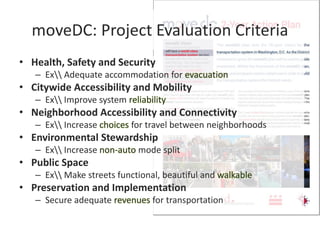
moveDC: Project Evaluation Criteria
• Health, Safety and Security
– Ex Adequate accommodation for evacuation
• Citywide Accessibility and Mobility
– Ex Improve system reliability
• Neighborhood Accessibility and Connectivity
– Ex Increase choices for travel between neighborhoods
• Environmental Stewardship
– Ex Increase non-auto mode split
• Public Space
– Ex Make streets functional, beautiful and walkable
• Preservation and Implementation
– Secure adequate revenues for transportation
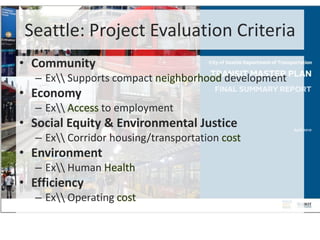
Seattle: Project Evaluation Criteria
• Community
– Ex Supports compact neighborhood development
• Economy
– Ex Access to employment
• Social Equity & Environmental Justice
– Ex Corridor housing/transportation cost
• Environment
– Ex Human Health
• Efficiency
– Ex Operating cost
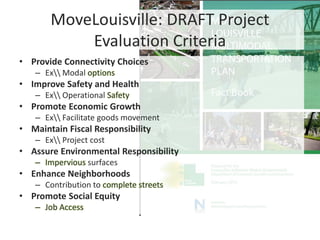
MoveLouisville: DRAFT Project
Evaluation Criteria
• Provide Connectivity Choices
– Ex Modal options
• Improve Safety and Health
– Ex Operational Safety
• Promote Economic Growth
– Ex Facilitate goods movement
• Maintain Fiscal Responsibility
– Ex Project cost
• Assure Environmental Responsibility
– Impervious surfaces
• Enhance Neighborhoods
– Contribution to complete streets
• Promote Social Equity
– Job Access
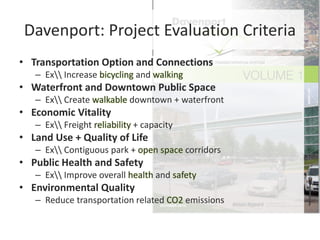
Davenport: Project Evaluation Criteria
• Transportation Option and Connections
– Ex Increase bicycling and walking
• Waterfront and Downtown Public Space
– Ex Create walkable downtown + waterfront
• Economic Vitality
– Ex Freight reliability + capacity
• Land Use + Quality of Life
– Ex Contiguous park + open space corridors
• Public Health and Safety
– Ex Improve overall health and safety
• Environmental Quality
– Reduce transportation related CO2 emissions
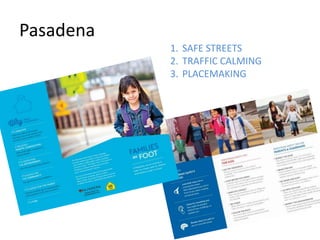
1. SAFE STREETS
2. TRAFFIC CALMING
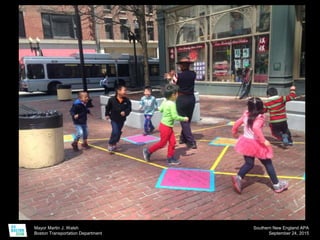
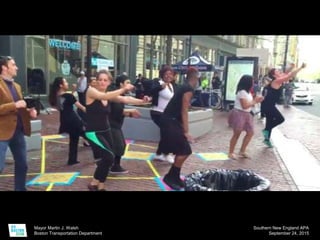
3. PLACEMAKING
Pasadena
Mayor Martin J. Walsh
Boston Transportation Department
Southern New England APA
September 24, 2015
Mayor Martin J. Walsh
Boston Transportation Department
Southern New England APA
September 24, 2015
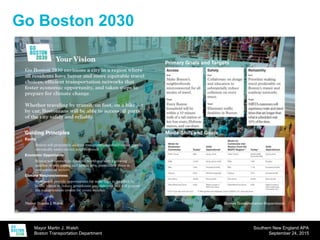
Go Boston 2030
Mayor Martin J. Walsh
Boston Transportation Department
Southern New England APA
September 24, 2015
What’s your question about getting
around Boston in the future?
Mayor Martin J. Walsh
Boston Transportation Department
Southern New England APA
September 24, 2015
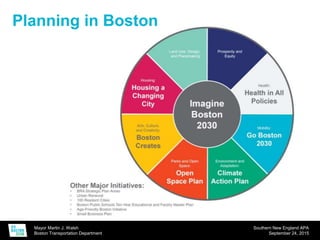
Planning in Boston
Mayor Martin J. Walsh
Boston Transportation Department
Southern New England APA
September 24, 2015
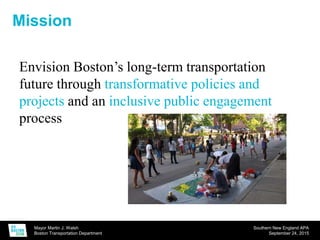
Mission
Envision Boston’s long-term transportation
future through transformative policies and
projects and an inclusive public engagement
process
Mayor Martin J. Walsh
Boston Transportation Department
Southern New England APA
September 24, 2015
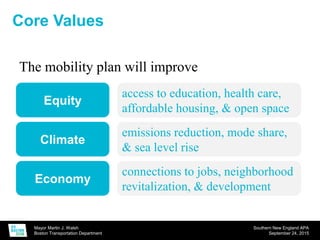
Core Values
The mobility plan will improve
Equity
Climate
Economy
access to education, health care,
affordable housing, & open space
emissions reduction, mode share,
& sea level rise
connections to jobs, neighborhood
revitalization, & development
Mayor Martin J. Walsh
Boston Transportation Department
Southern New England APA
September 24, 2015
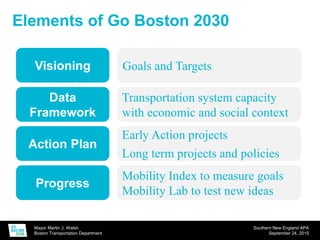
Elements of Go Boston 2030
Visioning Goals and Targets
Data
Framework
Action Plan
Progress
Transportation system capacity
with economic and social context
Early Action projects
Long term projects and policies
Mobility Index to measure goals
Mobility Lab to test new ideas
Mayor Martin J. Walsh
Boston Transportation Department
Southern New England APA
September 24, 2015
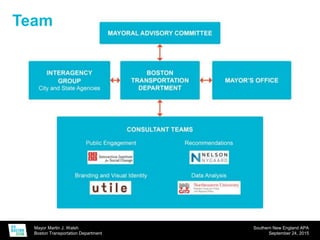
Team
Mayor Martin J. Walsh
Boston Transportation Department
Southern New England APA
September 24, 2015
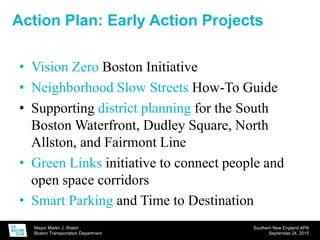
Action Plan: Early Action Projects
• Vision Zero Boston Initiative
• Neighborhood Slow Streets How-To Guide
• Supporting district planning for the South
Boston Waterfront, Dudley Square, North
Allston, and Fairmont Line
• Green Links initiative to connect people and
open space corridors
• Smart Parking and Time to Destination
Mayor Martin J. Walsh
Boston Transportation Department
Southern New England APA
September 24, 2015
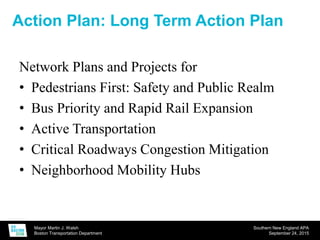
Action Plan: Long Term Action Plan
Network Plans and Projects for
• Pedestrians First: Safety and Public Realm
• Bus Priority and Rapid Rail Expansion
• Active Transportation
• Critical Roadways Congestion Mitigation
• Neighborhood Mobility Hubs
Mayor Martin J. Walsh
Boston Transportation Department
Southern New England APA
September 24, 2015
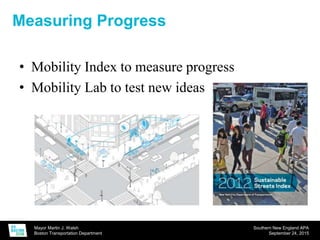
Measuring Progress
• Mobility Index to measure progress
• Mobility Lab to test new ideas
Mayor Martin J. Walsh
Boston Transportation Department
Southern New England APA
September 24, 2015
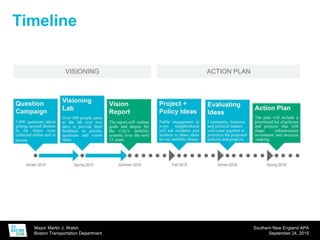
Timeline
Mayor Martin J. Walsh
Boston Transportation Department
Southern New England APA
September 24, 2015
PUBLIC ENGAGEMENT
Mayor Martin J. Walsh
Boston Transportation Department
Southern New England APA
September 24, 2015
Public Engagement Criteria
How do we design a truly bottom-up process?
• Work with community partners and
stakeholders
• Collect ideas before presenting ideas
• Craft a citywide plan with participation from
all neighborhoods
• Ensure that people who aren’t the “usual
voices” contribute to the plan
Mayor Martin J. Walsh
Boston Transportation Department
Southern New England APA
September 24, 2015
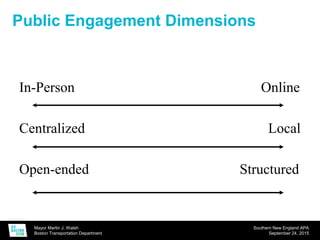
Public Engagement Dimensions
In-Person Online
Centralized Local
Open-ended Structured
Mayor Martin J. Walsh
Boston Transportation Department
Southern New England APA
September 24, 2015
PUBLIC ENGAGEMENT:
QUESTION CAMPAIGN
Mayor Martin J. Walsh
Boston Transportation Department
Southern New England APA
September 24, 2015
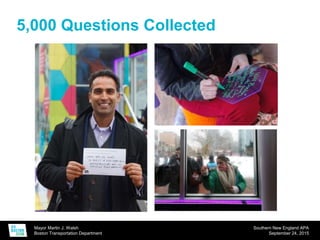
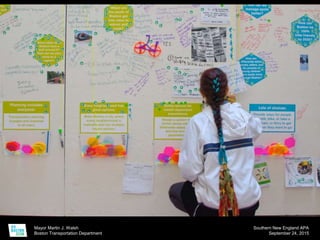
5,000 Questions Collected
Mayor Martin J. Walsh
Boston Transportation Department
Southern New England APA
September 24, 2015
The Question Campaign is a unique, simple, and
powerful tool that supports a diverse public to
engage in dialogue, learning, and action for the
social change it seeks.
Great ideas often start with a question. Bold
questions can inspire a vision or make concerns
visible.
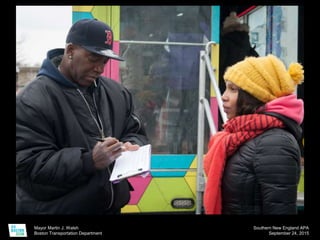
What Is a Question Campaign?
Mayor Martin J. Walsh
Boston Transportation Department
Southern New England APA
September 24, 2015
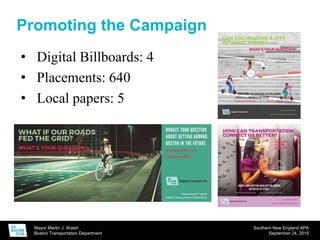
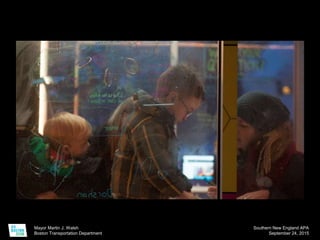
• Digital Billboards: 4
• Placements: 640
• Local papers: 5
Promoting the Campaign
Mayor Martin J. Walsh
Boston Transportation Department
Southern New England APA
September 24, 2015
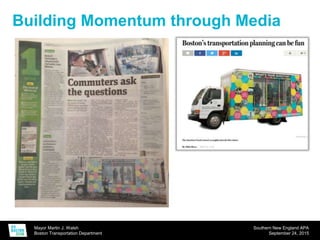
Building Momentum through Media
Mayor Martin J. Walsh
Boston Transportation Department
Southern New England APA
September 24, 2015
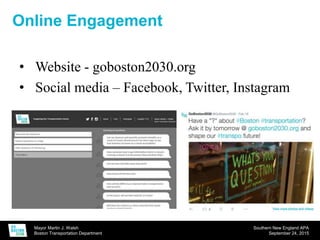
Online Engagement
• Website - goboston2030.org
• Social media – Facebook, Twitter, Instagram
Mayor Martin J. Walsh
Boston Transportation Department
Southern New England APA
September 24, 2015
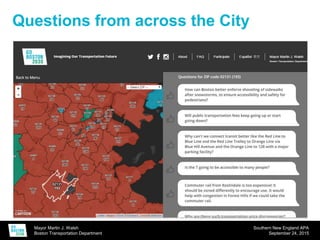
Questions from across the City
Mayor Martin J. Walsh
Boston Transportation Department
Southern New England APA
September 24, 2015
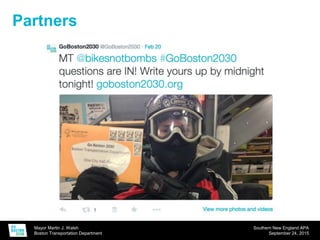
Partners
Mayor Martin J. Walsh
Boston Transportation Department
Southern New England APA
September 24, 2015
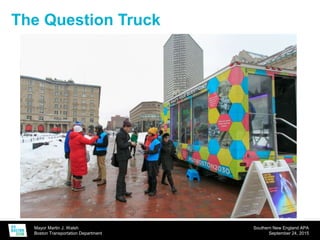
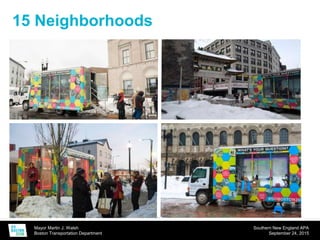
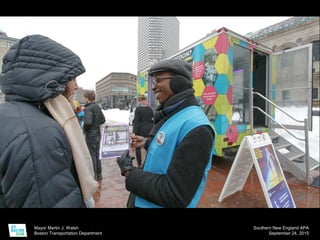
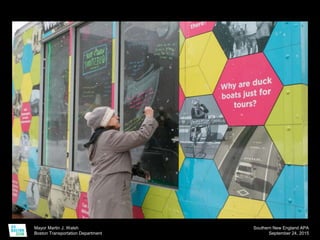
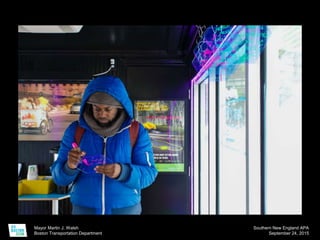
The Question Truck
Mayor Martin J. Walsh
Boston Transportation Department
Southern New England APA
September 24, 2015
15 Neighborhoods
Mayor Martin J. Walsh
Boston Transportation Department
Southern New England APA
September 24, 2015
Mayor Martin J. Walsh
Boston Transportation Department
Southern New England APA
September 24, 2015
Mayor Martin J. Walsh
Boston Transportation Department
Southern New England APA
September 24, 2015
Mayor Martin J. Walsh
Boston Transportation Department
Southern New England APA
September 24, 2015
Mayor Martin J. Walsh
Boston Transportation Department
Southern New England APA
September 24, 2015
Mayor Martin J. Walsh
Boston Transportation Department
Southern New England APA
September 24, 2015
Mayor Martin J. Walsh
Boston Transportation Department
Southern New England APA
September 24, 2015
PUBLIC ENGAGEMENT:
QUESTION REVIEW SESSION
Mayor Martin J. Walsh
Boston Transportation Department
Southern New England APA
September 24, 2015
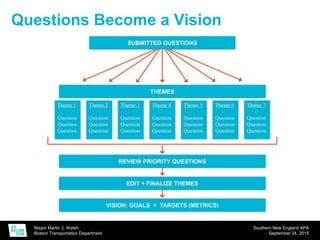
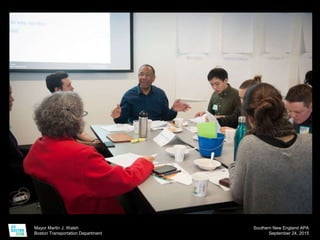
Questions Become a Vision
Mayor Martin J. Walsh
Boston Transportation Department
Southern New England APA
September 24, 2015
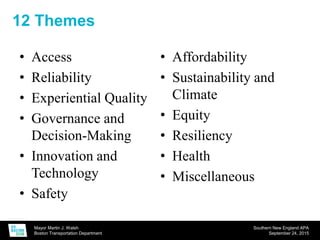
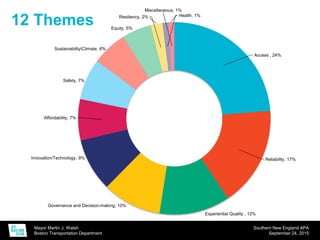
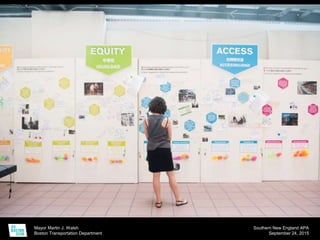
12 Themes
• Access
• Reliability
• Experiential Quality
• Governance and
Decision-Making
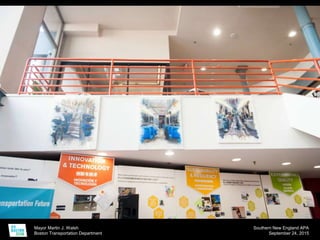
• Innovation and
Technology
• Safety
• Affordability
• Sustainability and
Climate
• Equity
• Resiliency
• Health
• Miscellaneous
Mayor Martin J. Walsh
Boston Transportation Department
Southern New England APA
September 24, 2015
Access , 24%
Reliability, 17%
Experiential Quality , 12%
Governance and Decision-making, 10%
Innovation/Technology, 9%
Affordability, 7%
Safety, 7%
SustainabilityClimate, 6%
Equity, 5%
Resiliency, 2% Health, 1%
Miscellaneous, 1%
12 Themes
Mayor Martin J. Walsh
Boston Transportation Department
Southern New England APA
September 24, 2015
Mayor Martin J. Walsh
Boston Transportation Department
Southern New England APA
September 24, 2015
Mayor Martin J. Walsh
Boston Transportation Department
Southern New England APA
September 24, 2015
PUBLIC ENGAGEMENT:
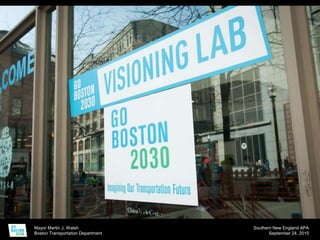
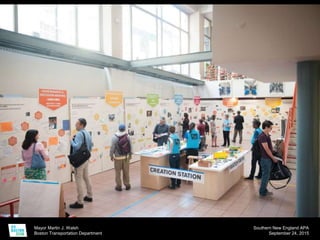
VISIONING LAB
Mayor Martin J. Walsh
Boston Transportation Department
Southern New England APA
September 24, 2015
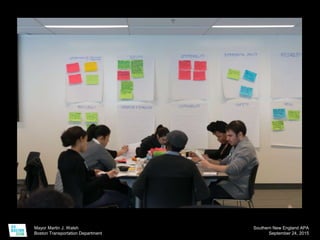
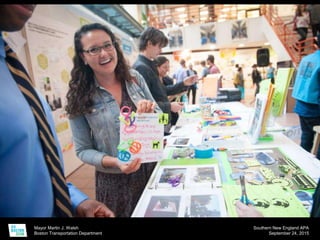
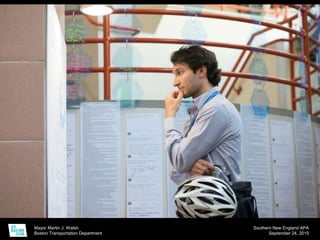
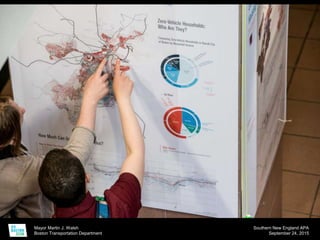
Objectives of the Visioning Lab
• People have an engaging, hands-on experience that leaves
them feeling heard and makes them excited for the
transportation plan
• There is diverse participation and many voices shape the
vision
• People who attend feel enriched, it was time well spent
• People understand that the event was part of a thread –the
question campaign, question review session, and vision forum
are a continuum that will impact future of Boston
Mayor Martin J. Walsh
Boston Transportation Department
Southern New England APA
September 24, 2015
Mayor Martin J. Walsh
Boston Transportation Department
Southern New England APA
September 24, 2015
Mayor Martin J. Walsh
Boston Transportation Department
Southern New England APA
September 24, 2015
Mayor Martin J. Walsh
Boston Transportation Department
Southern New England APA
September 24, 2015
Mayor Martin J. Walsh
Boston Transportation Department
Southern New England APA
September 24, 2015
Mayor Martin J. Walsh
Boston Transportation Department
Southern New England APA
September 24, 2015
Mayor Martin J. Walsh
Boston Transportation Department
Southern New England APA
September 24, 2015
Mayor Martin J. Walsh
Boston Transportation Department
Southern New England APA
September 24, 2015
Mayor Martin J. Walsh
Boston Transportation Department
Southern New England APA
September 24, 2015
Mayor Martin J. Walsh
Boston Transportation Department
Southern New England APA
September 24, 2015
Mayor Martin J. Walsh
Boston Transportation Department
Southern New England APA
September 24, 2015
Mayor Martin J. Walsh
Boston Transportation Department
Southern New England APA
September 24, 2015
Mayor Martin J. Walsh
Boston Transportation Department
Southern New England APA
September 24, 2015
Mayor Martin J. Walsh
Boston Transportation Department
Southern New England APA
September 24, 2015
Mayor Martin J. Walsh
Boston Transportation Department
Southern New England APA
September 24, 2015
Mayor Martin J. Walsh
Boston Transportation Department
Southern New England APA
September 24, 2015
Mayor Martin J. Walsh
Boston Transportation Department
Southern New England APA
September 24, 2015
Mayor Martin J. Walsh
Boston Transportation Department
Southern New England APA
September 24, 2015
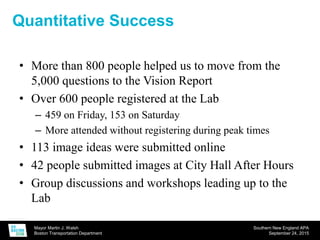
Quantitative Success
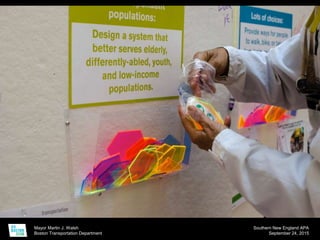
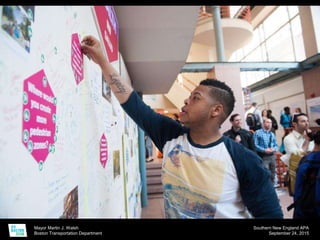
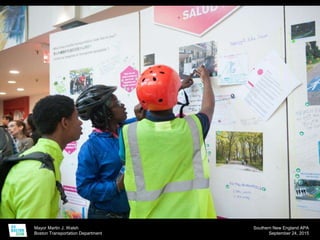
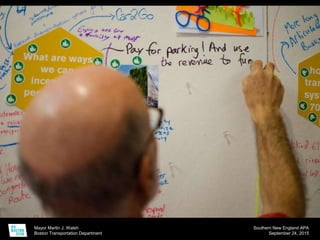
• More than 800 people helped us to move from the
5,000 questions to the Vision Report
• Over 600 people registered at the Lab
– 459 on Friday, 153 on Saturday
– More attended without registering during peak times
• 113 image ideas were submitted online
• 42 people submitted images at City Hall After Hours
• Group discussions and workshops leading up to the
Lab
Mayor Martin J. Walsh
Boston Transportation Department
Southern New England APA
September 24, 2015
PUBLIC ENGAGEMENT
FOR THE ACTION PLAN
Mayor Martin J. Walsh
Boston Transportation Department
Southern New England APA
September 24, 2015
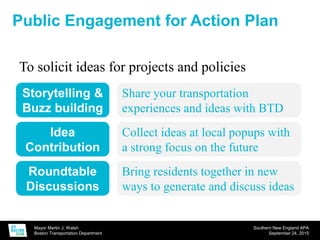
Public Engagement for Action Plan
To solicit ideas for projects and policies
Storytelling &
Buzz building
Idea
Contribution
Roundtable
Discussions
Share your transportation
experiences and ideas with BTD
Collect ideas at local popups with
a strong focus on the future
Bring residents together in new
ways to generate and discuss ideas
Mayor Martin J. Walsh
Boston Transportation Department
Southern New England APA
September 24, 2015
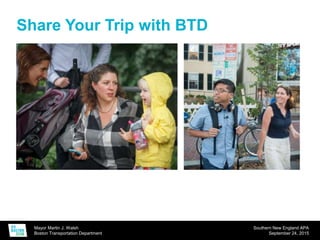
Share Your Trip with BTD
Mayor Martin J. Walsh
Boston Transportation Department
Southern New England APA
September 24, 2015
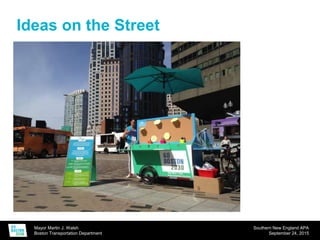
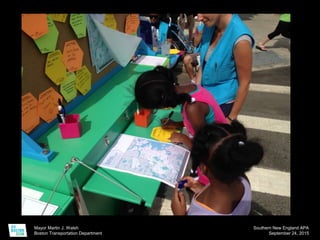
Ideas on the Street
Mayor Martin J. Walsh
Boston Transportation Department
Southern New England APA
September 24, 2015
Mayor Martin J. Walsh
Boston Transportation Department
Southern New England APA
September 24, 2015
Mayor Martin J. Walsh
Boston Transportation Department
Southern New England APA
September 24, 2015
alice.brown@boston.gov
goboston2030.org
Mayor Martin J. Walsh
Boston Transportation Department
Southern New England APA
September 24, 2015
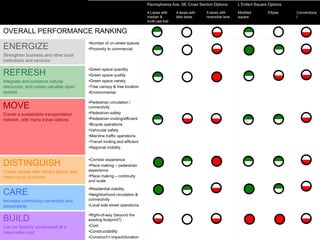
Performance MeasuresPennsylvania Ave, SE Cross Section Options L’Enfant Square Options
4-Lanes with
median &
multi-use trail
4-lanes with
bike lanes
5-lanes with
reversible lane
Modified
square
Ellipse Conventiona
l
OVERALL PERFORMANCE RANKING
ENERGIZE
Strengthen business and other local
institutions and services
•Number of on-street spaces
•Proximity to commercial
REFRESH
Integrate and conserve natural
resources, and create valuable open
spaces
•Green space quantity
•Green space quality
•Green space variety
•Tree canopy & tree location
•Environmental
MOVE
Create a sustainable transportation
network, with many travel options
•Pedestrian circulation /
connectivity
•Pedestrian safety
•Pedestrian inviting/efficient
•Bicycle operations
•Vehicular safety
•Mainline traffic operations
•Transit inviting and efficient
•Regional mobility
DISTINGUISH
Create streets with vibrant places that
reflect local character
•Corridor experience
•Place making – pedestrian
experience
•Place making – continuity
and scale
CARE
Increase community ownership and
stewardship
•Residential viability
•Neighborhood circulation &
connectivity
•Local side street operations
BUILD
Can be feasibly constructed at a
reasonable cost
•Right-of-way (beyond the
existing footprint?)
•Cost
•Constructability
•Construct’n impact/duration
Framework
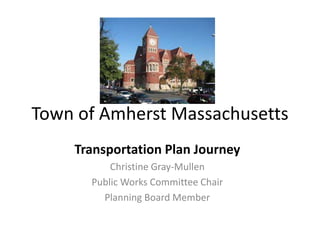
Town of Amherst Massachusetts
Transportation Plan Journey
Christine Gray-Mullen
Public Works Committee Chair
Planning Board Member
Town of Amherst
• ~38,000 residents
• 3 colleges: add >30,000 students
• Select Board/Town Manager Government
• Pioneer Valley Transit Authority: buses
• > 50 Town Committees: volunteer residents
• Master Plan completed 2010
• Only “h” silent
77
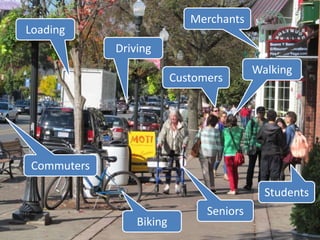
Loading
Walking
Biking
Driving
Merchants
Seniors
Students
Customers
Commuters
Transportation Task Force
• 1st Meeting in January 2012
• 6 Members:
– 2 Planning Board
– 2 Public Works Committee
– 2 Public Transit and Bike Committee
Town Liaisons:
• DPW Superintendent
• Senior Planner
Additional Town Government with
Vested Interest
• Town Manager
• Select Board
• Town Meeting
• Other Committees
– Disability Access Advisory Committee
– Council on Aging
Mission Statement
• The Amherst Transportation Plan will be a
document created to guide the Town toward an
economically and environmentally sustainable,
multi-modal transportation system that
accommodates all members of the Amherst
Community. The Plan will provide for the safe,
convenient and efficient movement of people
and goods throughout the Town and connecting
with other communities. The Plan will be
consistent with the goals and objectives set forth
in the Amherst Master Plan.
Documentation & Reports
• Town of Amherst Master Plan, Transportation Chapter
• Downtown Parking Study
• Massachusetts DOT traffic counts
• Existing traffic studies
• Town trail map
• Current roadway system including Town classification and Mass DOT or Federal
Classifications
• Current sidewalk inventory and any classification system
• Current transit routes & amenities such as bus pull offs, shelters, ridership
• Bike routes and bikeways
• Existing traffic calming measures
• Existing crash data
• Existing Public Transit Systems
• Ride share system
• UMass and Amherst College Parking Plans & parking systems
• University of Massachusetts Traffic Center resources
• Vehicle excise tax information
RFP
• TM approved funds: $50,000
• Proposed Scope of Work
• Only one submitted proposal??
• Rework RFP
• 2nd time: 6 Proposals Received
• Interviews: 4
• Selection
Goal: Identify Strengths,
Weaknesses, and Need to Improve
• Public bus and rail transit systems
• Alternative transportation modes
• Transportation needs of the business community
• Traffic calming
• Transportation needs of neighborhoods and
village centers
• Roadway system
• Traffic circulation
• Vehicle parking
• Connections with neighboring communities
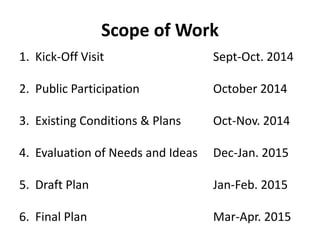
Scope of Work
1. Kick-Off Visit Sept-Oct. 2014
2. Public Participation October 2014
3. Existing Conditions & Plans Oct-Nov. 2014
4. Evaluation of Needs and Ideas Dec-Jan. 2015
5. Draft Plan Jan-Feb. 2015
6. Final Plan Mar-Apr. 2015
Stakeholder Interviews
• Business Improvement District
• Chamber of Commerce
• Developers/Large Property Owners
• Institutions: 3 Colleges
• Pioneer Valley Transit Authority
• Amherst Public Schools
• Amherst Housing Authority
88
90
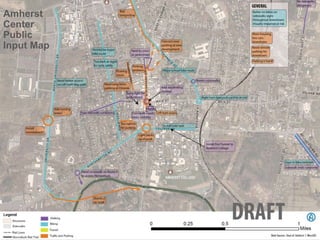
Amherst
Center
Public
Input Map
91
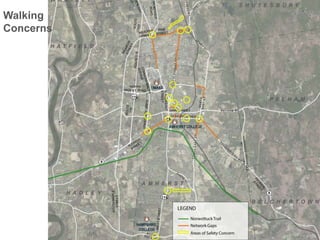
Walking
Concerns
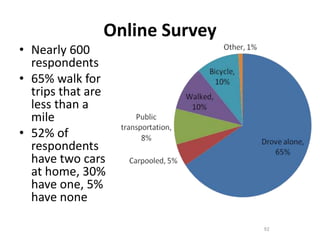
Online Survey
• Nearly 600
respondents
• 65% walk for
trips that are
less than a
mile
• 52% of
respondents
have two cars
at home, 30%
have one, 5%
have none
92
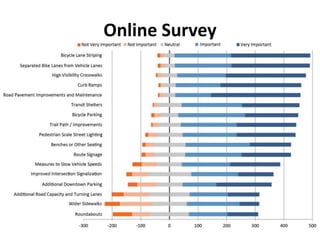
Online Survey
93
Transportation Plan Strategies for:
• Multi-Modal
• Walking
• Bicycling
• Transit
• Driving/Parking
• Quick Wins/New Strategies/Long Term
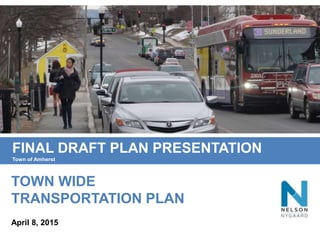
TOWN WIDE
TRANSPORTATION PLAN
FINAL DRAFT PLAN PRESENTATION
Town of Amherst
April 8, 2015
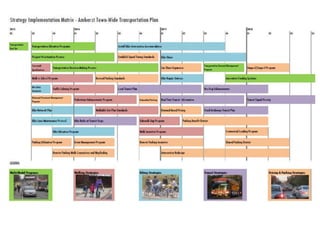
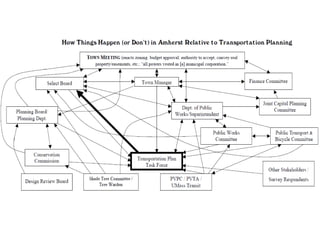
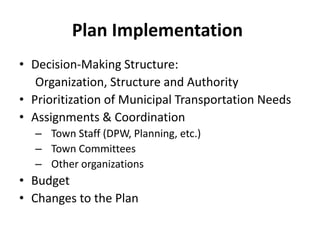
Plan Implementation
• Decision-Making Structure:
Organization, Structure and Authority
• Prioritization of Municipal Transportation Needs
• Assignments & Coordination
– Town Staff (DPW, Planning, etc.)
– Town Committees
– Other organizations
• Budget
• Changes to the Plan
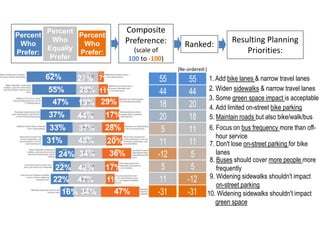
Percent
Who
Prefer:
Percent
Who
Equally
Prefer
Percent
Who
Prefer:
Composite
Preference:
(scale of
100 to -100)
Resulting Planning
Priorities:
55
44
18
20
5
11
-12
5
11
-31
55
44
20
18
11
11
5
5
-12
-31
1. Add bike lanes & narrow travel lanes
2. Widen sidewalks & narrow travel lanes
3. Some green space impact is acceptable
4. Add limited on-street bike parking
5. Maintain roads but also bike/walk/bus
6. Focus on bus frequency more than off-
hour service
7. Don't lose on-street parking for bike
lanes
8. Buses should cover more people more
frequently
9. Widening sidewalks shouldn't impact
on-street parking
10. Widening sidewalks shouldn't impact
green space
(Re-ordered:)
Ranked:
62% 27% 7%
55%
47%
37%
33%
31%
24%
22%
22%
16%
28%
19%
44%
37%
48%
34%
42%
47%
34%
11%
29%
17%
28%
20%
36%
17%
11%
47%
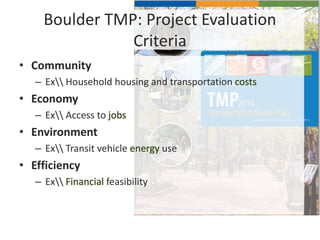
Boulder TMP: Project Evaluation
Criteria
• Community
– Ex Household housing and transportation costs
• Economy
– Ex Access to jobs
• Environment
– Ex Transit vehicle energy use
• Efficiency
– Ex Financial feasibility
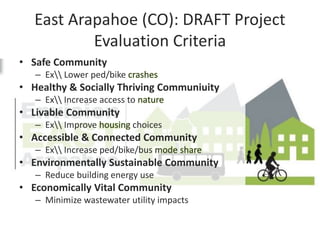
East Arapahoe (CO): DRAFT Project
Evaluation Criteria
• Safe Community
– Ex Lower ped/bike crashes
• Healthy & Socially Thriving Communiuity
– Ex Increase access to nature
• Livable Community
– Ex Improve housing choices
• Accessible & Connected Community
– Ex Increase ped/bike/bus mode share
• Environmentally Sustainable Community
– Reduce building energy use
• Economically Vital Community
– Minimize wastewater utility impacts
AFFORDABILITY
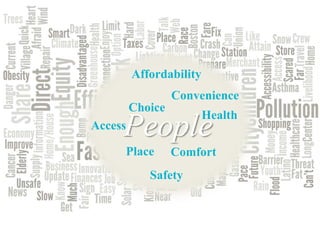
People
Choice
Access
Convenience
Health
ComfortPlace
Safety
Affordability
MAKING MULTIMODAL MATTER
Successes from Bottom-Up
Inspired Transportation Plans
Alice Brown, City of Boston
Christine Gray-Mullen, Town of Amherst
Jason Schrieber, NelsonNygaard

B2 Making Multimodal Matter

  • 1.
    MAKING MULTIMODAL MATTER Successesfrom Bottom-Up Inspired Transportation Plans Alice Brown, City of Boston Christine Gray-Mullen, Town of Amherst Jason Schrieber, NelsonNygaard
  • 2.
    Traditional Roadway DesignUrban Street Design
  • 3.
    Evaluation Criteria – Socio-economic •Economic development potential • Residential viability – Parking opportunities • Number of on-street spaces • Proximity to commercial – Traffic operations • Mainline/through traffic • Neighborhood circulation & connectivity / Local side street operations – Streetscape character • Tree canopy & tree location • Corridor experience – Pedestrian operations • Circulation / connectivity • Safety • Inviting & efficient – Coordination with land use • Existing -> phasing • Proposed redevelopment plan – Place making – Safety • Vehicular • Pedestrian – Green space • Quantity • Quality • Opportunity for variety – Environmental – Greenhouse gases & VMT – Water pollution – Transit operations • Inviting & efficient – Bicycle operations • Comfort – Cost • Land, jobs, services – Constructability • Versus alternative investments – Regional mobility
  • 4.
    moveDC: Project EvaluationCriteria • Health, Safety and Security – Ex Adequate accommodation for evacuation • Citywide Accessibility and Mobility – Ex Improve system reliability • Neighborhood Accessibility and Connectivity – Ex Increase choices for travel between neighborhoods • Environmental Stewardship – Ex Increase non-auto mode split • Public Space – Ex Make streets functional, beautiful and walkable • Preservation and Implementation – Secure adequate revenues for transportation
  • 5.
    Seattle: Project EvaluationCriteria • Community – Ex Supports compact neighborhood development • Economy – Ex Access to employment • Social Equity & Environmental Justice – Ex Corridor housing/transportation cost • Environment – Ex Human Health • Efficiency – Ex Operating cost
  • 6.
    MoveLouisville: DRAFT Project EvaluationCriteria • Provide Connectivity Choices – Ex Modal options • Improve Safety and Health – Ex Operational Safety • Promote Economic Growth – Ex Facilitate goods movement • Maintain Fiscal Responsibility – Ex Project cost • Assure Environmental Responsibility – Impervious surfaces • Enhance Neighborhoods – Contribution to complete streets • Promote Social Equity – Job Access
  • 7.
    Davenport: Project EvaluationCriteria • Transportation Option and Connections – Ex Increase bicycling and walking • Waterfront and Downtown Public Space – Ex Create walkable downtown + waterfront • Economic Vitality – Ex Freight reliability + capacity • Land Use + Quality of Life – Ex Contiguous park + open space corridors • Public Health and Safety – Ex Improve overall health and safety • Environmental Quality – Reduce transportation related CO2 emissions
  • 8.
    1. SAFE STREETS 2.TRAFFIC CALMING 3. PLACEMAKING Pasadena
  • 9.
    Mayor Martin J.Walsh Boston Transportation Department Southern New England APA September 24, 2015
  • 10.
    Mayor Martin J.Walsh Boston Transportation Department Southern New England APA September 24, 2015 Go Boston 2030
  • 11.
    Mayor Martin J.Walsh Boston Transportation Department Southern New England APA September 24, 2015 What’s your question about getting around Boston in the future?
  • 12.
    Mayor Martin J.Walsh Boston Transportation Department Southern New England APA September 24, 2015 Planning in Boston
  • 13.
    Mayor Martin J.Walsh Boston Transportation Department Southern New England APA September 24, 2015 Mission Envision Boston’s long-term transportation future through transformative policies and projects and an inclusive public engagement process
  • 14.
    Mayor Martin J.Walsh Boston Transportation Department Southern New England APA September 24, 2015 Core Values The mobility plan will improve Equity Climate Economy access to education, health care, affordable housing, & open space emissions reduction, mode share, & sea level rise connections to jobs, neighborhood revitalization, & development
  • 15.
    Mayor Martin J.Walsh Boston Transportation Department Southern New England APA September 24, 2015 Elements of Go Boston 2030 Visioning Goals and Targets Data Framework Action Plan Progress Transportation system capacity with economic and social context Early Action projects Long term projects and policies Mobility Index to measure goals Mobility Lab to test new ideas
  • 16.
    Mayor Martin J.Walsh Boston Transportation Department Southern New England APA September 24, 2015 Team
  • 17.
    Mayor Martin J.Walsh Boston Transportation Department Southern New England APA September 24, 2015 Action Plan: Early Action Projects • Vision Zero Boston Initiative • Neighborhood Slow Streets How-To Guide • Supporting district planning for the South Boston Waterfront, Dudley Square, North Allston, and Fairmont Line • Green Links initiative to connect people and open space corridors • Smart Parking and Time to Destination
  • 18.
    Mayor Martin J.Walsh Boston Transportation Department Southern New England APA September 24, 2015 Action Plan: Long Term Action Plan Network Plans and Projects for • Pedestrians First: Safety and Public Realm • Bus Priority and Rapid Rail Expansion • Active Transportation • Critical Roadways Congestion Mitigation • Neighborhood Mobility Hubs
  • 19.
    Mayor Martin J.Walsh Boston Transportation Department Southern New England APA September 24, 2015 Measuring Progress • Mobility Index to measure progress • Mobility Lab to test new ideas
  • 20.
    Mayor Martin J.Walsh Boston Transportation Department Southern New England APA September 24, 2015 Timeline
  • 21.
    Mayor Martin J.Walsh Boston Transportation Department Southern New England APA September 24, 2015 PUBLIC ENGAGEMENT
  • 22.
    Mayor Martin J.Walsh Boston Transportation Department Southern New England APA September 24, 2015 Public Engagement Criteria How do we design a truly bottom-up process? • Work with community partners and stakeholders • Collect ideas before presenting ideas • Craft a citywide plan with participation from all neighborhoods • Ensure that people who aren’t the “usual voices” contribute to the plan
  • 23.
    Mayor Martin J.Walsh Boston Transportation Department Southern New England APA September 24, 2015 Public Engagement Dimensions In-Person Online Centralized Local Open-ended Structured
  • 24.
    Mayor Martin J.Walsh Boston Transportation Department Southern New England APA September 24, 2015 PUBLIC ENGAGEMENT: QUESTION CAMPAIGN
  • 25.
    Mayor Martin J.Walsh Boston Transportation Department Southern New England APA September 24, 2015 5,000 Questions Collected
  • 26.
    Mayor Martin J.Walsh Boston Transportation Department Southern New England APA September 24, 2015 The Question Campaign is a unique, simple, and powerful tool that supports a diverse public to engage in dialogue, learning, and action for the social change it seeks. Great ideas often start with a question. Bold questions can inspire a vision or make concerns visible. What Is a Question Campaign?
  • 27.
    Mayor Martin J.Walsh Boston Transportation Department Southern New England APA September 24, 2015 • Digital Billboards: 4 • Placements: 640 • Local papers: 5 Promoting the Campaign
  • 28.
    Mayor Martin J.Walsh Boston Transportation Department Southern New England APA September 24, 2015 Building Momentum through Media
  • 29.
    Mayor Martin J.Walsh Boston Transportation Department Southern New England APA September 24, 2015 Online Engagement • Website - goboston2030.org • Social media – Facebook, Twitter, Instagram
  • 30.
    Mayor Martin J.Walsh Boston Transportation Department Southern New England APA September 24, 2015 Questions from across the City
  • 31.
    Mayor Martin J.Walsh Boston Transportation Department Southern New England APA September 24, 2015 Partners
  • 32.
    Mayor Martin J.Walsh Boston Transportation Department Southern New England APA September 24, 2015 The Question Truck
  • 33.
    Mayor Martin J.Walsh Boston Transportation Department Southern New England APA September 24, 2015 15 Neighborhoods
  • 34.
    Mayor Martin J.Walsh Boston Transportation Department Southern New England APA September 24, 2015
  • 35.
    Mayor Martin J.Walsh Boston Transportation Department Southern New England APA September 24, 2015
  • 36.
    Mayor Martin J.Walsh Boston Transportation Department Southern New England APA September 24, 2015
  • 37.
    Mayor Martin J.Walsh Boston Transportation Department Southern New England APA September 24, 2015
  • 38.
    Mayor Martin J.Walsh Boston Transportation Department Southern New England APA September 24, 2015
  • 39.
    Mayor Martin J.Walsh Boston Transportation Department Southern New England APA September 24, 2015
  • 40.
    Mayor Martin J.Walsh Boston Transportation Department Southern New England APA September 24, 2015 PUBLIC ENGAGEMENT: QUESTION REVIEW SESSION
  • 41.
    Mayor Martin J.Walsh Boston Transportation Department Southern New England APA September 24, 2015 Questions Become a Vision
  • 42.
    Mayor Martin J.Walsh Boston Transportation Department Southern New England APA September 24, 2015 12 Themes • Access • Reliability • Experiential Quality • Governance and Decision-Making • Innovation and Technology • Safety • Affordability • Sustainability and Climate • Equity • Resiliency • Health • Miscellaneous
  • 43.
    Mayor Martin J.Walsh Boston Transportation Department Southern New England APA September 24, 2015 Access , 24% Reliability, 17% Experiential Quality , 12% Governance and Decision-making, 10% Innovation/Technology, 9% Affordability, 7% Safety, 7% SustainabilityClimate, 6% Equity, 5% Resiliency, 2% Health, 1% Miscellaneous, 1% 12 Themes
  • 44.
    Mayor Martin J.Walsh Boston Transportation Department Southern New England APA September 24, 2015
  • 45.
    Mayor Martin J.Walsh Boston Transportation Department Southern New England APA September 24, 2015
  • 46.
    Mayor Martin J.Walsh Boston Transportation Department Southern New England APA September 24, 2015 PUBLIC ENGAGEMENT: VISIONING LAB
  • 47.
    Mayor Martin J.Walsh Boston Transportation Department Southern New England APA September 24, 2015 Objectives of the Visioning Lab • People have an engaging, hands-on experience that leaves them feeling heard and makes them excited for the transportation plan • There is diverse participation and many voices shape the vision • People who attend feel enriched, it was time well spent • People understand that the event was part of a thread –the question campaign, question review session, and vision forum are a continuum that will impact future of Boston
  • 48.
    Mayor Martin J.Walsh Boston Transportation Department Southern New England APA September 24, 2015
  • 49.
    Mayor Martin J.Walsh Boston Transportation Department Southern New England APA September 24, 2015
  • 50.
    Mayor Martin J.Walsh Boston Transportation Department Southern New England APA September 24, 2015
  • 51.
    Mayor Martin J.Walsh Boston Transportation Department Southern New England APA September 24, 2015
  • 52.
    Mayor Martin J.Walsh Boston Transportation Department Southern New England APA September 24, 2015
  • 53.
    Mayor Martin J.Walsh Boston Transportation Department Southern New England APA September 24, 2015
  • 54.
    Mayor Martin J.Walsh Boston Transportation Department Southern New England APA September 24, 2015
  • 55.
    Mayor Martin J.Walsh Boston Transportation Department Southern New England APA September 24, 2015
  • 56.
    Mayor Martin J.Walsh Boston Transportation Department Southern New England APA September 24, 2015
  • 57.
    Mayor Martin J.Walsh Boston Transportation Department Southern New England APA September 24, 2015
  • 58.
    Mayor Martin J.Walsh Boston Transportation Department Southern New England APA September 24, 2015
  • 59.
    Mayor Martin J.Walsh Boston Transportation Department Southern New England APA September 24, 2015
  • 60.
    Mayor Martin J.Walsh Boston Transportation Department Southern New England APA September 24, 2015
  • 61.
    Mayor Martin J.Walsh Boston Transportation Department Southern New England APA September 24, 2015
  • 62.
    Mayor Martin J.Walsh Boston Transportation Department Southern New England APA September 24, 2015
  • 63.
    Mayor Martin J.Walsh Boston Transportation Department Southern New England APA September 24, 2015
  • 64.
    Mayor Martin J.Walsh Boston Transportation Department Southern New England APA September 24, 2015
  • 65.
    Mayor Martin J.Walsh Boston Transportation Department Southern New England APA September 24, 2015 Quantitative Success • More than 800 people helped us to move from the 5,000 questions to the Vision Report • Over 600 people registered at the Lab – 459 on Friday, 153 on Saturday – More attended without registering during peak times • 113 image ideas were submitted online • 42 people submitted images at City Hall After Hours • Group discussions and workshops leading up to the Lab
  • 66.
    Mayor Martin J.Walsh Boston Transportation Department Southern New England APA September 24, 2015 PUBLIC ENGAGEMENT FOR THE ACTION PLAN
  • 67.
    Mayor Martin J.Walsh Boston Transportation Department Southern New England APA September 24, 2015 Public Engagement for Action Plan To solicit ideas for projects and policies Storytelling & Buzz building Idea Contribution Roundtable Discussions Share your transportation experiences and ideas with BTD Collect ideas at local popups with a strong focus on the future Bring residents together in new ways to generate and discuss ideas
  • 68.
    Mayor Martin J.Walsh Boston Transportation Department Southern New England APA September 24, 2015 Share Your Trip with BTD
  • 69.
    Mayor Martin J.Walsh Boston Transportation Department Southern New England APA September 24, 2015 Ideas on the Street
  • 70.
    Mayor Martin J.Walsh Boston Transportation Department Southern New England APA September 24, 2015
  • 71.
    Mayor Martin J.Walsh Boston Transportation Department Southern New England APA September 24, 2015
  • 72.
    Mayor Martin J.Walsh Boston Transportation Department Southern New England APA September 24, 2015 alice.brown@boston.gov goboston2030.org
  • 73.
    Mayor Martin J.Walsh Boston Transportation Department Southern New England APA September 24, 2015 Performance MeasuresPennsylvania Ave, SE Cross Section Options L’Enfant Square Options 4-Lanes with median & multi-use trail 4-lanes with bike lanes 5-lanes with reversible lane Modified square Ellipse Conventiona l OVERALL PERFORMANCE RANKING ENERGIZE Strengthen business and other local institutions and services •Number of on-street spaces •Proximity to commercial REFRESH Integrate and conserve natural resources, and create valuable open spaces •Green space quantity •Green space quality •Green space variety •Tree canopy & tree location •Environmental MOVE Create a sustainable transportation network, with many travel options •Pedestrian circulation / connectivity •Pedestrian safety •Pedestrian inviting/efficient •Bicycle operations •Vehicular safety •Mainline traffic operations •Transit inviting and efficient •Regional mobility DISTINGUISH Create streets with vibrant places that reflect local character •Corridor experience •Place making – pedestrian experience •Place making – continuity and scale CARE Increase community ownership and stewardship •Residential viability •Neighborhood circulation & connectivity •Local side street operations BUILD Can be feasibly constructed at a reasonable cost •Right-of-way (beyond the existing footprint?) •Cost •Constructability •Construct’n impact/duration
  • 74.
  • 75.
    Town of AmherstMassachusetts Transportation Plan Journey Christine Gray-Mullen Public Works Committee Chair Planning Board Member
  • 76.
    Town of Amherst •~38,000 residents • 3 colleges: add >30,000 students • Select Board/Town Manager Government • Pioneer Valley Transit Authority: buses • > 50 Town Committees: volunteer residents • Master Plan completed 2010 • Only “h” silent
  • 77.
  • 78.
    Transportation Task Force •1st Meeting in January 2012 • 6 Members: – 2 Planning Board – 2 Public Works Committee – 2 Public Transit and Bike Committee Town Liaisons: • DPW Superintendent • Senior Planner
  • 79.
    Additional Town Governmentwith Vested Interest • Town Manager • Select Board • Town Meeting • Other Committees – Disability Access Advisory Committee – Council on Aging
  • 80.
    Mission Statement • TheAmherst Transportation Plan will be a document created to guide the Town toward an economically and environmentally sustainable, multi-modal transportation system that accommodates all members of the Amherst Community. The Plan will provide for the safe, convenient and efficient movement of people and goods throughout the Town and connecting with other communities. The Plan will be consistent with the goals and objectives set forth in the Amherst Master Plan.
  • 81.
    Documentation & Reports •Town of Amherst Master Plan, Transportation Chapter • Downtown Parking Study • Massachusetts DOT traffic counts • Existing traffic studies • Town trail map • Current roadway system including Town classification and Mass DOT or Federal Classifications • Current sidewalk inventory and any classification system • Current transit routes & amenities such as bus pull offs, shelters, ridership • Bike routes and bikeways • Existing traffic calming measures • Existing crash data • Existing Public Transit Systems • Ride share system • UMass and Amherst College Parking Plans & parking systems • University of Massachusetts Traffic Center resources • Vehicle excise tax information
  • 82.
    RFP • TM approvedfunds: $50,000 • Proposed Scope of Work • Only one submitted proposal?? • Rework RFP • 2nd time: 6 Proposals Received • Interviews: 4 • Selection
  • 83.
    Goal: Identify Strengths, Weaknesses,and Need to Improve • Public bus and rail transit systems • Alternative transportation modes • Transportation needs of the business community • Traffic calming • Transportation needs of neighborhoods and village centers • Roadway system • Traffic circulation • Vehicle parking • Connections with neighboring communities
  • 84.
    Scope of Work 1.Kick-Off Visit Sept-Oct. 2014 2. Public Participation October 2014 3. Existing Conditions & Plans Oct-Nov. 2014 4. Evaluation of Needs and Ideas Dec-Jan. 2015 5. Draft Plan Jan-Feb. 2015 6. Final Plan Mar-Apr. 2015
  • 85.
    Stakeholder Interviews • BusinessImprovement District • Chamber of Commerce • Developers/Large Property Owners • Institutions: 3 Colleges • Pioneer Valley Transit Authority • Amherst Public Schools • Amherst Housing Authority
  • 88.
  • 90.
  • 91.
  • 92.
    Online Survey • Nearly600 respondents • 65% walk for trips that are less than a mile • 52% of respondents have two cars at home, 30% have one, 5% have none 92
  • 93.
  • 94.
    Transportation Plan Strategiesfor: • Multi-Modal • Walking • Bicycling • Transit • Driving/Parking • Quick Wins/New Strategies/Long Term
  • 97.
    TOWN WIDE TRANSPORTATION PLAN FINALDRAFT PLAN PRESENTATION Town of Amherst April 8, 2015
  • 99.
    Plan Implementation • Decision-MakingStructure: Organization, Structure and Authority • Prioritization of Municipal Transportation Needs • Assignments & Coordination – Town Staff (DPW, Planning, etc.) – Town Committees – Other organizations • Budget • Changes to the Plan
  • 102.
    Percent Who Prefer: Percent Who Equally Prefer Percent Who Prefer: Composite Preference: (scale of 100 to-100) Resulting Planning Priorities: 55 44 18 20 5 11 -12 5 11 -31 55 44 20 18 11 11 5 5 -12 -31 1. Add bike lanes & narrow travel lanes 2. Widen sidewalks & narrow travel lanes 3. Some green space impact is acceptable 4. Add limited on-street bike parking 5. Maintain roads but also bike/walk/bus 6. Focus on bus frequency more than off- hour service 7. Don't lose on-street parking for bike lanes 8. Buses should cover more people more frequently 9. Widening sidewalks shouldn't impact on-street parking 10. Widening sidewalks shouldn't impact green space (Re-ordered:) Ranked: 62% 27% 7% 55% 47% 37% 33% 31% 24% 22% 22% 16% 28% 19% 44% 37% 48% 34% 42% 47% 34% 11% 29% 17% 28% 20% 36% 17% 11% 47%
  • 103.
    Boulder TMP: ProjectEvaluation Criteria • Community – Ex Household housing and transportation costs • Economy – Ex Access to jobs • Environment – Ex Transit vehicle energy use • Efficiency – Ex Financial feasibility
  • 104.
    East Arapahoe (CO):DRAFT Project Evaluation Criteria • Safe Community – Ex Lower ped/bike crashes • Healthy & Socially Thriving Communiuity – Ex Increase access to nature • Livable Community – Ex Improve housing choices • Accessible & Connected Community – Ex Increase ped/bike/bus mode share • Environmentally Sustainable Community – Reduce building energy use • Economically Vital Community – Minimize wastewater utility impacts
  • 106.
  • 107.
  • 108.
    MAKING MULTIMODAL MATTER Successesfrom Bottom-Up Inspired Transportation Plans Alice Brown, City of Boston Christine Gray-Mullen, Town of Amherst Jason Schrieber, NelsonNygaard

Editor's Notes

  • #11 Vineet
  • #68 As we shared with you last time, there are three components to our public engagement work this fall. They focus on Storytelling and Buzz building; Idea Contribution; and Roundtable Discussions
  • #106 Source: wordle.com
  • #107 Source: wordle.com