PLANNING ETHICS
ETHICS OF DIGITAL COMMUNICATION
AND DEALING WITH ROGUE BOARDS
Southern New England Planning Conference
October 21, 2016
Bob Mitchell, FAICP, Robert Mitchell & Associates Consulting
Al Ranaldi, AICP, Town Planner, Lincoln, RI
Kristin Kassner, AICP, Town of Burlington , MA
Brian Smith, Attorney, Robinson and Cole
“Always do right. This will gratify some
people and astonish the rest”. - Mark Twain
Why we talk about ethics
Why talk about ethics?
 Citizens have a right to expect that their planners
will help elevate governance, not fall to its more
base level. Citizens should also expect Boards to
embody similar ethical principals in their
deliberations.
 Planners and Board members have ethical
responsibilities to their colleagues, their clients
and their communities.
 Ethics scenarios are rarely “cut and dried” and
often contain a high level of nuance. This session
should help to develop reasoning and reflection
skills that can be applied in everyday situations.
We are Communicators
 Every process involves communicating with
diverse stakeholders
 We play varied roles as communicators
 Educators
 Listeners/Conveyors
 Mediators
 Advocates
 Community Group Therapists
 Facilitators
Ethical Quicksand
 Client v. Community
 Technology
 Framing Issues (honesty, clarity,
completeness)
 Confidentiality v. Openness
 Facilitation v. Advocacy
AMENDED AS OF 4/1/2016
AICP Code of Ethics
AICP Code of Ethics and
Professional Conduct: Five
Sections
 Principles to which we Aspire – ideals to which
we are committed
 Rules of Conduct – rules to which we are held
accountable
 Procedures – how to obtain a formal or informal
advisory ruling
 Procedures – how complaints are filed and
investigated
 Procedures – forms of disciplinary actions
The slides that follow on the AICP Code are brief summaries of the
Code. The full text of the Code can be found
athttp://www.planning.org/ethicscode.htm
Principles to which we Aspire
1. Our Overall Responsibility to the Public
Our primary obligation is to serve the public interest
a) Be conscious of the rights of others
b) Have special concern for long range consequences of
actions
c) Pay special attention to interrelatedness of actions
d) Provide timely, adequate and clear information
e) Give people opportunity to have meaningful impact on
plans and programs that may affect them
f) Seek social justice; Expand choice and opportunity for all;
Plan for the needs of the disadvantaged; promote racial
and economic integration
g) Deal fairly with all participants in the planning process
Principles to which we Aspire
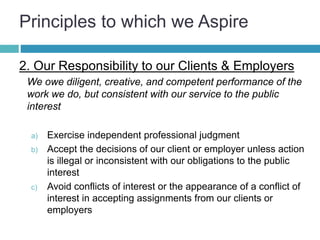
2. Our Responsibility to our Clients & Employers
We owe diligent, creative, and competent performance of the
work we do, but consistent with our service to the public
interest
a) Exercise independent professional judgment
b) Accept the decisions of our client or employer unless action
is illegal or inconsistent with our obligations to the public
interest
c) Avoid conflicts of interest or the appearance of a conflict of
interest in accepting assignments from our clients or
employers
Principles to which we Aspire
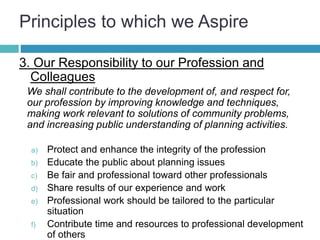
3. Our Responsibility to our Profession and
Colleagues
We shall contribute to the development of, and respect for,
our profession by improving knowledge and techniques,
making work relevant to solutions of community problems,
and increasing public understanding of planning activities.
a) Protect and enhance the integrity of the profession
b) Educate the public about planning issues
c) Be fair and professional toward other professionals
d) Share results of our experience and work
e) Professional work should be tailored to the particular
situation
f) Contribute time and resources to professional development
of others
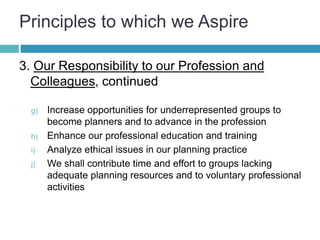
Principles to which we Aspire
3. Our Responsibility to our Profession and
Colleagues, continued
g) Increase opportunities for underrepresented groups to
become planners and to advance in the profession
h) Enhance our professional education and training
i) Analyze ethical issues in our planning practice
j) We shall contribute time and effort to groups lacking
adequate planning resources and to voluntary professional
activities
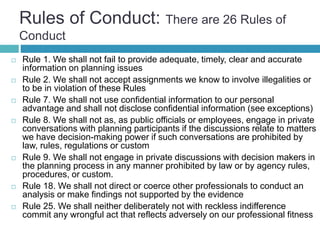
Rules of Conduct: There are 26 Rules of
Conduct
 Rule 1. We shall not fail to provide adequate, timely, clear and accurate
information on planning issues
 Rule 2. We shall not accept assignments we know to involve illegalities or
to be in violation of these Rules
 Rule 7. We shall not use confidential information to our personal
advantage and shall not disclose confidential information (see exceptions)
 Rule 8. We shall not as, as public officials or employees, engage in private
conversations with planning participants if the discussions relate to matters
we have decision-making power if such conversations are prohibited by
law, rules, regulations or custom
 Rule 9. We shall not engage in private discussions with decision makers in
the planning process in any manner prohibited by law or by agency rules,
procedures, or custom.
 Rule 18. We shall not direct or coerce other professionals to conduct an
analysis or make findings not supported by the evidence
 Rule 25. We shall neither deliberately not with reckless indifference
commit any wrongful act that reflects adversely on our professional fitness
Recent Changes to the Code
as of April 1, 2016
 Reduced complexity in
complaints and charges
procedures and reduced
number of steps for decision
making and appeals.
 Increase emphasis on
education and remediation.
 Eliminate prosecutorial
"hearing officer“ role and
replace with an increased
role for the Ethics Committee
and Ethics.
 Increase communication of
case activity and advisory
opinions.
 Section C is now “Advisory
Opinions”
 Formal or informal advisory
rulings
 Investigation & decision by
Ethics Officer/Committee
 Section D is now “Adjudication
of Complaints of Misconduct”
 Filing of complaint
 Case settlement
 Appeal
 Section E is now “Discipline of
Members”
 Forms of Discipline
 Conviction of Crimes
 Unethical Conduct
 Reinstatement
Shift In Communication Opportunities and
Needs
Ethics of Digital Communication
Common Issues in Digital Communication
Ethics of Digital Communication
Radical Shift In Communication
Opportunities and Needs
 Communication is central to our profession and
to our code of ethics
 Communication opportunities and requirements
have changed not only due to technology, but
due to diversity in our population.
 We have an ethical responsibility to respond
appropriately to the new communication
technology
and to the diverse needs of our constituents
Ethics of Digital Communication
 Use of new technology creates new
expectations and responsibilities
 Used judiciously, digital communication can be
an invaluable tool and can ensure more
inclusive, effective, and efficient public dialogue
 Used unwisely, it can exclude and
disenfranchise certain groups, erode respect for
the profession, and mislead the public, in
violation of our Code
Issues in Digital Communication
 Keeping information up-to-date and accurate
 Ensuring the wrong kind of message doesn’t go
out
 Breaching confidentiality
 Inappropriate materials
 Ensuring that open government laws are not
violated
 Preventing manipulation of public dialogue
 Avoiding over-reliance on digital communication
and thereby limiting accessibility to certain
groups
 Not taking advantage of increased ability to
Many things obvious, some subtle…where
are the red rags, take note!
Hypotheticals:
Two scenarios presenting ethical issues
Hypothetical #1
The Domineering Chairman
Questions
 What was the level of communications among the
board members, staff, applicant and public?
 What could the non-speaking members of the PB
done differently?
 Is the pledged “annual fundraiser for the fire
department” a problem? If so, why?
 Ronnie Roughshod indicated that the application was
reviewed beforehand with the town planner and a
couple of the board members. Does this raise issues?
 How could have Robin Retro helped support all PB
members?
 Should Robin go home and update her LinkedIn
account, and revise her resume?
 Other RED FLAGS?
AICP Ethical Principles
Involved
1. Our Overall Responsibility to the Public
a) Be conscious of the rights of others
d) Provide timely, adequate, clear and accurate
information
e) Give people opportunity to have meaningful impact
on plans and programs that may affect them
h) Deal fairly with all participants in the planning
process
3. Our Responsibility to our Profession and
Colleagues
a) Educate the public about planning issues
Rules of Conduct
 Rule 1. We shall not fail to provide adequate,
timely, clear and accurate information on planning
issues.
Hypothetical #2
The Grocery Store Encounter
Questions
 What could Luke have done differently when
meeting Mickey Green over the avocado bin?
 What advice could you give as Robin Retro to
Luke?
 Is there a problem with Luke Lips providing
information to Robin Retro regarding the
potential TCE contamination?
 Why did Robin Retro ask if the motorcycle was
part of his independent knowledge?
 What role did the avocados play in this
scenario?
 Other RED FLAGS?
AICP Ethical Principles
Involved
1. Our Overall Responsibility to the Public
a) Be conscious of the rights of others
d) Provide timely, adequate, clear and accurate
information
e) Give people opportunity to have meaningful impact
on plans and programs that may affect them
h) Deal fairly with all participants in the planning process
3. Our Responsibility to our Profession and
Colleagues
b) Educate the public about planning issues
Rules of Conduct
 Rule 1. We shall not fail to provide adequate,
timely, clear and accurate information on planning
issues.
 Rule 8. We shall not engage in private discussions
in any manner prohibited by law or regulations
The Attorney’s Role
 City Lawyer or Town Counsel
 City lawyer’s role in the public hearing setting
 How planners can utilize lawyers when
complying with the code and otherwise.
QUESTIONS
https://www.planning.org/ethics/ethicscoder
evision.htm
(Effective April 1, 2016)
AICP Code of Ethics
Thank you
Bob Mitchell, FAICP
Robert Mitchell & Associates Consulting
MitchellFAICP@gmail.com
Al Rinaldi, AICP
Town Planner, Lincoln, RI
aranaldi@lincolnri.org
Kristin E. Kassner, AICP
Town of Burlington, MA
kkassner@burlington.org
Brian Smith, Attorney
Robinson and Cole
BSMITH@rc.com

Ethics sneapa 2016 10 15_16

  • 1.
    PLANNING ETHICS ETHICS OFDIGITAL COMMUNICATION AND DEALING WITH ROGUE BOARDS Southern New England Planning Conference October 21, 2016 Bob Mitchell, FAICP, Robert Mitchell & Associates Consulting Al Ranaldi, AICP, Town Planner, Lincoln, RI Kristin Kassner, AICP, Town of Burlington , MA Brian Smith, Attorney, Robinson and Cole
  • 2.
    “Always do right.This will gratify some people and astonish the rest”. - Mark Twain Why we talk about ethics
  • 3.
    Why talk aboutethics?  Citizens have a right to expect that their planners will help elevate governance, not fall to its more base level. Citizens should also expect Boards to embody similar ethical principals in their deliberations.  Planners and Board members have ethical responsibilities to their colleagues, their clients and their communities.  Ethics scenarios are rarely “cut and dried” and often contain a high level of nuance. This session should help to develop reasoning and reflection skills that can be applied in everyday situations.
  • 4.
    We are Communicators Every process involves communicating with diverse stakeholders  We play varied roles as communicators  Educators  Listeners/Conveyors  Mediators  Advocates  Community Group Therapists  Facilitators
  • 5.
    Ethical Quicksand  Clientv. Community  Technology  Framing Issues (honesty, clarity, completeness)  Confidentiality v. Openness  Facilitation v. Advocacy
  • 6.
    AMENDED AS OF4/1/2016 AICP Code of Ethics
  • 7.
    AICP Code ofEthics and Professional Conduct: Five Sections  Principles to which we Aspire – ideals to which we are committed  Rules of Conduct – rules to which we are held accountable  Procedures – how to obtain a formal or informal advisory ruling  Procedures – how complaints are filed and investigated  Procedures – forms of disciplinary actions The slides that follow on the AICP Code are brief summaries of the Code. The full text of the Code can be found athttp://www.planning.org/ethicscode.htm
  • 8.
    Principles to whichwe Aspire 1. Our Overall Responsibility to the Public Our primary obligation is to serve the public interest a) Be conscious of the rights of others b) Have special concern for long range consequences of actions c) Pay special attention to interrelatedness of actions d) Provide timely, adequate and clear information e) Give people opportunity to have meaningful impact on plans and programs that may affect them f) Seek social justice; Expand choice and opportunity for all; Plan for the needs of the disadvantaged; promote racial and economic integration g) Deal fairly with all participants in the planning process
  • 9.
    Principles to whichwe Aspire 2. Our Responsibility to our Clients & Employers We owe diligent, creative, and competent performance of the work we do, but consistent with our service to the public interest a) Exercise independent professional judgment b) Accept the decisions of our client or employer unless action is illegal or inconsistent with our obligations to the public interest c) Avoid conflicts of interest or the appearance of a conflict of interest in accepting assignments from our clients or employers
  • 10.
    Principles to whichwe Aspire 3. Our Responsibility to our Profession and Colleagues We shall contribute to the development of, and respect for, our profession by improving knowledge and techniques, making work relevant to solutions of community problems, and increasing public understanding of planning activities. a) Protect and enhance the integrity of the profession b) Educate the public about planning issues c) Be fair and professional toward other professionals d) Share results of our experience and work e) Professional work should be tailored to the particular situation f) Contribute time and resources to professional development of others
  • 11.
    Principles to whichwe Aspire 3. Our Responsibility to our Profession and Colleagues, continued g) Increase opportunities for underrepresented groups to become planners and to advance in the profession h) Enhance our professional education and training i) Analyze ethical issues in our planning practice j) We shall contribute time and effort to groups lacking adequate planning resources and to voluntary professional activities
  • 12.
    Rules of Conduct:There are 26 Rules of Conduct  Rule 1. We shall not fail to provide adequate, timely, clear and accurate information on planning issues  Rule 2. We shall not accept assignments we know to involve illegalities or to be in violation of these Rules  Rule 7. We shall not use confidential information to our personal advantage and shall not disclose confidential information (see exceptions)  Rule 8. We shall not as, as public officials or employees, engage in private conversations with planning participants if the discussions relate to matters we have decision-making power if such conversations are prohibited by law, rules, regulations or custom  Rule 9. We shall not engage in private discussions with decision makers in the planning process in any manner prohibited by law or by agency rules, procedures, or custom.  Rule 18. We shall not direct or coerce other professionals to conduct an analysis or make findings not supported by the evidence  Rule 25. We shall neither deliberately not with reckless indifference commit any wrongful act that reflects adversely on our professional fitness
  • 13.
    Recent Changes tothe Code as of April 1, 2016  Reduced complexity in complaints and charges procedures and reduced number of steps for decision making and appeals.  Increase emphasis on education and remediation.  Eliminate prosecutorial "hearing officer“ role and replace with an increased role for the Ethics Committee and Ethics.  Increase communication of case activity and advisory opinions.  Section C is now “Advisory Opinions”  Formal or informal advisory rulings  Investigation & decision by Ethics Officer/Committee  Section D is now “Adjudication of Complaints of Misconduct”  Filing of complaint  Case settlement  Appeal  Section E is now “Discipline of Members”  Forms of Discipline  Conviction of Crimes  Unethical Conduct  Reinstatement
  • 14.
    Shift In CommunicationOpportunities and Needs Ethics of Digital Communication Common Issues in Digital Communication Ethics of Digital Communication
  • 15.
    Radical Shift InCommunication Opportunities and Needs  Communication is central to our profession and to our code of ethics  Communication opportunities and requirements have changed not only due to technology, but due to diversity in our population.  We have an ethical responsibility to respond appropriately to the new communication technology and to the diverse needs of our constituents
  • 16.
    Ethics of DigitalCommunication  Use of new technology creates new expectations and responsibilities  Used judiciously, digital communication can be an invaluable tool and can ensure more inclusive, effective, and efficient public dialogue  Used unwisely, it can exclude and disenfranchise certain groups, erode respect for the profession, and mislead the public, in violation of our Code
  • 17.
    Issues in DigitalCommunication  Keeping information up-to-date and accurate  Ensuring the wrong kind of message doesn’t go out  Breaching confidentiality  Inappropriate materials  Ensuring that open government laws are not violated  Preventing manipulation of public dialogue  Avoiding over-reliance on digital communication and thereby limiting accessibility to certain groups  Not taking advantage of increased ability to
  • 18.
    Many things obvious,some subtle…where are the red rags, take note! Hypotheticals: Two scenarios presenting ethical issues
  • 19.
  • 20.
    Questions  What wasthe level of communications among the board members, staff, applicant and public?  What could the non-speaking members of the PB done differently?  Is the pledged “annual fundraiser for the fire department” a problem? If so, why?  Ronnie Roughshod indicated that the application was reviewed beforehand with the town planner and a couple of the board members. Does this raise issues?  How could have Robin Retro helped support all PB members?  Should Robin go home and update her LinkedIn account, and revise her resume?  Other RED FLAGS?
  • 21.
    AICP Ethical Principles Involved 1.Our Overall Responsibility to the Public a) Be conscious of the rights of others d) Provide timely, adequate, clear and accurate information e) Give people opportunity to have meaningful impact on plans and programs that may affect them h) Deal fairly with all participants in the planning process 3. Our Responsibility to our Profession and Colleagues a) Educate the public about planning issues Rules of Conduct  Rule 1. We shall not fail to provide adequate, timely, clear and accurate information on planning issues.
  • 22.
  • 23.
    Questions  What couldLuke have done differently when meeting Mickey Green over the avocado bin?  What advice could you give as Robin Retro to Luke?  Is there a problem with Luke Lips providing information to Robin Retro regarding the potential TCE contamination?  Why did Robin Retro ask if the motorcycle was part of his independent knowledge?  What role did the avocados play in this scenario?  Other RED FLAGS?
  • 24.
    AICP Ethical Principles Involved 1.Our Overall Responsibility to the Public a) Be conscious of the rights of others d) Provide timely, adequate, clear and accurate information e) Give people opportunity to have meaningful impact on plans and programs that may affect them h) Deal fairly with all participants in the planning process 3. Our Responsibility to our Profession and Colleagues b) Educate the public about planning issues Rules of Conduct  Rule 1. We shall not fail to provide adequate, timely, clear and accurate information on planning issues.  Rule 8. We shall not engage in private discussions in any manner prohibited by law or regulations
  • 25.
    The Attorney’s Role City Lawyer or Town Counsel  City lawyer’s role in the public hearing setting  How planners can utilize lawyers when complying with the code and otherwise.
  • 26.
  • 27.
  • 28.
    Thank you Bob Mitchell,FAICP Robert Mitchell & Associates Consulting MitchellFAICP@gmail.com Al Rinaldi, AICP Town Planner, Lincoln, RI aranaldi@lincolnri.org Kristin E. Kassner, AICP Town of Burlington, MA kkassner@burlington.org Brian Smith, Attorney Robinson and Cole BSMITH@rc.com