Lesson OverviewLesson Overview The Process of Cell DivisionThe Process of Cell Division
Lesson OverviewLesson Overview
10.2 The Process10.2 The Process
of Cell Divisionof Cell Division
Lesson OverviewLesson Overview The Process of Cell DivisionThe Process of Cell Division
THINK ABOUT IT
What role does cell division play in your life?
Does cell division stop when you are finished growing?
Lesson OverviewLesson Overview The Process of Cell DivisionThe Process of Cell Division
Chromosomes
What is the role of chromosomes in cell division?
Lesson OverviewLesson Overview The Process of Cell DivisionThe Process of Cell Division
Chromosomes
What is the role of chromosomes in cell division?
Chromosomes make it possible to separate DNA precisely during cell
division.
Lesson OverviewLesson Overview The Process of Cell DivisionThe Process of Cell Division
The genetic information that is passed on from one generation of cells to
the next is carried by chromosomes.
Every cell must copy its genetic information before cell division begins.
Each daughter cell gets its own copy of that genetic information.
Cells of every organism have a specific number of chromosomes.
Chromosomes
Lesson OverviewLesson Overview The Process of Cell DivisionThe Process of Cell Division
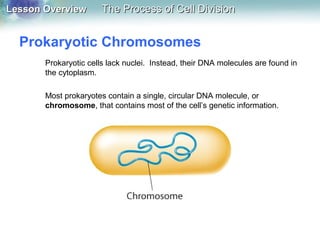
Prokaryotic Chromosomes
Prokaryotic cells lack nuclei. Instead, their DNA molecules are found in
the cytoplasm.
Most prokaryotes contain a single, circular DNA molecule, or
chromosome, that contains most of the cell’s genetic information.
Lesson OverviewLesson Overview The Process of Cell DivisionThe Process of Cell Division
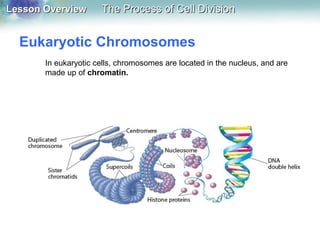
Eukaryotic Chromosomes
In eukaryotic cells, chromosomes are located in the nucleus, and are
made up of chromatin.
Lesson OverviewLesson Overview The Process of Cell DivisionThe Process of Cell Division
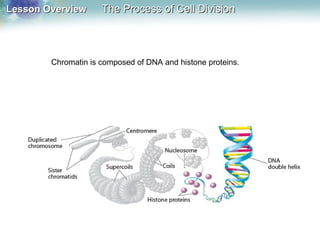
Chromatin is composed of DNA and histone proteins.
Lesson OverviewLesson Overview The Process of Cell DivisionThe Process of Cell Division
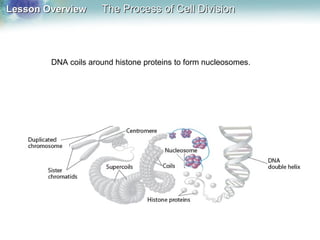
DNA coils around histone proteins to form nucleosomes.
Lesson OverviewLesson Overview The Process of Cell DivisionThe Process of Cell Division
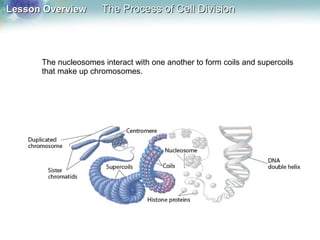
The nucleosomes interact with one another to form coils and supercoils
that make up chromosomes.
Lesson OverviewLesson Overview The Process of Cell DivisionThe Process of Cell Division
The Cell Cycle
What are the main events of the cell cycle?
Lesson OverviewLesson Overview The Process of Cell DivisionThe Process of Cell Division
The Cell Cycle
What are the main events of the cell cycle?
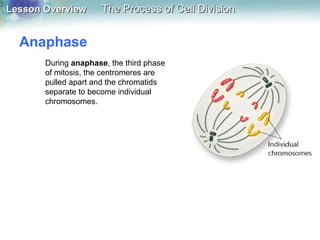
During the cell cycle, a cell grows, prepares for division, and divides to
form two daughter cells.
Lesson OverviewLesson Overview The Process of Cell DivisionThe Process of Cell Division
The Prokaryotic Cell Cycle
The prokaryotic cell cycle is a regular pattern of growth, DNA
replication, and cell division.
Most prokaryotic cells begin to replicate, or copy, their DNA once they
have grown to a certain size.
When DNA replication is complete, the cells divide through a process
known as binary fission.
Lesson OverviewLesson Overview The Process of Cell DivisionThe Process of Cell Division
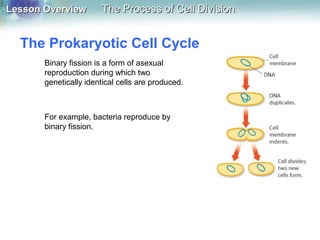
Binary fission is a form of asexual
reproduction during which two
genetically identical cells are produced.
For example, bacteria reproduce by
binary fission.
The Prokaryotic Cell Cycle
Lesson OverviewLesson Overview The Process of Cell DivisionThe Process of Cell Division
The Eukaryotic Cell Cycle
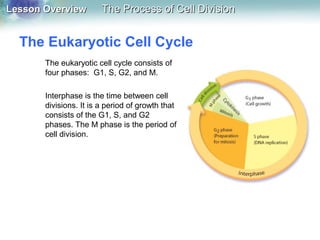
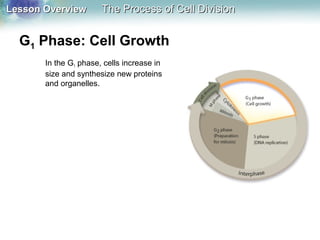
The eukaryotic cell cycle consists of
four phases: G1, S, G2, and M.
Interphase is the time between cell
divisions. It is a period of growth that
consists of the G1, S, and G2
phases. The M phase is the period of
cell division.
Lesson OverviewLesson Overview The Process of Cell DivisionThe Process of Cell Division
G1 Phase: Cell Growth
In the G1 phase, cells increase in
size and synthesize new proteins
and organelles.
Lesson OverviewLesson Overview The Process of Cell DivisionThe Process of Cell Division
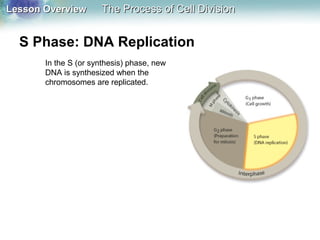
S Phase: DNA Replication
In the S (or synthesis) phase, new
DNA is synthesized when the
chromosomes are replicated.
Lesson OverviewLesson Overview The Process of Cell DivisionThe Process of Cell Division
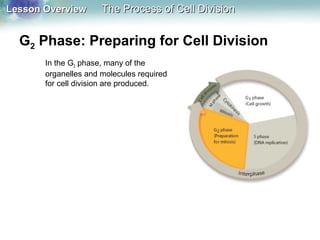
G2 Phase: Preparing for Cell Division
In the G2 phase, many of the
organelles and molecules required
for cell division are produced.
Lesson OverviewLesson Overview The Process of Cell DivisionThe Process of Cell Division
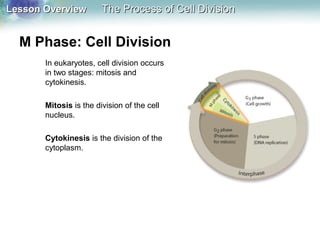
M Phase: Cell Division
In eukaryotes, cell division occurs
in two stages: mitosis and
cytokinesis.
Mitosis is the division of the cell
nucleus.
Cytokinesis is the division of the
cytoplasm.
Lesson OverviewLesson Overview The Process of Cell DivisionThe Process of Cell Division
Mitosis
What events occur during each of the four phases of mitosis?
Lesson OverviewLesson Overview The Process of Cell DivisionThe Process of Cell Division
Mitosis
What events occur during each of the four phases of mitosis?
During prophase, the genetic material inside the nucleus condenses and
the duplicated chromosomes become visible. Outside the nucleus, a
spindle starts to form.
Lesson OverviewLesson Overview The Process of Cell DivisionThe Process of Cell Division
Mitosis
What events occur during each of the four phases of mitosis?
During metaphase, the centromeres of the duplicated chromosomes line up
across the center of the cell. Spindle fibers connect the centromere of each
chromosome to the two poles of the spindle.
Lesson OverviewLesson Overview The Process of Cell DivisionThe Process of Cell Division
Mitosis
What events occur during each of the four phases of mitosis?
During anaphase, the chromosomes separate and move along spindle
fibers to opposite ends of the cell.
Lesson OverviewLesson Overview The Process of Cell DivisionThe Process of Cell Division
Mitosis
What events occur during each of the four phases of mitosis?
During telophase, the chromosomes, which were distinct and condensed,
begin to spread out into a tangle of chromatin.
Lesson OverviewLesson Overview The Process of Cell DivisionThe Process of Cell Division
Important Cell Structures Involved in
Mitosis
Chromatid – each strand of a duplicated chromosome
Centromere – the area where each pair of chromatids is joined
Centrioles – tiny structures located in the cytoplasm of animal cells that
help organize the spindle
Spindle – a fanlike microtubule structure that helps separate the
chromatids
Lesson OverviewLesson Overview The Process of Cell DivisionThe Process of Cell Division
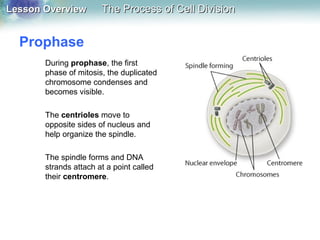
Prophase
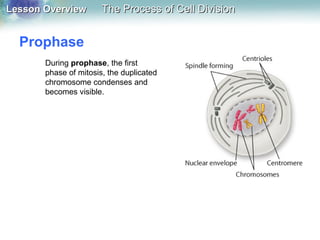
During prophase, the first
phase of mitosis, the duplicated
chromosome condenses and
becomes visible.
Lesson OverviewLesson Overview The Process of Cell DivisionThe Process of Cell Division
Prophase
During prophase, the first
phase of mitosis, the duplicated
chromosome condenses and
becomes visible.
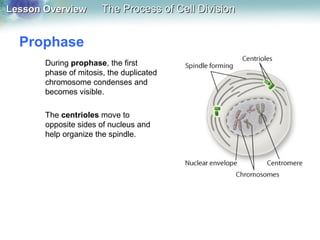
The centrioles move to
opposite sides of nucleus and
help organize the spindle.
Lesson OverviewLesson Overview The Process of Cell DivisionThe Process of Cell Division
Prophase
During prophase, the first
phase of mitosis, the duplicated
chromosome condenses and
becomes visible.
The centrioles move to
opposite sides of nucleus and
help organize the spindle.
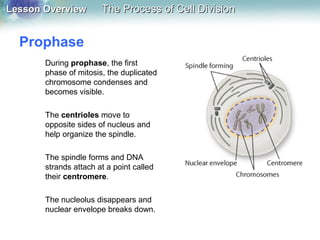
The spindle forms and DNA
strands attach at a point called
their centromere.
Lesson OverviewLesson Overview The Process of Cell DivisionThe Process of Cell Division
Prophase
During prophase, the first
phase of mitosis, the duplicated
chromosome condenses and
becomes visible.
The centrioles move to
opposite sides of nucleus and
help organize the spindle.
The spindle forms and DNA
strands attach at a point called
their centromere.
The nucleolus disappears and
nuclear envelope breaks down.
Lesson OverviewLesson Overview The Process of Cell DivisionThe Process of Cell Division
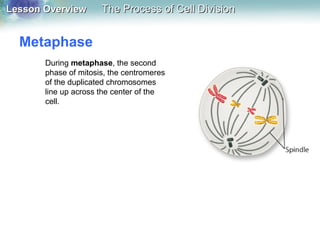
Metaphase
During metaphase, the second
phase of mitosis, the centromeres
of the duplicated chromosomes
line up across the center of the
cell.
Lesson OverviewLesson Overview The Process of Cell DivisionThe Process of Cell Division
Metaphase
During metaphase, the second
phase of mitosis, the centromeres
of the duplicated chromosomes
line up across the center of the
cell.
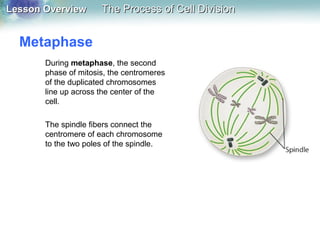
The spindle fibers connect the
centromere of each chromosome
to the two poles of the spindle.
Lesson OverviewLesson Overview The Process of Cell DivisionThe Process of Cell Division
Anaphase
During anaphase, the third phase
of mitosis, the centromeres are
pulled apart and the chromatids
separate to become individual
chromosomes.
Lesson OverviewLesson Overview The Process of Cell DivisionThe Process of Cell Division
Anaphase
During anaphase, the third phase
of mitosis, the centromeres are
pulled apart and the chromatids
separate to become individual
chromosomes.
The chromosomes separate into
two groups near the poles of the
spindle.
Lesson OverviewLesson Overview The Process of Cell DivisionThe Process of Cell Division
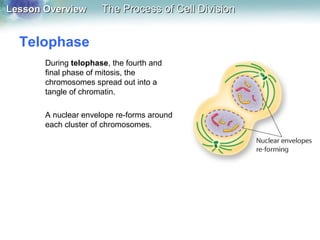
Telophase
During telophase, the fourth and
final phase of mitosis, the
chromosomes spread out into a
tangle of chromatin.
Lesson OverviewLesson Overview The Process of Cell DivisionThe Process of Cell Division
Telophase
During telophase, the fourth and
final phase of mitosis, the
chromosomes spread out into a
tangle of chromatin.
A nuclear envelope re-forms around
each cluster of chromosomes.
Lesson OverviewLesson Overview The Process of Cell DivisionThe Process of Cell Division
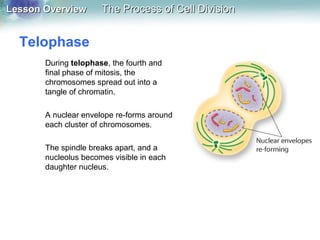
Telophase
During telophase, the fourth and
final phase of mitosis, the
chromosomes spread out into a
tangle of chromatin.
A nuclear envelope re-forms around
each cluster of chromosomes.
The spindle breaks apart, and a
nucleolus becomes visible in each
daughter nucleus.
Lesson OverviewLesson Overview The Process of Cell DivisionThe Process of Cell Division
Cytokinesis
How do daughter cells split apart after mitosis?
Lesson OverviewLesson Overview The Process of Cell DivisionThe Process of Cell Division
Cytokinesis
How do daughter cells split apart after mitosis?
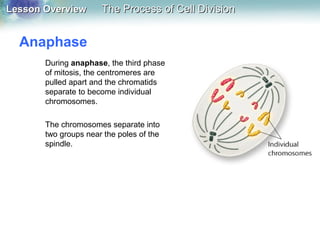
Cytokinesis completes the process of cell division – it splits one cell into
two.
Lesson OverviewLesson Overview The Process of Cell DivisionThe Process of Cell Division
Cytokinesis is the division of the cytoplasm.
The process of cytokinesis is different in animal and plant cells.
Cytokinesis
Lesson OverviewLesson Overview The Process of Cell DivisionThe Process of Cell Division
Cytokinesis in Animal Cells
The cell membrane is drawn in until the cytoplasm is pinched into two
equal parts.
Each part contains its own nucleus and organelles.
Lesson OverviewLesson Overview The Process of Cell DivisionThe Process of Cell Division
Cytokinesis in Plant Cells
In plants, the cell membrane is not flexible enough to draw inward
because of the rigid cell wall.
Instead, a cell plate forms between the divided nuclei that develops into
cell membranes.
A cell wall then forms in between the two new membranes.
Lesson OverviewLesson Overview The Process of Cell DivisionThe Process of Cell Division
The Stages of the Cell Cycle

CVA Biology I - B10vrv3102

  • 1.
    Lesson OverviewLesson OverviewThe Process of Cell DivisionThe Process of Cell Division Lesson OverviewLesson Overview 10.2 The Process10.2 The Process of Cell Divisionof Cell Division
  • 2.
    Lesson OverviewLesson OverviewThe Process of Cell DivisionThe Process of Cell Division THINK ABOUT IT What role does cell division play in your life? Does cell division stop when you are finished growing?
  • 3.
    Lesson OverviewLesson OverviewThe Process of Cell DivisionThe Process of Cell Division Chromosomes What is the role of chromosomes in cell division?
  • 4.
    Lesson OverviewLesson OverviewThe Process of Cell DivisionThe Process of Cell Division Chromosomes What is the role of chromosomes in cell division? Chromosomes make it possible to separate DNA precisely during cell division.
  • 5.
    Lesson OverviewLesson OverviewThe Process of Cell DivisionThe Process of Cell Division The genetic information that is passed on from one generation of cells to the next is carried by chromosomes. Every cell must copy its genetic information before cell division begins. Each daughter cell gets its own copy of that genetic information. Cells of every organism have a specific number of chromosomes. Chromosomes
  • 6.
    Lesson OverviewLesson OverviewThe Process of Cell DivisionThe Process of Cell Division Prokaryotic Chromosomes Prokaryotic cells lack nuclei. Instead, their DNA molecules are found in the cytoplasm. Most prokaryotes contain a single, circular DNA molecule, or chromosome, that contains most of the cell’s genetic information.
  • 7.
    Lesson OverviewLesson OverviewThe Process of Cell DivisionThe Process of Cell Division Eukaryotic Chromosomes In eukaryotic cells, chromosomes are located in the nucleus, and are made up of chromatin.
  • 8.
    Lesson OverviewLesson OverviewThe Process of Cell DivisionThe Process of Cell Division Chromatin is composed of DNA and histone proteins.
  • 9.
    Lesson OverviewLesson OverviewThe Process of Cell DivisionThe Process of Cell Division DNA coils around histone proteins to form nucleosomes.
  • 10.
    Lesson OverviewLesson OverviewThe Process of Cell DivisionThe Process of Cell Division The nucleosomes interact with one another to form coils and supercoils that make up chromosomes.
  • 11.
    Lesson OverviewLesson OverviewThe Process of Cell DivisionThe Process of Cell Division The Cell Cycle What are the main events of the cell cycle?
  • 12.
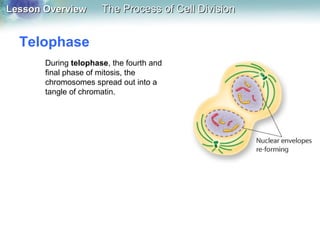
    Lesson OverviewLesson OverviewThe Process of Cell DivisionThe Process of Cell Division The Cell Cycle What are the main events of the cell cycle? During the cell cycle, a cell grows, prepares for division, and divides to form two daughter cells.
  • 13.
    Lesson OverviewLesson OverviewThe Process of Cell DivisionThe Process of Cell Division The Prokaryotic Cell Cycle The prokaryotic cell cycle is a regular pattern of growth, DNA replication, and cell division. Most prokaryotic cells begin to replicate, or copy, their DNA once they have grown to a certain size. When DNA replication is complete, the cells divide through a process known as binary fission.
  • 14.
    Lesson OverviewLesson OverviewThe Process of Cell DivisionThe Process of Cell Division Binary fission is a form of asexual reproduction during which two genetically identical cells are produced. For example, bacteria reproduce by binary fission. The Prokaryotic Cell Cycle
  • 15.
    Lesson OverviewLesson OverviewThe Process of Cell DivisionThe Process of Cell Division The Eukaryotic Cell Cycle The eukaryotic cell cycle consists of four phases: G1, S, G2, and M. Interphase is the time between cell divisions. It is a period of growth that consists of the G1, S, and G2 phases. The M phase is the period of cell division.
  • 16.
    Lesson OverviewLesson OverviewThe Process of Cell DivisionThe Process of Cell Division G1 Phase: Cell Growth In the G1 phase, cells increase in size and synthesize new proteins and organelles.
  • 17.
    Lesson OverviewLesson OverviewThe Process of Cell DivisionThe Process of Cell Division S Phase: DNA Replication In the S (or synthesis) phase, new DNA is synthesized when the chromosomes are replicated.
  • 18.
    Lesson OverviewLesson OverviewThe Process of Cell DivisionThe Process of Cell Division G2 Phase: Preparing for Cell Division In the G2 phase, many of the organelles and molecules required for cell division are produced.
  • 19.
    Lesson OverviewLesson OverviewThe Process of Cell DivisionThe Process of Cell Division M Phase: Cell Division In eukaryotes, cell division occurs in two stages: mitosis and cytokinesis. Mitosis is the division of the cell nucleus. Cytokinesis is the division of the cytoplasm.
  • 20.
    Lesson OverviewLesson OverviewThe Process of Cell DivisionThe Process of Cell Division Mitosis What events occur during each of the four phases of mitosis?
  • 21.
    Lesson OverviewLesson OverviewThe Process of Cell DivisionThe Process of Cell Division Mitosis What events occur during each of the four phases of mitosis? During prophase, the genetic material inside the nucleus condenses and the duplicated chromosomes become visible. Outside the nucleus, a spindle starts to form.
  • 22.
    Lesson OverviewLesson OverviewThe Process of Cell DivisionThe Process of Cell Division Mitosis What events occur during each of the four phases of mitosis? During metaphase, the centromeres of the duplicated chromosomes line up across the center of the cell. Spindle fibers connect the centromere of each chromosome to the two poles of the spindle.
  • 23.
    Lesson OverviewLesson OverviewThe Process of Cell DivisionThe Process of Cell Division Mitosis What events occur during each of the four phases of mitosis? During anaphase, the chromosomes separate and move along spindle fibers to opposite ends of the cell.
  • 24.
    Lesson OverviewLesson OverviewThe Process of Cell DivisionThe Process of Cell Division Mitosis What events occur during each of the four phases of mitosis? During telophase, the chromosomes, which were distinct and condensed, begin to spread out into a tangle of chromatin.
  • 25.
    Lesson OverviewLesson OverviewThe Process of Cell DivisionThe Process of Cell Division Important Cell Structures Involved in Mitosis Chromatid – each strand of a duplicated chromosome Centromere – the area where each pair of chromatids is joined Centrioles – tiny structures located in the cytoplasm of animal cells that help organize the spindle Spindle – a fanlike microtubule structure that helps separate the chromatids
  • 26.
    Lesson OverviewLesson OverviewThe Process of Cell DivisionThe Process of Cell Division Prophase During prophase, the first phase of mitosis, the duplicated chromosome condenses and becomes visible.
  • 27.
    Lesson OverviewLesson OverviewThe Process of Cell DivisionThe Process of Cell Division Prophase During prophase, the first phase of mitosis, the duplicated chromosome condenses and becomes visible. The centrioles move to opposite sides of nucleus and help organize the spindle.
  • 28.
    Lesson OverviewLesson OverviewThe Process of Cell DivisionThe Process of Cell Division Prophase During prophase, the first phase of mitosis, the duplicated chromosome condenses and becomes visible. The centrioles move to opposite sides of nucleus and help organize the spindle. The spindle forms and DNA strands attach at a point called their centromere.
  • 29.
    Lesson OverviewLesson OverviewThe Process of Cell DivisionThe Process of Cell Division Prophase During prophase, the first phase of mitosis, the duplicated chromosome condenses and becomes visible. The centrioles move to opposite sides of nucleus and help organize the spindle. The spindle forms and DNA strands attach at a point called their centromere. The nucleolus disappears and nuclear envelope breaks down.
  • 30.
    Lesson OverviewLesson OverviewThe Process of Cell DivisionThe Process of Cell Division Metaphase During metaphase, the second phase of mitosis, the centromeres of the duplicated chromosomes line up across the center of the cell.
  • 31.
    Lesson OverviewLesson OverviewThe Process of Cell DivisionThe Process of Cell Division Metaphase During metaphase, the second phase of mitosis, the centromeres of the duplicated chromosomes line up across the center of the cell. The spindle fibers connect the centromere of each chromosome to the two poles of the spindle.
  • 32.
    Lesson OverviewLesson OverviewThe Process of Cell DivisionThe Process of Cell Division Anaphase During anaphase, the third phase of mitosis, the centromeres are pulled apart and the chromatids separate to become individual chromosomes.
  • 33.
    Lesson OverviewLesson OverviewThe Process of Cell DivisionThe Process of Cell Division Anaphase During anaphase, the third phase of mitosis, the centromeres are pulled apart and the chromatids separate to become individual chromosomes. The chromosomes separate into two groups near the poles of the spindle.
  • 34.
    Lesson OverviewLesson OverviewThe Process of Cell DivisionThe Process of Cell Division Telophase During telophase, the fourth and final phase of mitosis, the chromosomes spread out into a tangle of chromatin.
  • 35.
    Lesson OverviewLesson OverviewThe Process of Cell DivisionThe Process of Cell Division Telophase During telophase, the fourth and final phase of mitosis, the chromosomes spread out into a tangle of chromatin. A nuclear envelope re-forms around each cluster of chromosomes.
  • 36.
    Lesson OverviewLesson OverviewThe Process of Cell DivisionThe Process of Cell Division Telophase During telophase, the fourth and final phase of mitosis, the chromosomes spread out into a tangle of chromatin. A nuclear envelope re-forms around each cluster of chromosomes. The spindle breaks apart, and a nucleolus becomes visible in each daughter nucleus.
  • 37.
    Lesson OverviewLesson OverviewThe Process of Cell DivisionThe Process of Cell Division Cytokinesis How do daughter cells split apart after mitosis?
  • 38.
    Lesson OverviewLesson OverviewThe Process of Cell DivisionThe Process of Cell Division Cytokinesis How do daughter cells split apart after mitosis? Cytokinesis completes the process of cell division – it splits one cell into two.
  • 39.
    Lesson OverviewLesson OverviewThe Process of Cell DivisionThe Process of Cell Division Cytokinesis is the division of the cytoplasm. The process of cytokinesis is different in animal and plant cells. Cytokinesis
  • 40.
    Lesson OverviewLesson OverviewThe Process of Cell DivisionThe Process of Cell Division Cytokinesis in Animal Cells The cell membrane is drawn in until the cytoplasm is pinched into two equal parts. Each part contains its own nucleus and organelles.
  • 41.
    Lesson OverviewLesson OverviewThe Process of Cell DivisionThe Process of Cell Division Cytokinesis in Plant Cells In plants, the cell membrane is not flexible enough to draw inward because of the rigid cell wall. Instead, a cell plate forms between the divided nuclei that develops into cell membranes. A cell wall then forms in between the two new membranes.
  • 42.
    Lesson OverviewLesson OverviewThe Process of Cell DivisionThe Process of Cell Division The Stages of the Cell Cycle