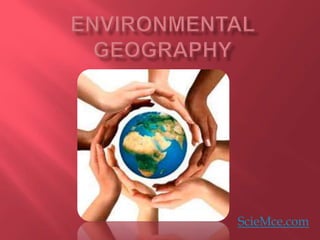
Environmental geography is the study of the components of the natural environment, their interactions with each other and with humans, and the resulting environmental issues. It examines the characteristics, composition, and functions of different environmental components; their interdependence; and the processes linking them within geoecosystems at varying spatial and temporal scales. Environmental geography also analyzes the interactions between technologically advanced humans and the natural environment, how this impacts and modifies geoecosystems, causes problems like degradation and pollution, and requires pollution control and ecological resource management.