Download to read offline
![Characterization of Arsenic contaminated Rice (Oryza Sativa L.) through RAPD Markers
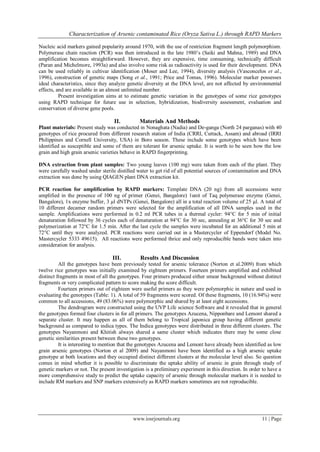
Figure B: RAPD analysis with primer X
Figure C: RAPD analysis with primer V
Amplification products from genomic DNAs of 12 accessions rice using a, primer OPA-14 (Fig B) and
primer OPA-08(Fig C). The lanes represent, M-molecular weight size marker, 1- Azucena, 2-KalingaII, 3Bon Ahu, 4- Lemont, 5- WGL 20471, 6-Khitish, 7-Nayanmon, 8-Badami, 9-Dee Geo Woe Gen 45, 10Shatabdi, 11-Peh Kuh Tsao Tu, 12-Nipponbare,
V.
Conclusion
It is concluded that all Japonica rice genotypes possess considerable variation in their genetic
base. Genetic makeup of a crop species is not affected by environment and only expression profiles
can be the targets of environment proved in present study as the landraces collected from different
geographical zones grouped together on the basis of RAPD banding profiles. The landraces with wide
genetic distance can be used as parents to exploit heterosis in future rice breeding programs. The rare
or unique alleles observed can further been employed for marker assisted selection programs. The
primers which proved more informative can be converted to sequence tagged sites (STS) and
sequence characterized amplified regions (SCAR) for amplification of specific alleles which could be
further utilized in rice genome analysis.
Acknowledgements
The authors would like to thank Dr. Adam Price (Department of Plant and Soil Science, School of
Biological Sciences, University of Aberdeen, Aberdeen) for the estimation of Arsenic in soil and grain and
provide all necessary information. We thank the International Rice Research Institute for providing the seeds of
some boro rice genotypes and grateful to the Department of Agriculture, Government of West Bengal for
providing fellowship and contingency support.
References
[1]
[2]
[3]
[4]
[5]
[6]
[7]
Christen, K. 2001. The arsenic threat worsens. Environmental science and technology 35: 286A- 291A.
Chowdhury, U.K., Biswas, B.K., Chowdhury, T.R., Samanta, G., Mandal, B.K., Basu, G.C., Chanda, C.R., Lodh, D., Saha, K.C.,
Mukherjee, S.K., Roy, S., Kabir, S., Quamruzzaman, Q., Chakraborti, D., 2000. Groundwater arsenic contamination in Bangladesh
and West Bengal, India. Environ. Health Perspect. 108, 393–397.
Cohen, S. M., L. L. Arnold, M. Eldan, A. S. Lewis, and B. D. Beck. 2006. Methylated arsenicals: The implications of metabolism
and carcinogenicity studies in rodents to human risk assessment. Crit. Rev. Toxicol. 36:99–133.
Dasgupta T, Hossain SA, Meharg AA, Price AH. 2004. An arsenate tolerance gene on chromosome 6 of rice. New Phytologist 163,
45–49.
Gareth J. Norton1, Meher Nigar1, Paul N. Williams1, Tapash Dasgupta, Andrew A. Meharg1 and Adam H. Price. 2008. Rice–
arsenate interactions in hydroponics: a three-gene model for tolerance Journal of Experimental Botany, Vol. 59, No. 8, pp. 2277–
2284,
Duxbury, J. M.; Panaullah, G. Remediation of Arsenic for Agriculture Sustainability, Food Security and Health in Bangladesh;FAO
Water Working Paper; FAO: Rome, 2007; p 28.
Fazal, M.A., Kawachi, T., Ichio, E., 2001. Validity of the latest research findings on causes of groundwater arsenic contamination in
Bangladesh. Water Int.26, 380–389.
www.iosrjournals.org
13 | Page](https://image.slidesharecdn.com/b0511014-131203234843-phpapp02/85/Characterization-of-Arsenic-contaminated-Rice-Oryza-Sativa-L-through-RAPD-Markers-4-320.jpg)
![Characterization of Arsenic contaminated Rice (Oryza Sativa L.) through RAPD Markers
[8]
[9]
[10]
[11]
[12]
[13]
[14]
[15]
[16]
[17]
[18]
[19]
[20]
[21]
[22]
[23]
[24]
[25]
Hopenhayn, C., 2006. Arsenic in drinking water: impact on human health. Elements 2, 103–107
Gamble, M. V., X. Liu, H. Ahsan, J. R. Pilsner, V. Llievski, V. Slavkovich, F. Parvez, D. Levy, P. Factor-Litvak, and J. H. Graziano.
2005. Folate, homocysteine, and arsenic metabolism in arsenic exposed individuals in Bangladesh. Environ. Health Perspect.
113:1683–1688.
Hopenhayn, C., 2006. Arsenic in drinking water: impact on human health. Elements 2, 103–107.
Judd, W.S.; Campbell, C.S.; Kellog, E.A. and Stevens P.F. (1999). Plant systematics; a Phylogenetic Approach .Sinaus Associat es.
Inc, Sunderland, 464
Kelly, J.D. (1995). Use of randomly amplified DNA markers is breeding from major gene resistance to plant pathogens. Hort.
Science, 30: 461 - 426.
Mead, M. N. 2005. Arsenic: In search of an antidote to a global poison. Environ. Health Perspect. 113:A379–A386.
Norton GJ, Lou-Hing DE, Meharg A, Price AH. Rice–arsenate interactions in hydroponics: whole genome transcriptional analysis.
Journal of Experimental Botany (2008) 59.
Norton, G. J.; Duan, G.; Dasgupta, T.; Islam, M. R.; Lei, M.; Zhu, Y. G.; Deacon, C. M.; Moran, A. C.; Islam, S.; Zhao, F. J.; Stroud,
J. L.; McGrath, S. P.; Feldmann, J.; Price, A. H.; Meharg, A. A. Environmental and genetic control of arsenic accumulation an d
speciation in rice grain: comparing a range ofcommoncultivars grown in contaminated sites across Bangladesh, China and India.
Environ. Sci. Technol. 2009, 43, 8381–8386.
Namkoong, G.; Kang, C.H. and Brouard, J.S. (1988). Tree Breeding : Principles and Strategies, Springer – Verlag, 170.
O’Neill, P., 1995. Arsenic. In: Alloway, B.J. (Ed.), Heavy Metals in Soils, pp.105–121.Paran, I. and Michelmore, R.W. (1993a).
Development of reliable PCR-based markers linked to downy mildew resistance genes in lettuce. Theor. Appl. Genet. 85: 985-993
Price, A. and Tomos, D. (1996). Locating genes for drought resistance in upland rice. In “ Plant Genome III, Abstructs of the
International Conference on the status of Plant Genome Research”, 70, 15-19 Jan, (1995) at San Diego, California, USA
Saiki, G.G. and Mahna, S.K. (1989). Induction of variation in mung bean. J. of Phytological Research. 2(1): 61 – 68
Sinclair, W.T.; Dorman, J.D. and Ennos R.A. (1980). Multiple origin of Scot Pine (Pinus syslvestris L.) in Scotland : evidence from
mitrochandrial DNA Variation. Heredity. 80: 233 - 240.
Smedley, P.L., Kinniburgh, D.G., 2002. A review of the source, behavior and distribution of arsenic in natural waters. Appl.
Geochem. 17, 517–568.
Smith, A.H., Lingas, E.O., Rahman, M., 2000. Contamination of drinking water by arsenic in Bangladesh: a public health emergency.
Bull. World HealthOrgan. 78, 1093–1103.
Song, K.M.; Suzuki J.Y.; Slocum M.K.; Williams, P.H. and Osborn, T.C. (1991). A linkage map of Brassica napa (syn. Campestris)
based on restriction fragment length polymorphism loci. Theor. Appl. Genet. 82 : 296 – 304
Vasconcelos, M.J.V.; De Barros, E.G.; Moreira, M.A. and Vieira, C. (1996). Genetic diversity of the common bean Phaseolus
vulgaris L. determined by DNA based molecular markers. Braz J. Genet. 19 : 447 - 451.
Williams, P. N.; Villada, A.; Deacon, C.; Raab, A.; Figuerola, J.;Green, A. J.; Feldmann, J.; Meharg, A. A. 2007b. Greatly enhanced
arsenic shoot assimilation in rice leads to elevated grain levels compared to wheat and barley. Environ. Sci. Technol., 41, 6854–6859.
www.iosrjournals.org
14 | Page](https://image.slidesharecdn.com/b0511014-131203234843-phpapp02/85/Characterization-of-Arsenic-contaminated-Rice-Oryza-Sativa-L-through-RAPD-Markers-5-320.jpg)

This study characterized rice genotypes for arsenic contamination using RAPD markers. Forty rice genotypes from India and other countries were tested for arsenic levels in fields with known arsenic contamination. DNA was extracted from plants and amplified using RAPD primers. Fourteen primers produced polymorphic bands that were scored. Cluster analysis grouped genotypes into four main clusters, separating japonica types from indica. Varieties previously found to have low or high arsenic levels clustered separately, indicating RAPD may help discriminate arsenic uptake ability. Further research with more markers is needed to better predict arsenic accumulation through genetics. This study provides a preliminary analysis of using molecular markers to study genetic control of arsenic uptake in rice.


