TOPIC :COMPREHENSION
MAHATMA GANDHI ARTS, SCIENCE & LATE N. P.
COMMERCE COLLEGE ARMORI, DIST. GADCHIROLI.
CLASS : B.A. II (III SEM)
SUBJECT : COMPULSORY ENGLISH
-Presented By-
Anil P. Raut ,
Assistant Professor ,
Department of English .
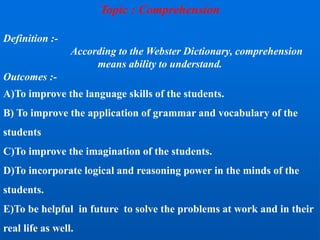
Topic : Comprehension
Definition :-
According to the Webster Dictionary, comprehension
means ability to understand.
Outcomes :-
A)To improve the language skills of the students.
B) To improve the application of grammar and vocabulary of the
students
C)To improve the imagination of the students.
D)To incorporate logical and reasoning power in the minds of the
students.
E)To be helpful in future to solve the problems at work and in their
real life as well.
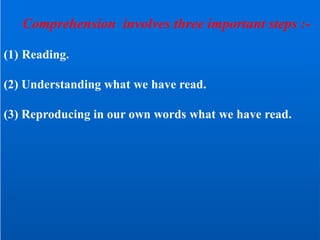
Comprehension involves three important steps :-
(1) Reading.
(2) Understanding what we have read.
(3) Reproducing in our own words what we have read.
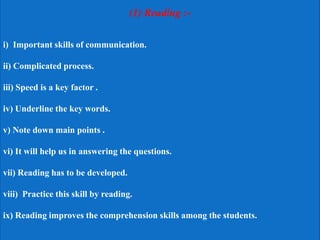
(1) Reading :-
i) Important skills of communication.
ii) Complicated process.
iii) Speed is a key factor .
iv) Underline the key words.
v) Note down main points .
vi) It will help us in answering the questions.
vii) Reading has to be developed.
viii) Practice this skill by reading.
ix) Reading improves the comprehension skills among the students.
(2) Understanding what we have read : -
i) A processes which is performed simultaneously with reading.
ii) Require focus / concentration.
iii) Need active involvement of our brain.
iv) We should figure out the beginning, middle and end of the passage.
v) Try to figure out the contextual meaning of the key words .
vi) Read the questions and try to find the answers in the passage.
vii) Try to understand what the writer wants to explain.
viii) Be able to read between lines.
ix) Write down important points.
x) Try to understand whom, why and when aspects in the passage.
xi) Find out the subject or discipline the passage related to.
xii) Know the content or the essence of the passage.
xiii) Try to understand the main outline and theme of the passage.
xiv) These things help us to set our mind and think in terms of the author.
3) Reproducing in our own words what we have read : -
i) Read the passage for several times.
ii) Reproducing the ideas is the toughest part.
iii) The keywords are the best way to find answers.
iv) Try to find closely related words.
v) Try to guess the meaning of a word or a phrase according to the context.
vi) Try to judge the mood of the author.
vii) Solve the questions first which can be answered with direct answers.
viii) Try to use our own language.
ix) Use indirect speech or narration.
x) Try to use simple sentences with correct grammatical expressions.
xi) Do not try to write lengthy answers.
xii) While giving a title or headline follow some hints :
a) Figure out the main character or subject in the passage if any.
b) Important expressions, slogans or proverb which may refer to the theme .
01) Who - dks.k (ltho izFkek foHkDrh)
02) Whom - dks.kkyk (ltho f}rh;kfoHkDrh)
03) Whose - dks.kkpk (ltho सष्ठीfoHkDrh)
04) Which - dks.krk (futhZooLrw i.k i;kZ;)
05) Why - dk (dkj.k)
06) What - dk; (futhZooLrw@oLrwfLFkrh)
07) When - dsOgk (निश्चितवेळ)
08) Where - dksBs(निश्चितठिकाण)
09) How - dlk (fjr@i)r)
10) How many - fdrh(la[;sr ekstrk ;s.kkjs)
11) How much - fdrh(la[;sr u ekstrk ;s.kkjs)
12) How long - fdrhdkG (dky[kaM@dkyko/kh)
13) How far - fdrhnwj (varj)
14) How often - fdrhnk(okjaokfjrk)
15) How many times – (okjaokfjrk)
16) At what time – (निश्चितवेळ)
17) At what place – (निश्चितठिकाण)
18) i)What kind of
ii)What sort of (ववशिष्ट प्रकार )
iii)What type of
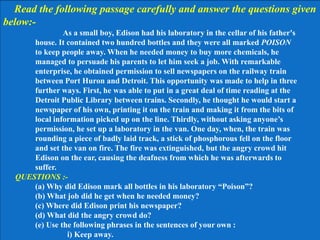
Read the following passage carefully and answer the questions given
below:-
As a small boy, Edison had his laboratory in the cellar of his father's
house. It contained two hundred bottles and they were all marked POISON
to keep people away. When he needed money to buy more chemicals, he
managed to persuade his parents to let him seek a job. With remarkable
enterprise, he obtained permission to sell newspapers on the railway train
between Port Huron and Detroit. This opportunity was made to help in three
further ways. First, he was able to put in a great deal of time reading at the
Detroit Public Library between trains. Secondly, he thought he would start a
newspaper of his own, printing it on the train and making it from the bits of
local information picked up on the line. Thirdly, without asking anyone’s
permission, he set up a laboratory in the van. One day, when, the train was
rounding a piece of badly laid track, a stick of phosphorous fell on the floor
and set the van on fire. The fire was extinguished, but the angry crowd hit
Edison on the ear, causing the deafness from which he was afterwards to
suffer.
QUESTIONS :-
(a) Why did Edison mark all bottles in his laboratory “Poison”?
(b) What job did he get when he needed money?
(c) Where did Edison print his newspaper?
(d) What did the angry crowd do?
(e) Use the following phrases in the sentences of your own :
i) Keep away.
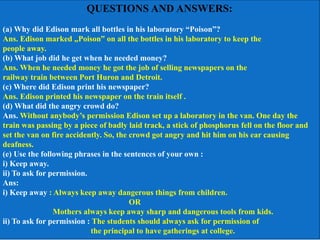
QUESTIONS AND ANSWERS:
(a) Why did Edison mark all bottles in his laboratory “Poison”?
Ans. Edison marked „Poison‟ on all the bottles in his laboratory to keep the
people away.
(b) What job did he get when he needed money?
Ans. When he needed money he got the job of selling newspapers on the
railway train between Port Huron and Detroit.
(c) Where did Edison print his newspaper?
Ans. Edison printed his newspaper on the train itself .
(d) What did the angry crowd do?
Ans. Without anybody’s permission Edison set up a laboratory in the van. One day the
train was passing by a piece of badly laid track, a stick of phosphorus fell on the floor and
set the van on fire accidently. So, the crowd got angry and hit him on his ear causing
deafness.
(e) Use the following phrases in the sentences of your own :
i) Keep away.
ii) To ask for permission.
Ans:
i) Keep away : Always keep away dangerous things from children.
OR
Mothers always keep away sharp and dangerous tools from kids.
ii) To ask for permission : The students should always ask for permission of
the principal to have gatherings at college.
B. A. SEM - III   -   Comprehension

B. A. SEM - III - Comprehension

  • 1.
    TOPIC :COMPREHENSION MAHATMA GANDHIARTS, SCIENCE & LATE N. P. COMMERCE COLLEGE ARMORI, DIST. GADCHIROLI. CLASS : B.A. II (III SEM) SUBJECT : COMPULSORY ENGLISH -Presented By- Anil P. Raut , Assistant Professor , Department of English .
  • 2.
    Topic : Comprehension Definition:- According to the Webster Dictionary, comprehension means ability to understand. Outcomes :- A)To improve the language skills of the students. B) To improve the application of grammar and vocabulary of the students C)To improve the imagination of the students. D)To incorporate logical and reasoning power in the minds of the students. E)To be helpful in future to solve the problems at work and in their real life as well.
  • 3.
    Comprehension involves threeimportant steps :- (1) Reading. (2) Understanding what we have read. (3) Reproducing in our own words what we have read.
  • 4.
    (1) Reading :- i)Important skills of communication. ii) Complicated process. iii) Speed is a key factor . iv) Underline the key words. v) Note down main points . vi) It will help us in answering the questions. vii) Reading has to be developed. viii) Practice this skill by reading. ix) Reading improves the comprehension skills among the students.
  • 5.
    (2) Understanding whatwe have read : - i) A processes which is performed simultaneously with reading. ii) Require focus / concentration. iii) Need active involvement of our brain. iv) We should figure out the beginning, middle and end of the passage. v) Try to figure out the contextual meaning of the key words . vi) Read the questions and try to find the answers in the passage. vii) Try to understand what the writer wants to explain. viii) Be able to read between lines. ix) Write down important points. x) Try to understand whom, why and when aspects in the passage. xi) Find out the subject or discipline the passage related to. xii) Know the content or the essence of the passage. xiii) Try to understand the main outline and theme of the passage. xiv) These things help us to set our mind and think in terms of the author.
  • 6.
    3) Reproducing inour own words what we have read : - i) Read the passage for several times. ii) Reproducing the ideas is the toughest part. iii) The keywords are the best way to find answers. iv) Try to find closely related words. v) Try to guess the meaning of a word or a phrase according to the context. vi) Try to judge the mood of the author. vii) Solve the questions first which can be answered with direct answers. viii) Try to use our own language. ix) Use indirect speech or narration. x) Try to use simple sentences with correct grammatical expressions. xi) Do not try to write lengthy answers. xii) While giving a title or headline follow some hints : a) Figure out the main character or subject in the passage if any. b) Important expressions, slogans or proverb which may refer to the theme .
  • 7.
    01) Who -dks.k (ltho izFkek foHkDrh) 02) Whom - dks.kkyk (ltho f}rh;kfoHkDrh) 03) Whose - dks.kkpk (ltho सष्ठीfoHkDrh) 04) Which - dks.krk (futhZooLrw i.k i;kZ;) 05) Why - dk (dkj.k) 06) What - dk; (futhZooLrw@oLrwfLFkrh) 07) When - dsOgk (निश्चितवेळ) 08) Where - dksBs(निश्चितठिकाण) 09) How - dlk (fjr@i)r) 10) How many - fdrh(la[;sr ekstrk ;s.kkjs) 11) How much - fdrh(la[;sr u ekstrk ;s.kkjs) 12) How long - fdrhdkG (dky[kaM@dkyko/kh) 13) How far - fdrhnwj (varj) 14) How often - fdrhnk(okjaokfjrk) 15) How many times – (okjaokfjrk) 16) At what time – (निश्चितवेळ) 17) At what place – (निश्चितठिकाण) 18) i)What kind of ii)What sort of (ववशिष्ट प्रकार ) iii)What type of
  • 8.
    Read the followingpassage carefully and answer the questions given below:- As a small boy, Edison had his laboratory in the cellar of his father's house. It contained two hundred bottles and they were all marked POISON to keep people away. When he needed money to buy more chemicals, he managed to persuade his parents to let him seek a job. With remarkable enterprise, he obtained permission to sell newspapers on the railway train between Port Huron and Detroit. This opportunity was made to help in three further ways. First, he was able to put in a great deal of time reading at the Detroit Public Library between trains. Secondly, he thought he would start a newspaper of his own, printing it on the train and making it from the bits of local information picked up on the line. Thirdly, without asking anyone’s permission, he set up a laboratory in the van. One day, when, the train was rounding a piece of badly laid track, a stick of phosphorous fell on the floor and set the van on fire. The fire was extinguished, but the angry crowd hit Edison on the ear, causing the deafness from which he was afterwards to suffer. QUESTIONS :- (a) Why did Edison mark all bottles in his laboratory “Poison”? (b) What job did he get when he needed money? (c) Where did Edison print his newspaper? (d) What did the angry crowd do? (e) Use the following phrases in the sentences of your own : i) Keep away.
  • 9.
    QUESTIONS AND ANSWERS: (a)Why did Edison mark all bottles in his laboratory “Poison”? Ans. Edison marked „Poison‟ on all the bottles in his laboratory to keep the people away. (b) What job did he get when he needed money? Ans. When he needed money he got the job of selling newspapers on the railway train between Port Huron and Detroit. (c) Where did Edison print his newspaper? Ans. Edison printed his newspaper on the train itself . (d) What did the angry crowd do? Ans. Without anybody’s permission Edison set up a laboratory in the van. One day the train was passing by a piece of badly laid track, a stick of phosphorus fell on the floor and set the van on fire accidently. So, the crowd got angry and hit him on his ear causing deafness. (e) Use the following phrases in the sentences of your own : i) Keep away. ii) To ask for permission. Ans: i) Keep away : Always keep away dangerous things from children. OR Mothers always keep away sharp and dangerous tools from kids. ii) To ask for permission : The students should always ask for permission of the principal to have gatherings at college.