

Bhakthi Liyanage
SharePoint Saturday Charlotte
17 September 2016
@CASPUG #SPSCLT16
Platinum
Gold
SilverandBronze
Charlotte SharePoint Community!



THANK YOU
EVENT SPONSORS!
@CASPUG #SPSCLT16
PLEASE TELL US WHAT YOU THINK
http://bit.do/SPSCLT16
@CASPUG #SPSCLT16
CONFERENCE COMMUNICATION

lanyrd.com/2016/spsclt16

@CASPUG #SPSCLT16

info@casug.org
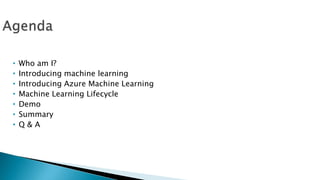
• Who am I?
• Introducing machine learning
• Introducing Azure Machine Learning
• Machine Learning Lifecycle
• Demo
• Summary
• Q & A
6
Sr. SharePoint Architect
16+ years in the IT industry
11+ years in SharePoint
bhakthil@gmail.com
@bhakthil
https://www.linkedin.com/pub/bhakthi-
liyanage/14/15/912
https://github.com/bhakthil
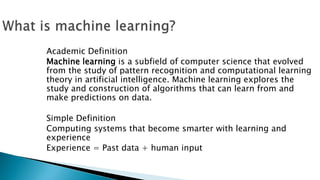
Academic Definition
Machine learning is a subfield of computer science that evolved
from the study of pattern recognition and computational learning
theory in artificial intelligence. Machine learning explores the
study and construction of algorithms that can learn from and
make predictions on data.
Simple Definition
Computing systems that become smarter with learning and
experience
Experience = Past data + human input
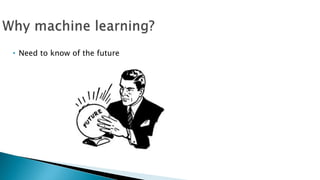
• Need to know of the future
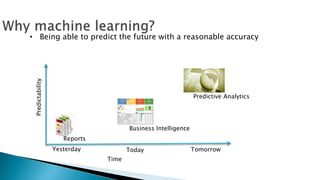
• Being able to predict the future with a reasonable accuracy
Reports
Yesterday Today Tomorrow
Business Intelligence
Predictive Analytics
Predictability
Time
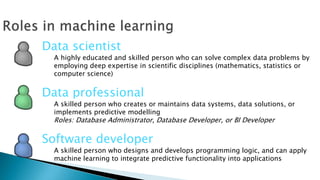
A highly educated and skilled person who can solve complex data problems by
employing deep expertise in scientific disciplines (mathematics, statistics or
computer science)
A skilled person who creates or maintains data systems, data solutions, or
implements predictive modelling
Roles: Database Administrator, Database Developer, or BI Developer
A skilled person who designs and develops programming logic, and can apply
machine learning to integrate predictive functionality into applications
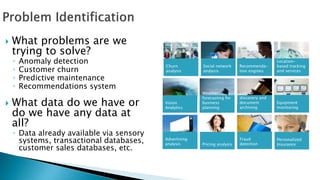
 What problems are we
trying to solve?
◦ Anomaly detection
◦ Customer churn
◦ Predictive maintenance
◦ Recommendations system
 What data do we have or
do we have any data at
all?
◦ Data already available via sensory
systems, transactional databases,
customer sales databases, etc.
Predictive
maintenance
Vision
Analytics
Recommenda-
tion engines
Advertising
analysis
Weather
forecasting for
business
planning
Social network
analysis
Legal
discovery and
document
archiving
Pricing analysis
Fraud
detection
Churn
analysis
Equipment
monitoring
Location-
based tracking
and services
Personalized
Insurance
 Data Consist of
◦ Features (aka input parameters) : The data that
is fed in to the model
◦ Identify which features relevant for the problem
◦ Labels : Historical result of each observation
 Training Data
◦ Pairing of features and label
◦ Historical
 Data Validation
◦ Used to verify the trained model
 Supervised
◦ Machine learning task of inferring a function/model from labeled
training data or examples
◦ Training data consist of both features and labels
 Un-supervised
◦ Machine learning task of inferring a function to describe hidden
structure from unlabeled data
◦ Data contains only features
 Enables powerful cloud-based predictive analytics
 Professionals can easily build, deploy and share
advanced analytics solutions
 Browser based, Rapid Deployment
 Connects seamlessly with other Azure data-related services,
including:
 Azure HDInsight (Big Data)
 Azure SQL Database, and
 Virtual Machines
 Models are consumed via ML API service
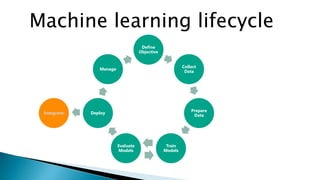
Machine learning lifecycle
Define
Objective
Collect
Data
Prepare
Data
Train
Models
Evaluate
Models
Deploy
Manage
Integrate
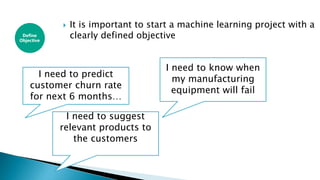
 It is important to start a machine learning project with a
clearly defined objective
I need to predict
customer churn rate
for next 6 months…
Define
Objective
I need to suggest
relevant products to
the customers
I need to know when
my manufacturing
equipment will fail
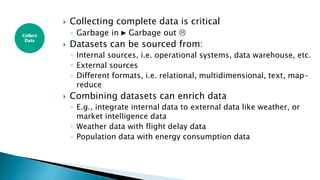
 Collecting complete data is critical
◦ Garbage in ► Garbage out 
 Datasets can be sourced from:
◦ Internal sources, i.e. operational systems, data warehouse, etc.
◦ External sources
◦ Different formats, i.e. relational, multidimensional, text, map-
reduce
 Combining datasets can enrich data
◦ E.g., integrate internal data to external data like weather, or
market intelligence data
◦ Weather data with flight delay data
◦ Population data with energy consumption data
Collect
Data
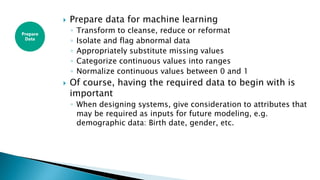
 Prepare data for machine learning
◦ Transform to cleanse, reduce or reformat
◦ Isolate and flag abnormal data
◦ Appropriately substitute missing values
◦ Categorize continuous values into ranges
◦ Normalize continuous values between 0 and 1
 Of course, having the required data to begin with is
important
◦ When designing systems, give consideration to attributes that
may be required as inputs for future modeling, e.g.
demographic data: Birth date, gender, etc.
Prepare
Data
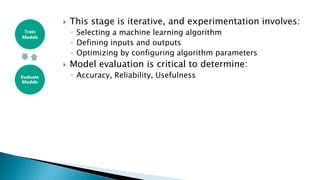
 This stage is iterative, and experimentation involves:
◦ Selecting a machine learning algorithm
◦ Defining inputs and outputs
◦ Optimizing by configuring algorithm parameters
 Model evaluation is critical to determine:
◦ Accuracy, Reliability, Usefulness
Train
Models
Evaluate
Models
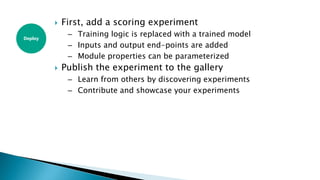
 First, add a scoring experiment
– Training logic is replaced with a trained model
– Inputs and output end-points are added
– Module properties can be parameterized
 Publish the experiment to the gallery
– Learn from others by discovering experiments
– Contribute and showcase your experiments
Deploy
Integrate
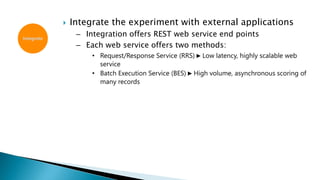
 Integrate the experiment with external applications
– Integration offers REST web service end points
– Each web service offers two methods:
• Request/Response Service (RRS) ► Low latency, highly scalable web
service
• Batch Execution Service (BES) ► High volume, asynchronous scoring of
many records
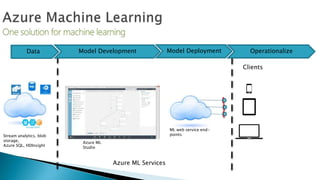
Stream analytics, blob
storage,
Azure SQL, HDInsight
Azure ML Services
Clients
Azure ML
Studio
ML web service end-
points
Data Model Development Model Deployment Operationalize
Power BI/DashboardsMobile AppsWeb Apps
Azure Portal
Azure Ops Team
ML Studio
Data Scientist
HDInsight
Azure Storage
Desktop Data
Azure Portal &
ML API service
Azure Ops Team
ML API service Developer
ML Studio
and the Data Professional
• Access and prepare data
• Create, test and train models
• Collaborate
• One click to stage for
production via the API service
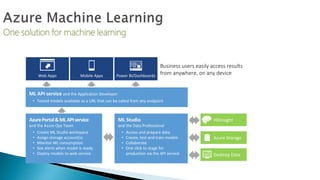
AzurePortal&MLAPIservice
and the Azure Ops Team
• Create ML Studio workspace
• Assign storage account(s)
• Monitor ML consumption
• See alerts when model is ready
• Deploy models to web service
ML API service and the Application Developer
• Tested models available as a URL that can be called from any endpoint
Business users easily access results
from anywhere, on any device
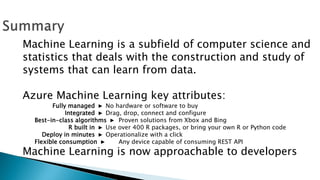
Machine Learning is a subfield of computer science and
statistics that deals with the construction and study of
systems that can learn from data.
Azure Machine Learning key attributes:
Fully managed ► No hardware or software to buy
Integrated ► Drag, drop, connect and configure
Best-in-class algorithms ► Proven solutions from Xbox and Bing
R built in ► Use over 400 R packages, or bring your own R or Python code
Deploy in minutes ► Operationalize with a click
Flexible consumption ► Any device capable of consuming REST API
Machine Learning is now approachable to developers
JOIN US FOR SHAREPINT
 Immediately following today’s
event
 First drink is on us
 Brink your event ticket for
validation
 Duckworth’s Grill & Taphouse
330 North Tryon Street
Charlotte, NC 28202
(7th and Tryon)
Q & A

Integrating Azure Machine Learning and Predictive Analytics with SharePoint Online

  • 1.
    Bhakthi Liyanage SharePoint SaturdayCharlotte 17 September 2016
  • 2.
    @CASPUG #SPSCLT16 Platinum Gold SilverandBronze Charlotte SharePointCommunity!    THANK YOU EVENT SPONSORS!
  • 3.
    @CASPUG #SPSCLT16 PLEASE TELLUS WHAT YOU THINK http://bit.do/SPSCLT16
  • 4.
  • 5.
    • Who amI? • Introducing machine learning • Introducing Azure Machine Learning • Machine Learning Lifecycle • Demo • Summary • Q & A
  • 6.
    6 Sr. SharePoint Architect 16+years in the IT industry 11+ years in SharePoint bhakthil@gmail.com @bhakthil https://www.linkedin.com/pub/bhakthi- liyanage/14/15/912 https://github.com/bhakthil
  • 8.
    Academic Definition Machine learningis a subfield of computer science that evolved from the study of pattern recognition and computational learning theory in artificial intelligence. Machine learning explores the study and construction of algorithms that can learn from and make predictions on data. Simple Definition Computing systems that become smarter with learning and experience Experience = Past data + human input
  • 9.
    • Need toknow of the future
  • 10.
    • Being ableto predict the future with a reasonable accuracy Reports Yesterday Today Tomorrow Business Intelligence Predictive Analytics Predictability Time
  • 11.
    A highly educatedand skilled person who can solve complex data problems by employing deep expertise in scientific disciplines (mathematics, statistics or computer science) A skilled person who creates or maintains data systems, data solutions, or implements predictive modelling Roles: Database Administrator, Database Developer, or BI Developer A skilled person who designs and develops programming logic, and can apply machine learning to integrate predictive functionality into applications
  • 12.
     What problemsare we trying to solve? ◦ Anomaly detection ◦ Customer churn ◦ Predictive maintenance ◦ Recommendations system  What data do we have or do we have any data at all? ◦ Data already available via sensory systems, transactional databases, customer sales databases, etc. Predictive maintenance Vision Analytics Recommenda- tion engines Advertising analysis Weather forecasting for business planning Social network analysis Legal discovery and document archiving Pricing analysis Fraud detection Churn analysis Equipment monitoring Location- based tracking and services Personalized Insurance
  • 13.
     Data Consistof ◦ Features (aka input parameters) : The data that is fed in to the model ◦ Identify which features relevant for the problem ◦ Labels : Historical result of each observation  Training Data ◦ Pairing of features and label ◦ Historical  Data Validation ◦ Used to verify the trained model
  • 14.
     Supervised ◦ Machinelearning task of inferring a function/model from labeled training data or examples ◦ Training data consist of both features and labels  Un-supervised ◦ Machine learning task of inferring a function to describe hidden structure from unlabeled data ◦ Data contains only features
  • 16.
     Enables powerfulcloud-based predictive analytics  Professionals can easily build, deploy and share advanced analytics solutions  Browser based, Rapid Deployment  Connects seamlessly with other Azure data-related services, including:  Azure HDInsight (Big Data)  Azure SQL Database, and  Virtual Machines  Models are consumed via ML API service
  • 17.
  • 18.
     It isimportant to start a machine learning project with a clearly defined objective I need to predict customer churn rate for next 6 months… Define Objective I need to suggest relevant products to the customers I need to know when my manufacturing equipment will fail
  • 19.
     Collecting completedata is critical ◦ Garbage in ► Garbage out   Datasets can be sourced from: ◦ Internal sources, i.e. operational systems, data warehouse, etc. ◦ External sources ◦ Different formats, i.e. relational, multidimensional, text, map- reduce  Combining datasets can enrich data ◦ E.g., integrate internal data to external data like weather, or market intelligence data ◦ Weather data with flight delay data ◦ Population data with energy consumption data Collect Data
  • 20.
     Prepare datafor machine learning ◦ Transform to cleanse, reduce or reformat ◦ Isolate and flag abnormal data ◦ Appropriately substitute missing values ◦ Categorize continuous values into ranges ◦ Normalize continuous values between 0 and 1  Of course, having the required data to begin with is important ◦ When designing systems, give consideration to attributes that may be required as inputs for future modeling, e.g. demographic data: Birth date, gender, etc. Prepare Data
  • 21.
     This stageis iterative, and experimentation involves: ◦ Selecting a machine learning algorithm ◦ Defining inputs and outputs ◦ Optimizing by configuring algorithm parameters  Model evaluation is critical to determine: ◦ Accuracy, Reliability, Usefulness Train Models Evaluate Models
  • 22.
     First, adda scoring experiment – Training logic is replaced with a trained model – Inputs and output end-points are added – Module properties can be parameterized  Publish the experiment to the gallery – Learn from others by discovering experiments – Contribute and showcase your experiments Deploy
  • 23.
    Integrate  Integrate theexperiment with external applications – Integration offers REST web service end points – Each web service offers two methods: • Request/Response Service (RRS) ► Low latency, highly scalable web service • Batch Execution Service (BES) ► High volume, asynchronous scoring of many records
  • 24.
    Stream analytics, blob storage, AzureSQL, HDInsight Azure ML Services Clients Azure ML Studio ML web service end- points Data Model Development Model Deployment Operationalize
  • 25.
    Power BI/DashboardsMobile AppsWebApps Azure Portal Azure Ops Team ML Studio Data Scientist HDInsight Azure Storage Desktop Data Azure Portal & ML API service Azure Ops Team ML API service Developer ML Studio and the Data Professional • Access and prepare data • Create, test and train models • Collaborate • One click to stage for production via the API service AzurePortal&MLAPIservice and the Azure Ops Team • Create ML Studio workspace • Assign storage account(s) • Monitor ML consumption • See alerts when model is ready • Deploy models to web service ML API service and the Application Developer • Tested models available as a URL that can be called from any endpoint Business users easily access results from anywhere, on any device
  • 27.
    Machine Learning isa subfield of computer science and statistics that deals with the construction and study of systems that can learn from data. Azure Machine Learning key attributes: Fully managed ► No hardware or software to buy Integrated ► Drag, drop, connect and configure Best-in-class algorithms ► Proven solutions from Xbox and Bing R built in ► Use over 400 R packages, or bring your own R or Python code Deploy in minutes ► Operationalize with a click Flexible consumption ► Any device capable of consuming REST API Machine Learning is now approachable to developers
  • 28.
    JOIN US FORSHAREPINT  Immediately following today’s event  First drink is on us  Brink your event ticket for validation  Duckworth’s Grill & Taphouse 330 North Tryon Street Charlotte, NC 28202 (7th and Tryon)
  • 29.