BASIC PRINCIPLES OF AYURVEDA
AYURVEDA
 Ayurveda (the science of life) is one of the
branches of vedas.
 It is regarded as upaveda of rigveda or
atharva-veda
 Ayurveda ‘the Science of Life’ is a holistic
system of medicine from India, which evolved
in India about 3000-5000 years ago.
 The principles and philosophy of Ayurveda,
view man as a complex whole, including our
external and internal environments.
AYURVEDA
 Ayurveda defines life ‘Ayuh’ as the intelligent
coordination of our four parts, the soul, the
mind, the senses and the body.
 Health is not just a state of the body.
 We interact with the seasons, planetary
changes of the earth, moon and other planets,
as well as orbiting relationships within our
lives, our loved ones and friends, co-workers
etc.
AYURVEDA
 We affect and are affected by every other
animate and inanimate thing in existence.
Bringing all of this into balance is the key to
living healthy.
 Mind, self and body – these three make a
tripod on which the living world stands.
AYURVEDA
Definition of Sarira (Body)
 The science of Ayurveda has simplified the
organizational layout of the human body into
three basic components, Dosa (Body
Humours), Dhatu (Tissue) and Mala
(Impurities).
 Body is originally composed of dosas, dhatus
and malas.
AYURVEDA
 The Ayurvedic philosophy says that an individual
is bundle of 'spirit', desirous of expressing itself,
uses subjective consciousness or Satva to
manifest sense organs and a mind.
 Spirit and mind then project themselves into a
physical body, created from the five (Pancha)
great (maha) eternal elements (bhutas) together
called the Panchamahabhutas.
 The entire science of Ayurveda is based on the
“five great elements” (Pancamahabhuta) theory.
AYURVEDA
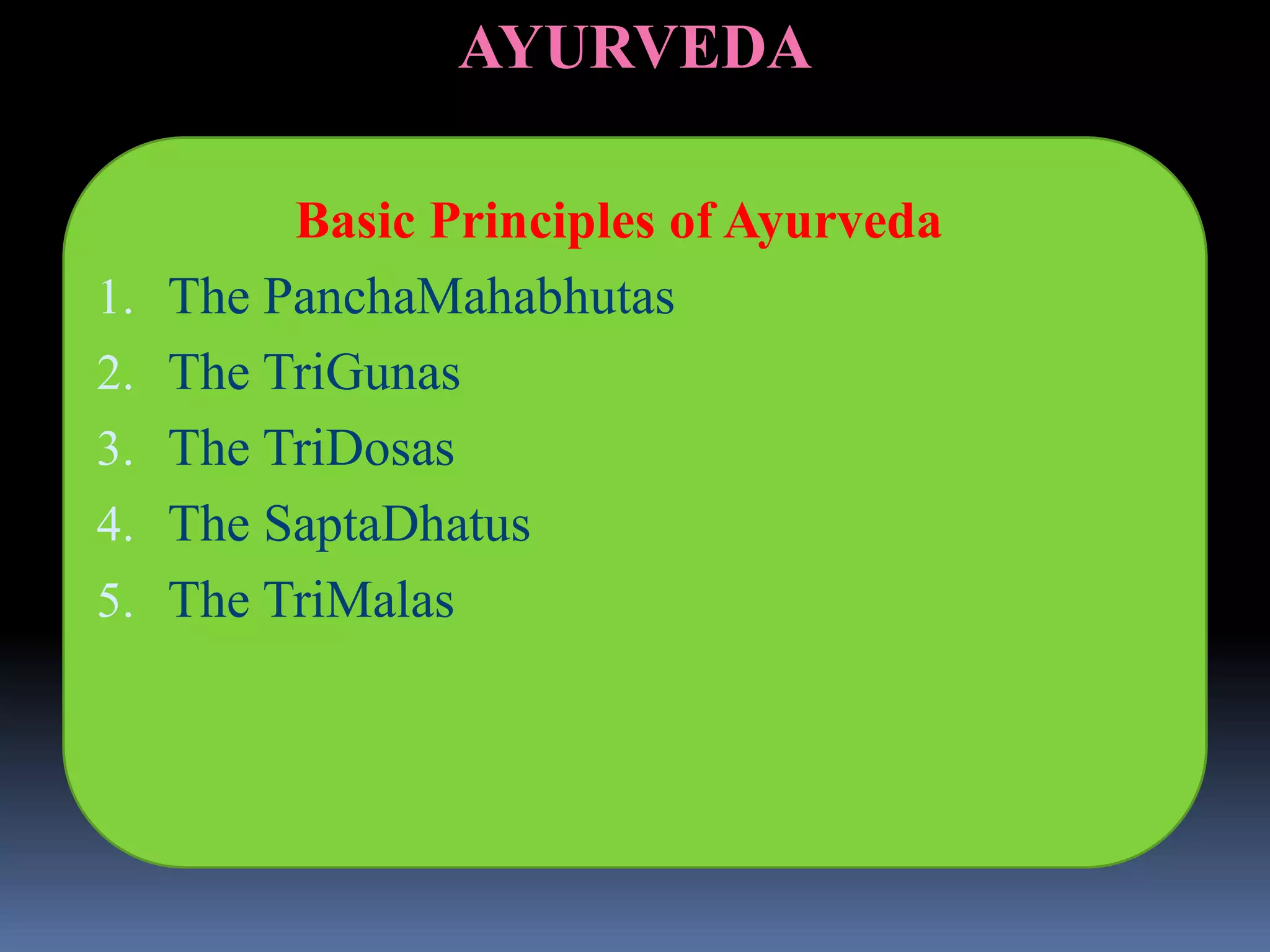
Basic Principles of Ayurveda
1. The PanchaMahabhutas
2. The TriGunas
3. The TriDosas
4. The SaptaDhatus
5. The TriMalas
AYURVEDA
The PanchaMahabhutas
 The five mahabhutas are
1. Akasa: Space
2. Vayu: Air
3. Teja or Agni: Fire
4. Jala: Water
5. Prthivi: Earth
AYURVEDA
The PanchaMahabhutas
 In simple word, single living cell for example
1. The earth element predominates by giving
structure to the cell.
2. The water element is present in the cytoplasm or
the liquid within the cell membrane.
3. The fire element regulates the metabolic
processes regulating the cell.
4. While the air element predominates the gases
therein.
5. The space occupied by the cell denoting the
Akasa.
AYURVEDA
The PanchaMahabhutas
 In the case of a complex, multi-cellular organism as a
human being for
1. akasa corresponds to spaces within the body (mouth,
nostrils, abdomen etc.);
2. vayu denotes the movement (essentially muscular
also nervous system );
3. agni controls the functioning of enzymes
(intelligence, digestive system, metabolism);
4. jala is in all body fluids (as plasma, saliva, digestive
juices); and
5. prithvi manifests itself in the solid structure of the
body (bones, teeth, flesh, hair etc)
AYURVEDA
The TriGunas
 Provides a distinct description of people on
the basis of their Manasa (psychological) and
Prakriti (constitution).
1. Satva
2. Rajas
3. Tamasa
AYURVEDA
The TriGunas
 In equilibrium, the three gunas preserve the
mind (and indirectly the body), maintaining it
in a healthy state. Any disturbance in this
equilibrium results in various types of mental
disorders.
AYURVEDA
The TriGunas
 Satva characterized by lightness, consciousness, pleasure
and clarity, is pure, free from disease and cannot be
disturbed in any way. It activates the senses and is
responsible for the perception of knowledge.
 Rajas, the most active of the gunas, has motion and
stimulation as its characteristics. All desires, wishes,
ambitions and fickle-mindedness are a result of the same.
 Tamasa is characterized by heaviness and resistance. It
produces disturbances in the process of perception and
activities of the mind. Delusion, false knowledge, laziness,
apathy (lack of interest, enthusiasm), sleep and drowsiness
are due to it.
AYURVEDA
The TriGunas
 Rajas and Tamasa as with the dosas, can be
unbalanced by stress and negative desires as
kama (lust), irshya (malice), moha (delusion
and hallucination), lobha (greed), chinta
(anxiety), bhaya (fear) and krodha (anger).
AYURVEDA
The TriDosas
 Vata, Pitta and Kapha are three name of
tridosas.
 Vata: air
 Pitta:bile.
 Kapha:Phlegm
 Dosas are basically three different forms of
energy.
AYURVEDA
The TriDosas
 The Tridosas (tri meaning three and dosas being
the basic physical energies) are the primary and
essential factors of the human body that govern
our entire physical structure and function.
 Derived from the Pancamahabhutas, each dosa
which like the elements cannot be detected with
our senses but their qualities can be – is a
combination of any two of the five bhutas with
the predominance of one.
AYURVEDA
The TriDosas
 Vata, Pitta and Kapha in Sanskrit, these three
are responsible for all the physiological and
psychological processes within the body and
mind – dynamic forces that determine growth
and decay. Every physical characteristic,
mental capacity and the emotional tendency of
a human being can therefore be explained in
terms of the tridosas.
AYURVEDA
The TriDosas
 Most of the physical phenomena caused to the
nervous system by modern physiology, can be
identified with Vata.
 Just as the entire chemical process operating in the
human body can be attributed to Pitta, including
enzymes, hormones and the complete nutritional
system.
 The activities of the skeletal and the anabolic system,
actually the entire physical volume of an organism,
can be considered as Kapha.
AYURVEDA
AYURVEDA
The SaptaDhatus
 Nourishment of these seven body tissues takes
place in sequential manner with original
material provided by digested food material.
 The Sapta (seven) Dhatus (tissues) elements
form the pillars of the body that form the
means of nourishment and growth while
providing support to the body as well as the
mind.
AYURVEDA
The SaptaDhatus
 Rasa (fluid) Dhatu –Derived from the digested food, it
nourishes each and every tissue and cell of the body.
 Rakta (blood) Dhatu - Regarded as the basis of life, it is
analogous to the circulating blood cells. It not only nourishes
the body tissues, but provides physical strength and colour to
the body.
 Mamsa Dhatu – The muscle tissue, its main function is to
provide physical strength and support for the meda dhatu..
 Meda (fat) Dhatu – Consists of adipose tissue providing
support to asthi dhatu. It also lubricates the body.
AYURVEDA
The SaptaDhatus
 Asthi Dhatu – Comprising of bone tissues, including
cartilages, its main function is to give nourishment to
the majja dhatu and provide support to the mamsa
dhatu.
 Majja Dhatu– Denoting the yellow and red bone
marrow tissue, its main function is to fill up the asthi.
 Shukra Dhatu – The main aim of this reproductive
tissue is to help reproduction and strengthen the body.
It Provides discharge, pleasure, physical strength,
exhilaration (excitement or happness).
AYURVEDA
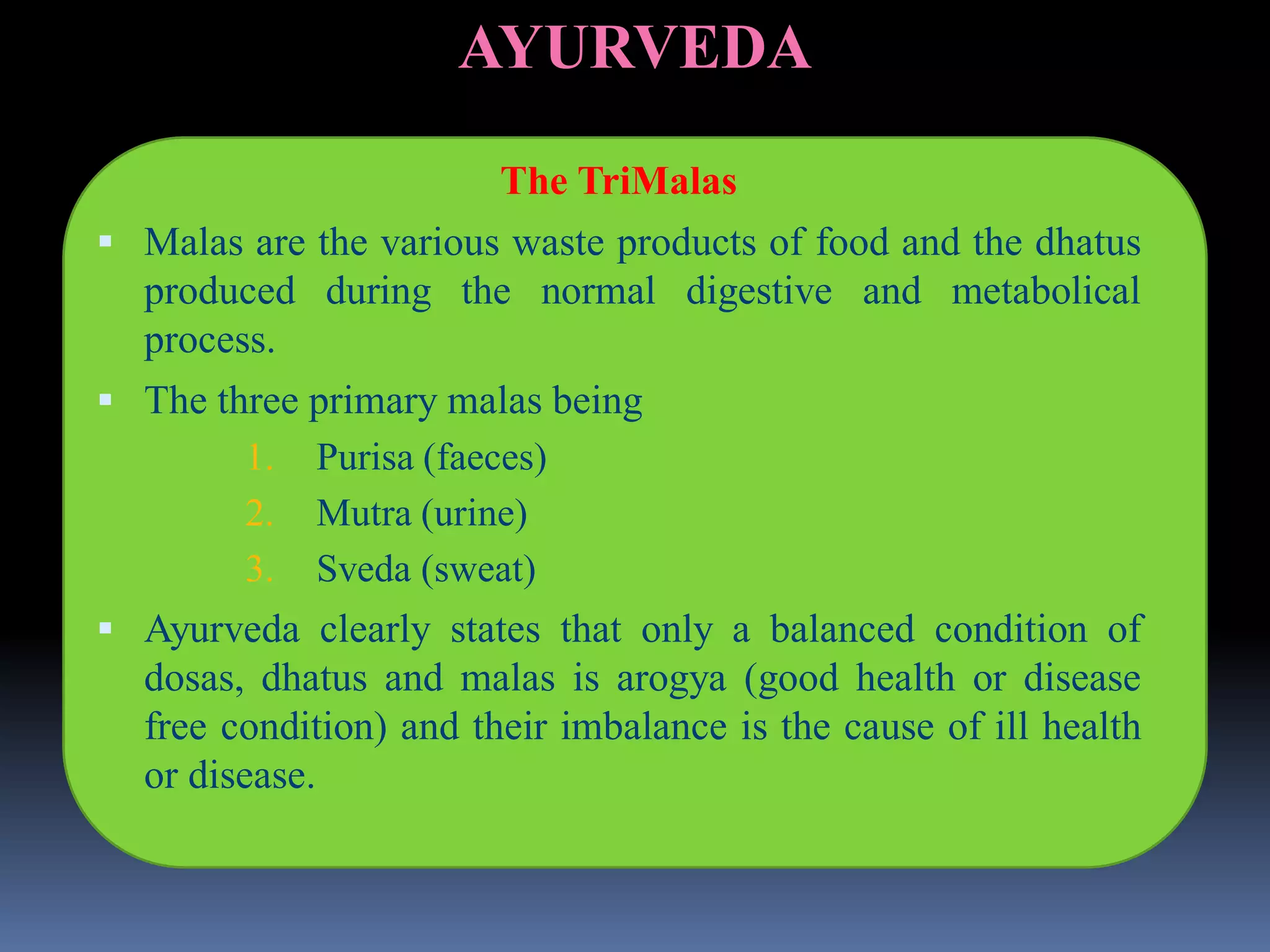
The TriMalas
 Malas are the various waste products of food and the dhatus
produced during the normal digestive and metabolical
process.
 The three primary malas being
1. Purisa (faeces)
2. Mutra (urine)
3. Sveda (sweat)
 Ayurveda clearly states that only a balanced condition of
dosas, dhatus and malas is arogya (good health or disease
free condition) and their imbalance is the cause of ill health
or disease.
AYURVEDA
The TriMalas
 Malas are the various waste products of food and the dhatus
produced during the normal digestive and metabolical
process.
 The three primary malas being
1. Purisa (faeces)
2. Mutra (urine)
3. Sveda (sweat)
 Ayurveda clearly states that only a balanced condition of
dosas, dhatus and malas is arogya (good health or disease
free condition) and their imbalance is the cause of ill health
or disease.
THANK YOU

basic principles Ayurveda PDF.pdf

  • 1.
  • 2.
    AYURVEDA  Ayurveda (thescience of life) is one of the branches of vedas.  It is regarded as upaveda of rigveda or atharva-veda  Ayurveda ‘the Science of Life’ is a holistic system of medicine from India, which evolved in India about 3000-5000 years ago.  The principles and philosophy of Ayurveda, view man as a complex whole, including our external and internal environments.
  • 3.
    AYURVEDA  Ayurveda defineslife ‘Ayuh’ as the intelligent coordination of our four parts, the soul, the mind, the senses and the body.  Health is not just a state of the body.  We interact with the seasons, planetary changes of the earth, moon and other planets, as well as orbiting relationships within our lives, our loved ones and friends, co-workers etc.
  • 4.
    AYURVEDA  We affectand are affected by every other animate and inanimate thing in existence. Bringing all of this into balance is the key to living healthy.  Mind, self and body – these three make a tripod on which the living world stands.
  • 5.
    AYURVEDA Definition of Sarira(Body)  The science of Ayurveda has simplified the organizational layout of the human body into three basic components, Dosa (Body Humours), Dhatu (Tissue) and Mala (Impurities).  Body is originally composed of dosas, dhatus and malas.
  • 6.
    AYURVEDA  The Ayurvedicphilosophy says that an individual is bundle of 'spirit', desirous of expressing itself, uses subjective consciousness or Satva to manifest sense organs and a mind.  Spirit and mind then project themselves into a physical body, created from the five (Pancha) great (maha) eternal elements (bhutas) together called the Panchamahabhutas.  The entire science of Ayurveda is based on the “five great elements” (Pancamahabhuta) theory.
  • 7.
    AYURVEDA Basic Principles ofAyurveda 1. The PanchaMahabhutas 2. The TriGunas 3. The TriDosas 4. The SaptaDhatus 5. The TriMalas
  • 8.
    AYURVEDA The PanchaMahabhutas  Thefive mahabhutas are 1. Akasa: Space 2. Vayu: Air 3. Teja or Agni: Fire 4. Jala: Water 5. Prthivi: Earth
  • 9.
    AYURVEDA The PanchaMahabhutas  Insimple word, single living cell for example 1. The earth element predominates by giving structure to the cell. 2. The water element is present in the cytoplasm or the liquid within the cell membrane. 3. The fire element regulates the metabolic processes regulating the cell. 4. While the air element predominates the gases therein. 5. The space occupied by the cell denoting the Akasa.
  • 10.
    AYURVEDA The PanchaMahabhutas  Inthe case of a complex, multi-cellular organism as a human being for 1. akasa corresponds to spaces within the body (mouth, nostrils, abdomen etc.); 2. vayu denotes the movement (essentially muscular also nervous system ); 3. agni controls the functioning of enzymes (intelligence, digestive system, metabolism); 4. jala is in all body fluids (as plasma, saliva, digestive juices); and 5. prithvi manifests itself in the solid structure of the body (bones, teeth, flesh, hair etc)
  • 11.
    AYURVEDA The TriGunas  Providesa distinct description of people on the basis of their Manasa (psychological) and Prakriti (constitution). 1. Satva 2. Rajas 3. Tamasa
  • 12.
    AYURVEDA The TriGunas  Inequilibrium, the three gunas preserve the mind (and indirectly the body), maintaining it in a healthy state. Any disturbance in this equilibrium results in various types of mental disorders.
  • 13.
    AYURVEDA The TriGunas  Satvacharacterized by lightness, consciousness, pleasure and clarity, is pure, free from disease and cannot be disturbed in any way. It activates the senses and is responsible for the perception of knowledge.  Rajas, the most active of the gunas, has motion and stimulation as its characteristics. All desires, wishes, ambitions and fickle-mindedness are a result of the same.  Tamasa is characterized by heaviness and resistance. It produces disturbances in the process of perception and activities of the mind. Delusion, false knowledge, laziness, apathy (lack of interest, enthusiasm), sleep and drowsiness are due to it.
  • 14.
    AYURVEDA The TriGunas  Rajasand Tamasa as with the dosas, can be unbalanced by stress and negative desires as kama (lust), irshya (malice), moha (delusion and hallucination), lobha (greed), chinta (anxiety), bhaya (fear) and krodha (anger).
  • 15.
    AYURVEDA The TriDosas  Vata,Pitta and Kapha are three name of tridosas.  Vata: air  Pitta:bile.  Kapha:Phlegm  Dosas are basically three different forms of energy.
  • 16.
    AYURVEDA The TriDosas  TheTridosas (tri meaning three and dosas being the basic physical energies) are the primary and essential factors of the human body that govern our entire physical structure and function.  Derived from the Pancamahabhutas, each dosa which like the elements cannot be detected with our senses but their qualities can be – is a combination of any two of the five bhutas with the predominance of one.
  • 17.
    AYURVEDA The TriDosas  Vata,Pitta and Kapha in Sanskrit, these three are responsible for all the physiological and psychological processes within the body and mind – dynamic forces that determine growth and decay. Every physical characteristic, mental capacity and the emotional tendency of a human being can therefore be explained in terms of the tridosas.
  • 18.
    AYURVEDA The TriDosas  Mostof the physical phenomena caused to the nervous system by modern physiology, can be identified with Vata.  Just as the entire chemical process operating in the human body can be attributed to Pitta, including enzymes, hormones and the complete nutritional system.  The activities of the skeletal and the anabolic system, actually the entire physical volume of an organism, can be considered as Kapha.
  • 19.
  • 20.
    AYURVEDA The SaptaDhatus  Nourishmentof these seven body tissues takes place in sequential manner with original material provided by digested food material.  The Sapta (seven) Dhatus (tissues) elements form the pillars of the body that form the means of nourishment and growth while providing support to the body as well as the mind.
  • 21.
    AYURVEDA The SaptaDhatus  Rasa(fluid) Dhatu –Derived from the digested food, it nourishes each and every tissue and cell of the body.  Rakta (blood) Dhatu - Regarded as the basis of life, it is analogous to the circulating blood cells. It not only nourishes the body tissues, but provides physical strength and colour to the body.  Mamsa Dhatu – The muscle tissue, its main function is to provide physical strength and support for the meda dhatu..  Meda (fat) Dhatu – Consists of adipose tissue providing support to asthi dhatu. It also lubricates the body.
  • 22.
    AYURVEDA The SaptaDhatus  AsthiDhatu – Comprising of bone tissues, including cartilages, its main function is to give nourishment to the majja dhatu and provide support to the mamsa dhatu.  Majja Dhatu– Denoting the yellow and red bone marrow tissue, its main function is to fill up the asthi.  Shukra Dhatu – The main aim of this reproductive tissue is to help reproduction and strengthen the body. It Provides discharge, pleasure, physical strength, exhilaration (excitement or happness).
  • 23.
    AYURVEDA The TriMalas  Malasare the various waste products of food and the dhatus produced during the normal digestive and metabolical process.  The three primary malas being 1. Purisa (faeces) 2. Mutra (urine) 3. Sveda (sweat)  Ayurveda clearly states that only a balanced condition of dosas, dhatus and malas is arogya (good health or disease free condition) and their imbalance is the cause of ill health or disease.
  • 24.
    AYURVEDA The TriMalas  Malasare the various waste products of food and the dhatus produced during the normal digestive and metabolical process.  The three primary malas being 1. Purisa (faeces) 2. Mutra (urine) 3. Sveda (sweat)  Ayurveda clearly states that only a balanced condition of dosas, dhatus and malas is arogya (good health or disease free condition) and their imbalance is the cause of ill health or disease.
  • 25.