By pharmacist aya fawzi talib
In the last two decades vitamin D has gone from being recognized
for its importance in bone health to being investigated for its
roles in a wide range of physiological functions.
Also it has been found to have potential as a preventive or curative
drug for more than 100 disorders, ranging from:
Cancer.
Diabetes.
Multiple sclerosis.
Depression.
• Many doctors now routinely test blood levels of vitamin D for
their patients and recommend supplementation when levels are
found to be low.
• By many estimates, at least half of the U.S. population and that of
many other countries have blood level considered either
deficient or insufficient.
Types of vitamin D
D2(Ergocalciferol):
Is manufactured .
Added to fortified foods and milk.
D3(cholecalciferol):
Synthesised in the skin under the effect of ultraviolet sunlight.
Precursor is 7-dehydrocholisterol.
Consumed in diet from animal sources.
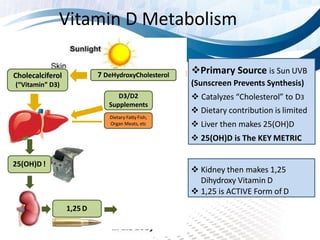
Vitamin D Metabolism
7 DeHydroxyCholesterolCholecalciferol
(“Vitamin” D3)
D3/D2
Supplements
Dietary FattyFish,
Organ Meats, etc
25(OH)D !
1,25 D
 Kidney then makes 1,25
Dihydroxy Vitamin D
 1,25 is ACTIVE Form of D
Primary Source is Sun UVB
(Sunscreen Prevents Synthesis)
 Catalyzes “Cholesterol” to D3
 Dietary contribution is limited
 Liver then makes 25(OH)D
 25(OH)D is The KEY METRIC
Vitamin D Sources
Why the sun is not enough ?
Skin pigmentation:
Dark skin reduces penetration of ultraviolet rays from
sunlight. Therefore it lowers vitamin D production.
Time of day and cloud cover:
The sun’s ultraviolet rays are strongest between 10 a.m.
and 3 p.m.
Age:
The skin’s ability to manufacture vitamin D declines with age.
On average, a 70-year-old synthesizes only about one-quarter
as much vitamin D as a 20-year-old from the same sun
exposure.
Sunscreen use:
Sunscreens filter out or block ultraviolet rays and prevent the
production of vitamin D.
A sunscreen with a sun protection factor (SPF) of 15 reduces
the production of vitamin D by 99 percent.
Sitting behind a window:
Glass filters out most of the ultraviolet rays that trigger vitamin D
production in the skin.
Low intake of foods containing vitamin D:
People rarely get enough vitamin D from their diet, since few foods contain
it.
Obesity:
Obesity is linked with lower blood levels of vitamin D because some of this
fat-soluble vitamin is trapped in fat tissue and because of other changes
in vitamin D metabolism.
Medications:
Certain drugs—notably anticonvulsants, corticosteroids, and some HIV
medications—reduce vitamin D levels.
Medical causes:
GIT disorders can impair fat absorption.
Vitamin D needs fat to be absorbed in the intestines, so disorders that
affect fat absorption (such as Crohn’s or celiac disease and cystic
fibrosis) can reduce vitamin D levels.
Some types of gastrointestinal surgery (such as gastric bypass for
obesity) can also lead to vitamin D deficiency.
Liver or Kidney impairment.
Genetics:
Various genetic factors influence the body’s ability to produce and
utilize vitamin D.
Causes of Deficiency
Benefits of Vitamin D
Improved bone health.
Increased absorption of calcium.
Reduced risk of falls and bone fractures.
Reduced coronary artery disease.
Improved muscular function.
Lowering of high blood pressure.
Improved blood sugar tolerance.
Improved nerve function.
Improved kidney function.
Reduced risk of 17 cancers.
Reduced influenza, cold infections, tuberculosis.
Calcium and Phosphate Homeostasis
Vitamin D acts in the small intestine to increase calcium
absorption.
The dominant function of vitamin D in its active form (calcitriol
or 1,25 dihydroxyvitamin D) is the elevation of plasma
calcium AND phosphate levels, which are required for
mineralization of bone.
Vitamin D and Bones
Vitamin D is
important for people
with osteoporosis.
calcium and vitamin
D together can
increase bone density
in postmenopausal
women.
Vitamin D also helps
with other disorders
associated with weak
bones, like rickets.
Vitamin D and the elderly
The risk of falls in the elderly (and subsequently, rate of bone fractures)
appears to be significantly reduced with Vitamin D supplementation
at 700 IU or greater, with most research in the 700-1000 IU range.
Lower doses do not appear effective, and a greater protective effect
appears to exist alongside calcium supplementation (and possibly
Vitamin K supplementation).
Cohorts of people with higher serum Vitamin D appear to die less
frequently than cohorts with less serum Vitamin D; this may be
heavily influenced by reducing falls in the elderly (reduction of falls
and subsequent hospitalizations reducing mortality rates).
Vitamin D and Diabetes
Vitamin D deficiency is associated with impaired glucose
tolerance and reduced insulin turnover and insulin
sensitivity.
An improvement in insulin secretion is noted in diabetics
(type II mostly) and in persons at risk for diabetes, which is
thought to be secondary to protective effects at the level of
the pancreas.
Furthermore, vitamin D repletion improves glucose clearance
in vitamin D-deficient animals independent of other
nutritional factors.
Vitamin D and the CVS
There is evolving data about the possible relationship of
vitamin D with CVD risk factors.
There appears to be less risk of cardiovascular disease and
related cardiovascular complications with supplementation
of 1,000 IU of Vitamin D or higher.
Some intervention studies note that higher serum vitamin D is
associated with mildly lower blood pressure.
Vitamin D may:
affect the renin-angiotensin system.
exert beneficial effects on vascular smooth muscle cells and the
endothelium and cardiomyocytes.
There is also evidence for the relationship of vitamin D deficiency
to statin myopathy.
One study reported resolution of myalgia after restoring
vitamin D levels in vitamin D-deficient individuals.
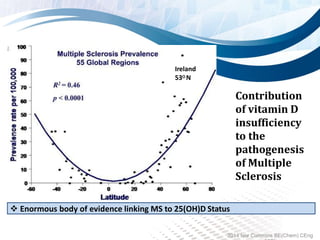
Vitamin D and MS
• Several studies have suggested that maintaining adequate levels of
vitamin D may have a protective effect and lower the risk of
developing multiple sclerosis (MS).
• The risk of developing MS is significantly reduced by both
sunlight, latitude, and supplemental Vitamin D.
• There appears to be a lower relapse rate in multiple sclerosis
patients when Vitamin D is present at higher concentrations.
 Enormous body of evidence linking MS to 25(OH)D Status
Contribution
of vitamin D
insufficiency
to the
pathogenesis
of Multiple
Sclerosis
Ireland
53O N
2014 Ivor Cummins BE(Chem) CEng
• Is there any proof that vitamin D supplements can prevent MS or
keep symptoms of MS from worsening?
• In MS, the immune system attacks the coating that protects the nerve
cells.
• Research suggests that a connection between vitamin D and MS
could be tied to the positive effects vitamin D has on the immune
system.
• The link between vitamin D and MS is strengthened by the
association between sunlight and the risk of MS.
• The farther away from the equator a person lives, the higher the risk
of MS.
• Sunlight is the body's most efficient source for vitamin D —
suggesting that exposure to sunlight may offer protection from MS.
Vitamin D and
Alzheimer’s disease
a large 2014 study published in
Neurology showed people with
extremely low blood levels of
vitamin D were more than twice as
likely to develop Alzheimer's disease
or other types of dementia than those
with normal vitamin D levels.
Vitamin D and cancer
Inverse correlation between Vitamin D levels and the incidence,
mortality and/or survival rates for many cancers including
breast, colorectal, ovarian, and prostate cancers.
Emerging evidence that more than 17 cancers are likely to be vitamin
D sensitive.
1000 IU/day could reduce cancers 7% for men, 9% for women in US.
25(OH)D level of 52 ng/ml reduced breast cancer by 50%
25(OH)D level increase from 29 to 39 reduced cancer risk by
60% after 4 years.
Assmann G, Schulte H. Am J Cardiol. 1992;70:733–737.
Key Takeaways:
 Incidence Rate Average of 6 Studies, consistent association throughout
Colon
Cancer
Incincidene
rate
55% reduction in Colon
Cancer Risk associated
with 38ng/ml 25(OH)D
OddsRatioofColorectalCancer
COLON CANCER
INCIDENCE
P trend
<0.0001
10 20 4030
2014 Ivor Cummins BE(Chem) CEng
Vitamin D and the Lungs
Asthma: Appears to be somewhat effective at
reducing the occurrence of asthma attacks in youth,
and exercise induced bronchoconstriction.
Lower respiratory tract infections are more frequent
with low 25(OH)D levels.
2000 IU Vitamin D abolished the seasonality of
influenza.
Vitamin D reduces inflammation and viral pathogens.
Vitamin D and depression
Vitamin D may be primarily associated with
cognitive domains other than memory ,
such as executive cognitive functions,
depression, bipolar disorders, and
schizophrenia.
Receptors for Vitamin D are present in brain
cells
Vitamin D and depression
• May help brain development also essential in motor coordination
and emotional stability.
• This could be the reason why kids who often play sports and are
exposed in the sun tend to have a higher emotional quotient (EQ)
than children who stay at home just playing video games.
How Much Vitamin D
is Needed?
The only way to know how much is needed is to test 25(OH)D.
Everyone should be tested!
Goal: 25(OH)D between 60-80 ng/ml after a consistent intake level over 2
months.
100 IU of vitamin D raises 25(OH)D about 1 ng/ml.
Vitamin D
deficiency
25(OH)<20
ng/ml
50000iu/wk
D3
for8weeks
Maintenance
therapy
25000 IU
every 2
weeks
sunlight
1000 IU
2000IU
How much is YOUR vitamin
D level
THANK YOU!

Aya

  • 1.
    By pharmacist ayafawzi talib
  • 2.
    In the lasttwo decades vitamin D has gone from being recognized for its importance in bone health to being investigated for its roles in a wide range of physiological functions. Also it has been found to have potential as a preventive or curative drug for more than 100 disorders, ranging from: Cancer. Diabetes. Multiple sclerosis. Depression.
  • 3.
    • Many doctorsnow routinely test blood levels of vitamin D for their patients and recommend supplementation when levels are found to be low. • By many estimates, at least half of the U.S. population and that of many other countries have blood level considered either deficient or insufficient.
  • 4.
    Types of vitaminD D2(Ergocalciferol): Is manufactured . Added to fortified foods and milk. D3(cholecalciferol): Synthesised in the skin under the effect of ultraviolet sunlight. Precursor is 7-dehydrocholisterol. Consumed in diet from animal sources.
  • 5.
    Vitamin D Metabolism 7DeHydroxyCholesterolCholecalciferol (“Vitamin” D3) D3/D2 Supplements Dietary FattyFish, Organ Meats, etc 25(OH)D ! 1,25 D  Kidney then makes 1,25 Dihydroxy Vitamin D  1,25 is ACTIVE Form of D Primary Source is Sun UVB (Sunscreen Prevents Synthesis)  Catalyzes “Cholesterol” to D3  Dietary contribution is limited  Liver then makes 25(OH)D  25(OH)D is The KEY METRIC
  • 6.
  • 7.
    Why the sunis not enough ? Skin pigmentation: Dark skin reduces penetration of ultraviolet rays from sunlight. Therefore it lowers vitamin D production. Time of day and cloud cover: The sun’s ultraviolet rays are strongest between 10 a.m. and 3 p.m.
  • 8.
    Age: The skin’s abilityto manufacture vitamin D declines with age. On average, a 70-year-old synthesizes only about one-quarter as much vitamin D as a 20-year-old from the same sun exposure. Sunscreen use: Sunscreens filter out or block ultraviolet rays and prevent the production of vitamin D. A sunscreen with a sun protection factor (SPF) of 15 reduces the production of vitamin D by 99 percent.
  • 9.
    Sitting behind awindow: Glass filters out most of the ultraviolet rays that trigger vitamin D production in the skin. Low intake of foods containing vitamin D: People rarely get enough vitamin D from their diet, since few foods contain it. Obesity: Obesity is linked with lower blood levels of vitamin D because some of this fat-soluble vitamin is trapped in fat tissue and because of other changes in vitamin D metabolism. Medications: Certain drugs—notably anticonvulsants, corticosteroids, and some HIV medications—reduce vitamin D levels.
  • 10.
    Medical causes: GIT disorderscan impair fat absorption. Vitamin D needs fat to be absorbed in the intestines, so disorders that affect fat absorption (such as Crohn’s or celiac disease and cystic fibrosis) can reduce vitamin D levels. Some types of gastrointestinal surgery (such as gastric bypass for obesity) can also lead to vitamin D deficiency. Liver or Kidney impairment. Genetics: Various genetic factors influence the body’s ability to produce and utilize vitamin D.
  • 11.
  • 12.
    Benefits of VitaminD Improved bone health. Increased absorption of calcium. Reduced risk of falls and bone fractures. Reduced coronary artery disease. Improved muscular function. Lowering of high blood pressure. Improved blood sugar tolerance. Improved nerve function. Improved kidney function. Reduced risk of 17 cancers. Reduced influenza, cold infections, tuberculosis.
  • 13.
    Calcium and PhosphateHomeostasis Vitamin D acts in the small intestine to increase calcium absorption. The dominant function of vitamin D in its active form (calcitriol or 1,25 dihydroxyvitamin D) is the elevation of plasma calcium AND phosphate levels, which are required for mineralization of bone.
  • 14.
    Vitamin D andBones Vitamin D is important for people with osteoporosis. calcium and vitamin D together can increase bone density in postmenopausal women. Vitamin D also helps with other disorders associated with weak bones, like rickets.
  • 15.
    Vitamin D andthe elderly The risk of falls in the elderly (and subsequently, rate of bone fractures) appears to be significantly reduced with Vitamin D supplementation at 700 IU or greater, with most research in the 700-1000 IU range. Lower doses do not appear effective, and a greater protective effect appears to exist alongside calcium supplementation (and possibly Vitamin K supplementation). Cohorts of people with higher serum Vitamin D appear to die less frequently than cohorts with less serum Vitamin D; this may be heavily influenced by reducing falls in the elderly (reduction of falls and subsequent hospitalizations reducing mortality rates).
  • 16.
    Vitamin D andDiabetes Vitamin D deficiency is associated with impaired glucose tolerance and reduced insulin turnover and insulin sensitivity. An improvement in insulin secretion is noted in diabetics (type II mostly) and in persons at risk for diabetes, which is thought to be secondary to protective effects at the level of the pancreas. Furthermore, vitamin D repletion improves glucose clearance in vitamin D-deficient animals independent of other nutritional factors.
  • 17.
    Vitamin D andthe CVS There is evolving data about the possible relationship of vitamin D with CVD risk factors. There appears to be less risk of cardiovascular disease and related cardiovascular complications with supplementation of 1,000 IU of Vitamin D or higher. Some intervention studies note that higher serum vitamin D is associated with mildly lower blood pressure. Vitamin D may: affect the renin-angiotensin system. exert beneficial effects on vascular smooth muscle cells and the endothelium and cardiomyocytes.
  • 19.
    There is alsoevidence for the relationship of vitamin D deficiency to statin myopathy. One study reported resolution of myalgia after restoring vitamin D levels in vitamin D-deficient individuals.
  • 20.
    Vitamin D andMS • Several studies have suggested that maintaining adequate levels of vitamin D may have a protective effect and lower the risk of developing multiple sclerosis (MS). • The risk of developing MS is significantly reduced by both sunlight, latitude, and supplemental Vitamin D. • There appears to be a lower relapse rate in multiple sclerosis patients when Vitamin D is present at higher concentrations.
  • 21.
     Enormous bodyof evidence linking MS to 25(OH)D Status Contribution of vitamin D insufficiency to the pathogenesis of Multiple Sclerosis Ireland 53O N 2014 Ivor Cummins BE(Chem) CEng
  • 22.
    • Is thereany proof that vitamin D supplements can prevent MS or keep symptoms of MS from worsening? • In MS, the immune system attacks the coating that protects the nerve cells. • Research suggests that a connection between vitamin D and MS could be tied to the positive effects vitamin D has on the immune system. • The link between vitamin D and MS is strengthened by the association between sunlight and the risk of MS. • The farther away from the equator a person lives, the higher the risk of MS. • Sunlight is the body's most efficient source for vitamin D — suggesting that exposure to sunlight may offer protection from MS.
  • 23.
    Vitamin D and Alzheimer’sdisease a large 2014 study published in Neurology showed people with extremely low blood levels of vitamin D were more than twice as likely to develop Alzheimer's disease or other types of dementia than those with normal vitamin D levels.
  • 24.
    Vitamin D andcancer Inverse correlation between Vitamin D levels and the incidence, mortality and/or survival rates for many cancers including breast, colorectal, ovarian, and prostate cancers. Emerging evidence that more than 17 cancers are likely to be vitamin D sensitive. 1000 IU/day could reduce cancers 7% for men, 9% for women in US. 25(OH)D level of 52 ng/ml reduced breast cancer by 50% 25(OH)D level increase from 29 to 39 reduced cancer risk by 60% after 4 years.
  • 25.
    Assmann G, SchulteH. Am J Cardiol. 1992;70:733–737. Key Takeaways:  Incidence Rate Average of 6 Studies, consistent association throughout Colon Cancer Incincidene rate 55% reduction in Colon Cancer Risk associated with 38ng/ml 25(OH)D OddsRatioofColorectalCancer COLON CANCER INCIDENCE P trend <0.0001 10 20 4030 2014 Ivor Cummins BE(Chem) CEng
  • 26.
    Vitamin D andthe Lungs Asthma: Appears to be somewhat effective at reducing the occurrence of asthma attacks in youth, and exercise induced bronchoconstriction. Lower respiratory tract infections are more frequent with low 25(OH)D levels. 2000 IU Vitamin D abolished the seasonality of influenza. Vitamin D reduces inflammation and viral pathogens.
  • 27.
    Vitamin D anddepression Vitamin D may be primarily associated with cognitive domains other than memory , such as executive cognitive functions, depression, bipolar disorders, and schizophrenia. Receptors for Vitamin D are present in brain cells
  • 28.
    Vitamin D anddepression • May help brain development also essential in motor coordination and emotional stability. • This could be the reason why kids who often play sports and are exposed in the sun tend to have a higher emotional quotient (EQ) than children who stay at home just playing video games.
  • 29.
    How Much VitaminD is Needed? The only way to know how much is needed is to test 25(OH)D. Everyone should be tested! Goal: 25(OH)D between 60-80 ng/ml after a consistent intake level over 2 months. 100 IU of vitamin D raises 25(OH)D about 1 ng/ml.
  • 30.
  • 31.
  • 32.
    How much isYOUR vitamin D level
  • 33.