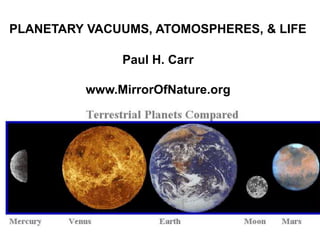
PLANETARY VACUUMS, ATOMOSPHERES, & LIFE
Paul H. Carr
www.MirrorOfNature.org
VACUUM ON THE MOON 3 X 10-15 BAR
No greenhouse gas atmosphere
• Diurnal Variations:
Day 123 C (396 Kelvin)
Night -233 C (40 Kelvin)
ON EARTH
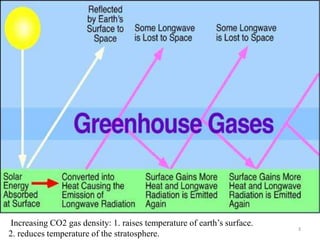
• Greenhouse gasses, blanketing the earth, give much
smaller variations.
• On cloudless nights, non-condensing and increasing
CO2 (100 year life) and other greenhouse gases keep us
warmer than on the moon.
Increasing CO2 gas density: 1. raises temperature of earth’s surface.
2. reduces temperature of the stratosphere.
3
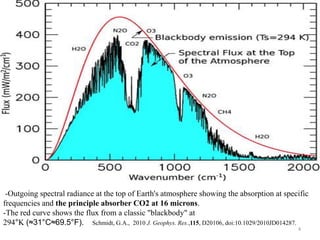
-Outgoing spectral radiance at the top of Earth's atmosphere showing the absorption at specific
frequencies and the principle absorber CO2 at 16 microns.
-The red curve shows the flux from a classic "blackbody" at
294°K (≈31°C≈69.5°F). Schmidt, G.A., 2010 J. Geophys. Res.,115, D20106, doi:10.1029/2010JD014287.
4
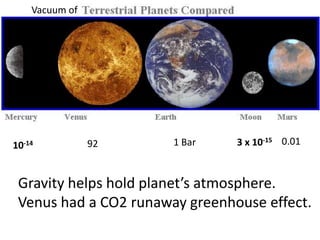
Vacuum of
1 Bar 3 x 10-15
10-14 0.0192
Gravity helps hold planet’s atmosphere.
Venus had a CO2 runaway greenhouse effect.
PLANETARY TEMPERATURES, VACUUMS, & ATMOSPHERES.
Science, 330, 356-359, 15 October 2010
Parameter Mars Earth Venus Mercury
Temp. (K) 223 Day 300 Day 730 Day 700 Day
213 Night 280 Night 730 Night 100 Night
Pressure (bar) 0.01 1 92 10-14
Ultraviolet observations of VENUS’ cloud cover----
Venus surface temp hotter than Mercury’s 700 K.
ATMOSPHERES
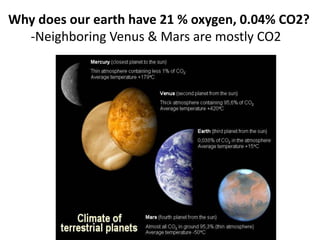
Venus: 96% CO2, 3% Nitrogen.
Earth: 21% Oxygen, 78% Nitrogen, 0.04% CO2
Mars: 95% CO2, 3% Nitrogen
Why does our earth have 21 % oxygen, 0.04% CO2?
-Neighboring Venus & Mars are mostly CO2
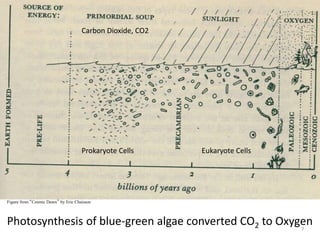
Figure from “Cosmic Dawn” by Eric Chaisson
Photosynthesis of blue-green algae converted CO2 to Oxygen
Carbon Dioxide, CO2
Prokaryote Cells Eukaryote Cells
7
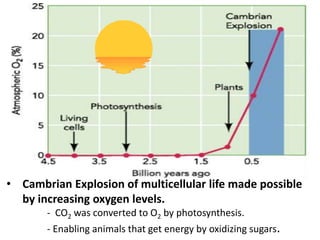
• Cambrian Explosion of multicellular life made possible
by increasing oxygen levels.
- CO2 was converted to O2 by photosynthesis.
- Enabling animals that get energy by oxidizing sugars.
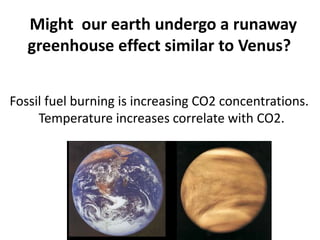
Might our earth undergo a runaway
greenhouse effect similar to Venus?
Fossil fuel burning is increasing CO2 concentrations.
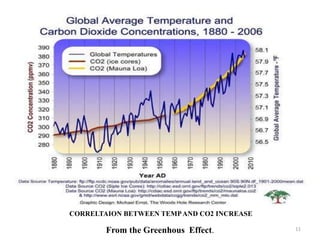
Temperature increases correlate with CO2.
CORRELTAION BETWEEN TEMPAND CO2 INCREASE
From the Greenhous Effect. 11
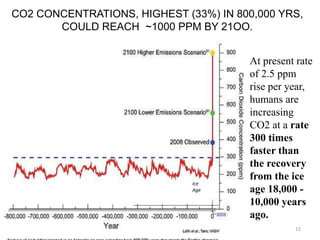
At present rate
of 2.5 ppm
rise per year,
humans are
increasing
CO2 at a rate
300 times
faster than
the recovery
from the ice
age 18,000 -
10,000 years
ago.
CO2 CONCENTRATIONS, HIGHEST (33%) IN 800,000 YRS,
COULD REACH ~1000 PPM BY 21OO.
Ice
Age
12
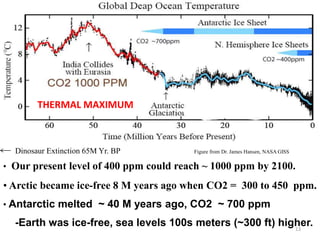
• Our present level of 400 ppm could reach ~ 1000 ppm by 2100.
• Arctic became ice-free 8 M years ago when CO2 = 300 to 450 ppm.
• Antarctic melted ~ 40 M years ago, CO2 ~ 700 ppm
-Earth was ice-free, sea levels 100s meters (~300 ft) higher.
Dinosaur Extinction 65M Yr. BP Figure from Dr. James Hansen, NASA GISS
13
THERMAL MAXIMUM
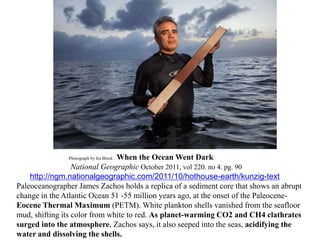
Photograph by Ira Block When the Ocean Went Dark
National Geographic October 2011, vol 220. no 4. pg. 90
http://ngm.nationalgeographic.com/2011/10/hothouse-earth/kunzig-text
Paleoceanographer James Zachos holds a replica of a sediment core that shows an abrupt
change in the Atlantic Ocean 51 -55 million years ago, at the onset of the Paleocene-
Eocene Thermal Maximum (PETM). White plankton shells vanished from the seafloor
mud, shifting its color from white to red. As planet-warming CO2 and CH4 clathrates
surged into the atmosphere, Zachos says, it also seeped into the seas, acidifying the
water and dissolving the shells.
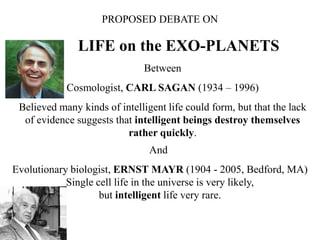
PROPOSED DEBATE ON
LIFE on the EXO-PLANETS
Between
Cosmologist, CARL SAGAN (1934 – 1996)
Believed many kinds of intelligent life could form, but that the lack
of evidence suggests that intelligent beings destroy themselves
rather quickly.
And
Evolutionary biologist, ERNST MAYR (1904 - 2005, Bedford, MA)
Single cell life in the universe is very likely,
but intelligent life very rare.
PLANETARY VACUUMS, ATOMOSPHERES, & LIFE
CONCLUSIONS:
• We must stop CO2 fossil fuel emissions by:
-Conservation, efficiency increases,
carbon emission surcharge.
- Energy from solar, wind, nuclear.
• The 21% oxygen that enables our life was
made possible by the emergence of plant
photosynthesis.

Planetary Vacuums, Atmospheres, & Life

  • 1.
    PLANETARY VACUUMS, ATOMOSPHERES,& LIFE Paul H. Carr www.MirrorOfNature.org
  • 2.
    VACUUM ON THEMOON 3 X 10-15 BAR No greenhouse gas atmosphere • Diurnal Variations: Day 123 C (396 Kelvin) Night -233 C (40 Kelvin) ON EARTH • Greenhouse gasses, blanketing the earth, give much smaller variations. • On cloudless nights, non-condensing and increasing CO2 (100 year life) and other greenhouse gases keep us warmer than on the moon.
  • 3.
    Increasing CO2 gasdensity: 1. raises temperature of earth’s surface. 2. reduces temperature of the stratosphere. 3
  • 4.
    -Outgoing spectral radianceat the top of Earth's atmosphere showing the absorption at specific frequencies and the principle absorber CO2 at 16 microns. -The red curve shows the flux from a classic "blackbody" at 294°K (≈31°C≈69.5°F). Schmidt, G.A., 2010 J. Geophys. Res.,115, D20106, doi:10.1029/2010JD014287. 4
  • 5.
    Vacuum of 1 Bar3 x 10-15 10-14 0.0192 Gravity helps hold planet’s atmosphere. Venus had a CO2 runaway greenhouse effect.
  • 6.
    PLANETARY TEMPERATURES, VACUUMS,& ATMOSPHERES. Science, 330, 356-359, 15 October 2010 Parameter Mars Earth Venus Mercury Temp. (K) 223 Day 300 Day 730 Day 700 Day 213 Night 280 Night 730 Night 100 Night Pressure (bar) 0.01 1 92 10-14 Ultraviolet observations of VENUS’ cloud cover---- Venus surface temp hotter than Mercury’s 700 K. ATMOSPHERES Venus: 96% CO2, 3% Nitrogen. Earth: 21% Oxygen, 78% Nitrogen, 0.04% CO2 Mars: 95% CO2, 3% Nitrogen
  • 7.
    Why does ourearth have 21 % oxygen, 0.04% CO2? -Neighboring Venus & Mars are mostly CO2
  • 8.
    Figure from “CosmicDawn” by Eric Chaisson Photosynthesis of blue-green algae converted CO2 to Oxygen Carbon Dioxide, CO2 Prokaryote Cells Eukaryote Cells 7
  • 9.
    • Cambrian Explosionof multicellular life made possible by increasing oxygen levels. - CO2 was converted to O2 by photosynthesis. - Enabling animals that get energy by oxidizing sugars.
  • 10.
    Might our earthundergo a runaway greenhouse effect similar to Venus? Fossil fuel burning is increasing CO2 concentrations. Temperature increases correlate with CO2.
  • 11.
    CORRELTAION BETWEEN TEMPANDCO2 INCREASE From the Greenhous Effect. 11
  • 12.
    At present rate of2.5 ppm rise per year, humans are increasing CO2 at a rate 300 times faster than the recovery from the ice age 18,000 - 10,000 years ago. CO2 CONCENTRATIONS, HIGHEST (33%) IN 800,000 YRS, COULD REACH ~1000 PPM BY 21OO. Ice Age 12
  • 13.
    • Our presentlevel of 400 ppm could reach ~ 1000 ppm by 2100. • Arctic became ice-free 8 M years ago when CO2 = 300 to 450 ppm. • Antarctic melted ~ 40 M years ago, CO2 ~ 700 ppm -Earth was ice-free, sea levels 100s meters (~300 ft) higher. Dinosaur Extinction 65M Yr. BP Figure from Dr. James Hansen, NASA GISS 13 THERMAL MAXIMUM
  • 14.
    Photograph by IraBlock When the Ocean Went Dark National Geographic October 2011, vol 220. no 4. pg. 90 http://ngm.nationalgeographic.com/2011/10/hothouse-earth/kunzig-text Paleoceanographer James Zachos holds a replica of a sediment core that shows an abrupt change in the Atlantic Ocean 51 -55 million years ago, at the onset of the Paleocene- Eocene Thermal Maximum (PETM). White plankton shells vanished from the seafloor mud, shifting its color from white to red. As planet-warming CO2 and CH4 clathrates surged into the atmosphere, Zachos says, it also seeped into the seas, acidifying the water and dissolving the shells.
  • 15.
    PROPOSED DEBATE ON LIFEon the EXO-PLANETS Between Cosmologist, CARL SAGAN (1934 – 1996) Believed many kinds of intelligent life could form, but that the lack of evidence suggests that intelligent beings destroy themselves rather quickly. And Evolutionary biologist, ERNST MAYR (1904 - 2005, Bedford, MA) Single cell life in the universe is very likely, but intelligent life very rare.
  • 16.
    PLANETARY VACUUMS, ATOMOSPHERES,& LIFE CONCLUSIONS: • We must stop CO2 fossil fuel emissions by: -Conservation, efficiency increases, carbon emission surcharge. - Energy from solar, wind, nuclear. • The 21% oxygen that enables our life was made possible by the emergence of plant photosynthesis.