The Green House
Effect
Presented By:-
Yamawanti Sharma
Stream:- ETCE
Semester:- 3rd
Roll N0. :- 02
Content:-
• Greenhouse Effect: How it works
• Greenhouse Gases
• Water Vapor
• Carbon Dioxide
• Methane
• Nitrous Oxide
• Ozone
• CFCs
Greenhouse Effect:
How it works
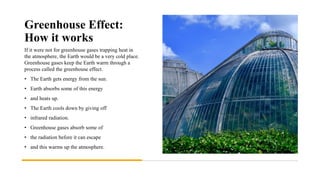
If it were not for greenhouse gases trapping heat in
the atmosphere, the Earth would be a very cold place.
Greenhouse gases keep the Earth warm through a
process called the greenhouse effect.
• The Earth gets energy from the sun.
• Earth absorbs some of this energy
• and heats up.
• The Earth cools down by giving off
• infrared radiation.
• Greenhouse gases absorb some of
• the radiation before it can escape
• and this warms up the atmosphere.
Greenhouse Gases:-
Greenhouse gases absorb this energy, thereby
allowing less heat to escape back to space, and
'trapping' it in the lower atmosphere. Some
greenhouse gasses are natural, while others are
man-made.
1. Water Vapor (H2O)
2. Carbon Dioxide (CO2)
3. Methane (NH4)
4. Nitrous Oxide (N2O)Ozone (O3)
5. Chlorofluorocarbons(CFCs)
Water Vapour:-
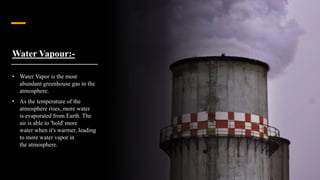
• Water Vapor is the most
abundant greenhouse gas in the
atmosphere.
• As the temperature of the
atmosphere rises, more water
is evaporated from Earth. The
air is able to 'hold' more
water when it's warmer, leading
to more water vapor in
the atmosphere.
Carbon Dioxide:-
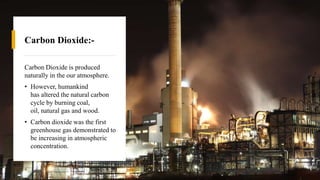
Carbon Dioxide is produced
naturally in the our atmosphere.
• However, humankind
has altered the natural carbon
cycle by burning coal,
oil, natural gas and wood.
• Carbon dioxide was the first
greenhouse gas demonstrated to
be increasing in atmospheric
concentration.
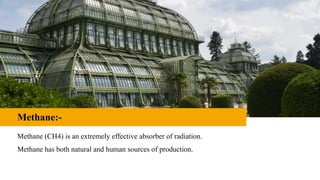
Methane:-
Methane (CH4) is an extremely effective absorber of radiation.
Methane has both natural and human sources of production.
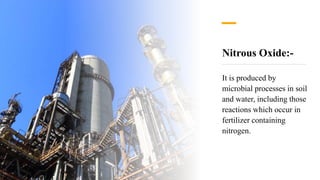
Nitrous Oxide:-
It is produced by
microbial processes in soil
and water, including those
reactions which occur in
fertilizer containing
nitrogen.
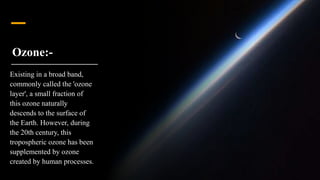
Ozone:-
Existing in a broad band,
commonly called the 'ozone
layer', a small fraction of
this ozone naturally
descends to the surface of
the Earth. However, during
the 20th century, this
tropospheric ozone has been
supplemented by ozone
created by human processes.
CFCs:-
• They destroy good ozone in
the stratosphere.
• Their long atmospheric lifetimes determine
that some concentration of the CFCs
will remain in the atmosphere for over 100
years.
• Chlorofluorocarbons (CFCs) have no
natural source, but were entirely synthesized
for such diverse uses as refrigerants, aerosol
propellants and cleaning solvents.

Green house effect

  • 1.
    The Green House Effect PresentedBy:- Yamawanti Sharma Stream:- ETCE Semester:- 3rd Roll N0. :- 02
  • 2.
    Content:- • Greenhouse Effect:How it works • Greenhouse Gases • Water Vapor • Carbon Dioxide • Methane • Nitrous Oxide • Ozone • CFCs
  • 3.
    Greenhouse Effect: How itworks If it were not for greenhouse gases trapping heat in the atmosphere, the Earth would be a very cold place. Greenhouse gases keep the Earth warm through a process called the greenhouse effect. • The Earth gets energy from the sun. • Earth absorbs some of this energy • and heats up. • The Earth cools down by giving off • infrared radiation. • Greenhouse gases absorb some of • the radiation before it can escape • and this warms up the atmosphere.
  • 4.
    Greenhouse Gases:- Greenhouse gasesabsorb this energy, thereby allowing less heat to escape back to space, and 'trapping' it in the lower atmosphere. Some greenhouse gasses are natural, while others are man-made. 1. Water Vapor (H2O) 2. Carbon Dioxide (CO2) 3. Methane (NH4) 4. Nitrous Oxide (N2O)Ozone (O3) 5. Chlorofluorocarbons(CFCs)
  • 5.
    Water Vapour:- • WaterVapor is the most abundant greenhouse gas in the atmosphere. • As the temperature of the atmosphere rises, more water is evaporated from Earth. The air is able to 'hold' more water when it's warmer, leading to more water vapor in the atmosphere.
  • 6.
    Carbon Dioxide:- Carbon Dioxideis produced naturally in the our atmosphere. • However, humankind has altered the natural carbon cycle by burning coal, oil, natural gas and wood. • Carbon dioxide was the first greenhouse gas demonstrated to be increasing in atmospheric concentration.
  • 7.
    Methane:- Methane (CH4) isan extremely effective absorber of radiation. Methane has both natural and human sources of production.
  • 8.
    Nitrous Oxide:- It isproduced by microbial processes in soil and water, including those reactions which occur in fertilizer containing nitrogen.
  • 9.
    Ozone:- Existing in abroad band, commonly called the 'ozone layer', a small fraction of this ozone naturally descends to the surface of the Earth. However, during the 20th century, this tropospheric ozone has been supplemented by ozone created by human processes.
  • 10.
    CFCs:- • They destroygood ozone in the stratosphere. • Their long atmospheric lifetimes determine that some concentration of the CFCs will remain in the atmosphere for over 100 years. • Chlorofluorocarbons (CFCs) have no natural source, but were entirely synthesized for such diverse uses as refrigerants, aerosol propellants and cleaning solvents.