Planetary Atmospheres II
Planets and Planetary
Systems
RENEE CONDORI APAZA, JULIO
VALDIVIA SILVA, Christopher P.
McKay
The Advanced Studies Laboratories
 What is an atmosphere?, What is its structure?
 Temperature of a planet, neglecting effects of
atmosphere (“no-greenhouse temperatures”)
 Generic atmospheric structure
 Global climate change
 Earth
 Venus
 Mars
• Planetary atmospheres as a balancing act:
– Gravity vs. thermal motions of air molecules
– Heating by Sun vs. heat radiated back into space
– Weather as a way to equalize pressures at different places on a
planet’s surface
• Atmospheres of terrestrial planets are very different now
from the way they were born
– Formation: volcanoes, comets
– Destruction: escape, incorporation into rocks, oceans
– Huge changes over a billion years or less
• Prospect of human-induced global warming on Earth needs
to be taken seriously
• Earth diameter
~ 12,000 km
• Top of troposphere
~ 12 km
• Thickness of
atmosphere divided
by Earth diameter = 1 /
1000
• About 10 km thick
• Consists mostly of
molecular nitrogen (N2)
and oxygen (O2)
• Fractions:
– 78% Nitrogen
– 21% Oxygen
– 0.04% CO2
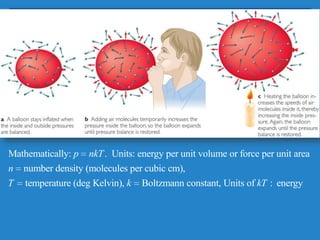
Gas
pressure
depends
on both
density
Adding
air
molecule
s
increase
Heatin
g the
air
also
increa
Mathematically: p nkT. Units: energy per unit volume or force per unit area
n number density (molecules per cubic cm),
T temperature (deg Kelvin), k Boltzmann constant, Units of kT : energy
• Pressure and density
decrease with altitude
because the weight of
overlying layers is less
• Earth’s pressure at sea
level is
– 1.03 kg per sq. meter
– 14.7 lbs per sq. inch
– 1 bar
P(h) P(h+ h)
Area A
h
P
h
0
P0
/e
• Pressure, density fall off exponentially with altitude
• Higher temperature T larger “scale height” h0
• Stronger gravity g shorter “scale height” h0
Hence the “thin blue line”
• Small amounts of gas are present even at > 300 km
• Create pressure that determines whether liquid water
can exist on surface
• Absorb and scatter light
• Create wind, weather, and climate
• Interact with solar wind to create a magnetosphere
• Can make planetary surfaces warmer through
greenhouse effect
“No-greenhouse”
temperature
albedo = fraction of sunlight
that is reflected by a surface
Conclusion: for Venus and Earth, at least, something else is
going on! (not just radiation into space.
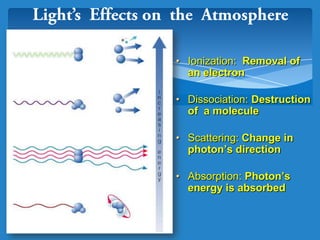
• Ionization: Removal of
an electron
• Dissociation: Destruction
of a molecule
• Scattering: Change in
photon’s direction
• Absorption: Photon’s
energy is absorbed
• carbon dioxide CO2
• water vapor H20
• methane CH4
• others too (NO2, ....)
• More greenhouse gases in atmosphere can
lead to higher surface temperatures.
• What would happen to Earth’s temperature if
Earth’s surface were less reflective?
a) It would go up.
b) It would go down.
c) It wouldn’t change
• This is one of the factors exacerbating global
warming.
– As more arctic ice melts in summer, arctic
ocean absorbs more light, temperature
rises
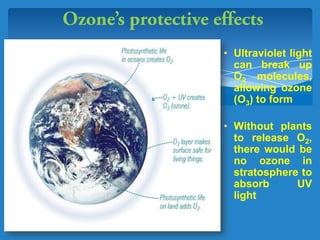
• Ultraviolet light
can break up
O2 molecules,
allowing ozone
(O3) to form
• Without plants
to release O2,
there would be
no ozone in
stratosphere to
absorb UV
light
• Ultra-violet light from Sun dissociates oxygen
molecules O2 to produce O in stratosphere
• O combines with O2 to form O3 (ozone)
• Ozone in stratosphere absorbs harmful ultraviolet
light from Sun, providing land-based life with a
protective shield
• Manmade aerosols (chlorofluorocarbons, CFCs)
can inhibit ozone formation
• Result: “Ozone hole”
Antarctic ozone hole is worst in late southern winter
?
• Why is ozone hole much deeper and larger in
the Antarctic than in the arctic?
– During winter, clouds form in the Antarctic ozone
layer.
– Chemical reactions on ice particles in the clouds
activate ozone destroying substances.
– In spring, these substances take part in chemical
reactions that destroy ozone.
• Arctic: warmer than Antarctic (fewer ice
clouds), more irregular air circulation
• Huge changes took place over the 4.6 billion
years since planets formed!
• Early atmospheres didn’t resemble current
ones at all
• Question: why are atmospheres of Venus,
Earth, Mars so different?
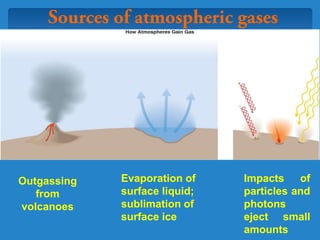
Outgassing
from
volcanoes
Evaporation of
surface liquid;
sublimation of
surface ice
Impacts of
particles and
photons
eject small
amounts
Condensation
onto surface
Chemical
reactions
with surface
Large impacts
blast gas into
space
Moon Mercury
• Very sensitive measurements show Moon and
Mercury have extremely thin atmospheres
• Gas comes from impacts that eject surface atoms
• Why are they so different?
• Were they always this different from each other?
 First Atmosphere: Primordial elements
Composition - Probably H2, He
 Today these gases are relatively rare on Earth compared to other
places in the universe.
 Were probably lost to space early in Earth's history because
Earth's gravity is not strong enough to hold lightest gases
Earth still did not have a differentiated core (solid inner/liquid
outer core) which creates Earth's magnetic field
(magnetosphere = Van Allen Belt) which deflects solar wind.
Magnetosphere protects any atmosphere from the solar wind.
 Once the core differentiated, gases could be retained.
Gases similar to those from
modern volcanoes (H2O, CO2,
SO2, CO, S2, Cl2, N2, H2) and NH3
(ammonia) and CH4 (methane)
No free oxygen (O2 not found in
volcanic gases)
Ocean Formation - As Earth
cooled, H2O produced by
outgassing could exist as liquid
CO2 could then dissolve in
ocean, be sequestered in
marine sediments
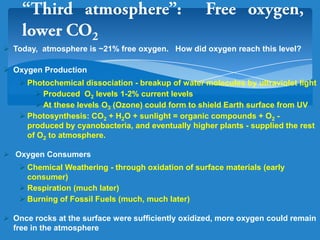
 Today, atmosphere is ~21% free oxygen. How did oxygen reach this level?
 Oxygen Production
 Photochemical dissociation - breakup of water molecules by ultraviolet light
 Produced O2 levels 1-2% current levels
 At these levels O3 (Ozone) could form to shield Earth surface from UV
 Photosynthesis: CO2 + H2O + sunlight = organic compounds + O2 -
produced by cyanobacteria, and eventually higher plants - supplied the rest
of O2 to atmosphere.
 Oxygen Consumers
 Chemical Weathering - through oxidation of surface materials (early
consumer)
 Respiration (much later)
 Burning of Fossil Fuels (much, much later)
 Once rocks at the surface were sufficiently oxidized, more oxygen could remain
free in the atmosphere
The Carbon Dioxide Cycle 1. Atmospheric CO2
dissolves in rainwater
2. Rain erodes minerals
which flow into ocean
3. Minerals combine with
carbon to make rocks
on ocean floor
4. Subduction carries
carbonate rocks down
into mantle
5. Rocks melt in mantle
and outgas CO2 back
into atmosphere
through volcanoes
Cooling allows CO2 to build up in atmosphere
Heating causes rain to reduce CO2 in atmosphere
• The first photosynthesis
–Consumes CO2,
release O2
 Chemical building blocks of life could not have formed in the
presence of atmospheric oxygen. Chemical reactions that yield
amino acids are inhibited by presence of very small amounts of
oxygen.
 Oxygen prevents growth of the most primitive living bacteria
such as photosynthetic bacteria, methane-producing bacteria
and bacteria that derive energy from fermentation.
 Conclusion - Since today's most primitive life forms are
anaerobic (don’t need oxygen), the first forms of cellular life
probably had similar metabolisms.
 Today these anaerobic life forms are restricted to anoxic (low
oxygen) habitats such as swamps, ponds, and lagoons.
Potential source of the Earth's ocean water is
comet-like balls of ice.
Enter atmosphere at rate of about 20/second.
Four billion years of such bombardment would
give enough water to fill the oceans to their
present volume.
Possible problems with isotope ratios. Under
active research.
Solar Brightening
• Sun very gradually grows brighter with time, increasing
the amount of sunlight warming planets
Changes in Axis Tilt
• Greater tilt makes more extreme seasons, while smaller
tilt keeps polar regions colder.
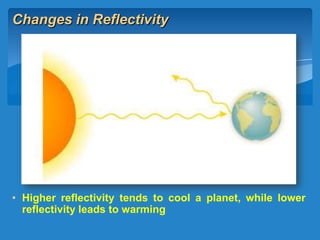
Changes in Reflectivity
• Higher reflectivity tends to cool a planet, while lower
reflectivity leads to warming
Changes in Greenhouse Gases
• Increase in greenhouse gases leads to warming, while a
decrease leads to cooling
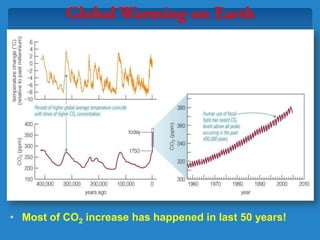
• Global temperatures
have tracked CO2
concentration for last
500,000 years
• Antarctic air bubbles
indicate current CO2
concentration is
highest in at least
500,000 years
• Most of CO2 increase has happened in last 50 years!
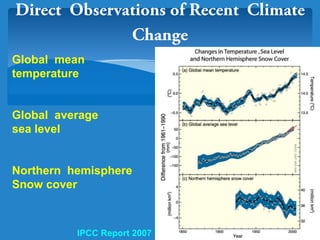
IPCC Report 2007
Global mean
temperature
Global average
sea level
Northern hemisphere
Snow cover
IPCC Report 2007
IPCC Report 2007
Increased Glacier retreat
since the early 1990s
Area of seasonally frozen
ground in NH has decreased
by 7% from 1901 to 2002
IPCC Report 2007
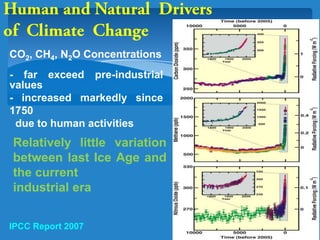
CO2, CH4, N2O Concentrations
- far exceed pre-industrial
values
- increased markedly since
1750
due to human activities
Relatively little variation
between last Ice Age and
the current
industrial era
IPCC Report 2007
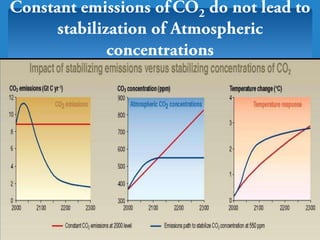
Once CO2 gets into atmosphere, it stays
Impacts are worse
Already more flood and drought prone
Larger share of the economy is in climate sensitive
sectors
Lower capacity to adapt
Lack of financial, institutional and technological
capacity
Climate change is likely to impact disproportionately
upon the poorest countries
.. and the poorest people within countries
Net economic effects expected to be negative in most
developing countries
• No evidence for plate
tectonics on Venus
– No mid-ocean rifts
– No subduction trenches
• Volcanos spread evenly
across surface instead of
at plate boundaries, as on
Earth.
• Lithosphere not broken
into plates; probably
because heat at surface
slightly softens the
lithosphere
Earth’s carbon-
silicate cycle
Source: Kasting,
Scientific
American
• Venus has far fewer impact craters than Moon & Mercury, but more than
Earth.
– The dense atmosphere protects it from smaller impacts
• Geologic activity (volcanic resurfacing) has erased much of the evidence
• Surface age is only about a billion years.
• Rather uniform age implies that Venus was "resurfaced" by lava flows
during a recent, relatively short period
• This differs profoundly from Earth's crustal history. What is it telling us?
– Could Venus' present crust only have formed that recently?
– Could there have been a growing crust before 1 billion years ago that
"turned over" as heat built up underneath, to lead to a new era of major
lava flows?
– Why?
• Geomorphological evidence (*lots* of it)
– River and flood channels, alluvial fans, slumps, canyons, ...
• One more piece of evidence: shape of ocean basins
• Evidence of previous
era when liquid water
was plentiful
• Today: Evidence for ice
mixed with soil in top
meter of ground
• Mars has not had
widespread surface
water for 3 billion
years
• Greenhouse effect
probably kept
surface warmer
before that
• Somehow Mars
lost most of its
atmosphere
One possible scenario
• Magnetic field may have preserved early Martian
atmosphere .
• Solar wind may have stripped atmosphere after field
decreased because of interior cooling (no more molten
core)
 Shortly after Mars formed, its surface temperature was ~ equal to its blackbody
temperature (around -55 C).
 As volcanoes dumped CO2 and H2O vapor into atmosphere, greenhouse effect
increased temperature above 0 C (freezing) so liquid water could exist.
 Liquid water was present, so rocks could efficiently remove CO2 from atmosphere.
 Two competing effects determined amount of CO2 in atmosphere: volcanoes
adding CO2, and rocks absorbing CO2. Result: moderate level of CO2 .
 Greenhouse effect could keep surface T > 0 C, as long as volcanoes kept erupting.
 Eventually Mars' core cooled and solidified (Mars is small). Volcanic activity
subsided. Magnetic field went away, solar wind particles eroded atmosphere.
 Once rate of eruptions tapered off, CO2 in the atmosphere started to fall.
 As the atmosphere thinned out, the greenhouse effect weakened. Eventually the
average surface temperature dropped, and surface water froze.
Balancing act between injection and removal of
CO2 from atmosphere
Role of liquid water in sequestering CO2
 Venus too hot
 Mars too cold
 Earth just right
What is evidence for these scenarios? How
could you test them?
Planetary Atmospheres II

Planetary Atmospheres II

  • 1.
    Planetary Atmospheres II Planetsand Planetary Systems RENEE CONDORI APAZA, JULIO VALDIVIA SILVA, Christopher P. McKay The Advanced Studies Laboratories
  • 2.
     What isan atmosphere?, What is its structure?  Temperature of a planet, neglecting effects of atmosphere (“no-greenhouse temperatures”)  Generic atmospheric structure  Global climate change  Earth  Venus  Mars
  • 3.
    • Planetary atmospheresas a balancing act: – Gravity vs. thermal motions of air molecules – Heating by Sun vs. heat radiated back into space – Weather as a way to equalize pressures at different places on a planet’s surface • Atmospheres of terrestrial planets are very different now from the way they were born – Formation: volcanoes, comets – Destruction: escape, incorporation into rocks, oceans – Huge changes over a billion years or less • Prospect of human-induced global warming on Earth needs to be taken seriously
  • 4.
    • Earth diameter ~12,000 km • Top of troposphere ~ 12 km • Thickness of atmosphere divided by Earth diameter = 1 / 1000
  • 5.
    • About 10km thick • Consists mostly of molecular nitrogen (N2) and oxygen (O2) • Fractions: – 78% Nitrogen – 21% Oxygen – 0.04% CO2
  • 6.
  • 7.
    Mathematically: p nkT.Units: energy per unit volume or force per unit area n number density (molecules per cubic cm), T temperature (deg Kelvin), k Boltzmann constant, Units of kT : energy
  • 8.
    • Pressure anddensity decrease with altitude because the weight of overlying layers is less • Earth’s pressure at sea level is – 1.03 kg per sq. meter – 14.7 lbs per sq. inch – 1 bar
  • 9.
  • 10.
    h P h 0 P0 /e • Pressure, densityfall off exponentially with altitude • Higher temperature T larger “scale height” h0 • Stronger gravity g shorter “scale height” h0
  • 11.
    Hence the “thinblue line”
  • 12.
    • Small amountsof gas are present even at > 300 km
  • 13.
    • Create pressurethat determines whether liquid water can exist on surface • Absorb and scatter light • Create wind, weather, and climate • Interact with solar wind to create a magnetosphere • Can make planetary surfaces warmer through greenhouse effect
  • 15.
    “No-greenhouse” temperature albedo = fractionof sunlight that is reflected by a surface
  • 16.
    Conclusion: for Venusand Earth, at least, something else is going on! (not just radiation into space.
  • 17.
    • Ionization: Removalof an electron • Dissociation: Destruction of a molecule • Scattering: Change in photon’s direction • Absorption: Photon’s energy is absorbed
  • 20.
    • carbon dioxideCO2 • water vapor H20 • methane CH4 • others too (NO2, ....) • More greenhouse gases in atmosphere can lead to higher surface temperatures.
  • 24.
    • What wouldhappen to Earth’s temperature if Earth’s surface were less reflective? a) It would go up. b) It would go down. c) It wouldn’t change • This is one of the factors exacerbating global warming. – As more arctic ice melts in summer, arctic ocean absorbs more light, temperature rises
  • 26.
    • Ultraviolet light canbreak up O2 molecules, allowing ozone (O3) to form • Without plants to release O2, there would be no ozone in stratosphere to absorb UV light
  • 27.
    • Ultra-violet lightfrom Sun dissociates oxygen molecules O2 to produce O in stratosphere • O combines with O2 to form O3 (ozone) • Ozone in stratosphere absorbs harmful ultraviolet light from Sun, providing land-based life with a protective shield • Manmade aerosols (chlorofluorocarbons, CFCs) can inhibit ozone formation • Result: “Ozone hole”
  • 28.
    Antarctic ozone holeis worst in late southern winter
  • 29.
    ? • Why isozone hole much deeper and larger in the Antarctic than in the arctic? – During winter, clouds form in the Antarctic ozone layer. – Chemical reactions on ice particles in the clouds activate ozone destroying substances. – In spring, these substances take part in chemical reactions that destroy ozone. • Arctic: warmer than Antarctic (fewer ice clouds), more irregular air circulation
  • 30.
    • Huge changestook place over the 4.6 billion years since planets formed! • Early atmospheres didn’t resemble current ones at all • Question: why are atmospheres of Venus, Earth, Mars so different?
  • 31.
    Outgassing from volcanoes Evaporation of surface liquid; sublimationof surface ice Impacts of particles and photons eject small amounts
  • 32.
  • 35.
    Moon Mercury • Verysensitive measurements show Moon and Mercury have extremely thin atmospheres • Gas comes from impacts that eject surface atoms
  • 36.
    • Why arethey so different? • Were they always this different from each other?
  • 37.
     First Atmosphere:Primordial elements Composition - Probably H2, He  Today these gases are relatively rare on Earth compared to other places in the universe.  Were probably lost to space early in Earth's history because Earth's gravity is not strong enough to hold lightest gases Earth still did not have a differentiated core (solid inner/liquid outer core) which creates Earth's magnetic field (magnetosphere = Van Allen Belt) which deflects solar wind. Magnetosphere protects any atmosphere from the solar wind.  Once the core differentiated, gases could be retained.
  • 38.
    Gases similar tothose from modern volcanoes (H2O, CO2, SO2, CO, S2, Cl2, N2, H2) and NH3 (ammonia) and CH4 (methane) No free oxygen (O2 not found in volcanic gases) Ocean Formation - As Earth cooled, H2O produced by outgassing could exist as liquid CO2 could then dissolve in ocean, be sequestered in marine sediments
  • 39.
     Today, atmosphereis ~21% free oxygen. How did oxygen reach this level?  Oxygen Production  Photochemical dissociation - breakup of water molecules by ultraviolet light  Produced O2 levels 1-2% current levels  At these levels O3 (Ozone) could form to shield Earth surface from UV  Photosynthesis: CO2 + H2O + sunlight = organic compounds + O2 - produced by cyanobacteria, and eventually higher plants - supplied the rest of O2 to atmosphere.  Oxygen Consumers  Chemical Weathering - through oxidation of surface materials (early consumer)  Respiration (much later)  Burning of Fossil Fuels (much, much later)  Once rocks at the surface were sufficiently oxidized, more oxygen could remain free in the atmosphere
  • 40.
    The Carbon DioxideCycle 1. Atmospheric CO2 dissolves in rainwater 2. Rain erodes minerals which flow into ocean 3. Minerals combine with carbon to make rocks on ocean floor 4. Subduction carries carbonate rocks down into mantle 5. Rocks melt in mantle and outgas CO2 back into atmosphere through volcanoes
  • 41.
    Cooling allows CO2to build up in atmosphere Heating causes rain to reduce CO2 in atmosphere
  • 42.
    • The firstphotosynthesis –Consumes CO2, release O2
  • 43.
     Chemical buildingblocks of life could not have formed in the presence of atmospheric oxygen. Chemical reactions that yield amino acids are inhibited by presence of very small amounts of oxygen.  Oxygen prevents growth of the most primitive living bacteria such as photosynthetic bacteria, methane-producing bacteria and bacteria that derive energy from fermentation.  Conclusion - Since today's most primitive life forms are anaerobic (don’t need oxygen), the first forms of cellular life probably had similar metabolisms.  Today these anaerobic life forms are restricted to anoxic (low oxygen) habitats such as swamps, ponds, and lagoons.
  • 45.
    Potential source ofthe Earth's ocean water is comet-like balls of ice. Enter atmosphere at rate of about 20/second. Four billion years of such bombardment would give enough water to fill the oceans to their present volume. Possible problems with isotope ratios. Under active research.
  • 46.
    Solar Brightening • Sunvery gradually grows brighter with time, increasing the amount of sunlight warming planets
  • 47.
    Changes in AxisTilt • Greater tilt makes more extreme seasons, while smaller tilt keeps polar regions colder.
  • 48.
    Changes in Reflectivity •Higher reflectivity tends to cool a planet, while lower reflectivity leads to warming
  • 49.
    Changes in GreenhouseGases • Increase in greenhouse gases leads to warming, while a decrease leads to cooling
  • 50.
    • Global temperatures havetracked CO2 concentration for last 500,000 years • Antarctic air bubbles indicate current CO2 concentration is highest in at least 500,000 years
  • 51.
    • Most ofCO2 increase has happened in last 50 years!
  • 52.
  • 53.
    Global mean temperature Global average sealevel Northern hemisphere Snow cover IPCC Report 2007
  • 54.
  • 55.
    Increased Glacier retreat sincethe early 1990s Area of seasonally frozen ground in NH has decreased by 7% from 1901 to 2002 IPCC Report 2007
  • 57.
    CO2, CH4, N2OConcentrations - far exceed pre-industrial values - increased markedly since 1750 due to human activities Relatively little variation between last Ice Age and the current industrial era IPCC Report 2007
  • 58.
    Once CO2 getsinto atmosphere, it stays
  • 61.
    Impacts are worse Alreadymore flood and drought prone Larger share of the economy is in climate sensitive sectors Lower capacity to adapt Lack of financial, institutional and technological capacity Climate change is likely to impact disproportionately upon the poorest countries .. and the poorest people within countries Net economic effects expected to be negative in most developing countries
  • 64.
    • No evidencefor plate tectonics on Venus – No mid-ocean rifts – No subduction trenches • Volcanos spread evenly across surface instead of at plate boundaries, as on Earth. • Lithosphere not broken into plates; probably because heat at surface slightly softens the lithosphere
  • 65.
  • 66.
  • 67.
    • Venus hasfar fewer impact craters than Moon & Mercury, but more than Earth. – The dense atmosphere protects it from smaller impacts • Geologic activity (volcanic resurfacing) has erased much of the evidence • Surface age is only about a billion years. • Rather uniform age implies that Venus was "resurfaced" by lava flows during a recent, relatively short period • This differs profoundly from Earth's crustal history. What is it telling us? – Could Venus' present crust only have formed that recently? – Could there have been a growing crust before 1 billion years ago that "turned over" as heat built up underneath, to lead to a new era of major lava flows? – Why?
  • 68.
    • Geomorphological evidence(*lots* of it) – River and flood channels, alluvial fans, slumps, canyons, ... • One more piece of evidence: shape of ocean basins
  • 69.
    • Evidence ofprevious era when liquid water was plentiful • Today: Evidence for ice mixed with soil in top meter of ground
  • 70.
    • Mars hasnot had widespread surface water for 3 billion years • Greenhouse effect probably kept surface warmer before that • Somehow Mars lost most of its atmosphere
  • 71.
    One possible scenario •Magnetic field may have preserved early Martian atmosphere . • Solar wind may have stripped atmosphere after field decreased because of interior cooling (no more molten core)
  • 72.
     Shortly afterMars formed, its surface temperature was ~ equal to its blackbody temperature (around -55 C).  As volcanoes dumped CO2 and H2O vapor into atmosphere, greenhouse effect increased temperature above 0 C (freezing) so liquid water could exist.  Liquid water was present, so rocks could efficiently remove CO2 from atmosphere.  Two competing effects determined amount of CO2 in atmosphere: volcanoes adding CO2, and rocks absorbing CO2. Result: moderate level of CO2 .  Greenhouse effect could keep surface T > 0 C, as long as volcanoes kept erupting.  Eventually Mars' core cooled and solidified (Mars is small). Volcanic activity subsided. Magnetic field went away, solar wind particles eroded atmosphere.  Once rate of eruptions tapered off, CO2 in the atmosphere started to fall.  As the atmosphere thinned out, the greenhouse effect weakened. Eventually the average surface temperature dropped, and surface water froze.
  • 73.
    Balancing act betweeninjection and removal of CO2 from atmosphere Role of liquid water in sequestering CO2  Venus too hot  Mars too cold  Earth just right What is evidence for these scenarios? How could you test them?