Paraphrase perfectionThe oh so attainable goal
paraphrase? What does that even mean?A paraphrase is a restatement of a section of text in your own words
Especially useful when you want to use a longer quote, paraphrasing allows you to use another person’s ideas but in your language
Because paraphrasing still involves using the ideas of others, you still need to cite where you found it and/or who wrote or said it originally
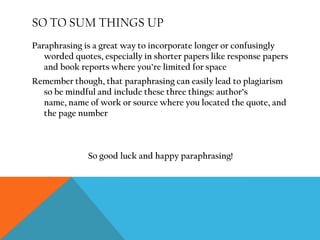
Paraphrasing can be extremely beneficial in your writing, but it can lend itself to plagiarism if you aren’t careful How do you paraphrase without Plagiarizing? To successfully paraphrase and not plagiarize, remember the following tips: 	1. Mention the source where you found the information, 	the original author, and the page (if applicable) where you 	located it. 	2. Always use wording and sentence structures that differ 	from those of the author you are paraphrasing.
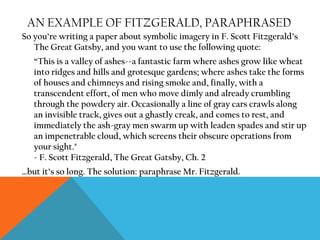
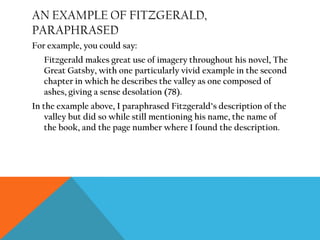
An example of Fitzgerald, ParaphrasedSo you’re writing a paper about symbolic imagery in F. Scott Fitzgerald’s The Great Gatsby, and you want to use the following quote: 	“This is a valley of ashes--a fantastic farm where ashes grow like wheat into ridges and hills and grotesque gardens; where ashes take the forms of houses and chimneys and rising smoke and, finally, with a transcendent effort, of men who move dimly and already crumbling through the powdery air. Occasionally a line of gray cars crawls along an invisible track, gives out a ghastly creak, and comes to rest, and immediately the ash-gray men swarm up with leaden spades and stir up an impenetrable cloud, which screens their obscure operations from your sight."- F. Scott Fitzgerald, The Great Gatsby, Ch. 2…but it’s so long. The solution: paraphrase Mr. Fitzgerald.

Paraphrase perfection

  • 1.
    Paraphrase perfectionThe ohso attainable goal
  • 2.
    paraphrase? What doesthat even mean?A paraphrase is a restatement of a section of text in your own words
  • 3.
    Especially useful whenyou want to use a longer quote, paraphrasing allows you to use another person’s ideas but in your language
  • 4.
    Because paraphrasing stillinvolves using the ideas of others, you still need to cite where you found it and/or who wrote or said it originally
  • 5.
    Paraphrasing can beextremely beneficial in your writing, but it can lend itself to plagiarism if you aren’t careful How do you paraphrase without Plagiarizing? To successfully paraphrase and not plagiarize, remember the following tips: 1. Mention the source where you found the information, the original author, and the page (if applicable) where you located it. 2. Always use wording and sentence structures that differ from those of the author you are paraphrasing.
  • 6.
    An example ofFitzgerald, ParaphrasedSo you’re writing a paper about symbolic imagery in F. Scott Fitzgerald’s The Great Gatsby, and you want to use the following quote: “This is a valley of ashes--a fantastic farm where ashes grow like wheat into ridges and hills and grotesque gardens; where ashes take the forms of houses and chimneys and rising smoke and, finally, with a transcendent effort, of men who move dimly and already crumbling through the powdery air. Occasionally a line of gray cars crawls along an invisible track, gives out a ghastly creak, and comes to rest, and immediately the ash-gray men swarm up with leaden spades and stir up an impenetrable cloud, which screens their obscure operations from your sight."- F. Scott Fitzgerald, The Great Gatsby, Ch. 2…but it’s so long. The solution: paraphrase Mr. Fitzgerald.