TYPES OF BARRIERS
We face many barriers while communicating. These barriers can create
obstacles in the communication process. These barriers are classified into
the following types.
1. Physical or Environmental Barriers:
i. Noise
ii. Time
iii. Distance
iv. High T
emperature/Humidity
v. Wrong S
electionof Medium
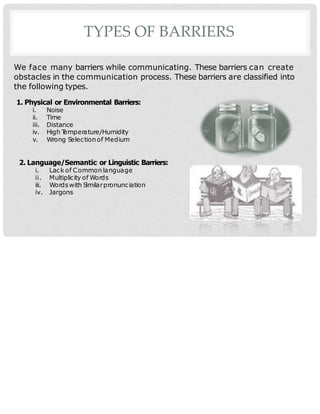
2. Language/Semantic or Linguistic Barriers:
i. Lack of Common language
ii. Multiplicity of Words
iii. Wordswith S
imilarpronunciation
iv. Jargons
TYPES OF BARRIERS
3. Psychological Barriers:
i. Ego
ii. Prejudice
iii. Emotion /Feelings
iv. Halo Effect
v
. S
elf Image
vi. Closed Mind
4. Socio-Cultural Barriers:
i. Concept of T
ime
ii. Assumption about Caste
iii. Body Language
iv. Concept of S
pace
PHYSICAL BARIIERS
Definition:
Many barriers arise in the surroundings or our environment.
These barriers create problems or confusion in
communication.
It is also known as Environmental barriers.
Following factors cause physical barriers.
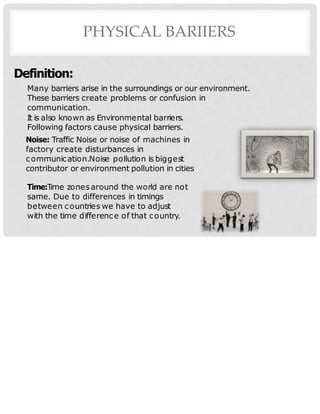
Noise: Traffic Noise or noise of machines in
factory create disturbances in
communication.Noise pollution is biggest
contributor or environment pollution in cities
Time:Time zones around the world are not
same. Due to differences in timings
between countries we have to adjust
with the time difference of that country.
PHYSICAL BARRIERS
Distance: Physical distances between
people can create major problems in
communication.
High Temperature and Humidity:
Excess T
emperature orheat or cold
T
emperature create difficulties in
communication
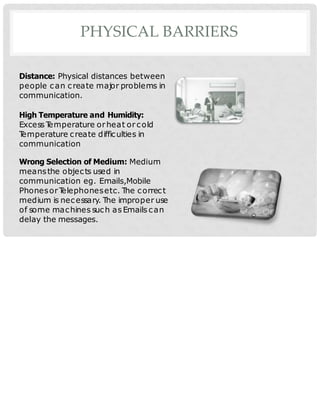
Wrong Selection of Medium: Medium
meansthe objects used in
communication eg. Emails,Mobile
Phonesor T
elephonesetc. The correct
medium is necessary. The improper use
of some machines such as Emails can
delay the messages.
LANGUAGE BARRIERS
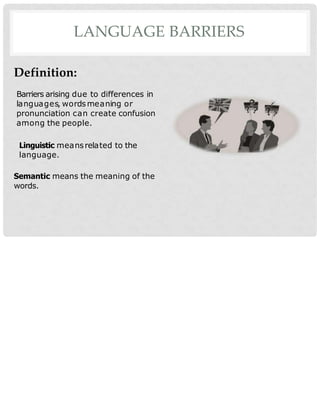
Definition:
Barriers arising due to differences in
languages, words meaning or
pronunciation can create confusion
among the people.
Linguistic meansrelated to the
language.
Semantic means the meaning of the
words.
EXAMPLES OF LANGUAGE BARRIER
1. Lack of Common Language can
create obstacles in Communication.
2. Multiplicity of words: words can have
different meanings.
.
3.Words with similar pronunciation but
different meaning. “Accept , Except”
4. Jargon words:technical words means
code language.
PSYCHOLOGICAL BARRIERS
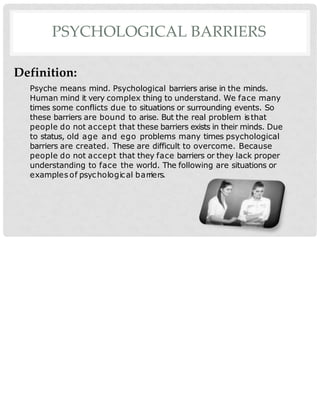
Definition:
Psyche means mind. Psychological barriers arise in the minds.
Human mind it very complex thing to understand. We face many
times some conflicts due to situations or surrounding events. So
these barriers are bound to arise. But the real problem isthat
people do not accept that these barriers exists in their minds. Due
to status, old age and ego problems many times psychological
barriers are created. These are difficult to overcome. Because
people do not accept that they face barriers or they lack proper
understanding to face the world. The following are situations or
examples of psychological barriers.
SITUATION OF PSYCHOLOGICAL
BARRRIER
Ego: `I’Attitude means Iam great feeling can create barrier in mind.
Ego barriers create conflict in human relations.
Prejudice: bias[wrong opinion] about people on the basis of
community, caste, religions or on personal basis is very negative for
communication. Prejudice can hamperthe communication.
Emotions and feelings : Emotional Disturbances of the senderor
receiver can distort[change] the communication .
Halo Effect: like or dislike about a person can create halo or horn
effect. This can affect communication.
SITUATION OF PSYCHOLOGICAL
BARRRIER
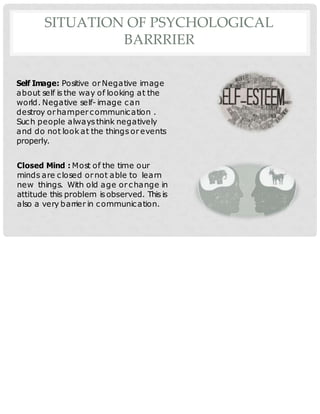
Self Image: Positive orNegative image
about self is the way of looking at the
world. Negative self- image can
destroy orhampercommunication .
Such people alwaysthink negatively
and do not look at the things or events
properly.
Closed Mind : Most of the time our
minds are closed ornot able to learn
new things. With old age orchange in
attitude this problem is observed. This is
also a very barrier in communication.
SOCIO-CULTURE BARRIERS
Definition:
Culture is way of life, values orprinciples.
Cultural differencesbetween people can
create barriers . Different religious practices
are followed around the world. Due to many
time differences in the culture can create
misunderstanding in communication. Due to
globalization and liberalized policies in
business, people around the world are
travelling and working in multinational
corporatesor companies.
EXAMPLES OF SOCIO-CULTURAL
BARRIERS
The following are examples are socio-cultural barriers.
Concept of Time :The time isnot perceived
similarly across the cultures. In Western culture
Time is important. In Asian culture Time is taken
leisurely. The concept of punctuality differs in
cultures.
Assumptions about caste system: Caste system is
observed in India. But in every culture some kind
or differences in the society in the form of religion,
community differences or sects or class division is
observed.
EXAMPLES OF SOCIO-CULTURAL
BARRIERS
Body Language: [Non Verbal
Behavior] methodsaround the world
are not same. There can be
misunderstandings because of this.
Concept of Space: Proximity differs
from culture to culture. In some culture
close distance between people is not
approved. In some culture close
distance is accepted.
HOW TO OVERCOME THE
COMMUNICATION BARRIERS
Physical Barriers:
By overcoming
a. Noise
b. Physical Distance
c. Defects in machines
Some physical barriers are cannot overcome such as Time , Distance
Language Barrier:
Lot of efforts are required to overcome Language Barriers. There
should be respect for any language before learning new language.
a. Correct Pronunciation & Accent
b. Improving Vocabulary
c. Improve Listening Skills
HOW TO OVERCOME THE
COMMUNICATION BARRIERS
Psychological Barriers:
It is true that psychological barriers are difficult to overcome or solve.
a. Acceptance of one’smistakes
b. Accept their faults & Limitations
c. Understanding of human life
Socio –Cultural Barriers:
Controlling by
a. Properstudy of othercultures
b. Learn to new culture values
c. Accepting their culture

DOC-20221118-WA0000..pptx

  • 2.
    TYPES OF BARRIERS Weface many barriers while communicating. These barriers can create obstacles in the communication process. These barriers are classified into the following types. 1. Physical or Environmental Barriers: i. Noise ii. Time iii. Distance iv. High T emperature/Humidity v. Wrong S electionof Medium 2. Language/Semantic or Linguistic Barriers: i. Lack of Common language ii. Multiplicity of Words iii. Wordswith S imilarpronunciation iv. Jargons
  • 3.
    TYPES OF BARRIERS 3.Psychological Barriers: i. Ego ii. Prejudice iii. Emotion /Feelings iv. Halo Effect v . S elf Image vi. Closed Mind 4. Socio-Cultural Barriers: i. Concept of T ime ii. Assumption about Caste iii. Body Language iv. Concept of S pace
  • 4.
    PHYSICAL BARIIERS Definition: Many barriersarise in the surroundings or our environment. These barriers create problems or confusion in communication. It is also known as Environmental barriers. Following factors cause physical barriers. Noise: Traffic Noise or noise of machines in factory create disturbances in communication.Noise pollution is biggest contributor or environment pollution in cities Time:Time zones around the world are not same. Due to differences in timings between countries we have to adjust with the time difference of that country.
  • 5.
    PHYSICAL BARRIERS Distance: Physicaldistances between people can create major problems in communication. High Temperature and Humidity: Excess T emperature orheat or cold T emperature create difficulties in communication Wrong Selection of Medium: Medium meansthe objects used in communication eg. Emails,Mobile Phonesor T elephonesetc. The correct medium is necessary. The improper use of some machines such as Emails can delay the messages.
  • 6.
    LANGUAGE BARRIERS Definition: Barriers arisingdue to differences in languages, words meaning or pronunciation can create confusion among the people. Linguistic meansrelated to the language. Semantic means the meaning of the words.
  • 7.
    EXAMPLES OF LANGUAGEBARRIER 1. Lack of Common Language can create obstacles in Communication. 2. Multiplicity of words: words can have different meanings. . 3.Words with similar pronunciation but different meaning. “Accept , Except” 4. Jargon words:technical words means code language.
  • 8.
    PSYCHOLOGICAL BARRIERS Definition: Psyche meansmind. Psychological barriers arise in the minds. Human mind it very complex thing to understand. We face many times some conflicts due to situations or surrounding events. So these barriers are bound to arise. But the real problem isthat people do not accept that these barriers exists in their minds. Due to status, old age and ego problems many times psychological barriers are created. These are difficult to overcome. Because people do not accept that they face barriers or they lack proper understanding to face the world. The following are situations or examples of psychological barriers.
  • 9.
    SITUATION OF PSYCHOLOGICAL BARRRIER Ego:`I’Attitude means Iam great feeling can create barrier in mind. Ego barriers create conflict in human relations. Prejudice: bias[wrong opinion] about people on the basis of community, caste, religions or on personal basis is very negative for communication. Prejudice can hamperthe communication. Emotions and feelings : Emotional Disturbances of the senderor receiver can distort[change] the communication . Halo Effect: like or dislike about a person can create halo or horn effect. This can affect communication.
  • 10.
    SITUATION OF PSYCHOLOGICAL BARRRIER SelfImage: Positive orNegative image about self is the way of looking at the world. Negative self- image can destroy orhampercommunication . Such people alwaysthink negatively and do not look at the things or events properly. Closed Mind : Most of the time our minds are closed ornot able to learn new things. With old age orchange in attitude this problem is observed. This is also a very barrier in communication.
  • 11.
    SOCIO-CULTURE BARRIERS Definition: Culture isway of life, values orprinciples. Cultural differencesbetween people can create barriers . Different religious practices are followed around the world. Due to many time differences in the culture can create misunderstanding in communication. Due to globalization and liberalized policies in business, people around the world are travelling and working in multinational corporatesor companies.
  • 12.
    EXAMPLES OF SOCIO-CULTURAL BARRIERS Thefollowing are examples are socio-cultural barriers. Concept of Time :The time isnot perceived similarly across the cultures. In Western culture Time is important. In Asian culture Time is taken leisurely. The concept of punctuality differs in cultures. Assumptions about caste system: Caste system is observed in India. But in every culture some kind or differences in the society in the form of religion, community differences or sects or class division is observed.
  • 13.
    EXAMPLES OF SOCIO-CULTURAL BARRIERS BodyLanguage: [Non Verbal Behavior] methodsaround the world are not same. There can be misunderstandings because of this. Concept of Space: Proximity differs from culture to culture. In some culture close distance between people is not approved. In some culture close distance is accepted.
  • 14.
    HOW TO OVERCOMETHE COMMUNICATION BARRIERS Physical Barriers: By overcoming a. Noise b. Physical Distance c. Defects in machines Some physical barriers are cannot overcome such as Time , Distance Language Barrier: Lot of efforts are required to overcome Language Barriers. There should be respect for any language before learning new language. a. Correct Pronunciation & Accent b. Improving Vocabulary c. Improve Listening Skills
  • 15.
    HOW TO OVERCOMETHE COMMUNICATION BARRIERS Psychological Barriers: It is true that psychological barriers are difficult to overcome or solve. a. Acceptance of one’smistakes b. Accept their faults & Limitations c. Understanding of human life Socio –Cultural Barriers: Controlling by a. Properstudy of othercultures b. Learn to new culture values c. Accepting their culture