AVERMECTINS
By Mariwan A. Omer & Pavel O. Qader
3rd year student
College of Veterinary medicine
OBJECTIVES
 Introduction about Helminth.
 Anthelmentic drug Avermectins.
 Describe the mechanism of action .
 Toxicity and side-effects.
HELMINTH
 Helminth infections of humans are clearly of
considerable importance
 They are of even greater relative importance in
our domestic animals
 herbivores are an easy target for many
nematode species.
PARASITIC HELMINTHES
 ‘Helminth’ is a general term meaning ‘worm’
 Nemat-helminths are round-worms
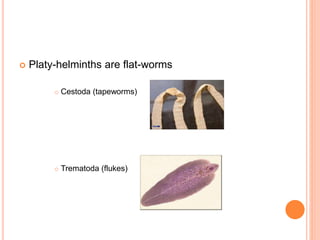
 Platy-helminths are flat-worms
 Cestoda (tapeworms)
 Trematoda (flukes)
ECONOMIC IMPACT OF HELMINTH
INFECTIONS
1. Direct tissue damage and
decreased functioning of the
affected organs.
2. Diversion of energy and protein
resources of the host from
production towards defense and
immune mechanisms.
3. Reduced feed intake.
NOW WHO CAN FIGHT WITH THEM?
 Simplest answer ((Anthelmintic agents))
AVERMECTINS
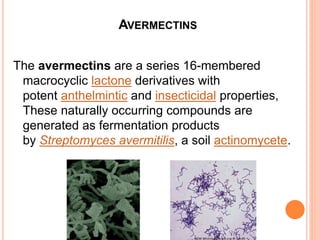
The avermectins are a series 16-membered
macrocyclic lactone derivatives with
potent anthelmintic and insecticidal properties,
These naturally occurring compounds are
generated as fermentation products
by Streptomyces avermitilis, a soil actinomycete.
HISTORY
 In 1978, an actinomycete was isolated at The
Kitasato Institute from a soil sample collected at
Kawana, Ito City, japan
 the product was introduced commercially (in 1981)
for the control of endoparasitic nematodes and
ectoparasitic arthropods in livestock.
CHEMICAL COMPOUND AVERMECTIN
 Other anthelmintics derived from the avermectins include :
 Ivermectin
 Selamectin
 Doramectin
 Abamectin
MECHANISM OF ACTION
These drugs bind to glutamate-gated
chloride channels in nerve and muscle
cells
Increase in the permeability of the cell
membrane to chloride ions with
hyperpolarization of the nerve or muscle
cell.
AVERMECTIN THERAPY
 A commonly used therapy in recent times has been based
on
 oral
 parenteral
 topical
 spot topical
flea repellant "drops administration of avermectins. They
show activity against a broad range
of nematodes and arthropod parasites of domestic animals
Oral adminsterationSubcutaneous asdminstration
TOXICITY AND SIDE-EFFECTS
 Avermectin therapy is not without its drawbacks.
 Resistance to avermectins has been reported,
which suggests use in moderation.
 Research on ivermectin, piperazine,
anddichlorvos in combinations also shows potential
for toxicity.
TOXICITY AND SIDE-EFFECTS
 Avermectin has been reported to block LPS-
induced secretion of tumor necrosis
factor, prostaglandinE2.
 Increase of intracellular concentration of Ca2+.
TOXICITY AND SIDE-EFFECTS
 Side effects are usually transient; severe effects are
rare and probably occur only with substantial
overdose, but include coma, hypotension,
and respiratory failure, which can lead to death. No
specific therapy exists, but symptomatic
management usually leads to a favorable
prognosis.
Ivermectin
IVERMECTIN
 Is a broad-spectrum antiparasitic drug in theavermectin
family. It is sold under brand names Heartgard
Ivomec worldwide by Merial Animal Health, Mectizan
 Ivermectin is used against many intestinal worms (but not
tapeworms),
 Like mites, and some lice. Despite this, it is not effective for
eliminating ticks, flies, flukes, or fleas. It is effective against
larval heartworms.
intestinal worms
mites
Strongyles in horse
Heart worm
MICHANISM OF ACTION
 Bind to glutamate – chloride channels
 Increase permeability cell membrane to chloride Ion
 Result paralysis and death
 Selective toxicity :
• Avermectin have low affinity for mammalian ligand-gate
chloride channel.
o Pharmacokinetcs :
• Well absorbed orally and metabolizes in liver
• Excreted in feces and urine
 Drugs and/or metabolites are excreted almost exclusively in
the feces over an estimated 12 days
 Less than 1% of the administered dose excreted in the urine.
Avermectin (2)

Avermectin (2)

  • 1.
    AVERMECTINS By Mariwan A.Omer & Pavel O. Qader 3rd year student College of Veterinary medicine
  • 2.
    OBJECTIVES  Introduction aboutHelminth.  Anthelmentic drug Avermectins.  Describe the mechanism of action .  Toxicity and side-effects.
  • 3.
    HELMINTH  Helminth infectionsof humans are clearly of considerable importance  They are of even greater relative importance in our domestic animals  herbivores are an easy target for many nematode species.
  • 4.
    PARASITIC HELMINTHES  ‘Helminth’is a general term meaning ‘worm’
  • 5.
  • 6.
     Platy-helminths areflat-worms  Cestoda (tapeworms)  Trematoda (flukes)
  • 7.
    ECONOMIC IMPACT OFHELMINTH INFECTIONS 1. Direct tissue damage and decreased functioning of the affected organs. 2. Diversion of energy and protein resources of the host from production towards defense and immune mechanisms. 3. Reduced feed intake.
  • 8.
    NOW WHO CANFIGHT WITH THEM?  Simplest answer ((Anthelmintic agents))
  • 9.
    AVERMECTINS The avermectins area series 16-membered macrocyclic lactone derivatives with potent anthelmintic and insecticidal properties, These naturally occurring compounds are generated as fermentation products by Streptomyces avermitilis, a soil actinomycete.
  • 10.
    HISTORY  In 1978,an actinomycete was isolated at The Kitasato Institute from a soil sample collected at Kawana, Ito City, japan  the product was introduced commercially (in 1981) for the control of endoparasitic nematodes and ectoparasitic arthropods in livestock.
  • 11.
  • 12.
     Other anthelminticsderived from the avermectins include :  Ivermectin  Selamectin  Doramectin  Abamectin
  • 13.
    MECHANISM OF ACTION Thesedrugs bind to glutamate-gated chloride channels in nerve and muscle cells Increase in the permeability of the cell membrane to chloride ions with hyperpolarization of the nerve or muscle cell.
  • 14.
    AVERMECTIN THERAPY  Acommonly used therapy in recent times has been based on  oral  parenteral  topical  spot topical flea repellant "drops administration of avermectins. They show activity against a broad range of nematodes and arthropod parasites of domestic animals
  • 15.
  • 16.
    TOXICITY AND SIDE-EFFECTS Avermectin therapy is not without its drawbacks.  Resistance to avermectins has been reported, which suggests use in moderation.  Research on ivermectin, piperazine, anddichlorvos in combinations also shows potential for toxicity.
  • 17.
    TOXICITY AND SIDE-EFFECTS Avermectin has been reported to block LPS- induced secretion of tumor necrosis factor, prostaglandinE2.  Increase of intracellular concentration of Ca2+.
  • 18.
    TOXICITY AND SIDE-EFFECTS Side effects are usually transient; severe effects are rare and probably occur only with substantial overdose, but include coma, hypotension, and respiratory failure, which can lead to death. No specific therapy exists, but symptomatic management usually leads to a favorable prognosis.
  • 19.
  • 20.
    IVERMECTIN  Is abroad-spectrum antiparasitic drug in theavermectin family. It is sold under brand names Heartgard Ivomec worldwide by Merial Animal Health, Mectizan
  • 21.
     Ivermectin isused against many intestinal worms (but not tapeworms),  Like mites, and some lice. Despite this, it is not effective for eliminating ticks, flies, flukes, or fleas. It is effective against larval heartworms.
  • 22.
  • 23.
    MICHANISM OF ACTION Bind to glutamate – chloride channels  Increase permeability cell membrane to chloride Ion  Result paralysis and death
  • 24.
     Selective toxicity: • Avermectin have low affinity for mammalian ligand-gate chloride channel. o Pharmacokinetcs : • Well absorbed orally and metabolizes in liver • Excreted in feces and urine  Drugs and/or metabolites are excreted almost exclusively in the feces over an estimated 12 days  Less than 1% of the administered dose excreted in the urine.