The Future of Battlefield Micro Air Vehicle Systems S.D. Prior, S-T. Shen, M. Karamanoglu, S. Odedra, M. Erbil,  C. Barlow and D. Lewis   18   December  200 9
The MOUT Environment Conducting Military Operations on Urban Terrain (MOUT) is clearly more dangerous than operating in open terrain, and therefore requires greater situational awareness if casualties are to be reduced.  
The Soldier – Christmas Tree Effect 1987 2009
The IED Problem IED fatalities in  Afghanistan (2001-09)  (http://www.icasualties.org/OEF/index.aspx ) By far the greatest problem to date for coalition forces has been the use of Improvised Explosive Devices (IED’s).  61% of all deaths
The Lucky Survivor? L/Cpl Tom Neathway (24) 2 Para
The Terrorist Threat The terrorist’s strength lies in their urban concealment and timing of an attack. The re exists an  opportunity to develop low-cost, novel systems which can be speedily deployed to these theatres to combat the main threats of IED’s, Snipers, ‘Technicals’ and Armed Terrorists.
Military Spending on Robotics The MoD have recently awarded Remotec UK Ltd a £64m contract to supply them with 80 CUTLASS units, which are to be used for Explosive Ordnance Disposal (EOD). iRobot have a contract to supply the U.S Army with a large number of advanced Small Unmanned Ground Vehicles (SUGV), which has recently grown to $ 286 m. The United States Defence Advanced Research Projects Agency (DARPA) are spending $ 34 0bn on the new Future Combat System (FCS) program which started in 2005. The program  ha s  now changed into  a new modernising initiative to give them a technological advantage in the field.
Military Spending on Robotics In August 2005, Thales UK was awarded the Watchkeeper WK450 contract worth £800m for the Development and Manufacture of an all weather Unmanned Aerial Vehicle (UAV) used for reconnaissance  which is due in service in 2010 . In Feb 2009, the UK MoD bought six T-Hawk systems (12 MAVs) from Honeywell worth a reputed US$5.7m .  The US Navy have already placed orders for 372 of these.
The Use of UAVs R&D  (<10%) Civil/Commercial  (150) (13%) Dual Purpose (260) (22%) Military (683) (57%) Source: UAS Yearbook – UAS: The Global Perspective (2009-10)
UAV Producing Countries UK (65) (5%) France  (77) (7%) Israel (83) (7%) US (386) (32%) Source: UAS Yearbook – UAS: The Global Perspective (2009-10)
UAV Design Possibilities What we have Now. What Nature Intended. Latest Advance in Tactical MAVs. Niche SF Delivery System. Static Surveillance. VTOL/Hover & Stare Capability. Source: UAS Yearbook – UAS: The Global Perspective (2009-10) Fixed Wing 72% Rotary Wing 17% Lighter-than Air 3% Ducted Fan 3% Ornithopter <1% Motorized Parachute <1% Micro Air Vehicles
Proposed Solution  – VTOL MAV Micro Air Vehicle (MAV) The MAV is envisioned as a  short to  medium   range reconnaissance system used primarily at the section or platoon level for what is over-the-hill. Autonomous flight using GPS   Waypoints. Hover and Perch capabilities. Can operate both day and night. Programmed and monitored in   real-time via a laptop/PDA.
VTOL  Design Specification Typical Small VTOL MAV Specification Criteria Value Criteria Value MTOW 1 -  5 kg EO Payload 0.2 – 1.5  kg Manoeuvrability 3 Dof -  (x or y) ,   z,  r z Speed 0 –  10  m/s (H) 0 – 5 m/s (V) Max Operational Size 0.7 x 0.7 x 0.2 m Set-up time < 5 min Endurance 30 - 60 min Concealment < 60 db @ 1 m Survivability Weather, collision Cost £ 10- 30  k
VTOL Multiple Rotary Winged Systems
T/P & T/A of Helicopters and Compound Craft
HALO: Patented Co-Axial Tri-Rotor UAV M ass = 3.3 kg; Payload = 1.5 kg Endurance = 40 min
Autonomous Control CARVEC. Micropilot.
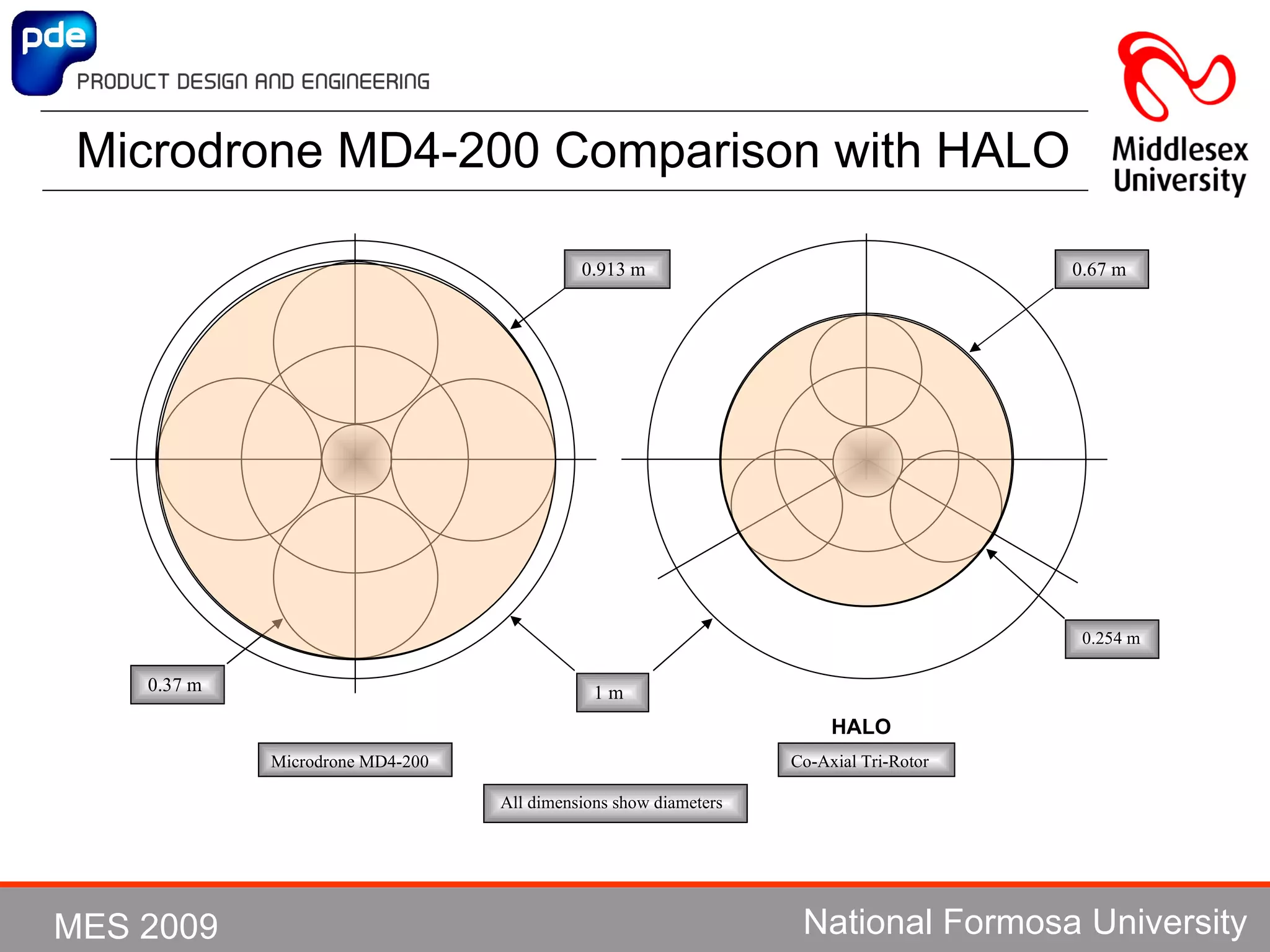
Microdrone MD4-200 Comparison with HALO  HALO 1 m Co-Axial Tri-Rotor Microdrone MD4-200 0.254 m 0.67 m 0.913 m  0.37 m All dimensions show diameters
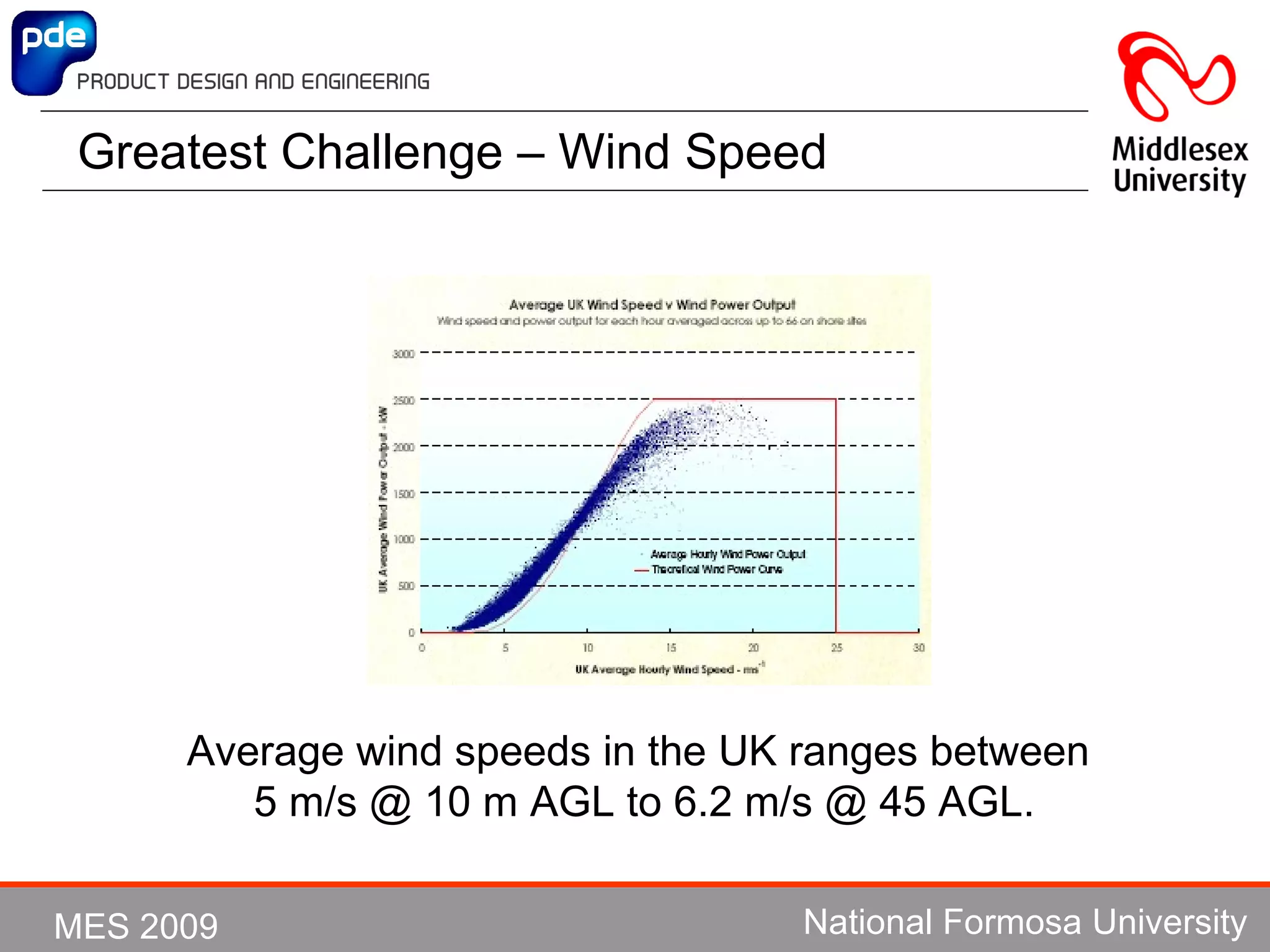
Greatest Challenge – Wind Speed  Average wind speeds in the UK ranges between  5 m/s @ 10 m AGL to 6.2 m/s @ 45 AGL.
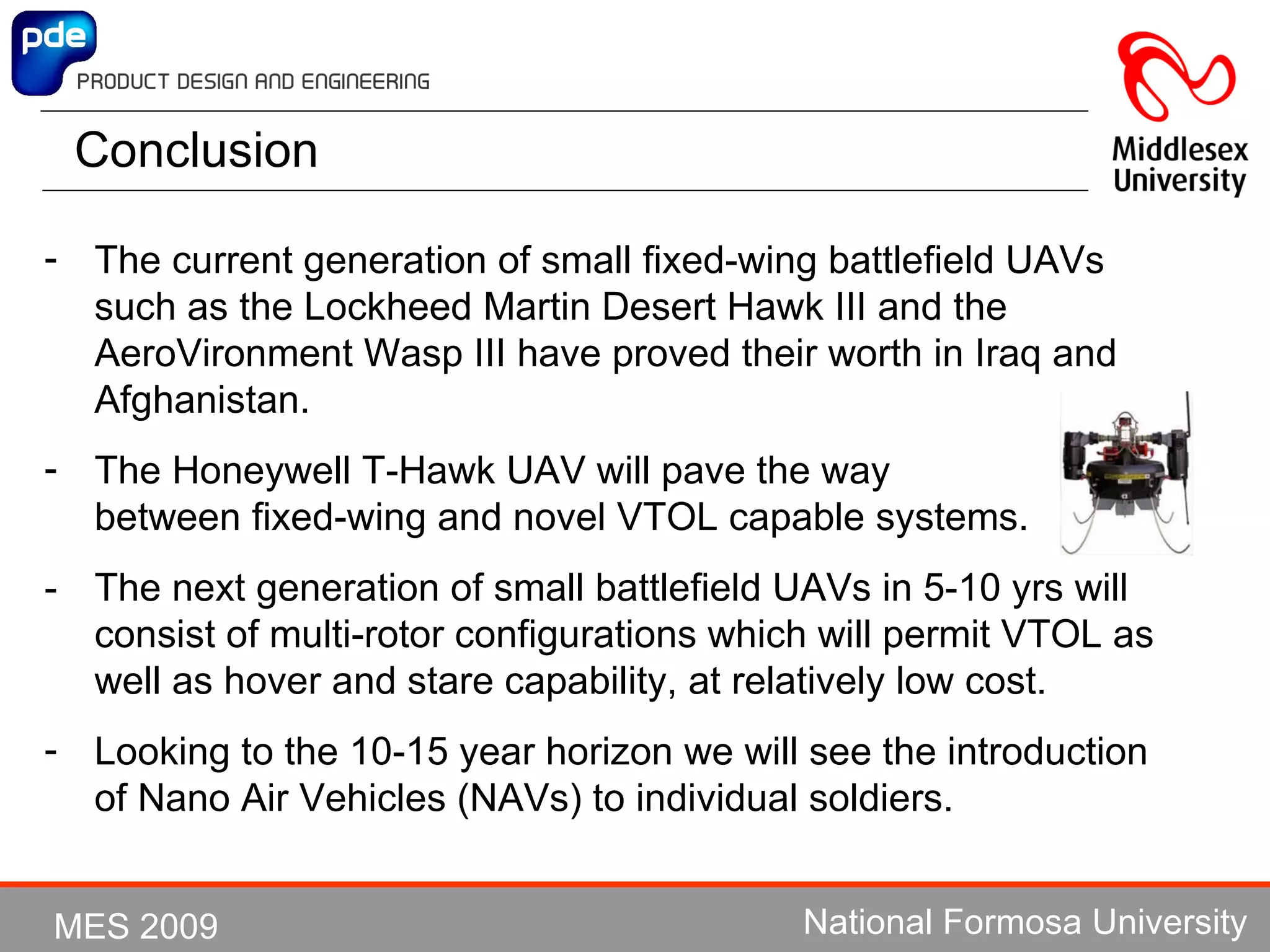
Conclusion The current generation of small fixed-wing battlefield UAVs such as the Lockheed Martin Desert Hawk III and the AeroVironment Wasp III have proved their worth in Iraq and Afghanistan. The Honeywell T-Hawk UAV will pave the way  between fixed-wing and novel VTOL capable systems. -  The next generation of small battlefield UAVs in 5-10 yrs will consist of multi-rotor configurations which will permit VTOL as well as hover and stare capability, at relatively low cost. Looking to the 10-15 year horizon we will see the introduction of Nano Air Vehicles (NAVs) to individual soldiers.
Future NAV systems
International Journal of MAVs International Journal of Micro Air Vehicles Editor-in-Chief:  Dr. Mark Reeder published quarterly • ISSN 1756-8293 • 2010 journal prices/format options 2010 is volume 2

The Future Of Battlefield Ma Vs

  • 1.
    The Future ofBattlefield Micro Air Vehicle Systems S.D. Prior, S-T. Shen, M. Karamanoglu, S. Odedra, M. Erbil, C. Barlow and D. Lewis 18 December 200 9
  • 2.
    The MOUT EnvironmentConducting Military Operations on Urban Terrain (MOUT) is clearly more dangerous than operating in open terrain, and therefore requires greater situational awareness if casualties are to be reduced.  
  • 3.
    The Soldier –Christmas Tree Effect 1987 2009
  • 4.
    The IED ProblemIED fatalities in Afghanistan (2001-09) (http://www.icasualties.org/OEF/index.aspx ) By far the greatest problem to date for coalition forces has been the use of Improvised Explosive Devices (IED’s). 61% of all deaths
  • 5.
    The Lucky Survivor?L/Cpl Tom Neathway (24) 2 Para
  • 6.
    The Terrorist ThreatThe terrorist’s strength lies in their urban concealment and timing of an attack. The re exists an opportunity to develop low-cost, novel systems which can be speedily deployed to these theatres to combat the main threats of IED’s, Snipers, ‘Technicals’ and Armed Terrorists.
  • 7.
    Military Spending onRobotics The MoD have recently awarded Remotec UK Ltd a £64m contract to supply them with 80 CUTLASS units, which are to be used for Explosive Ordnance Disposal (EOD). iRobot have a contract to supply the U.S Army with a large number of advanced Small Unmanned Ground Vehicles (SUGV), which has recently grown to $ 286 m. The United States Defence Advanced Research Projects Agency (DARPA) are spending $ 34 0bn on the new Future Combat System (FCS) program which started in 2005. The program ha s now changed into a new modernising initiative to give them a technological advantage in the field.
  • 8.
    Military Spending onRobotics In August 2005, Thales UK was awarded the Watchkeeper WK450 contract worth £800m for the Development and Manufacture of an all weather Unmanned Aerial Vehicle (UAV) used for reconnaissance which is due in service in 2010 . In Feb 2009, the UK MoD bought six T-Hawk systems (12 MAVs) from Honeywell worth a reputed US$5.7m . The US Navy have already placed orders for 372 of these.
  • 9.
    The Use ofUAVs R&D (<10%) Civil/Commercial (150) (13%) Dual Purpose (260) (22%) Military (683) (57%) Source: UAS Yearbook – UAS: The Global Perspective (2009-10)
  • 10.
    UAV Producing CountriesUK (65) (5%) France (77) (7%) Israel (83) (7%) US (386) (32%) Source: UAS Yearbook – UAS: The Global Perspective (2009-10)
  • 11.
    UAV Design PossibilitiesWhat we have Now. What Nature Intended. Latest Advance in Tactical MAVs. Niche SF Delivery System. Static Surveillance. VTOL/Hover & Stare Capability. Source: UAS Yearbook – UAS: The Global Perspective (2009-10) Fixed Wing 72% Rotary Wing 17% Lighter-than Air 3% Ducted Fan 3% Ornithopter <1% Motorized Parachute <1% Micro Air Vehicles
  • 12.
    Proposed Solution – VTOL MAV Micro Air Vehicle (MAV) The MAV is envisioned as a short to medium range reconnaissance system used primarily at the section or platoon level for what is over-the-hill. Autonomous flight using GPS Waypoints. Hover and Perch capabilities. Can operate both day and night. Programmed and monitored in real-time via a laptop/PDA.
  • 13.
    VTOL DesignSpecification Typical Small VTOL MAV Specification Criteria Value Criteria Value MTOW 1 - 5 kg EO Payload 0.2 – 1.5 kg Manoeuvrability 3 Dof - (x or y) , z, r z Speed 0 – 10 m/s (H) 0 – 5 m/s (V) Max Operational Size 0.7 x 0.7 x 0.2 m Set-up time < 5 min Endurance 30 - 60 min Concealment < 60 db @ 1 m Survivability Weather, collision Cost £ 10- 30 k
  • 14.
    VTOL Multiple RotaryWinged Systems
  • 15.
    T/P & T/Aof Helicopters and Compound Craft
  • 16.
    HALO: Patented Co-AxialTri-Rotor UAV M ass = 3.3 kg; Payload = 1.5 kg Endurance = 40 min
  • 17.
  • 18.
    Microdrone MD4-200 Comparisonwith HALO HALO 1 m Co-Axial Tri-Rotor Microdrone MD4-200 0.254 m 0.67 m 0.913 m 0.37 m All dimensions show diameters
  • 19.
    Greatest Challenge –Wind Speed Average wind speeds in the UK ranges between 5 m/s @ 10 m AGL to 6.2 m/s @ 45 AGL.
  • 20.
    Conclusion The currentgeneration of small fixed-wing battlefield UAVs such as the Lockheed Martin Desert Hawk III and the AeroVironment Wasp III have proved their worth in Iraq and Afghanistan. The Honeywell T-Hawk UAV will pave the way between fixed-wing and novel VTOL capable systems. - The next generation of small battlefield UAVs in 5-10 yrs will consist of multi-rotor configurations which will permit VTOL as well as hover and stare capability, at relatively low cost. Looking to the 10-15 year horizon we will see the introduction of Nano Air Vehicles (NAVs) to individual soldiers.
  • 21.
  • 22.
    International Journal ofMAVs International Journal of Micro Air Vehicles Editor-in-Chief: Dr. Mark Reeder published quarterly • ISSN 1756-8293 • 2010 journal prices/format options 2010 is volume 2