Assessment Report on the Nile River Ports Project:
“Promoting River Transport in Egypt”
1
ISMED Conference Defining a Way Forward for Infrastructure Investment in the
Middle East and North Africa
Paris, 4 December 2014
• The River Transport Authority of Egypt (RTA)
has sought assistance on framework and risk-
sharing issues for a potential public-private
partnership (PPP) covering four river ports.
• Previous attempt failed: 2009-10 tender of the
Qena port by way of BOT.
 Concession period too short,
 Site location inadequate,
 Bad project design: single port in a network of
multiple ports with no transport connections,
 Too much risk placed on the private party.
• New plan to tender 4 river pilot ports under
Public-Private Partnerships (PPPs) in Qena,
Sohag, Meet Ghamr, Assiut (Upper Egypt).
2
Investment Security in the Mediterranean:
The ISMED Support Programme in Egypt
3
• Objectives of ISMED Assistance to the RTA
 Identify the short and longer term actions required to strengthen the environment of a river ports
PPP project ;
 Identify investment climate shortcomings, and prioritise the implementation of appropriate policy
remedies ;
 Assist the RTA in advancing the project onto the Government of Egypt PPP pipeline
• Activities of the ISMED Support Programme in Egypt
 Drafting of the Assessment Report on the Nile River Ports project, including a proper delineation of
risk sharing between public and private sector actors and a proposal for template tender documents
and indicative terms of reference for a feasibility study ;
 Advice on other aspects of the PPP and/or sectoral framework that are critical for private investors
and may constitute obstacles to private sector participation in river transport infrastructure projects.
• Methodology
 Analysis of previous attempt by the RTA to tender a river ports project by PPP in 2009-10 ;
 Extensive consultations with public and private sector stakeholders as well as IFIs and experts ;
 Review of OECD good practices and guidance.
Investment Security in the Mediterranean:
The ISMED Support Programme in Egypt
4
The Nile River Ports project:
Sector Overview
• Yet plays a small part in Egypt's transportation sector:
 AFD study “Nile River Market, Financial and Institutional Transport Study” (2012, Royal
Haskoning): river transport accounts for less than 1% of total cargo volume shipped in Egypt ;
 In the past 30 years, river transport as a share of total cargo volume has decreased from 5 to
0.5 percent, while trucks continue to dominate transport
• Despite calls for investment over the past years to upgrade deteriorated infrastructure, cargo
transport on the Nile River remains under-utilized.
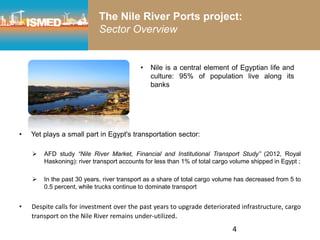
• Nile is a central element of Egyptian life and
culture: 95% of population live along its
banks
5
• Previous related studies:
 AFD River transport market feasibility study, funded by the French Development
Agency (AFD) and conducted by a Dutch logistics firm (Royal Haskoning), found that
customers are looking for reliable, year-round and round-the-clock operations, door-
to-door service and the ability to accommodate certain volumes
 “Misr National Transport Study” (MiNTS) by JICA: The study predicts that if no policy
changes are enacted, river transport volume by 2027 will constitute a mere 1 percent
of the predicted 900 million tons of cargo clogging Egypt’s roads.
• Invite all river transport stakeholders to identify obstacles to the sector’s growth and
propose solutions.
The Nile River Ports project:
Sector Overview
6
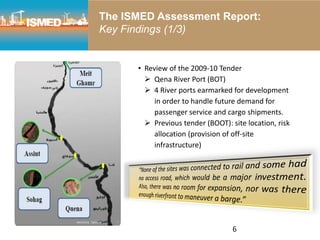
• Review of the 2009-10 Tender
 Qena River Port (BOT)
 4 River ports earmarked for development
in order to handle future demand for
passenger service and cargo shipments.
 Previous tender (BOOT): site location, risk
allocation (provision of off-site
infrastructure)
The ISMED Assessment Report:
Key Findings (1/3)
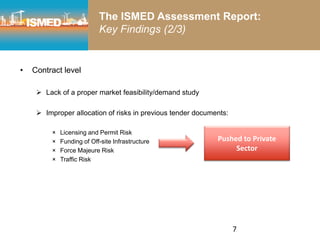
• Contract level
 Lack of a proper market feasibility/demand study
 Improper allocation of risks in previous tender documents:
× Licensing and Permit Risk
× Funding of Off-site Infrastructure
× Force Majeure Risk
× Traffic Risk
Pushed to Private
Sector
7
The ISMED Assessment Report:
Key Findings (2/3)
8
The ISMED Assessment Report:
Key Findings (3/3)
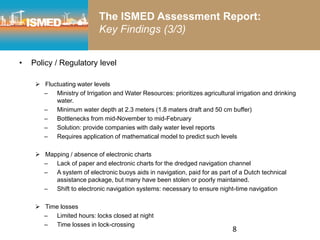
• Policy / Regulatory level
 Fluctuating water levels
– Ministry of Irrigation and Water Resources: prioritizes agricultural irrigation and drinking
water.
– Minimum water depth at 2.3 meters (1.8 maters draft and 50 cm buffer)
– Bottlenecks from mid-November to mid-February
– Solution: provide companies with daily water level reports
– Requires application of mathematical model to predict such levels
 Mapping / absence of electronic charts
– Lack of paper and electronic charts for the dredged navigation channel
– A system of electronic buoys aids in navigation, paid for as part of a Dutch technical
assistance package, but many have been stolen or poorly maintained.
– Shift to electronic navigation systems: necessary to ensure night-time navigation
 Time losses
– Limited hours: locks closed at night
– Time losses in lock-crossing
9
The ISMED Assessment Report:
Key Recommendations (1/2)
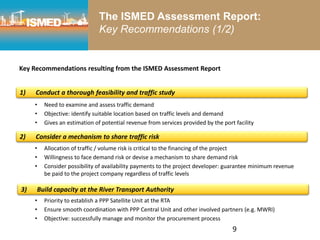
Key Recommendations resulting from the ISMED Assessment Report
• Need to examine and assess traffic demand
• Objective: identify suitable location based on traffic levels and demand
• Gives an estimation of potential revenue from services provided by the port facility
• Allocation of traffic / volume risk is critical to the financing of the project
• Willingness to face demand risk or devise a mechanism to share demand risk
• Consider possibility of availability payments to the project developer: guarantee minimum revenue
be paid to the project company regardless of traffic levels
• Priority to establish a PPP Satellite Unit at the RTA
• Ensure smooth coordination with PPP Central Unit and other involved partners (e.g. MWRI)
• Objective: successfully manage and monitor the procurement process
1) Conduct a thorough feasibility and traffic study
2) Consider a mechanism to share traffic risk
3) Build capacity at the River Transport Authority
10
The ISMED Assessment Report:
Key Recommendations (2/2)
Additional Recommendations
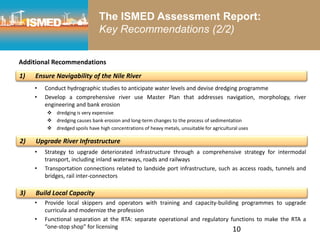
• Conduct hydrographic studies to anticipate water levels and devise dredging programme
• Develop a comprehensive river use Master Plan that addresses navigation, morphology, river
engineering and bank erosion
 dredging is very expensive
 dredging causes bank erosion and long-term changes to the process of sedimentation
 dredged spoils have high concentrations of heavy metals, unsuitable for agricultural uses
• Strategy to upgrade deteriorated infrastructure through a comprehensive strategy for intermodal
transport, including inland waterways, roads and railways
• Transportation connections related to landside port infrastructure, such as access roads, tunnels and
bridges, rail inter-connectors
• Provide local skippers and operators with training and capacity-building programmes to upgrade
curricula and modernize the profession
• Functional separation at the RTA: separate operational and regulatory functions to make the RTA a
“one-stop shop” for licensing
1) Ensure Navigability of the Nile River
2) Upgrade River Infrastructure
3) Build Local Capacity
rd
• OECD assessment of the RTA suggests there is a need for training and capacity building
assistance on fundamental PPP issues.
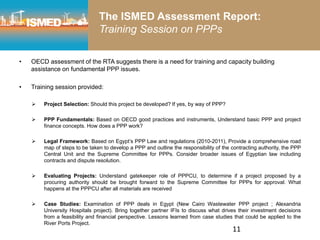
• Training session provided:
 Project Selection: Should this project be developed? If yes, by way of PPP?
 PPP Fundamentals: Based on OECD good practices and instruments, Understand basic PPP and project
finance concepts. How does a PPP work?
 Legal Framework: Based on Egypt’s PPP Law and regulations (2010-2011), Provide a comprehensive road
map of steps to be taken to develop a PPP and outline the responsibility of the contracting authority, the PPP
Central Unit and the Supreme Committee for PPPs. Consider broader issues of Egyptian law including
contracts and dispute resolution.
 Evaluating Projects: Understand gatekeeper role of PPPCU, to determine if a project proposed by a
procuring authority should be brought forward to the Supreme Committee for PPPs for approval. What
happens at the PPPCU after all materials are received
 Case Studies: Examination of PPP deals in Egypt (New Cairo Wastewater PPP project ; Alexandria
University Hospitals project). Bring together partner IFIs to discuss what drives their investment decisions
from a feasibility and financial perspective. Lessons learned from case studies that could be applied to the
River Ports Project.
11
The ISMED Assessment Report:
Training Session on PPPs
Key contacts
Mr Andrew FITZPATRICK
Coordinator
ISMED Support Programme
Andrew.Fitzpatrick@oecd.org
www.oecd.org/investment/psd/ismed.htm
With the financial assistance of the European Commission

Session 3: River Transport Authority

  • 1.
    Assessment Report onthe Nile River Ports Project: “Promoting River Transport in Egypt” 1 ISMED Conference Defining a Way Forward for Infrastructure Investment in the Middle East and North Africa Paris, 4 December 2014
  • 2.
    • The RiverTransport Authority of Egypt (RTA) has sought assistance on framework and risk- sharing issues for a potential public-private partnership (PPP) covering four river ports. • Previous attempt failed: 2009-10 tender of the Qena port by way of BOT.  Concession period too short,  Site location inadequate,  Bad project design: single port in a network of multiple ports with no transport connections,  Too much risk placed on the private party. • New plan to tender 4 river pilot ports under Public-Private Partnerships (PPPs) in Qena, Sohag, Meet Ghamr, Assiut (Upper Egypt). 2 Investment Security in the Mediterranean: The ISMED Support Programme in Egypt
  • 3.
    3 • Objectives ofISMED Assistance to the RTA  Identify the short and longer term actions required to strengthen the environment of a river ports PPP project ;  Identify investment climate shortcomings, and prioritise the implementation of appropriate policy remedies ;  Assist the RTA in advancing the project onto the Government of Egypt PPP pipeline • Activities of the ISMED Support Programme in Egypt  Drafting of the Assessment Report on the Nile River Ports project, including a proper delineation of risk sharing between public and private sector actors and a proposal for template tender documents and indicative terms of reference for a feasibility study ;  Advice on other aspects of the PPP and/or sectoral framework that are critical for private investors and may constitute obstacles to private sector participation in river transport infrastructure projects. • Methodology  Analysis of previous attempt by the RTA to tender a river ports project by PPP in 2009-10 ;  Extensive consultations with public and private sector stakeholders as well as IFIs and experts ;  Review of OECD good practices and guidance. Investment Security in the Mediterranean: The ISMED Support Programme in Egypt
  • 4.
    4 The Nile RiverPorts project: Sector Overview • Yet plays a small part in Egypt's transportation sector:  AFD study “Nile River Market, Financial and Institutional Transport Study” (2012, Royal Haskoning): river transport accounts for less than 1% of total cargo volume shipped in Egypt ;  In the past 30 years, river transport as a share of total cargo volume has decreased from 5 to 0.5 percent, while trucks continue to dominate transport • Despite calls for investment over the past years to upgrade deteriorated infrastructure, cargo transport on the Nile River remains under-utilized. • Nile is a central element of Egyptian life and culture: 95% of population live along its banks
  • 5.
    5 • Previous relatedstudies:  AFD River transport market feasibility study, funded by the French Development Agency (AFD) and conducted by a Dutch logistics firm (Royal Haskoning), found that customers are looking for reliable, year-round and round-the-clock operations, door- to-door service and the ability to accommodate certain volumes  “Misr National Transport Study” (MiNTS) by JICA: The study predicts that if no policy changes are enacted, river transport volume by 2027 will constitute a mere 1 percent of the predicted 900 million tons of cargo clogging Egypt’s roads. • Invite all river transport stakeholders to identify obstacles to the sector’s growth and propose solutions. The Nile River Ports project: Sector Overview
  • 6.
    6 • Review ofthe 2009-10 Tender  Qena River Port (BOT)  4 River ports earmarked for development in order to handle future demand for passenger service and cargo shipments.  Previous tender (BOOT): site location, risk allocation (provision of off-site infrastructure) The ISMED Assessment Report: Key Findings (1/3)
  • 7.
    • Contract level Lack of a proper market feasibility/demand study  Improper allocation of risks in previous tender documents: × Licensing and Permit Risk × Funding of Off-site Infrastructure × Force Majeure Risk × Traffic Risk Pushed to Private Sector 7 The ISMED Assessment Report: Key Findings (2/3)
  • 8.
    8 The ISMED AssessmentReport: Key Findings (3/3) • Policy / Regulatory level  Fluctuating water levels – Ministry of Irrigation and Water Resources: prioritizes agricultural irrigation and drinking water. – Minimum water depth at 2.3 meters (1.8 maters draft and 50 cm buffer) – Bottlenecks from mid-November to mid-February – Solution: provide companies with daily water level reports – Requires application of mathematical model to predict such levels  Mapping / absence of electronic charts – Lack of paper and electronic charts for the dredged navigation channel – A system of electronic buoys aids in navigation, paid for as part of a Dutch technical assistance package, but many have been stolen or poorly maintained. – Shift to electronic navigation systems: necessary to ensure night-time navigation  Time losses – Limited hours: locks closed at night – Time losses in lock-crossing
  • 9.
    9 The ISMED AssessmentReport: Key Recommendations (1/2) Key Recommendations resulting from the ISMED Assessment Report • Need to examine and assess traffic demand • Objective: identify suitable location based on traffic levels and demand • Gives an estimation of potential revenue from services provided by the port facility • Allocation of traffic / volume risk is critical to the financing of the project • Willingness to face demand risk or devise a mechanism to share demand risk • Consider possibility of availability payments to the project developer: guarantee minimum revenue be paid to the project company regardless of traffic levels • Priority to establish a PPP Satellite Unit at the RTA • Ensure smooth coordination with PPP Central Unit and other involved partners (e.g. MWRI) • Objective: successfully manage and monitor the procurement process 1) Conduct a thorough feasibility and traffic study 2) Consider a mechanism to share traffic risk 3) Build capacity at the River Transport Authority
  • 10.
    10 The ISMED AssessmentReport: Key Recommendations (2/2) Additional Recommendations • Conduct hydrographic studies to anticipate water levels and devise dredging programme • Develop a comprehensive river use Master Plan that addresses navigation, morphology, river engineering and bank erosion  dredging is very expensive  dredging causes bank erosion and long-term changes to the process of sedimentation  dredged spoils have high concentrations of heavy metals, unsuitable for agricultural uses • Strategy to upgrade deteriorated infrastructure through a comprehensive strategy for intermodal transport, including inland waterways, roads and railways • Transportation connections related to landside port infrastructure, such as access roads, tunnels and bridges, rail inter-connectors • Provide local skippers and operators with training and capacity-building programmes to upgrade curricula and modernize the profession • Functional separation at the RTA: separate operational and regulatory functions to make the RTA a “one-stop shop” for licensing 1) Ensure Navigability of the Nile River 2) Upgrade River Infrastructure 3) Build Local Capacity
  • 11.
    rd • OECD assessmentof the RTA suggests there is a need for training and capacity building assistance on fundamental PPP issues. • Training session provided:  Project Selection: Should this project be developed? If yes, by way of PPP?  PPP Fundamentals: Based on OECD good practices and instruments, Understand basic PPP and project finance concepts. How does a PPP work?  Legal Framework: Based on Egypt’s PPP Law and regulations (2010-2011), Provide a comprehensive road map of steps to be taken to develop a PPP and outline the responsibility of the contracting authority, the PPP Central Unit and the Supreme Committee for PPPs. Consider broader issues of Egyptian law including contracts and dispute resolution.  Evaluating Projects: Understand gatekeeper role of PPPCU, to determine if a project proposed by a procuring authority should be brought forward to the Supreme Committee for PPPs for approval. What happens at the PPPCU after all materials are received  Case Studies: Examination of PPP deals in Egypt (New Cairo Wastewater PPP project ; Alexandria University Hospitals project). Bring together partner IFIs to discuss what drives their investment decisions from a feasibility and financial perspective. Lessons learned from case studies that could be applied to the River Ports Project. 11 The ISMED Assessment Report: Training Session on PPPs
  • 12.
    Key contacts Mr AndrewFITZPATRICK Coordinator ISMED Support Programme Andrew.Fitzpatrick@oecd.org www.oecd.org/investment/psd/ismed.htm With the financial assistance of the European Commission