Drugs Affecting The
Autonomic Nervous System
DR.JAMA
•Introduction to Nervous
system
2
NERVOUS SYSTEM
•The nervous system is divided into two parts: the
central nervous system (CNS) and the
peripheral nervous system (PNS).
•The CNS consists of the brain and spinal cord.
•The PNS consists of afferent(sensory) and
efferent(motor) neurons.
•Afferent (sensory) neurons carry nerve impulses
into the CNS from sensory end organs.
•Efferent (motor) neurons carry nerve impulses
from the CNS to effector cells in peripheral
tissues.
Cont…
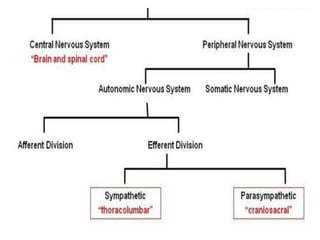
•The peripheral efferent system is further
divided into the somatic nervous system and
the autonomic nervous system which control
voluntary and involuntary functions
respectively
•The autonomic nervous system is subdivided
into two major sub-divisions; this
classification is based on both anatomic and
physiologic grounds:
• Sympathetic (Adrenergic)Nervous System(SNS)
• Parasympathetic (Cholinergic) Nervous System(PNS)
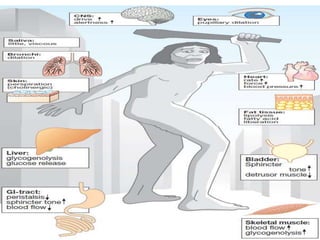
The Autonomic Nervous System
Sympathetic (Adrenergic) N S
• Arises from thoracic &
lumbar areas of the spinal
cord.
• Concerned with the
expenditure of energy & it is
associated with arousal or
emergency situations, i.e.
prepares the body for fight
or flight responses
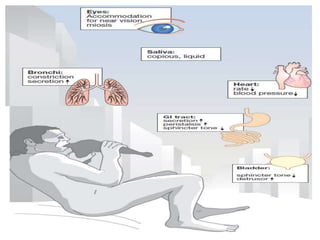
Parasympathetic (Cholinergic) N S
• Arises from the cranial and
sacral of the spinal cord.
• Concerned with the
conservative & restoration of
functions, i.e. prepare the
body for rest
• Digestive processes &
elimination of wastes, and is
required for life.
Nerve Transmission
•There are two important neurotransmitters in the
autonomic nervous system.
• Acetylcholine and
• Noradrenaline (norepinephrine)
•Acetylcholine
• Released after stimulation of the PNS to act
•On effector organs (cells) to elicit their response
•As a neurotransmitter:
• At all preganglionic neurons of both SNS & PNS
Cont…
• The effect of PNS activity in an organ is produced either by
•Stimulation of a parasympathetic nerve fibers
supplying the organ or
•The application of acetylcholine or other
parasympathomimetics to the effector cells.
•This is known as cholinergic activity.
•Norepinephrine
•Released by postganglionic sympathetic nerves to
elicit its effect on effectors cells.
•Acts as a neurotransmitters at
•Most postganglionic sympathetic nerve ending
•Adrenal medullary nerve ending
Cont…
•Sympathetic nerve activity is produced by
•Sympathetic nerve stimulation or
•Application of noradrenaline or adrenaline or
other sympathomimetics, i.e. ‘adrenergic
activity.
• These neurotransmitters have different receptors but there are
two basic categories of receptors associated with the ANS:
•Cholinergic receptors: M and N receptors
•Adrenergic receptors: Alpha and Beta
Cont…
Cholinergic receptors
• Are those receptors that mediate responses to acetylcholine
• Cholinergic receptors for Ach are classified into
• Muscarinic R.( most autonomic effector cells)
• Nicotinic R.( ganglia and skeletal muscles)
Adrenergic receptors
• Are those receptors that mediate responses to
norepinephrine
• Adrenergic receptors for norepinephrine are
•Alpha R.(α)
•Beta R.(β)
•Agents that increase the activity of Ach or stimulate
Parasympathetic nerve system are known as
Parasympathomimetics or Cholinergic agonist
•Those work against this are known as Parasympatholytics
or Anticholinergics
•The agents which increase the activity of Epinephrine and
norepinephrine are known as sympathomimetics or
Adrenergic agonists
•and those which oppose are called Sympatholytics or
Adrenergic antagonists
13
Drugs Acting on Parasympathetic(Cholinergic)
system
Neurotransmission at Cholinergic Neurons
Neurotransmission in cholinergic neurons involves six
steps:
1) Synthesis,
2) Storage,
3) Release,
4) Binding of acetylcholine to a receptor,
5) Degradation of the neurotransmitter in the synaptic cleft
(that is, the space between the nerve endings and adjacent
receptors located on nerves or effector organs),
6) Recycling of choline and acetate
14
Cholinergic Receptors
A. Muscarinic receptors
They have high affinity for muscarine and low affinity for
Nicotine
There are five subclasses of muscarinic receptors.
However, only M1, M2, and M3 receptors have been
functionally characterized.
Locations
Ganglia of PNS and autonomic effector organ such as Heart
, smooth muscle, brain, Exocrine glands
M1: Gastric parietal cell
M2: Cardiac smooth muscle
M3: bladder, exocrine glands(sweat ,salivary), bronchial tree,
eye, gastrointestinal tract.
15
B) Nicotinic Receptors
Have high affinity for Nicotine and low affinity for
Muscarine
Located in
CNS, Adrenal medulla, Autonomic ganglia,
Neuromuscular junction NMJ in skeletal muscles
16
1. Cholinergic Agonists(Parasympathomimetics)
• Result in an increase in the parasympathetic activities in the systems
innervated by cholinergic nerves.
• There are two groups of cholinergic Agonists:
1. Direct-acting: bind to and activate muscarinic or nicotinic
receptors (mostly both) and include the following subgroups:
• Esters of choline: Acetylcholine, methacholine, carbachol,
betanechol
• Cholinergic alkaloids: pilocarpine, muscarine, nicotine
2. Indirect-acting: inhibit the action of acetylcholinesterase
enzyme
• Reversible: Neostigmine, physostigmine, Edrophonium
Pyridostigmine, ambenonium,
Tacrine, donepezil, rivastigmine, and galantamine
• Irreversible: Organophosphate compounds; Echothiophate,
17
Esters of choline
ACETYLCHOLINE
• It is the prototype of all cholinergic agents.
• It is ineffective if given orally, but given parenteral.
• MECHANISM OF ACTION(MOA):
• It has two types of actions: nicotinic and muscarinic; the
muscarinic actions are of main interest.
• CVS: slow HR, vasodilate Blood vessels(arterial smooth
muscle) thus decrease BP.
• GIT: It stimulates the tone and motility of the Gl tract but
relaxes the sphincters.
• Urinary tract: It stimulates the detrusor muscle and relaxes the
urethral sphincter resulting in evacuation of bladder.
• Bronchioles: It increase bronchial secretion and brings about
bronchoconstriction
18
•Eye: It has two effects- miosis and accommodation for
near objects because of stimulation of the constrictor
pupillae and ciliary muscles respectively.
•Exocrine glands: it stimulates salivary, gastric,
bronchial, lachrymal and sweat gland secretions.
19
Synthetic Choline Esters
•These Include:
•Metacholine
•Carbachol
•Betanechol
•These drugs have the following advantages over
acetylcholine:
They have longer duration of action,
They are effective orally as well as parenterally, and
They are relatively more selective in their actions
Betanechol
• MECHANISM OF ACTION(MOA):
•It has similar actions to those of acetylcholine with
pronounced effects on the GIT and the urinary bladder.
•Therapeutic uses:
•Retention of urine (postoperative, post partum)
•Paralytic ileus
•Congenital megacolon
•It can be given orally(5, 25, 50 mg tablets), parenteral (5
mg/mL) or topically(0.01% solution)
•Adverse effects: headache, flushing, diarrhea, sweating,
hypotension, urinary urgency.
21
•Other choline esters(Carbachol & Metacholine) are similar
to Betanechol in all sides.
Uses: Glaucoma
•Contraindications to the use of choline esters
•Bronchial asthma(bronchial constriction and increase
bronchial secretions)
•Peptic ulcer disease(increase in gastric acid secretion)
•Coronary insufficiency(compromise coronary blood flow)
•Hyperthyroidism
22
Pilocarpine
•Pilocarpine is a naturally occurring cholinomimetic
alkaloid
•MOA: it directly stimulates the muscarinic receptors to
bring about all the muscarinic effects of acetylcholine.
•It crosses the blood-brain barrier.
•Therapeutic uses: it is primarily used in ophthalmology
•It is the first choice among cholinomimetics for the
treatment of glaucoma.
•Post operative urine retention
•Xerostomia
•It is given orally(5 mg tablets) or topically(10% solutions)
Uses of Indirect acting Cholinergic agents
1. Diagnosis of myasthenia gravis(Edrophonium)
2. Treatment of myasthenia gravis (Neostigmine,
physostigmine, Pyridostigmine, ambenonium,)
3. Antidote Anticholinegics e.g
Atropine(Neostigmine, physostigmine,
Pyridostigmine, ambenonium,)
4. Antidote of Skeletal muscle relaxants
(Neostigmine)
5. Management of Alzheimer's disease(Tacrine,
donepezil, rivastigmine, and galantamine)
6/13/2016 24
Adverse effects of cholinergic agonists
Miosis
Sweating,
Salivation,
Flushing,
Decreased blood pressure,
Nausea,
Abdominal pain,
Diarrhea,
Bronchospasm
CNS disturbances

AUTONOMIC NERVOUS SYSTEM DR. JAMA copy.pptx

  • 1.
    Drugs Affecting The AutonomicNervous System DR.JAMA
  • 2.
  • 4.
    NERVOUS SYSTEM •The nervoussystem is divided into two parts: the central nervous system (CNS) and the peripheral nervous system (PNS). •The CNS consists of the brain and spinal cord. •The PNS consists of afferent(sensory) and efferent(motor) neurons. •Afferent (sensory) neurons carry nerve impulses into the CNS from sensory end organs. •Efferent (motor) neurons carry nerve impulses from the CNS to effector cells in peripheral tissues.
  • 5.
    Cont… •The peripheral efferentsystem is further divided into the somatic nervous system and the autonomic nervous system which control voluntary and involuntary functions respectively •The autonomic nervous system is subdivided into two major sub-divisions; this classification is based on both anatomic and physiologic grounds: • Sympathetic (Adrenergic)Nervous System(SNS) • Parasympathetic (Cholinergic) Nervous System(PNS)
  • 6.
    The Autonomic NervousSystem Sympathetic (Adrenergic) N S • Arises from thoracic & lumbar areas of the spinal cord. • Concerned with the expenditure of energy & it is associated with arousal or emergency situations, i.e. prepares the body for fight or flight responses Parasympathetic (Cholinergic) N S • Arises from the cranial and sacral of the spinal cord. • Concerned with the conservative & restoration of functions, i.e. prepare the body for rest • Digestive processes & elimination of wastes, and is required for life.
  • 9.
    Nerve Transmission •There aretwo important neurotransmitters in the autonomic nervous system. • Acetylcholine and • Noradrenaline (norepinephrine) •Acetylcholine • Released after stimulation of the PNS to act •On effector organs (cells) to elicit their response •As a neurotransmitter: • At all preganglionic neurons of both SNS & PNS
  • 10.
    Cont… • The effectof PNS activity in an organ is produced either by •Stimulation of a parasympathetic nerve fibers supplying the organ or •The application of acetylcholine or other parasympathomimetics to the effector cells. •This is known as cholinergic activity. •Norepinephrine •Released by postganglionic sympathetic nerves to elicit its effect on effectors cells. •Acts as a neurotransmitters at •Most postganglionic sympathetic nerve ending •Adrenal medullary nerve ending
  • 11.
    Cont… •Sympathetic nerve activityis produced by •Sympathetic nerve stimulation or •Application of noradrenaline or adrenaline or other sympathomimetics, i.e. ‘adrenergic activity. • These neurotransmitters have different receptors but there are two basic categories of receptors associated with the ANS: •Cholinergic receptors: M and N receptors •Adrenergic receptors: Alpha and Beta
  • 12.
    Cont… Cholinergic receptors • Arethose receptors that mediate responses to acetylcholine • Cholinergic receptors for Ach are classified into • Muscarinic R.( most autonomic effector cells) • Nicotinic R.( ganglia and skeletal muscles) Adrenergic receptors • Are those receptors that mediate responses to norepinephrine • Adrenergic receptors for norepinephrine are •Alpha R.(α) •Beta R.(β)
  • 13.
    •Agents that increasethe activity of Ach or stimulate Parasympathetic nerve system are known as Parasympathomimetics or Cholinergic agonist •Those work against this are known as Parasympatholytics or Anticholinergics •The agents which increase the activity of Epinephrine and norepinephrine are known as sympathomimetics or Adrenergic agonists •and those which oppose are called Sympatholytics or Adrenergic antagonists 13
  • 14.
    Drugs Acting onParasympathetic(Cholinergic) system Neurotransmission at Cholinergic Neurons Neurotransmission in cholinergic neurons involves six steps: 1) Synthesis, 2) Storage, 3) Release, 4) Binding of acetylcholine to a receptor, 5) Degradation of the neurotransmitter in the synaptic cleft (that is, the space between the nerve endings and adjacent receptors located on nerves or effector organs), 6) Recycling of choline and acetate 14
  • 15.
    Cholinergic Receptors A. Muscarinicreceptors They have high affinity for muscarine and low affinity for Nicotine There are five subclasses of muscarinic receptors. However, only M1, M2, and M3 receptors have been functionally characterized. Locations Ganglia of PNS and autonomic effector organ such as Heart , smooth muscle, brain, Exocrine glands M1: Gastric parietal cell M2: Cardiac smooth muscle M3: bladder, exocrine glands(sweat ,salivary), bronchial tree, eye, gastrointestinal tract. 15
  • 16.
    B) Nicotinic Receptors Havehigh affinity for Nicotine and low affinity for Muscarine Located in CNS, Adrenal medulla, Autonomic ganglia, Neuromuscular junction NMJ in skeletal muscles 16
  • 17.
    1. Cholinergic Agonists(Parasympathomimetics) •Result in an increase in the parasympathetic activities in the systems innervated by cholinergic nerves. • There are two groups of cholinergic Agonists: 1. Direct-acting: bind to and activate muscarinic or nicotinic receptors (mostly both) and include the following subgroups: • Esters of choline: Acetylcholine, methacholine, carbachol, betanechol • Cholinergic alkaloids: pilocarpine, muscarine, nicotine 2. Indirect-acting: inhibit the action of acetylcholinesterase enzyme • Reversible: Neostigmine, physostigmine, Edrophonium Pyridostigmine, ambenonium, Tacrine, donepezil, rivastigmine, and galantamine • Irreversible: Organophosphate compounds; Echothiophate, 17
  • 18.
    Esters of choline ACETYLCHOLINE •It is the prototype of all cholinergic agents. • It is ineffective if given orally, but given parenteral. • MECHANISM OF ACTION(MOA): • It has two types of actions: nicotinic and muscarinic; the muscarinic actions are of main interest. • CVS: slow HR, vasodilate Blood vessels(arterial smooth muscle) thus decrease BP. • GIT: It stimulates the tone and motility of the Gl tract but relaxes the sphincters. • Urinary tract: It stimulates the detrusor muscle and relaxes the urethral sphincter resulting in evacuation of bladder. • Bronchioles: It increase bronchial secretion and brings about bronchoconstriction 18
  • 19.
    •Eye: It hastwo effects- miosis and accommodation for near objects because of stimulation of the constrictor pupillae and ciliary muscles respectively. •Exocrine glands: it stimulates salivary, gastric, bronchial, lachrymal and sweat gland secretions. 19
  • 20.
    Synthetic Choline Esters •TheseInclude: •Metacholine •Carbachol •Betanechol •These drugs have the following advantages over acetylcholine: They have longer duration of action, They are effective orally as well as parenterally, and They are relatively more selective in their actions
  • 21.
    Betanechol • MECHANISM OFACTION(MOA): •It has similar actions to those of acetylcholine with pronounced effects on the GIT and the urinary bladder. •Therapeutic uses: •Retention of urine (postoperative, post partum) •Paralytic ileus •Congenital megacolon •It can be given orally(5, 25, 50 mg tablets), parenteral (5 mg/mL) or topically(0.01% solution) •Adverse effects: headache, flushing, diarrhea, sweating, hypotension, urinary urgency. 21
  • 22.
    •Other choline esters(Carbachol& Metacholine) are similar to Betanechol in all sides. Uses: Glaucoma •Contraindications to the use of choline esters •Bronchial asthma(bronchial constriction and increase bronchial secretions) •Peptic ulcer disease(increase in gastric acid secretion) •Coronary insufficiency(compromise coronary blood flow) •Hyperthyroidism 22
  • 23.
    Pilocarpine •Pilocarpine is anaturally occurring cholinomimetic alkaloid •MOA: it directly stimulates the muscarinic receptors to bring about all the muscarinic effects of acetylcholine. •It crosses the blood-brain barrier. •Therapeutic uses: it is primarily used in ophthalmology •It is the first choice among cholinomimetics for the treatment of glaucoma. •Post operative urine retention •Xerostomia •It is given orally(5 mg tablets) or topically(10% solutions)
  • 24.
    Uses of Indirectacting Cholinergic agents 1. Diagnosis of myasthenia gravis(Edrophonium) 2. Treatment of myasthenia gravis (Neostigmine, physostigmine, Pyridostigmine, ambenonium,) 3. Antidote Anticholinegics e.g Atropine(Neostigmine, physostigmine, Pyridostigmine, ambenonium,) 4. Antidote of Skeletal muscle relaxants (Neostigmine) 5. Management of Alzheimer's disease(Tacrine, donepezil, rivastigmine, and galantamine) 6/13/2016 24
  • 25.
    Adverse effects ofcholinergic agonists Miosis Sweating, Salivation, Flushing, Decreased blood pressure, Nausea, Abdominal pain, Diarrhea, Bronchospasm CNS disturbances

Editor's Notes

  • #6 The simplest distinction the neurons of the somatic division innervate skeletal muscle, the autonomic neurons innervate smooth and cardiac muscle, glands, and neurons in the gastrointestinal tract