
M A N U A L
T H E
#LongLivetheManual
WHAT’S SO SPECIAL ABOUT
A MANUAL TRANSMISSION?
True sports cars have long been defined
by engine performance, handling agility
and the ability to connect the driver to
the road. For decades, sports car purists
considered a manual transmission a must.
Providing a purely mechanical, direct and
visceral link to the control over the car’s
power delivery, a manual transmission
creates a unique melding of human
and machine. Automatics were seen as
detracting from the connections among
car, road and driver.
Manual transmissions once also offered
tangible benefits in performance and
fuel economy over automatics. Recent
developments in automatic transmission
technology have in some cases flipped
that equation, and automatics have
become more engaging to drive, as well.
They’ve got more gears and paddle
shifters on the steering wheel, just like in
a Formula 1 racecar.
why drive a sports car
with a stick shift?
Because it’s a lot of fun, especially when
the sports car is a 2016 Jaguar F-TYPE.
To the driving enthusiast, every well
executed shift with a manual transmission
brings a sense of accomplishment
and reward. The manual transmission
stimulates other senses, too. If you think
the F-TYPE engine sounds wicked with
the automatic cracking off lightning-
quick shifts, wait until you master your
own ultra-quick shifts with the manual.
But, we’re getting ahead of ourselves.
If you’ve long been an adherent of
manual transmissions, please pass this
booklet on to a friend who has not.
Consider that your good deed for
the day.
What’s the Difference Between a Manual
Transmission and an Automatic Transmission?
That was easier to answer a few years ago, but there are more types of automatic
transmissions today than ever before. We’re not concerned with automatics here,
so let’s just say that a manual transmission is a simpler, singular entity. All work
the same way. When you move the shift lever, cables or rods beneath the console
change the engagement of gears on shafts within the transmission to yield
different ratios. The 6-speed format, as in the F-TYPE, is common these days.
Don’t be intimidated by the number of gears. Think of bicycles. Years ago, you
might have had a 10-speed bike (or even a 3- or 5-speed if you’re over 50). Then
you started riding 21- and 24-speed bikes. And didn’t you find that you enjoyed
riding more than ever?
Depending on your age, you might remember 3-, 4- and 5-speed manuals in cars.
“Three on the tree” and “Four on the floor” were the epitome of cool in the 1960s
and early 1970s. Then came more gears, mainly for better highway fuel economy
and quieter cruising (the higher the gear, the slower the engine runs for a given
vehicle speed).
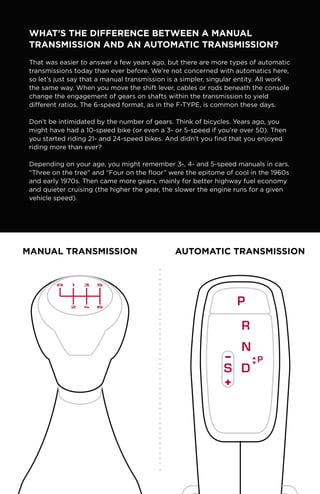
manual transmission automatic transmission
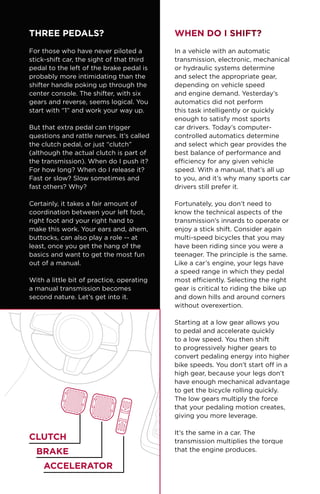
THREE PEDALS?
For those who have never piloted a
stick-shift car, the sight of that third
pedal to the left of the brake pedal is
probably more intimidating than the
shifter handle poking up through the
center console. The shifter, with six
gears and reverse, seems logical. You
start with “1” and work your way up.
But that extra pedal can trigger
questions and rattle nerves. It’s called
the clutch pedal, or just “clutch”
(although the actual clutch is part of
the transmission). When do I push it?
For how long? When do I release it?
Fast or slow? Slow sometimes and
fast others? Why?
Certainly, it takes a fair amount of
coordination between your left foot,
right foot and your right hand to
make this work. Your ears and, ahem,
buttocks, can also play a role -- at
least, once you get the hang of the
basics and want to get the most fun
out of a manual.
With a little bit of practice, operating
a manual transmission becomes
second nature. Let’s get into it.
When Do I Shift?
In a vehicle with an automatic
transmission, electronic, mechanical
or hydraulic systems determine
and select the appropriate gear,
depending on vehicle speed
and engine demand. Yesterday’s
automatics did not perform
this task intelligently or quickly
enough to satisfy most sports
car drivers. Today’s computer-
controlled automatics determine
and select which gear provides the
best balance of performance and
efficiency for any given vehicle
speed. With a manual, that’s all up
to you, and it’s why many sports car
drivers still prefer it.
Fortunately, you don’t need to
know the technical aspects of the
transmission’s innards to operate or
enjoy a stick shift. Consider again
multi-speed bicycles that you may
have been riding since you were a
teenager. The principle is the same.
Like a car’s engine, your legs have
a speed range in which they pedal
most efficiently. Selecting the right
gear is critical to riding the bike up
and down hills and around corners
without overexertion.
Starting at a low gear allows you
to pedal and accelerate quickly
to a low speed. You then shift
to progressively higher gears to
convert pedaling energy into higher
bike speeds. You don’t start off in a
high gear, because your legs don’t
have enough mechanical advantage
to get the bicycle rolling quickly.
The low gears multiply the force
that your pedaling motion creates,
giving you more leverage.
It’s the same in a car. The
transmission multiplies the torque
that the engine produces.
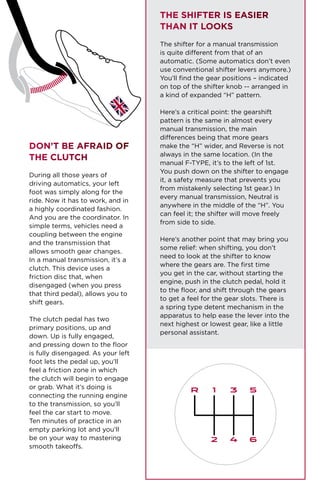
Clutch
BRAKE
ACCELERATOR
Don’t be Afraid of
The Clutch
During all those years of
driving automatics, your left
foot was simply along for the
ride. Now it has to work, and in
a highly coordinated fashion.
And you are the coordinator. In
simple terms, vehicles need a
coupling between the engine
and the transmission that
allows smooth gear changes.
In a manual transmission, it’s a
clutch. This device uses a
friction disc that, when
disengaged (when you press
that third pedal), allows you to
shift gears.
The clutch pedal has two
primary positions, up and
down. Up is fully engaged,
and pressing down to the floor
is fully disengaged. As your left
foot lets the pedal up, you’ll
feel a friction zone in which
the clutch will begin to engage
or grab. What it’s doing is
connecting the running engine
to the transmission, so you’ll
feel the car start to move.
Ten minutes of practice in an
empty parking lot and you’ll
be on your way to mastering
smooth takeoffs.
The Shifter is Easier
Than It Looks
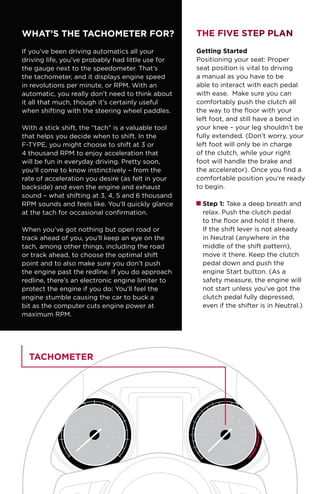
The shifter for a manual transmission
is quite different from that of an
automatic. (Some automatics don’t even
use conventional shifter levers anymore.)
You’ll find the gear positions – indicated
on top of the shifter knob -- arranged in
a kind of expanded “H” pattern.
Here’s a critical point: the gearshift
pattern is the same in almost every
manual transmission, the main
differences being that more gears
make the “H” wider, and Reverse is not
always in the same location. (In the
manual F-TYPE, it’s to the left of 1st.
You push down on the shifter to engage
it, a safety measure that prevents you
from mistakenly selecting 1st gear.) In
every manual transmission, Neutral is
anywhere in the middle of the “H”. You
can feel it; the shifter will move freely
from side to side.
Here’s another point that may bring you
some relief: when shifting, you don’t
need to look at the shifter to know
where the gears are. The first time
you get in the car, without starting the
engine, push in the clutch pedal, hold it
to the floor, and shift through the gears
to get a feel for the gear slots. There is
a spring type detent mechanism in the
apparatus to help ease the lever into the
next highest or lowest gear, like a little
personal assistant.
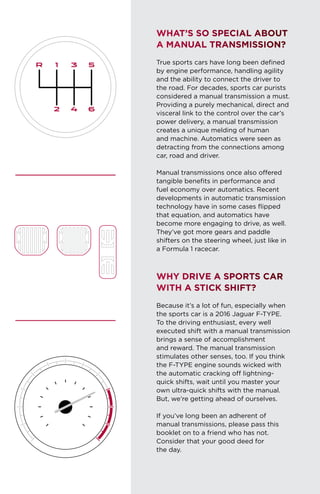
R 1 3 5
2 4 6
The five step plan
Getting Started
Positioning your seat: Proper
seat position is vital to driving
a manual as you have to be
able to interact with each pedal
with ease. Make sure you can
comfortably push the clutch all
the way to the floor with your
left foot, and still have a bend in
your knee – your leg shouldn’t be
fully extended. (Don’t worry, your
left foot will only be in charge
of the clutch, while your right
foot will handle the brake and
the accelerator). Once you find a
comfortable position you’re ready
to begin.
Step 1: Take a deep breath and
relax. Push the clutch pedal
to the floor and hold it there.
If the shift lever is not already
in Neutral (anywhere in the
middle of the shift pattern),
move it there. Keep the clutch
pedal down and push the
engine Start button. (As a
safety measure, the engine will
not start unless you’ve got the
clutch pedal fully depressed,
even if the shifter is in Neutral.)
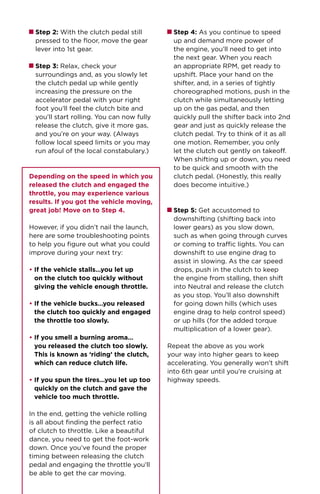
What’s thE TACHOMETER For?
If you’ve been driving automatics all your
driving life, you’ve probably had little use for
the gauge next to the speedometer. That’s
the tachometer, and it displays engine speed
in revolutions per minute, or RPM. With an
automatic, you really don’t need to think about
it all that much, though it’s certainly useful
when shifting with the steering wheel paddles.
With a stick shift, the “tach” is a valuable tool
that helps you decide when to shift. In the
F-TYPE, you might choose to shift at 3 or
4 thousand RPM to enjoy acceleration that
will be fun in everyday driving. Pretty soon,
you’ll come to know instinctively – from the
rate of acceleration you desire (as felt in your
backside) and even the engine and exhaust
sound – what shifting at 3, 4, 5 and 6 thousand
RPM sounds and feels like. You’ll quickly glance
at the tach for occasional confirmation.
When you’ve got nothing but open road or
track ahead of you, you’ll keep an eye on the
tach, among other things, including the road
or track ahead, to choose the optimal shift
point and to also make sure you don’t push
the engine past the redline. If you do approach
redline, there’s an electronic engine limiter to
protect the engine if you do: You’ll feel the
engine stumble causing the car to buck a
bit as the computer cuts engine power at
maximum RPM.
TACHOMETER
Step 2: With the clutch pedal still
pressed to the floor, move the gear
lever into 1st gear.
Step 3: Relax, check your
surroundings and, as you slowly let
the clutch pedal up while gently
increasing the pressure on the
accelerator pedal with your right
foot you’ll feel the clutch bite and
you’ll start rolling. You can now fully
release the clutch, give it more gas,
and you’re on your way. (Always
follow local speed limits or you may
run afoul of the local constabulary.)
Depending on the speed in which you
released the clutch and engaged the
throttle, you may experience various
results. If you got the vehicle moving,
great job! Move on to Step 4.
However, if you didn’t nail the launch,
here are some troubleshooting points
to help you figure out what you could
improve during your next try:
• If the vehicle stalls…you let up
on the clutch too quickly without
giving the vehicle enough throttle.
• If the vehicle bucks…you released
the clutch too quickly and engaged
the throttle too slowly.
• If you smell a burning aroma…
you released the clutch too slowly.
This is known as ‘riding’ the clutch,
which can reduce clutch life.
• If you spun the tires…you let up too
quickly on the clutch and gave the
vehicle too much throttle.
In the end, getting the vehicle rolling
is all about finding the perfect ratio
of clutch to throttle. Like a beautiful
dance, you need to get the foot-work
down. Once you’ve found the proper
timing between releasing the clutch
pedal and engaging the throttle you’ll
be able to get the car moving.
Step 4: As you continue to speed
up and demand more power of
the engine, you’ll need to get into
the next gear. When you reach
an appropriate RPM, get ready to
upshift. Place your hand on the
shifter, and, in a series of tightly
choreographed motions, push in the
clutch while simultaneously letting
up on the gas pedal, and then
quickly pull the shifter back into 2nd
gear and just as quickly release the
clutch pedal. Try to think of it as all
one motion. Remember, you only
let the clutch out gently on takeoff.
When shifting up or down, you need
to be quick and smooth with the
clutch pedal. (Honestly, this really
does become intuitive.)
Step 5: Get accustomed to
downshifting (shifting back into
lower gears) as you slow down,
such as when going through curves
or coming to traffic lights. You can
downshift to use engine drag to
assist in slowing. As the car speed
drops, push in the clutch to keep
the engine from stalling, then shift
into Neutral and release the clutch
as you stop. You’ll also downshift
for going down hills (which uses
engine drag to help control speed)
or up hills (for the added torque
multiplication of a lower gear).
Repeat the above as you work
your way into higher gears to keep
accelerating. You generally won’t shift
into 6th gear until you’re cruising at
highway speeds.
I Have to Slow Down or Stop.
What Do I Need to Do?
The smart aleck answer is, “That depends.” Well, it’s true, what you do with a
stick shift when slowing down or stopping does depend on how much you’re
slowing, or from what speed you’re slowing down when approaching a stop.
If you’re cruising along a suburban thoroughfare at about 40 mph, you’re likely in
5th gear in a six-speed transmission. (But you could be in sixth). In any case, as
you approach a traffic light or stop sign, just ease off the gas and begin to brake
as you would in an automatic car. Depending on the distance to the light, some
drivers will just shift into Neutral, coast down and brake to a stop. That’s OK to do
in low-speed situations, but it’s not good for all stops. The reason: While coasting
in Neutral, you will not have the ability to accelerate if you need to, such as if you
need to avoid a car whose driver has carelessly backed into the road without
looking. It happens.
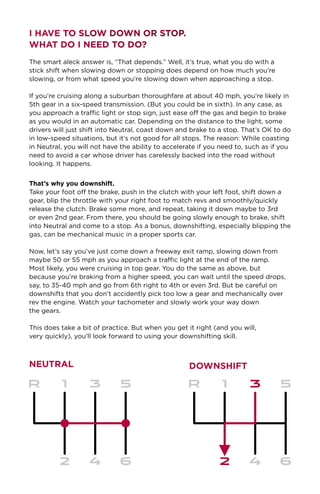
That’s why you downshift.
Take your foot off the brake, push in the clutch with your left foot, shift down a
gear, blip the throttle with your right foot to match revs and smoothly/quickly
release the clutch. Brake some more, and repeat, taking it down maybe to 3rd
or even 2nd gear. From there, you should be going slowly enough to brake, shift
into Neutral and come to a stop. As a bonus, downshifting, especially blipping the
gas, can be mechanical music in a proper sports car.
Now, let’s say you’ve just come down a freeway exit ramp, slowing down from
maybe 50 or 55 mph as you approach a traffic light at the end of the ramp.
Most likely, you were cruising in top gear. You do the same as above, but
because you’re braking from a higher speed, you can wait until the speed drops,
say, to 35-40 mph and go from 6th right to 4th or even 3rd. But be careful on
downshifts that you don’t accidently pick too low a gear and mechanically over
rev the engine. Watch your tachometer and slowly work your way down
the gears.
This does take a bit of practice. But when you get it right (and you will,
very quickly), you’ll look forward to using your downshifting skill.
DownshiftNEUTRAL
The Hills Are Alive
This might seem a bit sneaky, but
we’ve been holding something back
about learning to drive a stick shift.
It’s hills, or specifically, starting out on
a hill, such as at a stop sign or traffic
light. Even experienced stick drivers
will tell you hills take a bit more
practice than other maneuvers.
Here goes.
In a stick shift car, if you’re at a stop
while heading uphill, starting out
takes some quick footwork. If you’re
getting ready to move away, you’re
right foot is already on the brake and
the shifter is likely in neutral. Push in
the clutch and shift into first. Keep
the clutch down! When the light
turns green, you’ll pull away as you
would from any stop, but your clutch
release and movement of right foot
from brake to gas pedal needs to
be super-coordinated and quick. Be
prepared: no matter how good you
are, the car is going to roll back a bit.
Here’s a hint: it will feel like it’s rolling
back more than it actually is, so don’t
let that frighten you. However, if you
drive a manual F-TYPE, you’re lucky
enough to have a helpful little feature
called Hill Assist that will momentarily
prevent the vehicle from rolling back
on hills.
Ideally, you’d practice the hill start in
a quiet part of town with little traffic.
Maybe you can find an empty parking
lot that has an incline for the exit.
The footwork needed for this
maneuver will, like other stick shift
maneuvers, become second nature
to you. And you will most definitively
feel a great sense of accomplishment
when you master it. What sense of
accomplishment did you get from an
automatic transmission today?
SOMETHING IS NOT
QUITE RIGHT.
It’s nothing to be embarrassed
about. It happens to all stick shift
drivers once in a while, especially
beginners: stalling. It happens
when you’re pulling away from
a stop and either (1) release the
clutch pedal too quickly or (2)
don’t put enough pressure on the
accelerator or (3) a combination
of the two. The engine just dies,
and so does your dignity, if only
for a moment.
This wonderful teaching tool
almost always occurs when there
is a line of cars behind you, which
amplifies the embarrassment.
Unfortunately, the resulting
cacophony of car horns is bound
to throw off your concentration.
Take a breath. Press the clutch
pedal to the floor, put the shifter
into Neutral, push the Start
button (or turn the key, if your car
has one), shift back into 1st and
try the launch again. Off you go!
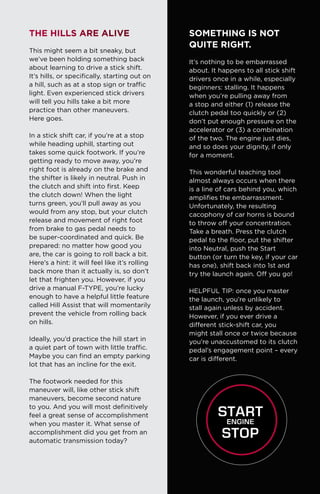
HELPFUL TIP: once you master
the launch, you’re unlikely to
stall again unless by accident.
However, if you ever drive a
different stick-shift car, you
might stall once or twice because
you’re unaccustomed to its clutch
pedal’s engagement point – every
car is different.
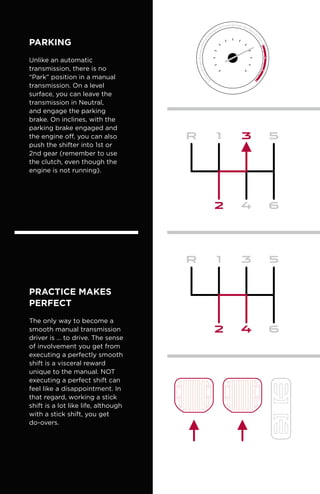
Parking
Unlike an automatic
transmission, there is no
“Park” position in a manual
transmission. On a level
surface, you can leave the
transmission in Neutral,
and engage the parking
brake. On inclines, with the
parking brake engaged and
the engine off, you can also
push the shifter into 1st or
2nd gear (remember to use
the clutch, even though the
engine is not running).
PRACTICE MAKES
PERFECT
The only way to become a
smooth manual transmission
driver is … to drive. The sense
of involvement you get from
executing a perfectly smooth
shift is a visceral reward
unique to the manual. NOT
executing a perfect shift can
feel like a disappointment. In
that regard, working a stick
shift is a lot like life, although
with a stick shift, you get
do-overs.
ADVANCED TECHNIQUES
Matching revs: Because you release the gas pedal when you shift, engine speed
drops. On a downshift, such as when going into a curve or turn, you might feel
a jolt when you release the clutch. To avoid that and execute a smooth shift,
you need to “match revs.” By tapping the gas pedal before releasing the clutch,
you bring engine revs back up to match the transmission’s still-turning gears,
resulting in a smoother engagement.
Upshifts for performance: It’s not always necessary to shift at the tachometer’s
red line to get maximum acceleration. We dont encourage aggresive or
excessively fast driving; doing so on a public road can lead to unfettered
hooliganism. Engines have peaks in their horsepower and torque curves, and
keeping the engine RPM within this range can provide ideal performance. You’ll
get a feel for it.
In the Jaguar F-TYPE, the supercharged V6 engine produces high torque at
relatively low engine speeds, which yields powerful acceleration from the start
and then throughout the power band. There’s no need to shift at redline, as the
F-TYPE will sound amazing at any RPM.
Skip-shifting for fuel economy: The gears do not always need to be upshifted
sequentially. To reduce engine RPM and improve fuel efficiency, one can select
a gear that is numerically two or more higher. A higher gear can be selected
as long as the engine is not “lugging,” a condition when the engine speed
is too low to accelerate or maintain the desired speed. You’ll know it by the
noticeable vibration and lack of acceleration. Think back to the bicycle analogy;
if you slow down to enter a turn without downshifting, you may have trouble
pedaling as you exit the curve. You’ll feel strain in your legs and not be able to
accelerate quickly.
HELPFUL TIP: in a sports car like the F-TYPE, skip-shifting is a mood killer.
So skip it.
Emergency response: In an emergency braking situation, remember to also
push in the clutch pedal to prevent the engine from stalling.After the car comes
to a complete stop, simply shift into 1st gear and motor on your way. If it’s not a
complete stop, a downshift of one or two gears may suffice.
As a qualified manual driver, it is now your
responsibility to pass on the knowledge and
teach someone else. Long live the manual!
JaguarUSA.com
© 2014 Jaguar Land Rover North America, LLC

jaguar_how_to_use_manual_stick

  • 1.
    M A NU A L T H E #LongLivetheManual
  • 2.
    WHAT’S SO SPECIALABOUT A MANUAL TRANSMISSION? True sports cars have long been defined by engine performance, handling agility and the ability to connect the driver to the road. For decades, sports car purists considered a manual transmission a must. Providing a purely mechanical, direct and visceral link to the control over the car’s power delivery, a manual transmission creates a unique melding of human and machine. Automatics were seen as detracting from the connections among car, road and driver. Manual transmissions once also offered tangible benefits in performance and fuel economy over automatics. Recent developments in automatic transmission technology have in some cases flipped that equation, and automatics have become more engaging to drive, as well. They’ve got more gears and paddle shifters on the steering wheel, just like in a Formula 1 racecar. why drive a sports car with a stick shift? Because it’s a lot of fun, especially when the sports car is a 2016 Jaguar F-TYPE. To the driving enthusiast, every well executed shift with a manual transmission brings a sense of accomplishment and reward. The manual transmission stimulates other senses, too. If you think the F-TYPE engine sounds wicked with the automatic cracking off lightning- quick shifts, wait until you master your own ultra-quick shifts with the manual. But, we’re getting ahead of ourselves. If you’ve long been an adherent of manual transmissions, please pass this booklet on to a friend who has not. Consider that your good deed for the day.
  • 3.
    What’s the DifferenceBetween a Manual Transmission and an Automatic Transmission? That was easier to answer a few years ago, but there are more types of automatic transmissions today than ever before. We’re not concerned with automatics here, so let’s just say that a manual transmission is a simpler, singular entity. All work the same way. When you move the shift lever, cables or rods beneath the console change the engagement of gears on shafts within the transmission to yield different ratios. The 6-speed format, as in the F-TYPE, is common these days. Don’t be intimidated by the number of gears. Think of bicycles. Years ago, you might have had a 10-speed bike (or even a 3- or 5-speed if you’re over 50). Then you started riding 21- and 24-speed bikes. And didn’t you find that you enjoyed riding more than ever? Depending on your age, you might remember 3-, 4- and 5-speed manuals in cars. “Three on the tree” and “Four on the floor” were the epitome of cool in the 1960s and early 1970s. Then came more gears, mainly for better highway fuel economy and quieter cruising (the higher the gear, the slower the engine runs for a given vehicle speed). manual transmission automatic transmission
  • 4.
    THREE PEDALS? For thosewho have never piloted a stick-shift car, the sight of that third pedal to the left of the brake pedal is probably more intimidating than the shifter handle poking up through the center console. The shifter, with six gears and reverse, seems logical. You start with “1” and work your way up. But that extra pedal can trigger questions and rattle nerves. It’s called the clutch pedal, or just “clutch” (although the actual clutch is part of the transmission). When do I push it? For how long? When do I release it? Fast or slow? Slow sometimes and fast others? Why? Certainly, it takes a fair amount of coordination between your left foot, right foot and your right hand to make this work. Your ears and, ahem, buttocks, can also play a role -- at least, once you get the hang of the basics and want to get the most fun out of a manual. With a little bit of practice, operating a manual transmission becomes second nature. Let’s get into it. When Do I Shift? In a vehicle with an automatic transmission, electronic, mechanical or hydraulic systems determine and select the appropriate gear, depending on vehicle speed and engine demand. Yesterday’s automatics did not perform this task intelligently or quickly enough to satisfy most sports car drivers. Today’s computer- controlled automatics determine and select which gear provides the best balance of performance and efficiency for any given vehicle speed. With a manual, that’s all up to you, and it’s why many sports car drivers still prefer it. Fortunately, you don’t need to know the technical aspects of the transmission’s innards to operate or enjoy a stick shift. Consider again multi-speed bicycles that you may have been riding since you were a teenager. The principle is the same. Like a car’s engine, your legs have a speed range in which they pedal most efficiently. Selecting the right gear is critical to riding the bike up and down hills and around corners without overexertion. Starting at a low gear allows you to pedal and accelerate quickly to a low speed. You then shift to progressively higher gears to convert pedaling energy into higher bike speeds. You don’t start off in a high gear, because your legs don’t have enough mechanical advantage to get the bicycle rolling quickly. The low gears multiply the force that your pedaling motion creates, giving you more leverage. It’s the same in a car. The transmission multiplies the torque that the engine produces. Clutch BRAKE ACCELERATOR
  • 5.
    Don’t be Afraidof The Clutch During all those years of driving automatics, your left foot was simply along for the ride. Now it has to work, and in a highly coordinated fashion. And you are the coordinator. In simple terms, vehicles need a coupling between the engine and the transmission that allows smooth gear changes. In a manual transmission, it’s a clutch. This device uses a friction disc that, when disengaged (when you press that third pedal), allows you to shift gears. The clutch pedal has two primary positions, up and down. Up is fully engaged, and pressing down to the floor is fully disengaged. As your left foot lets the pedal up, you’ll feel a friction zone in which the clutch will begin to engage or grab. What it’s doing is connecting the running engine to the transmission, so you’ll feel the car start to move. Ten minutes of practice in an empty parking lot and you’ll be on your way to mastering smooth takeoffs. The Shifter is Easier Than It Looks The shifter for a manual transmission is quite different from that of an automatic. (Some automatics don’t even use conventional shifter levers anymore.) You’ll find the gear positions – indicated on top of the shifter knob -- arranged in a kind of expanded “H” pattern. Here’s a critical point: the gearshift pattern is the same in almost every manual transmission, the main differences being that more gears make the “H” wider, and Reverse is not always in the same location. (In the manual F-TYPE, it’s to the left of 1st. You push down on the shifter to engage it, a safety measure that prevents you from mistakenly selecting 1st gear.) In every manual transmission, Neutral is anywhere in the middle of the “H”. You can feel it; the shifter will move freely from side to side. Here’s another point that may bring you some relief: when shifting, you don’t need to look at the shifter to know where the gears are. The first time you get in the car, without starting the engine, push in the clutch pedal, hold it to the floor, and shift through the gears to get a feel for the gear slots. There is a spring type detent mechanism in the apparatus to help ease the lever into the next highest or lowest gear, like a little personal assistant. R 1 3 5 2 4 6
  • 6.
    The five stepplan Getting Started Positioning your seat: Proper seat position is vital to driving a manual as you have to be able to interact with each pedal with ease. Make sure you can comfortably push the clutch all the way to the floor with your left foot, and still have a bend in your knee – your leg shouldn’t be fully extended. (Don’t worry, your left foot will only be in charge of the clutch, while your right foot will handle the brake and the accelerator). Once you find a comfortable position you’re ready to begin. Step 1: Take a deep breath and relax. Push the clutch pedal to the floor and hold it there. If the shift lever is not already in Neutral (anywhere in the middle of the shift pattern), move it there. Keep the clutch pedal down and push the engine Start button. (As a safety measure, the engine will not start unless you’ve got the clutch pedal fully depressed, even if the shifter is in Neutral.) What’s thE TACHOMETER For? If you’ve been driving automatics all your driving life, you’ve probably had little use for the gauge next to the speedometer. That’s the tachometer, and it displays engine speed in revolutions per minute, or RPM. With an automatic, you really don’t need to think about it all that much, though it’s certainly useful when shifting with the steering wheel paddles. With a stick shift, the “tach” is a valuable tool that helps you decide when to shift. In the F-TYPE, you might choose to shift at 3 or 4 thousand RPM to enjoy acceleration that will be fun in everyday driving. Pretty soon, you’ll come to know instinctively – from the rate of acceleration you desire (as felt in your backside) and even the engine and exhaust sound – what shifting at 3, 4, 5 and 6 thousand RPM sounds and feels like. You’ll quickly glance at the tach for occasional confirmation. When you’ve got nothing but open road or track ahead of you, you’ll keep an eye on the tach, among other things, including the road or track ahead, to choose the optimal shift point and to also make sure you don’t push the engine past the redline. If you do approach redline, there’s an electronic engine limiter to protect the engine if you do: You’ll feel the engine stumble causing the car to buck a bit as the computer cuts engine power at maximum RPM. TACHOMETER
  • 7.
    Step 2: Withthe clutch pedal still pressed to the floor, move the gear lever into 1st gear. Step 3: Relax, check your surroundings and, as you slowly let the clutch pedal up while gently increasing the pressure on the accelerator pedal with your right foot you’ll feel the clutch bite and you’ll start rolling. You can now fully release the clutch, give it more gas, and you’re on your way. (Always follow local speed limits or you may run afoul of the local constabulary.) Depending on the speed in which you released the clutch and engaged the throttle, you may experience various results. If you got the vehicle moving, great job! Move on to Step 4. However, if you didn’t nail the launch, here are some troubleshooting points to help you figure out what you could improve during your next try: • If the vehicle stalls…you let up on the clutch too quickly without giving the vehicle enough throttle. • If the vehicle bucks…you released the clutch too quickly and engaged the throttle too slowly. • If you smell a burning aroma… you released the clutch too slowly. This is known as ‘riding’ the clutch, which can reduce clutch life. • If you spun the tires…you let up too quickly on the clutch and gave the vehicle too much throttle. In the end, getting the vehicle rolling is all about finding the perfect ratio of clutch to throttle. Like a beautiful dance, you need to get the foot-work down. Once you’ve found the proper timing between releasing the clutch pedal and engaging the throttle you’ll be able to get the car moving. Step 4: As you continue to speed up and demand more power of the engine, you’ll need to get into the next gear. When you reach an appropriate RPM, get ready to upshift. Place your hand on the shifter, and, in a series of tightly choreographed motions, push in the clutch while simultaneously letting up on the gas pedal, and then quickly pull the shifter back into 2nd gear and just as quickly release the clutch pedal. Try to think of it as all one motion. Remember, you only let the clutch out gently on takeoff. When shifting up or down, you need to be quick and smooth with the clutch pedal. (Honestly, this really does become intuitive.) Step 5: Get accustomed to downshifting (shifting back into lower gears) as you slow down, such as when going through curves or coming to traffic lights. You can downshift to use engine drag to assist in slowing. As the car speed drops, push in the clutch to keep the engine from stalling, then shift into Neutral and release the clutch as you stop. You’ll also downshift for going down hills (which uses engine drag to help control speed) or up hills (for the added torque multiplication of a lower gear). Repeat the above as you work your way into higher gears to keep accelerating. You generally won’t shift into 6th gear until you’re cruising at highway speeds.
  • 8.
    I Have toSlow Down or Stop. What Do I Need to Do? The smart aleck answer is, “That depends.” Well, it’s true, what you do with a stick shift when slowing down or stopping does depend on how much you’re slowing, or from what speed you’re slowing down when approaching a stop. If you’re cruising along a suburban thoroughfare at about 40 mph, you’re likely in 5th gear in a six-speed transmission. (But you could be in sixth). In any case, as you approach a traffic light or stop sign, just ease off the gas and begin to brake as you would in an automatic car. Depending on the distance to the light, some drivers will just shift into Neutral, coast down and brake to a stop. That’s OK to do in low-speed situations, but it’s not good for all stops. The reason: While coasting in Neutral, you will not have the ability to accelerate if you need to, such as if you need to avoid a car whose driver has carelessly backed into the road without looking. It happens. That’s why you downshift. Take your foot off the brake, push in the clutch with your left foot, shift down a gear, blip the throttle with your right foot to match revs and smoothly/quickly release the clutch. Brake some more, and repeat, taking it down maybe to 3rd or even 2nd gear. From there, you should be going slowly enough to brake, shift into Neutral and come to a stop. As a bonus, downshifting, especially blipping the gas, can be mechanical music in a proper sports car. Now, let’s say you’ve just come down a freeway exit ramp, slowing down from maybe 50 or 55 mph as you approach a traffic light at the end of the ramp. Most likely, you were cruising in top gear. You do the same as above, but because you’re braking from a higher speed, you can wait until the speed drops, say, to 35-40 mph and go from 6th right to 4th or even 3rd. But be careful on downshifts that you don’t accidently pick too low a gear and mechanically over rev the engine. Watch your tachometer and slowly work your way down the gears. This does take a bit of practice. But when you get it right (and you will, very quickly), you’ll look forward to using your downshifting skill. DownshiftNEUTRAL
  • 9.
    The Hills AreAlive This might seem a bit sneaky, but we’ve been holding something back about learning to drive a stick shift. It’s hills, or specifically, starting out on a hill, such as at a stop sign or traffic light. Even experienced stick drivers will tell you hills take a bit more practice than other maneuvers. Here goes. In a stick shift car, if you’re at a stop while heading uphill, starting out takes some quick footwork. If you’re getting ready to move away, you’re right foot is already on the brake and the shifter is likely in neutral. Push in the clutch and shift into first. Keep the clutch down! When the light turns green, you’ll pull away as you would from any stop, but your clutch release and movement of right foot from brake to gas pedal needs to be super-coordinated and quick. Be prepared: no matter how good you are, the car is going to roll back a bit. Here’s a hint: it will feel like it’s rolling back more than it actually is, so don’t let that frighten you. However, if you drive a manual F-TYPE, you’re lucky enough to have a helpful little feature called Hill Assist that will momentarily prevent the vehicle from rolling back on hills. Ideally, you’d practice the hill start in a quiet part of town with little traffic. Maybe you can find an empty parking lot that has an incline for the exit. The footwork needed for this maneuver will, like other stick shift maneuvers, become second nature to you. And you will most definitively feel a great sense of accomplishment when you master it. What sense of accomplishment did you get from an automatic transmission today? SOMETHING IS NOT QUITE RIGHT. It’s nothing to be embarrassed about. It happens to all stick shift drivers once in a while, especially beginners: stalling. It happens when you’re pulling away from a stop and either (1) release the clutch pedal too quickly or (2) don’t put enough pressure on the accelerator or (3) a combination of the two. The engine just dies, and so does your dignity, if only for a moment. This wonderful teaching tool almost always occurs when there is a line of cars behind you, which amplifies the embarrassment. Unfortunately, the resulting cacophony of car horns is bound to throw off your concentration. Take a breath. Press the clutch pedal to the floor, put the shifter into Neutral, push the Start button (or turn the key, if your car has one), shift back into 1st and try the launch again. Off you go! HELPFUL TIP: once you master the launch, you’re unlikely to stall again unless by accident. However, if you ever drive a different stick-shift car, you might stall once or twice because you’re unaccustomed to its clutch pedal’s engagement point – every car is different.
  • 10.
    Parking Unlike an automatic transmission,there is no “Park” position in a manual transmission. On a level surface, you can leave the transmission in Neutral, and engage the parking brake. On inclines, with the parking brake engaged and the engine off, you can also push the shifter into 1st or 2nd gear (remember to use the clutch, even though the engine is not running). PRACTICE MAKES PERFECT The only way to become a smooth manual transmission driver is … to drive. The sense of involvement you get from executing a perfectly smooth shift is a visceral reward unique to the manual. NOT executing a perfect shift can feel like a disappointment. In that regard, working a stick shift is a lot like life, although with a stick shift, you get do-overs.
  • 11.
    ADVANCED TECHNIQUES Matching revs:Because you release the gas pedal when you shift, engine speed drops. On a downshift, such as when going into a curve or turn, you might feel a jolt when you release the clutch. To avoid that and execute a smooth shift, you need to “match revs.” By tapping the gas pedal before releasing the clutch, you bring engine revs back up to match the transmission’s still-turning gears, resulting in a smoother engagement. Upshifts for performance: It’s not always necessary to shift at the tachometer’s red line to get maximum acceleration. We dont encourage aggresive or excessively fast driving; doing so on a public road can lead to unfettered hooliganism. Engines have peaks in their horsepower and torque curves, and keeping the engine RPM within this range can provide ideal performance. You’ll get a feel for it. In the Jaguar F-TYPE, the supercharged V6 engine produces high torque at relatively low engine speeds, which yields powerful acceleration from the start and then throughout the power band. There’s no need to shift at redline, as the F-TYPE will sound amazing at any RPM. Skip-shifting for fuel economy: The gears do not always need to be upshifted sequentially. To reduce engine RPM and improve fuel efficiency, one can select a gear that is numerically two or more higher. A higher gear can be selected as long as the engine is not “lugging,” a condition when the engine speed is too low to accelerate or maintain the desired speed. You’ll know it by the noticeable vibration and lack of acceleration. Think back to the bicycle analogy; if you slow down to enter a turn without downshifting, you may have trouble pedaling as you exit the curve. You’ll feel strain in your legs and not be able to accelerate quickly. HELPFUL TIP: in a sports car like the F-TYPE, skip-shifting is a mood killer. So skip it. Emergency response: In an emergency braking situation, remember to also push in the clutch pedal to prevent the engine from stalling.After the car comes to a complete stop, simply shift into 1st gear and motor on your way. If it’s not a complete stop, a downshift of one or two gears may suffice. As a qualified manual driver, it is now your responsibility to pass on the knowledge and teach someone else. Long live the manual!
  • 12.
    JaguarUSA.com © 2014 JaguarLand Rover North America, LLC