Automatic Transfer Switch
(ATS)
What is the ATS
panal ?
is an electrical switch that
switches a load between two
sources.
Some transfer switches are
manual ,
in that an operator effects the
transfer by throwing a
switch,
while others are automatic
and trigger when
they sense one of the sources
has lost or gained power.
An Automatic Transfer
Switch (ATS) is often
installed where a
backup
generator is located,
so that the generator
may provide
temporary electrical
power if the utility
source fails.
Operation of a transfer switch
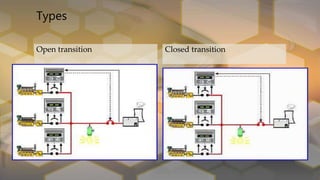
Types
Open transition Closed transition
Soft loading
• A softloading transfer switch
(SLTS) makes use of a CTTS, and
is commonly used to synchronize
and operate
onsite generation in parallel with
utility power, and to transfer loads
between the two sources while
minimizing
voltage or frequency
transients.[3][4][5]
Static transfer switch (STS)
• A static transfer switch uses power
semiconductors such as Silicon-
controlled rectifiers (SCRs) to transfer a
load
between two sources. Because there are
no mechanical moving parts, the
transfer can be completed rapidly,
perhaps within a quartercycle of the
power frequency. Static transfer
switches can be used where reliable and
independent sources of power are
available, and it is necessary to protect
the load from even a few power
frequency cycles interruption time, or
from any surges or sags in the prime
power source
Any (ATS)components
• 1- two contactor (with mechanical interlock)
• 2-one MCCB for the main load
• 3-two MCB to control circuit
• 4- three timers (on delay) at least two timers
• 5- over and under voltage relay
• 6- phase sequence and failure relay
• 7-charger to generator battery with over current protection
• 8-two power relay
• 9-four indication lamp –two grean and two red
• 10-selector switch and two push puton normal close and two
normal open
Automatic transfer switch (ats)

Automatic transfer switch (ats)

  • 1.
  • 2.
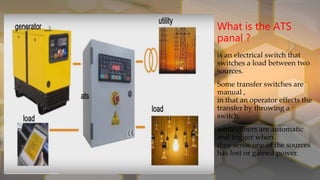
    What is theATS panal ? is an electrical switch that switches a load between two sources. Some transfer switches are manual , in that an operator effects the transfer by throwing a switch, while others are automatic and trigger when they sense one of the sources has lost or gained power.
  • 3.
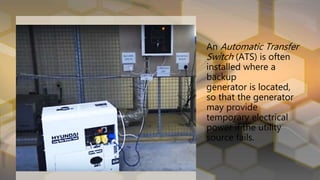
    An Automatic Transfer Switch(ATS) is often installed where a backup generator is located, so that the generator may provide temporary electrical power if the utility source fails.
  • 4.
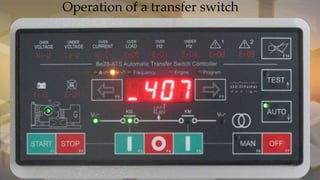
    Operation of atransfer switch
  • 5.
  • 6.
    Soft loading • Asoftloading transfer switch (SLTS) makes use of a CTTS, and is commonly used to synchronize and operate onsite generation in parallel with utility power, and to transfer loads between the two sources while minimizing voltage or frequency transients.[3][4][5] Static transfer switch (STS) • A static transfer switch uses power semiconductors such as Silicon- controlled rectifiers (SCRs) to transfer a load between two sources. Because there are no mechanical moving parts, the transfer can be completed rapidly, perhaps within a quartercycle of the power frequency. Static transfer switches can be used where reliable and independent sources of power are available, and it is necessary to protect the load from even a few power frequency cycles interruption time, or from any surges or sags in the prime power source
  • 7.
    Any (ATS)components • 1-two contactor (with mechanical interlock) • 2-one MCCB for the main load • 3-two MCB to control circuit • 4- three timers (on delay) at least two timers • 5- over and under voltage relay • 6- phase sequence and failure relay • 7-charger to generator battery with over current protection • 8-two power relay • 9-four indication lamp –two grean and two red • 10-selector switch and two push puton normal close and two normal open