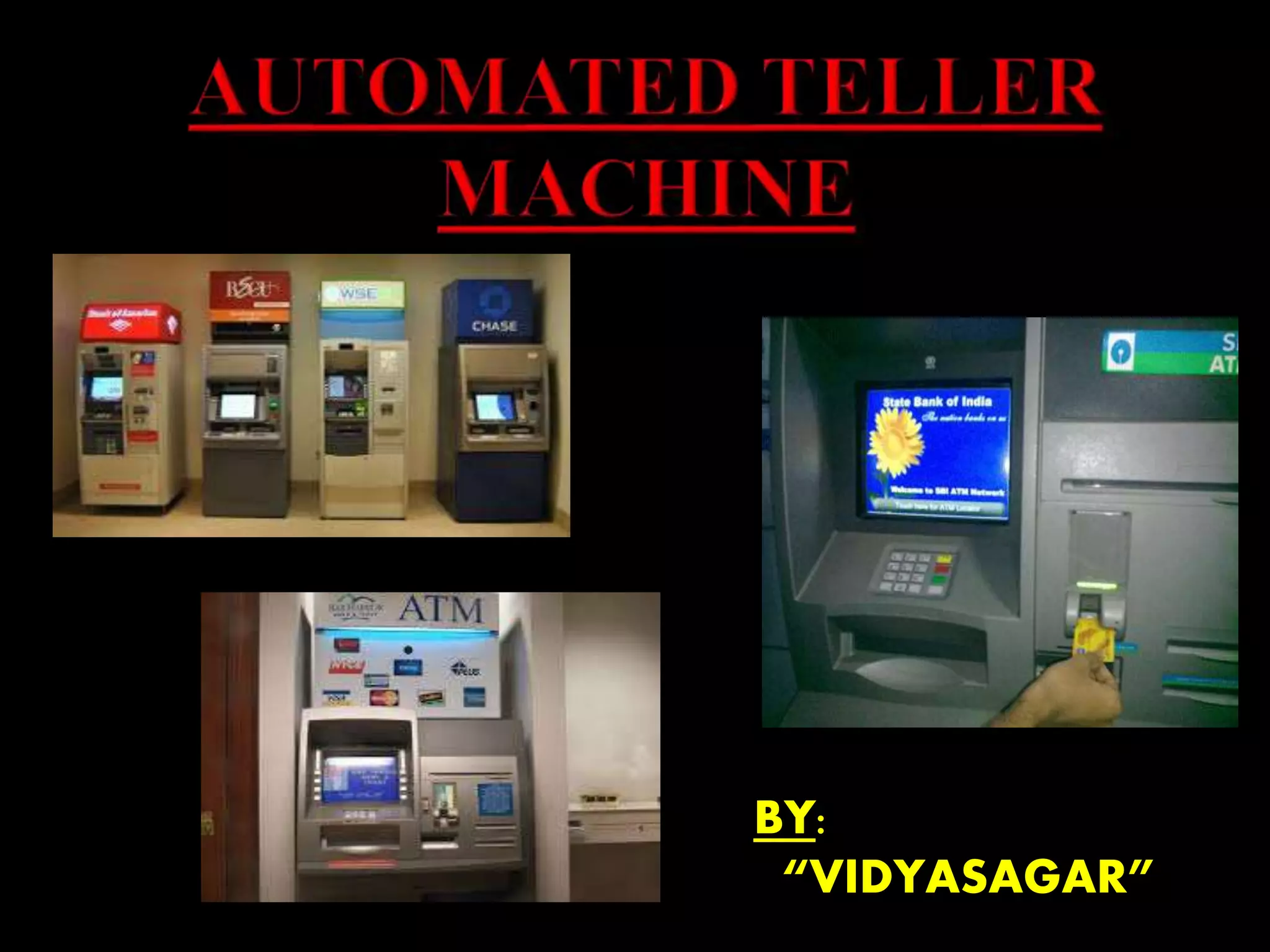
BY:
“VIDYASAGAR”
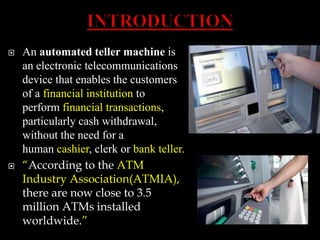
 An automated teller machine is
an electronic telecommunications
device that enables the customers
of a financial institution to
perform financial transactions,
particularly cash withdrawal,
without the need for a
human cashier, clerk or bank teller.
 “According to the ATM
Industry Association(ATMIA),
there are now close to 3.5
million ATMs installed
worldwide.”
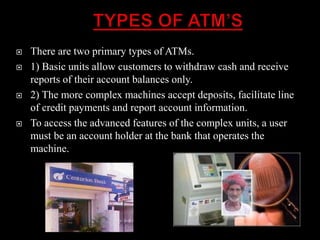
 There are two primary types of ATMs.
 1) Basic units allow customers to withdraw cash and receive
reports of their account balances only.
 2) The more complex machines accept deposits, facilitate line
of credit payments and report account information.
 To access the advanced features of the complex units, a user
must be an account holder at the bank that operates the
machine.
 An ATM is typically made up of the following devices:
 CPU(to control the user interface and transaction
devices)
 Magnetic card reader (to identify the customer)
 PIN pad EEP4 manufactured as part of a secure
enclosure
 Display (used by the customer for performing the
transaction)
 Function key buttons (usually close to the display)
 Record printer (to provide the customer with a record
of the transaction)
 Vault (to store the parts of the machinery requiring
restricted access)
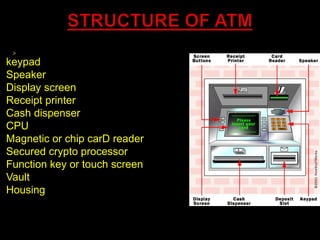
keypad
Speaker
Display screen
Receipt printer
Cash dispenser
CPU
Magnetic or chip carD reader
Secured crypto processor
Function key or touch screen
Vault
Housing
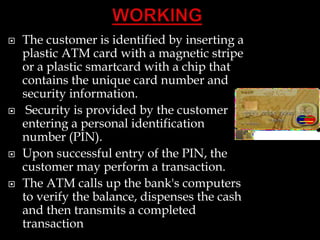
 The customer is identified by inserting a
plastic ATM card with a magnetic stripe
or a plastic smartcard with a chip that
contains the unique card number and
security information.
 Security is provided by the customer
entering a personal identification
number (PIN).
 Upon successful entry of the PIN, the
customer may perform a transaction.
 The ATM calls up the bank's computers
to verify the balance, dispenses the cash
and then transmits a completed
transaction
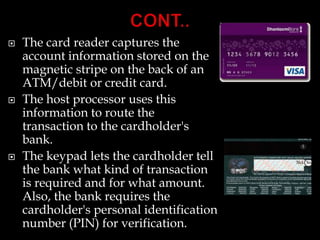
 The card reader captures the
account information stored on the
magnetic stripe on the back of an
ATM/debit or credit card.
 The host processor uses this
information to route the
transaction to the cardholder's
bank.
 The keypad lets the cardholder tell
the bank what kind of transaction
is required and for what amount.
Also, the bank requires the
cardholder's personal identification
number (PIN) for verification.
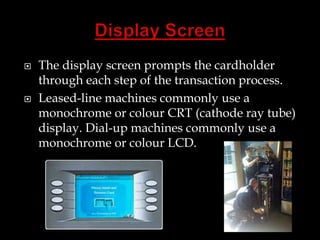
 The display screen prompts the cardholder
through each step of the transaction process.
 Leased-line machines commonly use a
monochrome or colour CRT (cathode ray tube)
display. Dial-up machines commonly use a
monochrome or colour LCD.
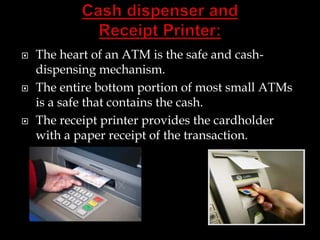
 The heart of an ATM is the safe and cash-
dispensing mechanism.
 The entire bottom portion of most small ATMs
is a safe that contains the cash.
 The receipt printer provides the cardholder
with a paper receipt of the transaction.
 Processor : Processorx86 Family 6 Model 15
Stepping 13
 GenuineIntel~2394Mhz
 RAM : 512 MB or more
 Hard disk : 20 GB or more
 Monitor : VGA/SVGA
 Keyboard : 104 Keys
 Mouse : 2 buttons/ 3 buttons
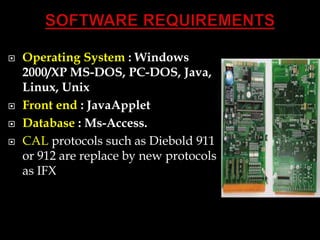
 Operating System : Windows
2000/XP MS-DOS, PC-DOS, Java,
Linux, Unix
 Front end : JavaApplet
 Database : Ms-Access.
 CAL protocols such as Diebold 911
or 912 are replace by new protocols
as IFX
 Paying routine bills, fees, and taxes (utilities,
phone bills, social security, legal fees, income
taxes, etc.)
 Printing bank statements updating passbooks
 Cheque Processing Module
 Paying (in full or partially) the credit balance on a
card linked to a specific current account.
 Transferring money between linked accounts (such
as transferring between accounts)
 Deposit currency recognition, acceptance, and
recycling
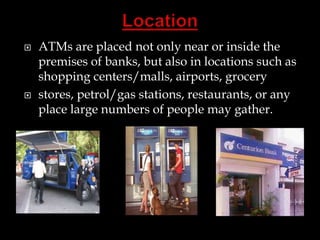
 ATMs are placed not only near or inside the
premises of banks, but also in locations such as
shopping centers/malls, airports, grocery
 stores, petrol/gas stations, restaurants, or any
place large numbers of people may gather.
THANK YOU!!!

Automated teller machine

  • 1.
  • 2.
     An automatedteller machine is an electronic telecommunications device that enables the customers of a financial institution to perform financial transactions, particularly cash withdrawal, without the need for a human cashier, clerk or bank teller.  “According to the ATM Industry Association(ATMIA), there are now close to 3.5 million ATMs installed worldwide.”
  • 3.
     There aretwo primary types of ATMs.  1) Basic units allow customers to withdraw cash and receive reports of their account balances only.  2) The more complex machines accept deposits, facilitate line of credit payments and report account information.  To access the advanced features of the complex units, a user must be an account holder at the bank that operates the machine.
  • 4.
     An ATMis typically made up of the following devices:  CPU(to control the user interface and transaction devices)  Magnetic card reader (to identify the customer)  PIN pad EEP4 manufactured as part of a secure enclosure  Display (used by the customer for performing the transaction)  Function key buttons (usually close to the display)  Record printer (to provide the customer with a record of the transaction)  Vault (to store the parts of the machinery requiring restricted access)
  • 5.
    keypad Speaker Display screen Receipt printer Cashdispenser CPU Magnetic or chip carD reader Secured crypto processor Function key or touch screen Vault Housing
  • 6.
     The customeris identified by inserting a plastic ATM card with a magnetic stripe or a plastic smartcard with a chip that contains the unique card number and security information.  Security is provided by the customer entering a personal identification number (PIN).  Upon successful entry of the PIN, the customer may perform a transaction.  The ATM calls up the bank's computers to verify the balance, dispenses the cash and then transmits a completed transaction
  • 7.
     The cardreader captures the account information stored on the magnetic stripe on the back of an ATM/debit or credit card.  The host processor uses this information to route the transaction to the cardholder's bank.  The keypad lets the cardholder tell the bank what kind of transaction is required and for what amount. Also, the bank requires the cardholder's personal identification number (PIN) for verification.
  • 8.
     The displayscreen prompts the cardholder through each step of the transaction process.  Leased-line machines commonly use a monochrome or colour CRT (cathode ray tube) display. Dial-up machines commonly use a monochrome or colour LCD.
  • 9.
     The heartof an ATM is the safe and cash- dispensing mechanism.  The entire bottom portion of most small ATMs is a safe that contains the cash.  The receipt printer provides the cardholder with a paper receipt of the transaction.
  • 10.
     Processor :Processorx86 Family 6 Model 15 Stepping 13  GenuineIntel~2394Mhz  RAM : 512 MB or more  Hard disk : 20 GB or more  Monitor : VGA/SVGA  Keyboard : 104 Keys  Mouse : 2 buttons/ 3 buttons
  • 11.
     Operating System: Windows 2000/XP MS-DOS, PC-DOS, Java, Linux, Unix  Front end : JavaApplet  Database : Ms-Access.  CAL protocols such as Diebold 911 or 912 are replace by new protocols as IFX
  • 12.
     Paying routinebills, fees, and taxes (utilities, phone bills, social security, legal fees, income taxes, etc.)  Printing bank statements updating passbooks  Cheque Processing Module  Paying (in full or partially) the credit balance on a card linked to a specific current account.  Transferring money between linked accounts (such as transferring between accounts)  Deposit currency recognition, acceptance, and recycling
  • 13.
     ATMs areplaced not only near or inside the premises of banks, but also in locations such as shopping centers/malls, airports, grocery  stores, petrol/gas stations, restaurants, or any place large numbers of people may gather.
  • 14.