
Discussant:
Miss Florabel M. Biasong
 learning that occurs in   actual
settings that are relevant to
today’s real world problems
and to the students’ experiences.
It is a form of assessment in which
students are asked to perform
real-world         tasks           that
demonstrate meaningful application
of essential knowledge and skills.
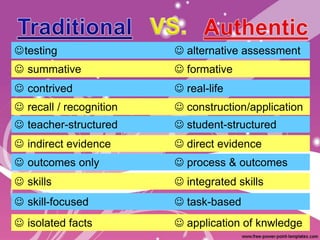
testing                  alternative assessment
 summative               formative
 contrived               real-life
 recall / recognition    construction/application
 teacher-structured      student-structured
 indirect evidence       direct evidence
 outcomes only           process & outcomes
 skills                  integrated skills
 skill-focused           task-based
 isolated facts          application of knwledge
 external evaluation      student self-evaluation
 single correct answer    many correct answers
 individuals              groups
 after instruction        during instruction
 secret criteria          public criteria
 paper & pen              performance type
 multiple choice type     supply
 selecting a response     performing a task /
                            constructing a response
 Students perform, construct, produce, or do
  something
 Uses close-real-life situations
 Integrates prior knowledge and uses HOTS
 Reasoning skills needed and assessed so
   students explain, justify and defend.
 Involves sustained work, often days and
   weeks.
 Performance is directly observable.
The      collection,
interpretation and
use of information
to help teachers
make          better
decisions         to
improve student
learning.
1. Assessment test should
measure clearly defined
learning    competencies
that are in harmony with
the lesson objectives.
2. Assessment test
   should measure a
representative sample of
   the learning tasks
      included in the
        instruction.
3. Assessment test should include the
    type of test items that are most
appropriate for measuring the desired
          learning outcomes.
4. Assessment should fit the
 particular uses that will be
    made of the results.
5. Assessment tests should
 be as reliable as possible
     and should then be
  interpreted with caution.
6. Assessment tests
   should improve
  student learning.
Authentic Learning
Authentic Learning

Authentic Learning

  • 1.
  • 4.
     learning thatoccurs in actual settings that are relevant to today’s real world problems and to the students’ experiences.
  • 6.
    It is aform of assessment in which students are asked to perform real-world tasks that demonstrate meaningful application of essential knowledge and skills.
  • 8.
    testing  alternative assessment  summative  formative  contrived  real-life  recall / recognition  construction/application  teacher-structured  student-structured  indirect evidence  direct evidence  outcomes only  process & outcomes  skills  integrated skills  skill-focused  task-based  isolated facts  application of knwledge
  • 9.
     external evaluation  student self-evaluation  single correct answer  many correct answers  individuals  groups  after instruction  during instruction  secret criteria  public criteria  paper & pen  performance type  multiple choice type  supply  selecting a response  performing a task / constructing a response
  • 11.
     Students perform,construct, produce, or do something  Uses close-real-life situations  Integrates prior knowledge and uses HOTS  Reasoning skills needed and assessed so students explain, justify and defend.  Involves sustained work, often days and weeks.  Performance is directly observable.
  • 12.
    The collection, interpretation and use of information to help teachers make better decisions to improve student learning.
  • 14.
    1. Assessment testshould measure clearly defined learning competencies that are in harmony with the lesson objectives.
  • 15.
    2. Assessment test should measure a representative sample of the learning tasks included in the instruction.
  • 16.
    3. Assessment testshould include the type of test items that are most appropriate for measuring the desired learning outcomes.
  • 17.
    4. Assessment shouldfit the particular uses that will be made of the results.
  • 18.
    5. Assessment testsshould be as reliable as possible and should then be interpreted with caution.
  • 19.
    6. Assessment tests should improve student learning.